From Surf Wiki (app.surf) — the open knowledge base
High Speed 1
High-speed railway linking London with the Channel Tunnel
High-speed railway linking London with the Channel Tunnel
| Field | Value | |
|---|---|---|
| name | High Speed 1 | |
| logo | London St. Pancras Highspeed logo.svgclass=skin-invert-image | |
| logo_width | 170 | |
| image | NashendenValley5490.JPG | |
| caption | High Speed 1 approaching the Medway Viaducts | |
| type | ||
| system | National Rail | |
| status | ||
| locale | ||
| start | London St Pancras International | |
| end | Channel Tunnel (UK portal) | |
| stations | 4 | |
| open | {{Plainlist | |
| owner | UK Government | |
| operator | DB Cargo UK, Eurostar, Southeastern | |
| linelength_km | 109.9 | |
| tracks | Double track throughout | |
| gauge | ||
| load_gauge | UIC GC | |
| electrification | ||
| speed | 300 km/h | |
| signalling | TVM-430, KVB, AWS, TPWS | |
| website | ||
| map | {{Switcher | |
| {{Channel Tunnel Rail Link | inline | y}} |
- (Section 1)
- (Section 2)}}
under concession to HS1 Limited (until 2040) | [[File:High Speed 1 CTRL.png|300px]] (Click to expand) | Show geographical map | | Show route diagram
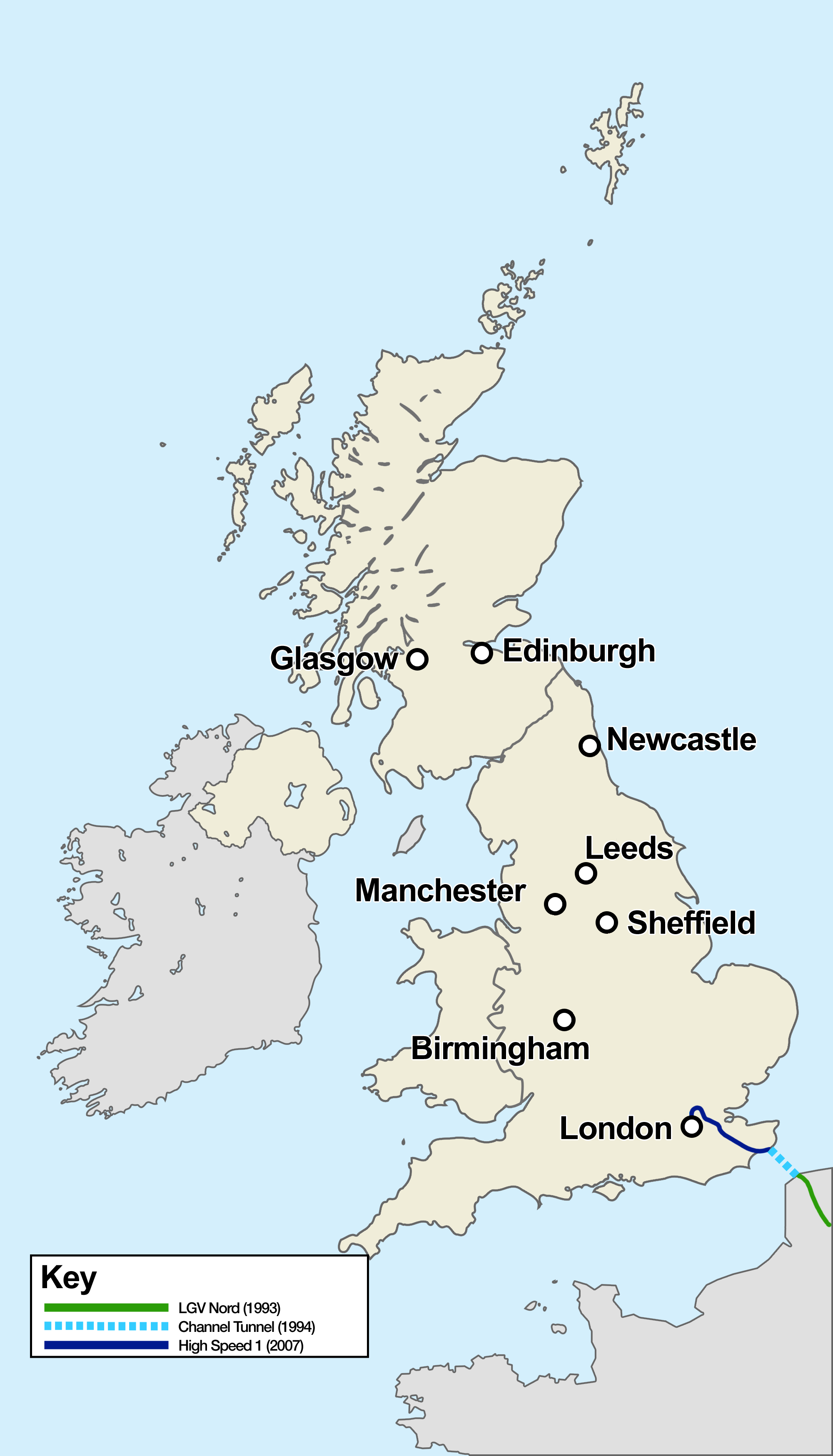
High Speed 1 (HS1), officially the Channel Tunnel Rail Link (CTRL), is a 109.9 km high-speed railway linking London with the Channel Tunnel.
It is part of the line carrying international passenger traffic between the United Kingdom and mainland Europe; it also carries domestic passenger traffic to and from stations in Kent and east London, and continental European loading gauge freight traffic. From the Channel Tunnel, the line crosses the River Medway, and tunnels under the River Thames, terminating at London St Pancras International station on the north side of central London. It cost £6.84 billion to build and opened on 14 November 2007. Trains run at speeds of up to 300 km/h on HS1. There are intermediate stations at in London, Ebbsfleet International in northern Kent and Ashford International in southern Kent.
International passenger services are provided by Eurostar International, with journey times from London St Pancras International to Paris Gare du Nord in 2hours 15minutes, and London St Pancras International to Brussels South/Bruxelles-Midi/Brussel Zuid in 1hour 51minutes. As of November 2015, Eurostar uses a fleet of 27 Class 373/1 multi-system trains capable of 300 km/h and 320 km/h Class 374 trains. Domestic high-speed commuter services serving intermediate stations and beyond began on 13 December 2009. The fleet of 29 Class 395 passenger trains reach speeds of 225 km/h. DB Cargo UK run freight services on High Speed 1 using adapted Class 92 locomotives, enabling flat wagons carrying continental-size swap body containers to reach London for the first time.
The CTRL project saw new bridges and tunnels built, with a combined length nearly as long as the Channel Tunnel itself, and significant archaeological research undertaken. In 2002, the CTRL project was awarded the Major Project Award at the British Construction Industry Awards.
Route


The high-speed railway operates as a "seven-day railway", with full availability on all days. Heavy maintenance is performed overnight. , track access charges were capped at approximately £71.35 per minute. In 2008, the cost of running a train along the full length of the line between St Pancras and the Channel Tunnel was £2,244; with lower costs of £2,192 for a domestic service to Ashford International, or £1,044 for St Pancras to Ebbsfleet International. A discounted rate of £4.00 per kilometre was made available for night-time-only railfreight operation until 31 March 2015.
Section 1
Section 1 of the Channel Tunnel Rail Link, opened on 28 September 2003, is a 74 km section of high-speed track from the Channel Tunnel to Fawkham Junction in north Kent with a maximum speed of 300 km/h. Its completion cut the London–Paris journey time by around 21minutes, to 2hours 35minutes. The line includes the Medway Viaduct, a 1.2 km bridge over the River Medway, and the North Downs Tunnel, a 3.2 km long, 12 m diameter tunnel. In safety testing on the section prior to opening, a new UK rail speed record of 334.7 km/h was set. Much of the new line runs alongside the M2 and M20 motorways through Kent. After its completion, Eurostar trains continued to use suburban lines to enter London, arriving at Waterloo International.
Unlike most LGV stations in France, the through tracks for Ashford International station are off to one side rather than going through, partly because the station pre-dates the line. High Speed 1 approaches Ashford International from the north in a cut-and-cover "box"; the southbound line rises out of this cutting and crosses over the main tracks to enter the station. The main tracks then rise out of the cutting and over a flyover. On leaving Ashford, southbound Eurostars return to the high-speed line by travelling under this flyover and joining from the outside. The international platforms at Ashford are supplied with both overhead 25kVAC and third-rail 750VDC power, avoiding the need to switch power supplies. Within Ashford, the speed limit on High Speed 1 is 270 km/h.
Section 2
Section 2 of the project opened on 14 November 2007, and is a 39.4 km stretch of track from the newly built Ebbsfleet station in Kent to London St Pancras. Completion of the section cut journey times by a further 20minutes (London–Paris in 2hours 15minutes; London–Brussels in 1hour 51minutes). The route starts with a 3.1 km tunnel which dives under the Thames on the edge of Swanscombe, then runs alongside the London, Tilbury and Southend line as far as Dagenham, where it enters two long tunnels to reach St Pancras. The two tunnels (much of which is directly under the North London Line) are 10.1 km and the 7.5 km in length, split by a 1 km stretch that runs close to the surface to serve Stratford International and the Temple Mills Depot. The new depot, to the north of Stratford, replaced the North Pole depot in the west of London. In testing, the first Eurostar train ran into St Pancras on 6 March 2007. All CTRL connections are fully grade-separated.
History
Background and planning
A high-speed rail line, LGV Nord, has been in operation between the Channel Tunnel and the outskirts of Paris since the Tunnel's opening in 1994. This has enabled Eurostar rail services to travel at 300 km/h (186 mph) for this part of their journey. A similar high-speed line in Belgium, from the French border to Brussels, HSL 1, opened in 1997. In Britain, Eurostar trains had to run at a maximum of 100 mph on existing tracks between London Waterloo International and the Channel Tunnel. These tracks were shared with local traffic, limiting the number of services that could be run, and jeopardising reliability. The case for a high-speed line similar to the continental part of the route was recognised by policymakers, and the construction of the line was authorised by Parliament with the Channel Tunnel Rail Link Act 1996, which was amended by the Channel Tunnel Rail Link (Supplementary Provisions) Act 2008.
An early plan conceived by British Rail in the early 1970s for a route passing through Tonbridge met considerable opposition on environmental and social grounds, especially from the Leigh Action Group and Surrey & Kent Action on Rail (SKAR). A committee was set up to examine the proposal under Sir Alexander Cairncross; but in due course environment minister Anthony Crosland announced that the project had been cancelled, together with the plan for the tunnel itself.
The next plan for the Channel Tunnel Rail Link involved a tunnel reaching London from the south-east, and an underground terminus in the vicinity of London King's Cross station. A late change in the plans, principally driven by Deputy Prime Minister Michael Heseltine's desire for urban regeneration in East London, led to a change of route, with the new line approaching London from the east. This opened the possibility of reusing the underused St Pancras railway station as the terminus, with access via the North London Line that crosses the throat of the station.
The idea of using the North London line proved illusory, and it was rejected in 1994 by the then Transport Secretary, John MacGregor, as too difficult to construct and environmentally damaging. The idea of using St Pancras station as the core of the new terminus was retained, albeit now linked by 20 km of specially built tunnels to Dagenham via Stratford.
London & Continental Railways (LCR) was chosen by the UK government in 1996 to build the line and to reconstruct St Pancras station as its terminus, and to take over the British share of the Eurostar operation, Eurostar (UK). The original LCR consortium members were National Express, Virgin Group, SG Warburg & Co, Bechtel and London Electric. While the project was under development by British Rail it was managed by Union Railways, which became a wholly owned subsidiary of LCR.
Construction
As the Channel Tunnel Act 1987 made government funding for a Channel Tunnel rail link unlawful, construction did not take place, as it was not financially viable. Construction was delayed until the passage of the Channel Tunnel Rail Link Act 1996, which provided construction powers that would run for ten years. The chief executive, Rob Holden, stated that it was the "largest land acquisition programme since the Second World War".
The whole route was to have been built as a single project, but in 1998, serious financial difficulties arose, and extensive changes came with a British government rescue plan. To reduce risk, the line was split into two separate phases, to be managed by Union Railways (South) and Union Railways (North). A recovery programme was agreed whereby LCR sold government-backed bonds worth £1.6 billion to pay for the construction of section 1, with the future of section 2 still not settled.
The original intention had been for the new railway, once completed, to be run by Union Railways as a separate line from the rest of the British railway network. As part of the 1998 rescue it was agreed that following completion, section 1 would be purchased by Railtrack with an option to purchase section 2. In return, Railtrack was committed to operate the whole route as well as London St Pancras International, which, unlike all other former British Rail stations, had been transferred to LCR/Union Railways in 1996.
In 2001, Railtrack announced that because of its own financial problems, it would not undertake to purchase section 2, triggering a second restructuring. The 2002 plan agreed that the two sections would have different owners (Railtrack for section 1, LCR for section 2) but with common Railtrack management. Following further financial problems at Railtrack, its interest was sold back to LCR, which then sold the operating rights for the completed line to Network Rail, Railtrack's successor. Under this arrangement LCR became the sole owner of both sections of the CTRL and the St Pancras property, as per the original 1996 plan. Amendments were made in 2001 for the new station at Stratford International and connections to the West Coast Main Line.
As a consequence of the restructuring, the LCR consortium in 2001 consisted of engineering consultants and construction firms Arup, Bechtel, Halcrow and Systra (which form Rail Link Engineering (RLE)); transport operators National Express and SNCF (which operates the Eurostar (UK) share of the Eurostar service with the National Railway Company of Belgium and British Airways), electricity company EDF and UBS.
There were several deaths of employees working on the CTRL over the construction period. One occurred on 28 March 2003 near Folkestone when a worker came into contact with the energised power supply. Another death occurred two months later, in May 2003, when a scaffolder fell 7 m at Thurrock, Essex. Three companies were found guilty of breaching health and safety legislation by omitting to provide barriers, resulting in Deverson Direct Ltd. being ordered to pay a fine of £50,000, J.Murphy & Sons Ltd £25,000, and Hochtief £25,000. Two more deaths resulted from a fire on board a train carrying wires, one mile (1 mi) inside a tunnel under the Thames between Swanscombe, Kent, and Thurrock, Essex on 16 August 2005. The train shunter died at the scene and the train driver later died in hospital. It has been suggested that a large amount of blame for accidents throughout the project lay with individual behaviour, becoming such a problem that an internal programme was launched to tackle problem behaviour during the construction.
The cost of construction was £6.84 billion. At £62 million per kilometre, this was higher than other projects in many other countries. The French LGV Est, a line built largely through near-flat fields (save for the Saverne Tunnel) and which terminates outside its urban centres (Vaires-sur-Marne for Paris and Vendenheim for Strasbourg) cost £22 million per mile. Its phase one was completed in 2003 and phase two in 2007.
Ownership and operation
On completion of section 1 by RLE, the line was handed over to Union Railways (South), which then handed it over to London & Continental Stations and Property (LCSP), the line's long-term owners. Once section 2 of the line had been completed, it was handed over to Union Railways (North), which handed it over to LCSP. The entire line, including St Pancras, is managed, operated and maintained by Network Rail (CTRL).
In February 2006, there were rumours that a 'third party' (believed to be a consortium headed by banker Sir Adrian Montague) had expressed an interest in buying out the present partners in the project. LCR shareholders rejected the proposal, and the government, which could effectively overrule shareholders' decisions as a result of LCR's reclassification as a state-owned body, decided that discussions with shareholders would not take place imminently, which effectively backed shareholders' views on the proposed takeover.
On 14 November 2006, LCR adopted High Speed 1 as the brand name for the completed railway. Official legislation, documentation and line-side signage have continued to refer to "CTRL".
By May 2009, LCR had become insolvent, and the government received an agreement to use state aid to purchase the line and to open it up to competition to allow other services to use it apart from Eurostar. LCR's wholly owned subsidiary, HS1 Ltd, thus became the property of the Secretary of State for Transport. On 12 October 2009 a proposal was announced to sell £16 billion of state assets including HS1 Ltd in the following two years to cut UK public debt.
In November 2010, the HS1 concession was awarded for a duration of thirty years to an investment consortium bringing together two Canadian public pension funds: Ontario Municipal Employees Retirement System (through its subsidiary Borealis Infrastructure), and Ontario Teachers' Pension Plan for £2.1billion. At the time, UK pension investors had generally limited interest in such long-term, illiquid, 'infrastructure assets'.
Under the concession, HS1 Ltd has the rights to sell access to track and to the four international stations (St Pancras, Stratford, Ebbsfleet and Ashford) on a commercial basis, under the scrutiny of the Office of Rail and Road. At the end of thirty years, ownership of the assets will revert to the government. The private operator does not hold the freehold or rights to any of the associated land.
In 2017, the sale of the 30 year HS1 concession was announced to funds advised and managed by InfraRed Capital Partners and Equitix Investment Management; participants include HICL Infrastructure (35%), Equitix (35%) and South Korea's National Pension Service (30%), for an enterprise value of £3billion.
HS1 Ltd rebranded as London St. Pancras Highspeed in February 2025.
Stations
In geographic order:
St Pancras International
Main article: St Pancras railway station
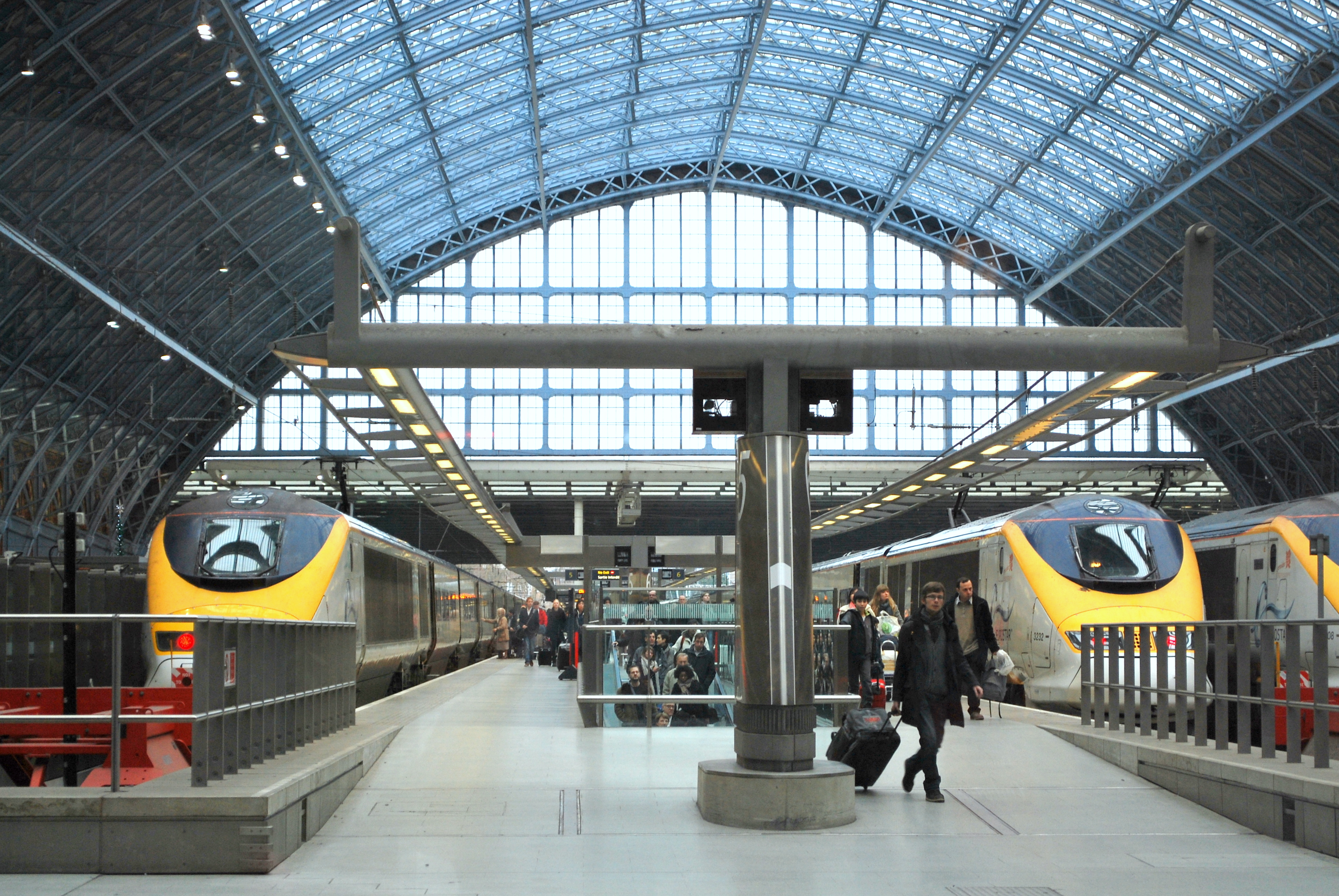
The terminus for the high-speed line in London is St Pancras railway station. During the 2000s, towards the end of the construction of the CTRL, the entire station complex was renovated, expanded and renamed as St Pancras International, with a new security-sealed terminal area for Eurostar trains to continental Europe. In addition, it retained traditional domestic connections to the north and south of England. The new extension doubled the length of the central platforms now used for Eurostar services; new platforms have been provided for existing domestic East Midlands Trains and the Southeastern high-speed services that run along High Speed 1 to Kent. New platforms on the Thameslink line across London were built beneath the western margins of the station, and the station at King's Cross Thameslink was closed.
A complex junction has been built north of St Pancras with connections to the East Coast Main Line, North London Line (for West Coast Main Line) and Midland Main Line, allowing for a wide variety of potential destinations albeit on conventional rails. As part of the works, tunnels connecting the East Coast Main Line to the Thameslink route were also built in readiness for the forthcoming Thameslink Programme.
Stratford International
Main article: Stratford International railway station
Stratford International railway station was not part of the original government plans for the CTRL. Despite its name, no international services have ever called there. Completed in April 2006, it opened on 30 November 2009 when the domestic preview Southeastern highspeed services started calling there. An extension of the Docklands Light Railway opened to Stratford International in August 2011. It forms part of the complex of railway stations for the main site where the 2012 Summer Olympics were held.
Ebbsfleet International
Main article: Ebbsfleet International railway station
Ebbsfleet International railway station in the borough of Dartford, Kent is 10 mi outside the eastern boundary of Greater London and opened to the public on 19 November 2007. It became Eurostar's main station in Kent. Two of the platforms are designed for international passenger trains and four for high-speed domestic services. A high-speed domestic service operated by Southeastern to London St Pancras began on 29 June 2009. Eurostar has not served the station since the COVID-19 pandemic in 2020, and services will not return until at least 2026.
Ashford International
Main article: Ashford International railway station
This station was rebuilt as Ashford International during the early 1990s for international services from mainland Europe; this included the addition of two platforms to the north of station (the original down island platform had been taken over by international services). Unlike normal LGV stations in France, the through tracks for Ashford International railway station are off to one side rather than going through. The number of services was reduced after the opening of the Ebbsfleet station. A high-speed domestic service operated by Southeastern to London St Pancras began on 29 June 2009. Eurostar has not served the station since the COVID-19 pandemic in 2020, and services will not return until at least 2026.
HS1 Ltd. (London St. Pancras Highspeed) also operates the Singlewell Infrastructure Maintenance Depot.
Temple Mills Depot in London Leyton, roughly 2 km northwest of Stratford International station, is used for storage and servicing of Eurostar trains and off-peak berthing of Class 395 Southeastern high-speed trains.
Infrastructure

The railway is maintained from Singlewell Infrastructure Maintenance Depot.
The construction work of the line was complex, and many contractors were involved in delivering them. The CTRL Section 2 construction works had caused considerable disruption around the Kings Cross area of London; in their wake redevelopment was stimulated. The large redevelopment area includes the run-down areas of post-industrial and ex-railway land close to King's Cross and St Pancras, a conservation area with many listed buildings; this was promoted as one of the benefits for building the CTRL. It has been postulated that this development was actually suppressed by the construction project, and some affected districts were said still to be in a poor state in 2005.
Track
Both track and signalling technology (TVM-430 + KVB) are based on or identical to the standards used on the French LGV high-speed lines. The areas around St Pancras and Gare du Nord use colour light and KVB signalling with the whole of the high-speed route to Paris (CTRL, Channel Tunnel, LGV Nord) using TVM-430. Traffic between London and the Channel Tunnel is controlled from the Ashford signalling centre. Signalling tests before opening were performed by the SNCF-owned "Lucie" test car.
The track is cleared to a larger modern European GC loading gauge enabling GC gauge freight as far as the yards at Barking. The line is electrified entirely using overhead lines with 25 kV AC railway electrification.[[File:Class373-eurostar-north-downs-tunnel-high-speed-1-telephoto.jpg|thumb|right|[[North Downs Tunnel]], northern portal under [[Blue Bell Hill]]]]
Tunnels
After local protests, early plans were modified to put more of the route into tunnels up until a point approximately 2 km from St Pancras. Previously the CTRL was planned to run on an elevated section alongside the North London Line on approach into the line's terminus. The twin tunnels bored under London were driven from Stratford westwards towards St Pancras, eastwards towards Dagenham and from Dagenham westwards to connect with the tunnel from Stratford. The tunnel boring machines were 120 m long and weighed 1100 t. The depth of the tunnels varies from 24 to. The two London tunnels are 7.5 km and 10.1 km in length, split by Stratford International station.
Other major tunnels along the route include a 3.1 km tunnel underneath the River Thames at Thurrock in Essex and the 3.2 km North Downs Tunnel near Maidstone in Kent.
Viaducts
Several major viaducts are present on the route, with three viaducts over 1000 metres in length. The Medway Viaduct takes the line over the River Medway adjacent to the M2 motorway, the Thurrock Viaduct takes the line under the A282 Dartford Crossing and the Ashford Viaduct takes the fast lines over Ashford International station.
Connection line to Waterloo
A 4 km connecting line providing access for Waterloo International leaves High Speed 1 at Southfleet Junction using a grade-separated junction; the main CTRL tracks continue uninterrupted through to CTRL Section 2 underneath the southbound flyover. The connection joins the Chatham Main Line at Fawkham Junction with a flat crossing. The retention of Eurostar services to Waterloo after the line to St Pancras opened was ruled out on cost grounds. Waterloo International closed upon opening of the section two of the CTRL in November 2007; Eurostar now serves the refurbished St Pancras as its only London terminal, so this connecting line is no longer used in regular service, but can be used by Class 395 passenger trains.{{cite AV media | people = Middleton, Peter (Producer) |date= 2009 | title = Eurostar: Brussels-Midi to London St Pancras International | url = http://www.video125.co.uk/acatalog/Eurostar_Brussels_to_London_St.Pancras.html | format = DVD | time = 1hr 29min 35sec | publisher = Video 125 Ltd |url-access=subscription
Services
International passenger services on this line are operated by Eurostar, with maximum speed 300 km/h, while domestic passenger services are operated by Southeastern as far as Ashford International, with maximum speed 225 km/h.
High Speed 1 was built to allow eight trains per hour through to the Channel Tunnel. As of May 2014, Eurostar runs two to three trains per hour in each direction between London and the Channel Tunnel. Southeastern runs in the high peak eight trains per hour between London and Ebbsfleet, two of these continuing to Ashford. During the 2012 Olympic Games, Southeastern provided the Olympic Javelin service with up to twelve trains per hour from Stratford into London.{{cite book |access-date = 17 December 2008 |url-status = dead |archive-url = https://web.archive.org/web/20090205045458/http://www.london2012.com/documents/oda-transport/tp-first-edition/tp-consultation-report.pdf |archive-date = 5 February 2009
Freight
The route was built with freight provision from the beginning. It has spurs leading to and from the freight terminal at Dollands Moor (Folkestone) and the freight depot at Barking (Ripple Lane), north of the River Thames. Long passing loops to hold freight trains while passenger trains overtake them were built at Lenham Heath and Singlewell.
Freight trains operated by EWS first ran over CTRL Section 1, on the consecutive evenings of 3–4 April 2004. Five freight trains that would have run via the classic lines were diverted to run over the Channel Tunnel Rail Link instead: three southbound intermodal trains on 3 April 2004 and two northbound intermodal trains on 4 April 2004.
Operators
The railway is operated on an open access basis. Trains are operated by several organisations all operating over the same track. HS1 Ltd. is the network manager for the line, stations, and other infrastructure. Since February 2025, HS1 Ltd. has traded as London St. Pancras Highspeed, which it suggests would reflect a more consumer-facing role whilst looking at options to expand capacity at London St Pancras International railway station.
Network Rail (High Speed) Ltd

HS1 Ltd is responsible for overall managing and running of the line – along with the international railway stations at St Pancras, Stratford, Ashford and Ebbsfleet – with responsibility for the infrastructure itself sub-contracted to Network Rail (High Speed) Ltd (formerly known as Network Rail (CTRL)) acting as the controller and infrastructure manager. Network Rail (CTRL) Limited was created as a subsidiary of Network Rail on 26 September 2003 for £57 million to take over the assets of the CTRL renewal and maintenance operations. Network Rail (High Speed) operates engineering, track maintenance machines, rescue locomotives, and infrastructure- and test trains. Eurotunnel's subsidiary Europorte 2 operates its Eurotunnel Class 0001 (Krupp/MaK 6400) rescue locomotives on the line when required.
Various track recording trains run as necessary, including visits by the New Measurement Train. On the night of 4/5 May 2011 the SNCF TGV Iris 320 laboratory train took over, being hauled from Coquelles to St Pancras and back, towed by Eurotunnel Krupp locomotives numbers 4 and 5. The Iris 320 runs for Network Rail (High Speed) are an extension of the 100 km/h monitoring cycle already undertaken by SNCF International since December 2010 for Eurotunnel every two months.
Eurostar
Main article: Eurostar
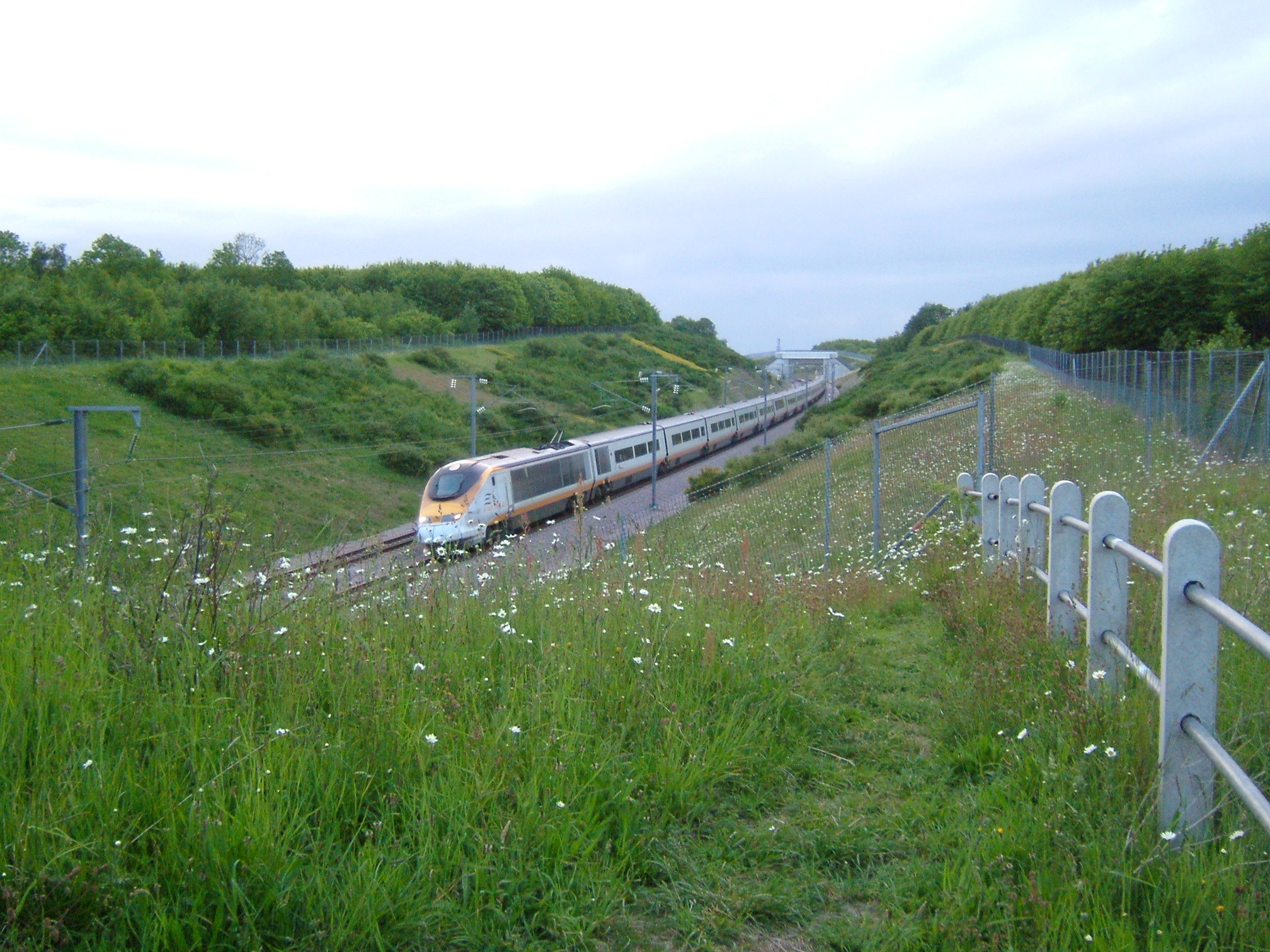
The Eurostar service uses about 40% of the capacity of High Speed 1, which in November 2007 became the company's route for all its services prior to the merger with Thalys. Eurostar trains are for international traffic only, passing along the high-speed line from London St Pancras railway station to the Channel Tunnel, with the majority terminating at either Paris Gare du Nord in France or Brussels-South railway station in Belgium. A Eurostar train was used to set a new British rail speed record of 334.7 km/h on 30 July 2003. Prior to the formation of Eurostar International Limited, the British component of the Eurostar grouping was owned by London & Continental Railways, which had also previously owned the High Speed 1 infrastructure.
The fastest regular-service Eurostar journeys on record are 2hours, 3minutes and 39seconds from Paris Gare du Nord to St Pancras, set on 4 September 2007; and 1hour 43minutes from Brussels South to St Pancras, set on 19 September 2007.
| Class | Image | Type | Top speed | Num­ber | Routes operated | Built | mph | km/h | ||
|---|---|---|---|---|---|---|---|---|---|---|
| Class 373 | ||||||||||
| Eurostar e300 | [[Image:3015 at Calais Frethun.jpg | 170px]] | EMU | 186 | 300 | 28 | {{plainlist | 1992–1996 | ||
| Class 374 | ||||||||||
| Eurostar e320 | [[File:Eurostar Class 374 on HS1.jpg | 170px]] | EMU | 200 | 320 | 17 | {{plainlist | 2011–2018 |
Southeastern
Main article: Southeastern (train operating company)

Domestic high-speed services on High Speed 1 are operated by Southeastern. Having been in planning since 2004, a preview service of the British Rail Class 395 trains, popularly known as Javelins, started in June 2009, and regular services began on 13 December 2009. The quickest journey time from Ashford to London St Pancras is 35minutes, compared with 80minutes for the service to London Charing Cross via Tonbridge. This service on Section 2 of the CTRL, known previously as CTRL-DS, was a factor in London's successful 2012 Olympic Bid, promising a seven-minute journey time from the Olympic Park at Stratford to the London terminus at St Pancras.
| Class | Image | Type | Top speed | Number | Routes operated | Built | mph | km/h | ||
|---|---|---|---|---|---|---|---|---|---|---|
| Class 395 | [[File:395018 London St Pancras.jpg | 170px]] | Electric multiple unit | 140 | 225 | 29 | {{plainlist | 2007–2009 |
DB Cargo UK
Main article: DB Cargo UK

DB Cargo is a global freight operator with a large interest in freight over rail in Europe. While High Speed 1 was constructed with freight loops, no freight traffic had run upon the line since opening in 2003. On 16 April 2009, DB Schenker signed an agreement with HS1 Ltd, the owner of High Speed 1, for a partnership to develop TVM modifications for class 92 freight locomotives to run on the line. On 25 March 2011, for the first time a modified class 92 locomotive travelled from Dollands Moor to Singlewell using the TVM430 signalling system. A loaded container train ran for the first time on 27 May 2011, to Novara in Italy. Following further trials with loaded wagons{{cite press release |access-date=27 May 2011 |url-status=dead |archive-url=https://web.archive.org/web/20110722185930/http://www.rail.dbschenker.co.uk/cmsnews/news_article.asp?guid=%7BB3DB6B7C-BD63-431F-B8D3-DC42B0205886%7D |archive-date=22 July 2011}} DB is to upgrade five Class 92 locomotives to allow them to run on High Speed 1. From 11 November 2011 a weekly service using European-sized swap body containers has run between London and Poland using High Speed 1.
| Class | Image | Type | Top speed | Number | Built | Notes | mph | km/h | |
|---|---|---|---|---|---|---|---|---|---|
| Class 92 | [[File:92027 George Eliot at Stafford.jpg | 170px]] | Electric locomotive | 87 | 140 | 46 | 1993–1996 |
Future operations and proposed services
Since the liberalisation of European rail in 2010 and subsequent regulatory changes, several operators have proposed international high-speed services via the Channel Tunnel and High Speed 1. Many early proposals did not progress, but renewed interest since 2023 has seen multiple new entrants applying for access rights under ORR oversight.
In 2009, Eurotunnel (the owners of the Channel Tunnel) announced that it was prepared to start relaxing the fire safety regulations, in order to permit other operators to transport passengers via the tunnel using other forms of rolling stock. In March 2010, Eurotunnel, HS1 Ltd, DB and other interested train operators formed a working group to discuss changes to the safety rules, including allowing 200 m trains. The Intergovernmental Commission (IGC) required trains to be at least 375 m long. In June 2011, the IGC decided to allow trains with distributed traction to operate in the Channel Tunnel.
In December 2023, Getlink announced it aimed to double the market for direct high speed trains from the UK over the next ten years. It aimed to reduce the time to market from ten to five years, with services considered including from London to Cologne, Frankfurt, Geneva and Zurich. This would be done through market research, standardising tunnel regulations, introducing tunnel specific criteria into standard rolling stock designs, and working with network operators and stations.
Early proposals (2007–2023)
In 2009, Veolia Transport (now merged into Transdev) planned to work on proposals in co-operation with Trenitalia to run services from Paris to Strasbourg, London and Brussels.
In August 2018, Bloomberg Businessweek reported that Getlink was interested in setting up an Ouigo-style low cost high speed rail service between London and Paris, travelling between the railway stations of Stratford International and Charles-de-Gaulle.
In March 2020, it was announced that High Speed 1 Ltd, along with SNCF and Lisea, were looking for an operator for a future London St PancrasBordeaux St Jean train service.
Heuro, a Dutch rail start up, led by Maarten van den Biggelaar, a Dutch entrepreneur, and his son, announced plans in 2023 to offer 16 services per day from Amsterdam to both London and Paris. It was looking to raise €600million for the service. It planned to use Zefiro V300 trains, similar to the Frecciarossa 1000.
Deutsche Bahn

In November 2007, reports suggested that Deutsche Bahn had applied to operate through the Channel Tunnel and High Speed 1, but both the company and the Channel Tunnel Safety Authority denied any formal application. Progress was hindered by safety regulations, as DB’s ICE 3M trains could not be divided in an emergency.
In December 2008, DB was reported to be interested in acquiring the British share of Eurostar — effectively Eurostar (UK) Ltd., a wholly owned subsidiary of London & Continental Railways (LCR), which the UK government planned to sell. SNCF president Guillaume Pépy described DB’s interest as “premature, presumptuous and arrogant,” while DB denied submitting any official request.
DB carried out evacuation trials in the tunnel on 17 October 2010, with two 200m long ICE 3 trains, and displayed one of them at St Pancras station on 19 October 2010. The train sets did not meet the fire safety requirements for services through the tunnel, but the Siemens Velaro D sets on order included the necessary additional fire-proofing.
DB planned three services a day to Frankfurt, Rotterdam and Amsterdam via Brussels from 2015, originally targeted for 2013. Delays were caused by the availability of the Channel Tunnel version of the Velaro D trains, high rental costs on the French network, and border-control issues at stations. As of 2016, no services had commenced, though HS1 Ltd continued to reference ongoing collaboration with DB for potential international services.
In March 2017, DB revived plans for a London to Frankfurt train service, with operations expected as early as 2020. The plan was shelved in June 2018 due to a "significantly changed economic environment". In January 2024, DB remarked "transport between London and the mainland through the Eurotunnel remains of fundamental interest to Deutsche Bahn", though noting that the routes and trains were not yet equipped with end-to-end ETCS.
Renfe

In 2009, Renfe, the Spanish national railway operator expressed interest in operating AVE services from Spain to London via Paris, Lyon, Barcelona, Madrid and Lisbon (using the Madrid–Barcelona high-speed rail line) once its AVE network was connected to France via the Barcelona to Figueres and Perpignan to Figueres lines in 2012.
In October 2021, Renfe announced plans to operate services between Paris and London. Renfe noted additional trains could be feasible along the route, and demand analyses suggested competition would Eurostar would be viable and profitable.
2024–2025 applicants and allocation of Temple Mills capacity
Main article: Temple Mills Depot capacity allocation (2025)
The Temple Mills International depot in East London is unique as the only UK facility able to house and maintain European UIC loading gauge trains. This makes it a bottleneck for any new Channel tunnel services. Virgin and Evolyn remarked in November 2024 at an industry event in the Houses of Parliament, that Eurostar had not agreed access to Temple Mills depot. The companies later appealed to the ORR to assess the available capacity. In early 2025, the ORR commissioned an independent report, which confirmed some capacity could be freed up at the depot for additional trains. Eurostar, however, has maintained that Temple Mills is effectively full, warning that only its own planned growth, following an €80 million investment, could be accommodated there.
The ORR formally invited rival operators to submit proposals for Temple Mills access. Four applications were received, submitted between August 2024 and March 2025, from Virgin Trains Europe (VTE), Evolyn Mobility, Gemini Trains and Trenitalia France. On 30 October 2025, the ORR approved Virgin Trains’ application for access to Temple Mills depot, while rejecting applications from Evolyn, Gemini, and Trenitalia. It concluded that Virgin Trains presented the most financially and operationally robust proposal.
Evolyn
Evolyn, led by the Cosmen family of Spain (the largest shareholder in Mobico) and backed by British and French partners, initially planned to start non-stop services between London and Paris by 2025. It proposed 33 daily services between London, Paris and Brussels. It initially planned to order 12 Avelia Horizon trains from Alstom, depending on securing project financing and regulatory approval.
Trenitalia France
In April 2025, the Ferrovie dello Stato Italiane Group announced their intention to offer services between London and Paris by 2029, with Frecciarossa branded trains. It signed a memorandum of understanding to explore working in partnership with Evolyn Under Trenitalia France, it proposed 10 daily return services between London and Paris from 2029. Although it uniquely had access to other depots in Europe, access to a British depot was seen to be necessary. It planned to use 10, 202m trains using the design of the Frecciarossa 1000 and manufactured by Hitachi Rail.
Gemini Trains
In April 2025, Gemini Trains, chaired by Lord Tony Berkeley, announced its plans to offer services from London and Ebbsfleet to Paris and Brussels. It noted Stratford International as being less crowded and as a "blank canvas". In May 2025, Gemini Trains, announced plans to co-brand its ten planned trains with Uber, who would also sell tickets through its app, similar to the Thames Clippers services. It aimed to operate 10 daily return services between Stratford International to Paris and Brussels, via Ebbsfleet, from 2029, later increasing to 18 daily return services. It planned to use 10, 202 m Siemens Velaro Novo trains.
Virgin Trains Europe
As of 2024, the Virgin Group was in the process of exploring whether high speed cross-Channel services would be feasible. Under the name "Project Bullet", it has a capital requirement of £700 million, with Virgin taking a 50% stake, alongside 2 other institutional shareholders. The business will be led by Phil Whittingham, who also ran Virgin Trains West Coast.
Following the March 2025 ORR report, Virgin reported "no more major hurdles" to market entry. It plans to acquire 12, 200 m Avelia Stream trains from Alstom for 20 daily return services, between London and Paris (13), Brussels (4) and Amsterdam (3). After receiving ORR approval to use Temple Mills depot, Virgin Trains intends to begin services by 2030.
References
Citations
Bibliography
- {{cite book
- {{cite book
- {{cite book
- {{cite book
- {{cite book
References
- Aecom and Atkins. "First Interim Evaluation of the Impacts of High Speed 1".
- "Channel Tunnel Rail Link Visit". Institute of Sound and Vibration Research, [[University of Southampton]].
- (1 May 1999). "Building Britain's first high speed line". [[Railway Gazette International]].
- "HS1 (Section 2) Register of Infrastructure". HS1 Ltd.
- (14 November 2006). "Eurostar to launch passenger services at St Pancras International on Wednesday 14 November 2007". Eurostar.
- (1 December 2009). "Southeastern Highspeed". Southeastern Railway.
- Haigh, Philip. (10 August 2011). "DB a step closer to European freight into London via HS1". Rail.
- Matthews, Roger. (2003). "The archaeology of Mesopotamia: theories and approaches". Routledge.
- Mylius, Andrew. (2 November 2006). "CTRL team scoops BCI Major Project Award".
- Roberts. (29 October 2007). "Seven Day Railway". Network Rail October 2007 Strategic Business Plan.
- (1 June 2009). "High speed preview services announced".
- sxmarcel. (17 November 2008). "Possessions allowance". Second Consultation on Prospective Levels and Principles of Track Access Charging for the High Speed 1 Railway.
- Coart, François. (5 July 2011). "HS1 Ltd Freight Avoidable Costs Review".
- (30 July 2003). "Eurostar breaks high speed record". Erik's Rail News.
- (9 January 2006). "Eurostar celebrates 10 years at Ashford International". Eurostar.
- (31 October 2007). "Depot mark 2 promises faster maintenance of faster trains". [[Railway Gazette International]].
- (9 March 2007). "Railway Herald on-line magazine, Issue 75".
- "Bilan LOTI de la LGV Nord Rapport". Cgedd Developpement.
- (14 December 2007). "Infrabel celebrates 10 years of the High Speed Line in Belgium". [[Infrabel]].
- "Technische Netkaart". Infrabel.
- Harper, Keith. (18 January 2001). "French attack Railtrack". The Guardian.
- "How the need for a CTRL developed". Department for Transport.
- Harrison, Michael. (18 June 1993). "2001: a rail odyssey drags on: Plans for a Channel tunnel link are finally gathering speed". The Independent.
- (1996). "Channel Tunnel Rail Link Act 1996 c61".
- (2008). "Channel Tunnel Rail Link (Supplementary Provisions) Act 2008 c5".
- (8 November 2007). "HC Hansard Volume 467 Part 3 Column 259". [[Parliament of the United Kingdom]].
- Hansard 20 January 1975
- Goodwin, Stephen. (21 January 1994). "Inside Parliament: Euro-sceptic derides 'white elephant' line". The Independent.
- Timpson, Trevor. (14 November 2007). "How St Pancras was chosen". BBC News.
- (1 September 1995). "Britain's Channel Tunnel rail link (four contract contenders named)". accessmylibrary.com.
- Wolmar, Christian. (4 July 1995). "Branson in last round of rail link fight". The Independent.
- (23 April 1990). "Channel Tunnel Oral Answers to Questions: Transport, House of Commons debates". theyworkforyou dot com.
- (23 March 2000). "Eastern approach".
- "The Channel Tunnel Rail Link: Report by the Controller and Auditor General". [[National Audit Office (United Kingdom).
- (28 March 2001). "Department of the Environment, Transport and the Regions: The Channel Tunnel Rail Link". [[National Audit Office (United Kingdom).
- "About St Pancras". HS 1 Limited.
- Harper, Keith. (30 May 2000). "Railtrack funding of Channel rail link in doubt again". The Guardian.
- Harrison, Michael. (16 January 2001). "Railtrack could ditch new Channel rail link". The Independent.
- Brown, Colin. (August 2021). "Railtrack to lose its new-line monopoly". The Independent.
- Harrison, Michael. (August 2021). "Phase two of tunnel link need not be built by Railtrack, says Eurostar". The Independent.
- Walters, Joanna. (21 October 2001). "Rail's shattered dream". The Guardian.
- (30 March 2003). "Engineer electrocuted on rail link". BBC News.
- (4 October 2004). "Firms fined over rail link death". BBC News.
- (17 August 2005). "Man killed in rail tunnel blaze". BBC News.
- (21 August 2005). "Channel Tunnel burns victim dies". BBC News.
- (22 February 2001). "Case study: Channel Tunnel Rail Link".
- Boles, Tracey. (19 February 2006). "City grandee tries to grab tunnel link firm". The Sunday Times.
- (21 February 2006). "Debt-laden Channel tunnel rail link is 'nationalised'". The Guardian.
- (31 March 2006). "LCR rejects takeover bid". RailwayPeople.
- (14 November 2006). "High-speed rail link open in year". BBC News.
- Owen, Ed. (8 June 2009). "Government takes control of London and Continental".
- (December 2010). "HS1 concession sold". [[Modern Railways]].
- (12 October 2009). "British state assets selloff". [[The Straits Times]].
- (5 November 2010). "High Speed 1 concession awarded to Canadian pension consortium". [[Railway Gazette International]].
- Firzli, M. Nicolas J.. (2013). "Transportation Infrastructure and Country Attractiveness". Revue Analyse Financière.
- Milmo, Dan. (28 January 2011). "Highest bidder asks why it lost Channel tunnel rail link sale". The Guardian.
- (17 July 2017). "HS1 concession sold on". Railway Gazette International.
- (14 July 2017). "HS1 railway line sold for EV of £3bn, below initial expectations". Financial Times.
- Tiana May. (14 February 2025). "UK: HS1 Ltd Rebrands as London St. Pancras Highspeed". Railway News.
- [http://www.whatdotheyknow.com/request/3099/response/6784/attach/html/3/080930%20FOI%20Response%20-%20Betts.doc.html Official name of the station according to the Department of Transport] {{Webarchive. link. (23 July 2011 , released in response to a [[Freedom of Information Act 2000). Freedom of Information Act]] request at [[Whatdotheyknow.com]]. Retrieved 2 December 2008.
- [http://www.whatdotheyknow.com/request/3111/response/6783/attach/html/3/Response%20to%20RFI03544.pdf.html Official name of the station according to the London Borough of Camden] {{Webarchive. link. (23 July 2011 released in response to a [[Freedom of Information Act 2000). Freedom of Information Act]] request at [[Whatdotheyknow.com]]. Retrieved 2 December 2008.
- Lydall, Ross. (7 March 2006). "Security at heart of St Pancras revamp". London Evening Standard }}{{dead link.
- (November 2007). "From concept to reality". Ian Allan.
- "Canal Tunnels - Thameslink Programme".
- Wolmar, Christian. (31 August 1994). "Channel rail link to get one station". [[The Independent]].
- (1 December 2009). "Southeastern Highspeed". Southeastern.
- (June 2016). "Docklands Light Railway extension marks one year to go to the London 2012 Paralympic Games".
- Clark, Andrew. (17 February 2005). "Decision makers go underground to ride the route of new rail link". The Guardian.
- (19 November 2007). "Ebbsfleet open to Eurostar trains". BBC News.
- (April 2012). "RailEurope". save-eurostar.org.
- (12 September 2006). "New station means Eurostar change". BBC News.
- "Save Ashford International (retrieved from archive.org)". saveashfordinternational.org.uk.
- "High speed timetable". Southeastern Railways.
- (9 October 2024). "Eurostar rules out resuming Kent stops before 2026". [[BBC News]].
- Wright, Robert. (5 July 2023). "Eurostar in recovery: is there light at the end of the tunnel?". Financial Times.
- (1 January 2009). "High Speed 1 security". Schofield Publishing.
- "Section 2 Major Contracts – Descriptions". High Speed 1.
- "The regeneration benefits of the CTRL". [[Department for Transport]].
- Griffiths, Emma. (5 August 2005). "Developers see London's eastern promise". BBC News.
- (3 April 2001). "Final phase of Channel Tunnel Rail Link will be major regeneration boost – Prescott". London and Continental Railways.
- Plowden, Stephen. (2 April 2001). "Special Report – Coming soon: the Dome on wheels". [[New Statesman]].
- Glancey, Jonathan. (27 May 2005). "Tunnel vision". The Guardian.
- (24 August 2007). "07 099 DGN certificate". Rail Safety and Standards Board.
- (August 2003). "Britain finally joins the high-speed club: the first section of CTRL opens on 28 September". [[International Railway Journal]].
- (17 August 2009). "HS1 Network Statement". HS1 Limited.
- "Strategic Freight Network: The Longer-Term Vision". Department for Transport.
- (15 October 2007). "Eurostar Revamps High-Speed Service". Railway Technology.
- (27 February 1989 }}{{Dead link). "Britons protest tunnel rail routes". [[Tampa Bay Times.
- Tully, Shawn. (20 November 1989). "Full Throttle towards a new era". CNN.
- (May 2013). "HS1 Sectional Appendix".
- (May 2013). "HS1 Sectional Appendix".
- (May 2013). "HS1 Sectional Appendix".
- (May 2013). "HS1 Sectional Appendix".
- (May 2013). "HS1 Sectional Appendix".
- (May 2013). "HS1 Sectional Appendix".
- (May 2013). "HS1 Sectional Appendix".
- Webster, Ben. (14 November 2007). "Five Waterloo platforms left in limbo by Eurostar pullout". [[The Times]].
- Higham, Nick. (6 November 2007). "The transformation of St Pancras". BBC News.
- Millward, David. (3 November 2007). "Eurostar will cross London — in 15 hours". The Daily Telegraph.
- [http://www.railway-technology.com/projects/highspeedone/ High Speed 1, United Kingdom] {{Webarchive. link. (11 June 2017 , Railway Technology)
- "Timetable Core destinations 15 December 2013 to 24 May 2014". Eurostar.
- (January 2010). "Kent Route Utilisation Strategy". [[Network Rail]].
- (2 April 2004). "Channel Tunnel Rail Link opens for freight services". [[DB Cargo UK.
- "High Speed One – What we do". HS1 Limited.
- Nicholson, Emma. (13 February 2025). "HS1 Ltd is now London St. Pancras Highspeed".
- "High Speed One". HS1 Ltd.
- Stretton, Andrew G.W.. (3 August 2010). "Exemption from the Fitment of an Automatic Train Protection System for Certain Types of Train on Network Rail (High Speed) Ltd Controlled Infrastructure". Office of Rail Regulation.
- (2004). "Annual Report and Accounts". Network Rail Infrastructure Limited.
- Deputy Chief Inspector of Railways. (4 June 2010). "Infrastructure Controller: Network Rail (High Speed) Ltd". Office of Rail Regulation.
- Deputy Director of Railway Safety. (8 February 2010). "Train Operators Certificate". Office of Rail Regulation.
- Milner, Chris. (2 June 2011). "TGV in secret visit to UK". [[The Railway Magazine]].
- "United Kingdom: Track Geometry Checks". SNCF International.
- (2010). "Inspecting the infrastructure at 100 km/h". Eurotunnel Group.
- (29 June 2009). "Overdue U.K. 'Bullet Train' Enters Service Amid Cuts". Bloomberg News.
- Rudd, Matt. (28 October 2007). "Eurostar to Brussels". The Sunday Times.
- "Eurostar Destinations". Eurostar.
- "Our history". Eurotunnel.
- (20 December 2007). "Waterloo Sunset". YouTube.
- (30 July 2003). "Eurostar breaks UK high speed record". Eurostar.
- "Official Eurostar video of Record-breaking High Speed 1 run from Paris to London". Eurostar.
- (8 June 2009). "London and Continental Railways Limited". [[Department for Transport]].
- (4 September 2007). "Eurostar set Paris-London record". BBC News.
- (July 2021). "Eurostar sets new record from Brussels". The Daily Telegraph.
- Booth, Jenny. (27 October 2004). "Britain is to have its own bullet trains". [[The Times]].
- "South Eastern High Speed Timetable". Southeastern.
- (11 May 2009). "South Eastern Mainline 4 Times". Southeastern.
- (8 November 2007). "Full speed ahead at St Pancras International Station". [[London2012]] blog.
- "Transportation and Logistics in the DB Group". [[DB Schenker]].
- (14 October 2007). "Eurostar Revamps High-Speed Service". Railway Technology.
- (16 April 2009). "Freight trains to use High Speed 1 from 2010".
- (25 March 2011). "European sized rail freight to arrive in the UK soon, following successful locomotive trial". DB Schenker Rail (UK).
- (29 May 2011). "First freight on High Speed 1". [[Railway Gazette International]].
- (12 December 2011). "DB Schenker to upgrade locomotives for High Speed 1 service". Railway Technology.com.
- (16 December 2009). "Deutsche Bahn gets access to Channel Tunnel". Deutsche Welle.
- Jameson, Angela. (10 March 2010). "Deutsche Bahn may run London to Frankfurt service". [[The Times]].
- "Unified safety rules consultation - Channel Tunnel Intergovernmental Commission".
- (14 December 2023). "Getlink to enable the doubling of direct high speed rail services from the UK over the next 10 years via the Channel Tunnel.". [[Getlink]].
- [http://www.breakingtravelnews.com/news/article/veoila-and-trenitalia-mount-rival-eurostar-service/ "Veoila and Trenitalia mount rival Eurostar service"] {{Webarchive. link. (27 December 2009, ''Breaking Travel News'', 24 December 2009.)
- (17 August 2018). "The Discount Airline Model Is Coming for Europe's Railways".
- (6 March 2020). "SNCF wants London - Bordeaux by 2022".
- Preston, Robert. (14 November 2023). "Heuro plans high-speed services from Amsterdam to Brussels, Paris and London". [[International Railway Journal]].
- Baldwin, Jeroen. (15 April 2024). "Looking for 600 million (H)euros for trains to Paris and London". RailTech.
- Bremont, Emmanuel. (11 June 2024). "The new high-end Dutch operator Heuro wants to compete with Eurostar with Zefiro V300s". Railcolor.
- Wolmar, Christian. (23 November 2007). "Who is going to use the new high speed line?". Rail.
- Murray, Dick. (19 December 2007). "German rival for Eurostar". London Evening Standard.
- Webster, Ben. (12 December 2008). "We'll buy UK's share of Eurostar — and run it better, say Germans". [[The Times]].
- O'Connell, Dominic. (13 March 2008). "Fees for high-speed tunnel link derail Eurostar's gravy train". [[The Times]].
- [http://www.lcrhq.co.uk/ London & Continental Railways] {{Webarchive. link. (24 July 2019 – scroll down to section "About the future".)
- (16 December 2008). "Chemins de fer: le ton monte entre Deutsche Bahn et la SNCF". Le Point.
- Barrow, Keith. (1 April 2009). "2010: A high-speed odyssey". International Railway Journal.
- Scott, Richard. (19 October 2010). "German rail firm DB competes for Channel Tunnel routes". BBC News.
- (29 July 2010). "Deutsche Bahn to run ICE3 to Britain this year". [[Railway Gazette International]].
- (26 September 2011). "Deutsche Bahn to start commercial services from London in 2013". Railway Herald, Issue 285 page 9.
- (19 February 2014). "Channel Tunnel". Business Traveller.
- "International Rail Services".
- Smith, Rebecca. (2 March 2017). "Gearing up for Brexit: London-Frankfurt express trains could arrive by 2020".
- Stone, Jon. (16 June 2018). "Plans for UK-Germany high speed rail services shelved due to 'significantly changed economic environment'".
- (13 January 2024). "Channel Tunnel: Deutsche Bahn keen on trains to London". [[Deutsche Welle]].
- (9 March 2010). "Deutsche Bahn Push for U.K. Rail Supremacy Upset by Failed Bids". Bloomberg.
- Keeley, Graham. (27 November 2009). "Rail offers London to Madrid in eight hours". [[The Times]].
- (26 October 2021). "Renfe wants to operate trains to London". International Rail Journal.
- (26 October 2021). "Spanish rail reveals plans for high-speed London to Paris link". The Guardian.
- Georgiadis, Philip. (20 November 2024). "Dispute over London depot threatens plans to break Eurostar monopoly". [[Financial Times]].
- (28 March 2025). "Temple Mills Depot – Independent Capacity Assessment 2025". IPEX.
- Topham, Gwyn. (2025-07-23). "Eurostar calls for ‘credible’ Channel rail strategy as monopoly decision looms". The Guardian.
- (30 October 2025). "Decision letter from ORR regarding access to Temple Mills International (TMI) depot".
- Edwards, Charlotte. (30 October 2025). "Virgin set to challenge Eurostar on Channel Tunnel route".
- (11 October 2023). "Evolyn to launch Paris – London trains in competition with Eurostar". [[Railway Gazette International]].
- (13 November 2023). "13/10/2023 - Alstom statement on Evolyn Press Release issued on October 11". [[Alstom]].
- (17 October 2025). "Evolyn letter to ORR regarding Alstom". Evolyn.
- (8 April 2025). "FS Group: plan to launch a new High-Speed link between London and Paris". FS Group.
- (17 September 2025). "Trenitalia France response – comments on submissions from Eurostar and interested persons and parties". Trenitalia France.
- https://geminitrains.com/ {{Bare URL inline. (August 2025)
- Calder, Simon. (21 May 2025). "Could Stratford replace St Pancras as the gateway to Europe?".
- Preston, Robert. (21 May 2025). "Uber joins cross-Channel new entrant".
- Roumpis, Nick. (26 July 2024). "Virgin plans equity raise for cross-channel rail".
- Lea, Robert. (13 August 2025). "Virgin signs deal for 12 new trains in challenge to Eurostar".
- Topham, Gwyn. (31 March 2025). "Virgin says 'no more major hurdles' to running cross-Channel trains". The Guardian.
- Wilcock, Richard. (13 August 2025). "Virgin opts for single-decker trains for its Channel Tunnel bid". Rail Magazine.
- {{Cite letter. link. Stephanie. Tobyn. (2025-10-30)
This article was imported from Wikipedia and is available under the Creative Commons Attribution-ShareAlike 4.0 License. Content has been adapted to SurfDoc format. Original contributors can be found on the article history page.
Ask Mako anything about High Speed 1 — get instant answers, deeper analysis, and related topics.
Research with MakoFree with your Surf account
Create a free account to save articles, ask Mako questions, and organize your research.
Sign up freeThis content may have been generated or modified by AI. CloudSurf Software LLC is not responsible for the accuracy, completeness, or reliability of AI-generated content. Always verify important information from primary sources.
Report