From Surf Wiki (app.surf) — the open knowledge base
High jump
Track and field event

Track and field event
| Field | Value | |
|---|---|---|
| event | High jump | |
| image | [[File:Nicole Forrester.JPG | 240px]] |
| caption | Canadian high jumper Nicole Forrester demonstrating the Fosbury flop | |
| WRmen | CUB Javier Sotomayor (1993) | |
| ORmen | USA Charles Austin (1996) | |
| CRmen | UKR Bohdan Bondarenko (2013) | |
| WRwomen | UKR Yaroslava Mahuchikh (2024) | |
| ORwomen | RUS Yelena Slesarenko (2004) | |
| CRwomen | BUL Stefka Kostadinova (1987) |
The high jump is a track and field event in which competitors must jump unaided over a horizontal bar placed at measured heights without dislodging it. In its modern, most-practiced format, a bar is placed between two standards with a crash mat for landing. Since ancient times, competitors have successively improved their technique, today employing the universally preferred Fosbury Flop, in which athletes run towards the bar and leap head first with their back to the bar.
The discipline is, alongside the pole vault, one of two vertical clearance events in the Olympic athletics program. It is contested at the World Championships in Athletics and the World Athletics Indoor Championships, and is a common occurrence at track and field meets. The high jump was among the first events deemed acceptable for women, having been held at the 1928 Olympic Games.
Javier Sotomayor (Cuba) is the world record holder with a jump of set in 1993 – the longest-standing record in the history of the men's high jump. Yaroslava Mahuchikh (Ukraine) is the women's world record holder with a jump of set in 2024.
Rules
The rules set for the high jump by World Athletics (previously named the IAAF) are Technical Rules TR26 and TR27 (previously Rules 181 and 182). Jumpers must take off from one foot. A jump is considered a failure if the jumper dislodges the bar or touches the ground or any object behind the bar before clearance.
Competitors may begin jumping at any height announced by the chief judge, or may pass at their own discretion. Most competitions state that three consecutive missed jumps, at any height or combination of heights, will eliminate the jumper from contention. The victory goes to the jumper who clears the greatest height during the final.
Tie breaking
If two or more jumpers tie for any place, the tie-breakers are: 1) the fewest misses at the height at which the tie occurred; and 2) the fewest misses throughout the competition. If the event remains tied for first place (or a limited-advancement position to a subsequent meet), the jumpers have a jump-off, beginning at the next height above their highest success. Jumpers have one attempt at each height. If only one succeeds, he or she wins; if more than one does, these try with the bar raised; if none does, all try with the bar lowered. This process was followed at the 2015 World Championship men's event and at the 2024 Summer Olympics.
Example:
| Competitor | Main competition | Jump-off | Place | 1.75m | 1.80m | 1.84m | 1.88m | 1.91m | 1.94m | 1.97m | 1.91m | 1.89m | 1.91m |
|---|---|---|---|---|---|---|---|---|---|---|---|---|---|
| A | o | xo | o | xo | x | – | xx | x | o | x | 2 | ||
| B | – | xo | – | xo | – | – | xxx | x | o | o | 1 | ||
| C | – | o | xo | xo | – | xxx | x | x | 3 | ||||
| D | – | xo | xo | xo | xxx | 4 |
In the example jump-off, the final cleared height is 1.88m, at which A B C and D each have one failure. D has two failures at lower heights compared to one each for the other three, who proceed to a jump-off at the next height above the final cleared height. C is eliminated in the second round of the jump-off 1.89m, then B wins in the third round.
A 2009 rule-change makes the jump-off optional, so that first place can be shared by agreement among tied athletes. This rule led to shared gold in the 2020 Olympic men's event held in 2021.
History

The first recorded high jump event took place in Scotland in the 19th century. Early jumpers used either an elaborate straight-on approach or a scissors technique. In later years, the bar was approached diagonally, and the jumper threw first the inside leg and then the other over the bar in a scissoring motion.
Around the turn of the 20th century, techniques began to change, beginning with the Irish-American Michael Sweeney's Eastern cut-off as a variation of the scissors technique. By taking off as in the scissors method, extending his spine and flattening out over the bar, Sweeney raised the world record to in 1895. Even in 1948, John Winter of Australia won the gold medal of the 1948 London Olympics with this style. Besides, one of the most successful female high jumpers, Iolanda Balaș of Romania, used this style to dominate women's high jump for about 10 years until her retirement in 1967.
Another American, George Horine, developed an even more efficient technique, the Western roll. In this style, the bar again is approached on a diagonal, but the inner leg is used for the take-off, while the outer leg is thrust up to lead the body sideways over the bar. Horine increased the world standard to in 1912. His technique was predominant through the 1936 Berlin Olympics, in which the event was won by Cornelius Johnson at .
American and Soviet jumpers were the most successful for the next four decades, and they pioneered the straddle technique. Straddle jumpers took off as in the Western roll but rotated their torso, belly-down, around the bar, obtaining the most efficient and highest clearance up to that time. Straddle jumper Charles Dumas was the first to clear 7 feet (2.13 m), in 1956. American John Thomas pushed the world mark to in 1960. Valeriy Brumel of the Soviet Union took over the event for the next four years, radically speeding up his approach run. He took the record up to and won the gold medal of the 1964 Tokyo Olympics, before a motorcycle accident in 1965 ended his career.

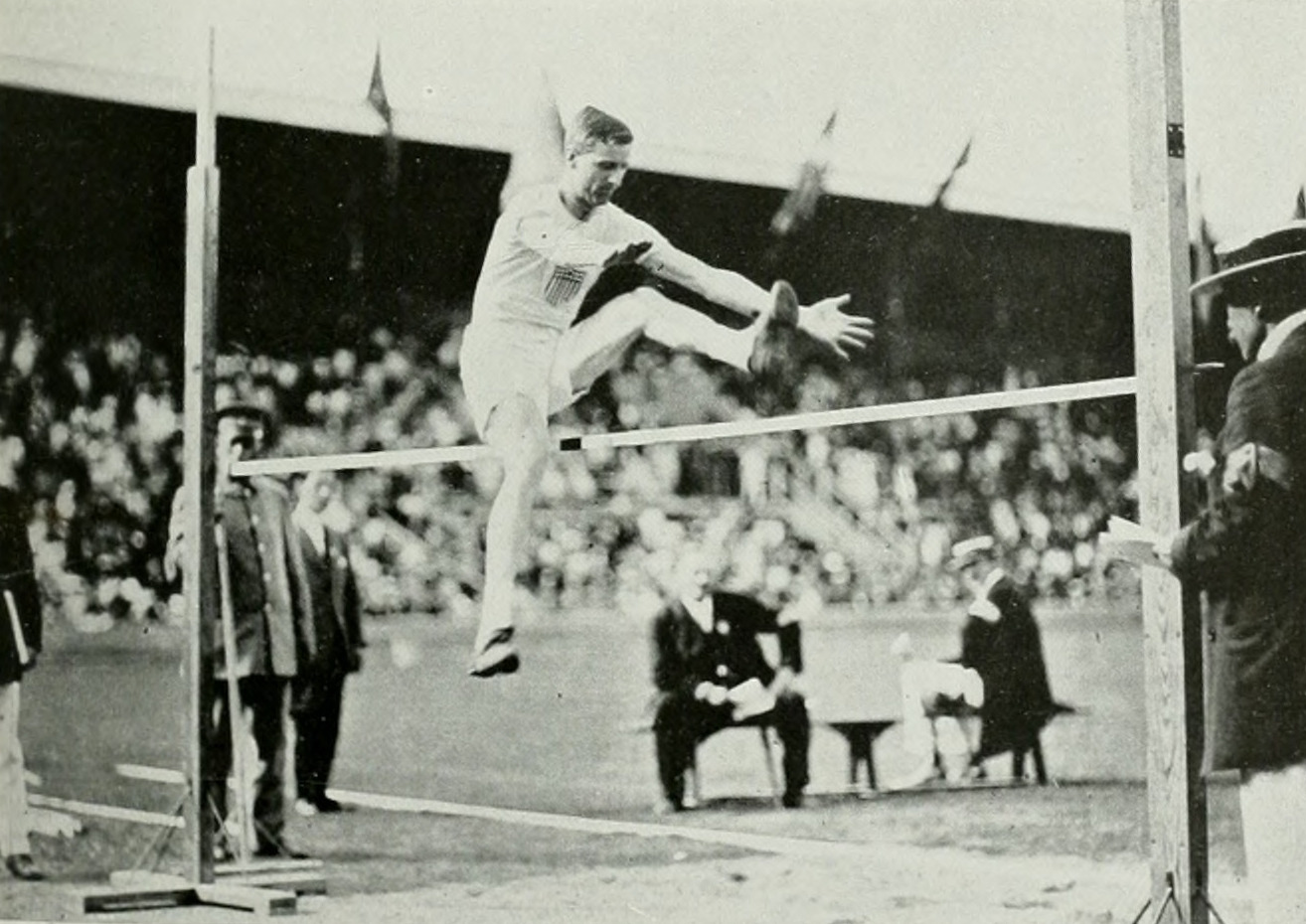
American coaches, including two-time NCAA champion Frank Costello of the University of Maryland, flocked to Russia to learn from Brumel and his coaches like Vladimir Dyachkov. However, it would be a solitary innovator at Oregon State University, Dick Fosbury, who would bring the high jump into the next century.
Taking advantage of the raised, softer, artificially-cushioned landing areas that were in use by then, Fosbury added a new twist to the outmoded Eastern cut-off. He directed himself over the bar head and shoulders first, going over on his back and landing in a fashion that would likely have resulted in serious injury in the old ground-level landing pits, which were usually filled with sawdust or sand mixtures. Around the same time, Debbie Brill independently came up with the same technique, which she called the 'Brill Bend'.
Since Fosbury used his new style, called the Fosbury flop, to win the gold medal of the 1968 Mexico Olympics, its use spread quickly, and soon "floppers" were dominating international high jump competitions. The first flopper setting a world record was the American Dwight Stones, who cleared in 1973. In the female side, the 16-year-old flopper Ulrike Meyfarth from West Germany won the gold medal of the 1972 Munich Olympics at , which tied the women's world record at that time (held by the Austrian straddler Ilona Gusenbauer a year before). However, it was not until 1978 when a flopper, Sara Simeoni of Italy, broke the women's world record.
Successful high jumpers following Fosbury's lead also included the rival of Dwight Stones, 5 ft-tall Franklin Jacobs of Paterson, New Jersey, who cleared , 0.59 m over his head (a feat equalled 27 years later by Stefan Holm of Sweden); Chinese record-setters Ni-chi Chin and Zhu Jianhua; Germans Gerd Wessig and Dietmar Mögenburg; Swedish Olympic medalist and former world record holder Patrik Sjöberg; female jumpers Ulrike Meyfarth of West Germany and Sara Simeoni of Italy.
In spite of this, the straddle technique did not disappear at once. In 1977, the 18-year-old Soviet straddler Vladimir Yashchenko set a new world record . In 1978, he raised the record to , and indoor, just before a knee injury effectively ended his career when he was only 20 years old. In the female side, the straddler Rosemarie Ackermann of East Germany, who was the first female jumper ever to clear , raised the world record from to during 1974 to 1977. In fact, from 2 June 1977 to 3 August 1978, almost 10 years after Fosbury's success, the men's and women's world records were still held by straddle jumpers Yashchenko and Ackermann respectively. However, they were the last world record holders using the straddle technique. Ackermann also won the gold medal of the 1976 Montreal Olympics, which was the last time for a straddle jumper (male or female) to win an Olympic medal.
In 1980, the Polish flopper, 1976 Olympic gold medalist Jacek Wszoła, broke Yashchenko's world record at . Two years before, the female Italian flopper Sara Simeoni, the long-term rival of Ackermann, broke Ackermann's world record at and became the first female flopper to break the women's world record. She also won the gold medal of the 1980 Moscow Olympics, where Ackermann placed fourth. Since then, the flop style has been completely dominant. All other techniques were almost extinct in serious high jump competitions after late 1980s.
Technical aspects
Technique and form have evolved greatly over the history of high jump. The Fosbury Flop is considered the most efficient way for competitors to propel themselves over the bar.
Approach
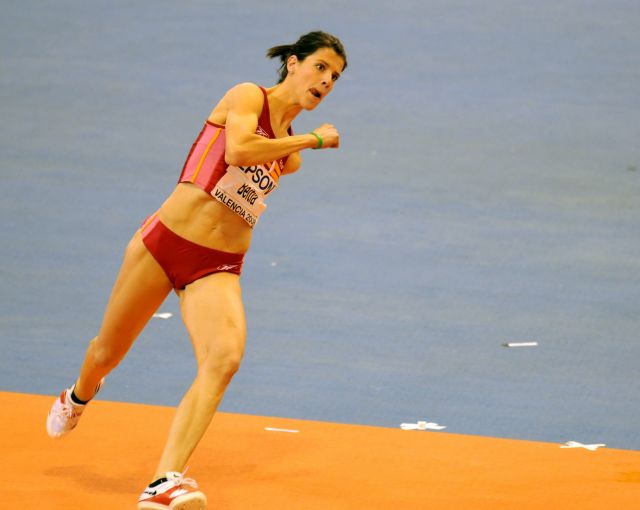
For a Fosbury Flop, depending on the athlete's jump foot, they start on the right or left of the high jump mat, placing their jump foot farthest away from the mat. They take an eight- to ten-step approach, with the first three to five steps being in a straight line and the last five being on a curve. The approach angle is critical for optimal height. Athletes generally mark their approach in order to find as much consistency as possible.
The straight run builds the momentum and sets the tone for a jump. The athlete starts by pushing off their takeoff foot with slow, powerful steps, then begins to accelerate. They should be running upright by the end of the straight portion.
The athlete's takeoff foot will be landing on the first step of the curve, and they will continue to accelerate, focusing their body towards the opposite back corner of the high jump mat. While staying erect and leaning away from the mat, the athlete takes their final two steps flat-footed, rolling from the heel to the toe.
Most great straddle jumpers run at angles of about 30 to 40 degrees. The length of the run is determined by the speed of the approach. A slower run requires about eight strides, but a faster high jumper might need about 13 strides. Greater speed allows a greater part of the body's forward momentum to be converted upward.
The J approach favored by Fosbury floppers allows for speed, the ability to turn in the air (centripetal force), and a good takeoff position, which helps turn horizontal momentum into vertical momentum. The approach should be a hard, controlled stride so that the athlete does not fall from running at an angle. Athletes should lean into the curve from their ankles, not their hips. This allows their hips to rotate during takeoff, which in turn allows their center of gravity to pass under the bar.
Takeoff
The takeoff can be double-arm or single-arm. In both cases, the plant foot should be the foot farthest from the bar, angled towards the opposite back corner of the mat, as they drive up the knee on their non-takeoff leg. This is accompanied by a one- or two-arm swing while driving the knee.
Unlike the straddle technique, where the takeoff foot is "planted" in the same spot regardless of the height of the bar, flop-style jumpers must adjust their approach run as the bar is raised so that their takeoff spot is slightly farther out from the bar. Jumpers attempting to reach record heights commonly fail when most of their energy is directed into the vertical effort and they knock the bar off the standards with the backs of their legs as they stall.
An effective approach shape can be derived from physics. For example, the rate of backward spin required as the jumper crosses the bar in order to facilitate shoulder clearance on the way up and foot clearance on the way down can be determined by computer simulation. This rotation rate can be back-calculated to determine the required angle of lean away from the bar at the moment of planting, based on how long the jumper is on the takeoff foot. This information, together with the jumper's speed, can be used to calculate the radius of the curved part of the approach. One can also work in the opposite direction by assuming a certain approach radius and determining the resulting backward rotation.
Drills can be practiced to solidify the approach. One drill is to run in a straight line and then run two to three circles spiraling into one another. Another is to run or skip a circle of any size two or three times in a row. It is important to leap upwards without first leaning into the bar, allowing the momentum of the J approach to carry the body across the bar.
Flight

The knee on the athlete's non-takeoff leg naturally turns their body, placing them in the air with their back to the bar. The athlete then drives their shoulders towards the back of their feet, arching their body over the bar. They can look over their shoulder to judge when to kick both feet over their head, causing their body to clear the bar and land on the mat.
All-time top 25
| *- denotes top performance (only) for other top 25 athletes who fall outside the top 25 high jump marks* |
|---|
- .
Men (outdoor)
| Ath.# | Perf.# | Mark | Athlete | Nation | Date | Place | |||||||
|---|---|---|---|---|---|---|---|---|---|---|---|---|---|
| 1 | 1 | Javier Sotomayor | 27 July 1993 | Salamanca | |||||||||
| 2 | Sotomayor #2 | 29 July 1989 | San Juan | ||||||||||
| 3 | Sotomayor #3 | 8 September 1988 | Salamanca | ||||||||||
| 2 | 3 | Mutaz Essa Barshim | 5 September 2014 | Brussels | |||||||||
| 3 | 5 | Patrik Sjöberg | 30 June 1987 | Stockholm | |||||||||
| 5 | Sotomayor #4 | 5 June 1994 | Seville | ||||||||||
| 3 | 5 | Bohdan Bondarenko | 14 June 2014 | New York City | |||||||||
| 5 | Barshim #2 | 14 June 2014 | New York City | ||||||||||
| 5 | 9 | Igor Paklin | 4 September 1985 | Kobe | |||||||||
| 9 | Sotomayor #5 | 25 June 1994 | Havana | ||||||||||
| Sotomayor #6 | 15 July 1994 | London | |||||||||||
| Bondarenko #2 | 4 July 2013 | Lausanne | |||||||||||
| Bondarenko #3 | 15 August 2013 | Moscow | |||||||||||
| Barshim #3 | 5 June 2014 | Rome | |||||||||||
| Barshim #4 | 22 August 2014 | Eberstadt | |||||||||||
| Barshim #5 | 30 May 2015 | Eugene | |||||||||||
| 6 | 17 | Rudolf Povarnitsyn | 11 August 1985 | Donetsk | |||||||||
| 17 | Sotomayor #7 | 12 March 1989 | Havana | ||||||||||
| Sjöberg #2 | 5 August 1989 | Brussels | |||||||||||
| 17 | Sotomayor #8 | 13 August 1989 | Bogotá | ||||||||||
| 6 | 17 | Sorin Matei | 20 June 1990 | Bratislava | |||||||||
| 17 | Sotomayor #9 | 19 July 1991 | Paris | ||||||||||
| 6 | 17 | Charles Austin | 7 August 1991 | Zurich | |||||||||
| 17 | Sotomayor #10 | 22 May 1993 | Havana | ||||||||||
| Sotomayor #11 | 23 July 1993 | London | |||||||||||
| Sotomayor #12 | 22 August 1993 | Stuttgart | |||||||||||
| Sotomayor #13 | 10 July 1994 | Eberstadt | |||||||||||
| Sotomayor #14 | 18 July 1994 | Nice | |||||||||||
| Sotomayor #15 | 29 July 1994 | Saint Petersburg | |||||||||||
| Sotomayor #16 | 11 September 1994 | London | |||||||||||
| Sotomayor #17 | 25 March 1995 | Mar del Plata | |||||||||||
| 6 | 17 | Vyacheslav Voronin | 5 August 2000 | London | |||||||||
| 17 | Barshim #6 | 1 June 2013 | Eugene | ||||||||||
| 6 | 17 | Derek Drouin | 25 April 2014 | Des Moines | |||||||||
| 17 | Bondarenko #4 | 11 May 2014 | Tokyo | ||||||||||
| Bondarenko #5 | 3 July 2014 | Lausanne | |||||||||||
| 6 | 17 | Andriy Protsenko | 3 July 2014 | Lausanne | |||||||||
| 17 | Bondarenko #6 | 18 July 2014 | Monaco | ||||||||||
| Bondarenko #7 | 5 September 2014 | Brussels | |||||||||||
| Barshim #7 | 11 June 2016 | Opole | |||||||||||
| Barshim #8 | 20 August 2017 | Birmingham | |||||||||||
| Barshim #9 | 27 August 2017 | Eberstadt | |||||||||||
| Barshim #10 | 4 May 2018 | Doha | |||||||||||
| Barshim #11 | 2 July 2018 | Székesfehérvár | |||||||||||
| 12 | Zhu Jianhua | 10 June 1984 | Eberstadt | ||||||||||
| Hollis Conway | 30 July 1989 | Norman | |||||||||||
| Ivan Ukhov | 5 July 2012 | Cheboksary | |||||||||||
| Gianmarco Tamberi | 15 July 2016 | Monaco | title=High Jump Results | url=http://static.sportresult.com/sports/at/data/2016/monaco/re0810040.pdf | publisher=sportresult.com | date=15 July 2016 | access-date=16 July 2016 | archive-date=5 August 2016 | archive-url=https://web.archive.org/web/20160805171132/http://static.sportresult.com/sports/at/data/2016/monaco/re0810040.pdf | url-status=dead}} | |||
| 16 | Hennadiy Avdyeyenko | 6 September 1987 | Rome | ||||||||||
| Sergey Malchenko | 4 September 1988 | Banská Bystrica | |||||||||||
| Dragutin Topić | 1 August 1993 | Belgrade | |||||||||||
| Troy Kemp | 12 July 1995 | Nice | |||||||||||
| Artur Partyka | 18 August 1996 | Eberstadt | |||||||||||
| Jacques Freitag | 5 March 2005 | Oudtshoorn | |||||||||||
| Andriy Sokolovskyy | 8 July 2005 | Rome | |||||||||||
| Andrey Silnov | 25 July 2008 | London | |||||||||||
| Zhang Guowei | 30 May 2015 | Eugene | |||||||||||
| Danil Lysenko | 27 August 2017 | Eberstadt |
Annulled marks
The following athletes have had their personal best annulled due to doping offences:
| Mark | Athlete | Date | Place | Ref |
|---|---|---|---|---|
| Ivan Ukhov | 10 May 2014 | Doha | ||
| Danil Lysenko | 20 July 2018 | Monaco |
Women (outdoor)
| Ath.# | Perf.# | Mark | Athlete | Nation | Date | Place | |||||||
|---|---|---|---|---|---|---|---|---|---|---|---|---|---|
| 1 | 1 | Yaroslava Mahuchikh | 7 July 2024 | Paris | |||||||||
| 2 | 2 | Stefka Kostadinova | Bulgaria | 30 August 1987 | Rome | ||||||||
| 3 | Kostadinova #2 | 31 May 1986 | Sofia | ||||||||||
| 3 | 3 | Blanka Vlašić | 31 August 2009 | Zagreb | |||||||||
| 4 | 5 | Lyudmila Andonova | Bulgaria | 20 July 1984 | Berlin | ||||||||
| 5 | Kostadinova #3 | 25 May 1986 | Sofia | ||||||||||
| Kostadinova #4 | 16 September 1987 | Cagliari | |||||||||||
| Kostadinova #5 | 3 September 1988 | Sofia | |||||||||||
| Vlašić #2 | 7 August 2007 | Stockholm | |||||||||||
| 4 | 5 | Anna Chicherova | 22 July 2011 | Cheboksary | |||||||||
| 11 | Kostadinova #6 | 18 August 1985 | Moscow | ||||||||||
| Kostadinova #7 | 15 June 1986 | Fürth | |||||||||||
| Kostadinova #8 | 14 September 1986 | Cagliari | |||||||||||
| Kostadinova #9 | 6 June 1987 | Worrstadt | |||||||||||
| Kostadinova #10 | 8 September 1987 | Rieti | |||||||||||
| 6 | 11 | Kajsa Bergqvist | 26 July 2003 | Eberstadt | |||||||||
| Hestrie Cloete | 31 August 2003 | Paris | |||||||||||
| Yelena Slesarenko | 28 August 2004 | Athens | |||||||||||
| 11 | Vlašić #3 | 30 July 2007 | Thessaloniki | ||||||||||
| Vlašić #4 | 22 June 2008 | Istanbul | |||||||||||
| Vlašić #5 | 5 July 2008 | Madrid | |||||||||||
| 6 | 11 | Ariane Friedrich | 14 June 2009 | Berlin | |||||||||
| Mariya Lasitskene | 6 July 2017 | Lausanne | title=High Jump Results | url=http://static.sportresult.com/sports/at/data/2017/lausanne/re1810040.pdf | work=sportresult.com | date=6 July 2017 | access-date=9 July 2017 | archive-date=4 August 2021 | archive-url=https://web.archive.org/web/20210804115830/http://static.sportresult.com/sports/at/data/2017/lausanne/re1810040.pdf | url-status=dead}} | |||
| 11 | Lasitskene #2 | 20 June 2019 | Ostrava | ||||||||||
| 11 | 25 | Tamara Bykova | 22 June 1984 | Kyiv | |||||||||
| 25 | Kostadinova #11 | 14 June 1986 | Worrstadt | ||||||||||
| Kostadinova #12 | 7 September 1986 | Rieti | |||||||||||
| Kostadinova #13 | 4 July 1987 | Oslo | |||||||||||
| Kostadinova #14 | 13 September 1987 | Padua | |||||||||||
| Kostadinova #15 | 12 August 1988 | Budapest | |||||||||||
| 11 | 25 | Heike Henkel | 31 August 1991 | Tokyo | |||||||||
| 25 | Kostadinova #16 | 4 July 1992 | San Marino | ||||||||||
| Kostadinova #17 | 18 September 1993 | Fukuoka | |||||||||||
| 11 | 25 | Inha Babakova | 15 September 1995 | Tokyo | |||||||||
| 25 | Kostadinova #18 | 3 August 1996 | Atlanta | ||||||||||
| Bergqvist #2 | 18 August 2002 | Poznań | |||||||||||
| Cloete #2 | 10 August 2003 | Berlin | |||||||||||
| Bergqvist #3 | 28 July 2006 | London | |||||||||||
| Vlašić #6 | 21 July 2007 | Madrid | |||||||||||
| Vlašić #7 | 2 September 2007 | Osaka | |||||||||||
| Vlašić #8 | 12 June 2008 | Ostrava | |||||||||||
| Vlašić #9 | 1 July 2008 | Bydgoszcz | |||||||||||
| 11 | 25 | Tia Hellebaut | 23 August 2008 | Beijing | |||||||||
| 25 | Vlašić #10 | 23 August 2008 | Beijing | ||||||||||
| Vlašić #11 | 8 May 2009 | Doha | |||||||||||
| 11 | 25 | Chaunté Lowe | 26 June 2010 | Des Moines | |||||||||
| 25 | Vlašić #12 | 5 September 2010 | Split | ||||||||||
| Chicherova #2 | 16 September 2011 | Brussels | |||||||||||
| Chicherova #3 | 11 August 2012 | London | |||||||||||
| Lasitskene #3 | 21 July 2017 | Monaco | |||||||||||
| Lasitskene #4 | 8 September 2021 | Zurich | |||||||||||
| Mahuchikh #2 | 2 September 2022 | Brussels | |||||||||||
| 16 | Silvia Costa | 9 September 1989 | Barcelona | ||||||||||
| Venelina Veneva-Mateeva | 2 June 2001 | Kalamata | |||||||||||
| Irina Gordeeva | 19 August 2012 | Eberstadt | |||||||||||
| Brigetta Barrett | 22 June 2013 | Des Moines | |||||||||||
| Nicola Olyslagers | 27 August 2025 | Zurich | |||||||||||
| 21 | Ulrike Meyfarth | 21 August 1983 | London | ||||||||||
| Louise Ritter | 8 July 1988 | Austin | |||||||||||
| Tatyana Motkova | 30 May 1995 | Bratislava | |||||||||||
| Niki Bakoyianni | 3 August 1996 | Atlanta | |||||||||||
| Antonietta Di Martino | 24 June 2007 | Milan |
Men (indoor)
Only one performance (best) per athlete
| Rank | Mark | Athlete | Date | Place | Ref | 1 | 2 | 3 | 5 | 9 | 11 | 21 |
|---|---|---|---|---|---|---|---|---|---|---|---|---|
| Javier Sotomayor | 4 March 1989 | Budapest | ||||||||||
| Carlo Thränhardt | 26 February 1988 | Berlin | ||||||||||
| Patrik Sjöberg | 1 February 1987 | Piraeus | ||||||||||
| Mutaz Essa Barshim | 18 February 2015 | Athlone | ||||||||||
| Hollis Conway | 10 March 1991 | Seville | ||||||||||
| Stefan Holm | 6 March 2005 | Madrid | ||||||||||
| Ivan Ukhov | 25 February 2009 | Piraeus | ||||||||||
| Aleksey Dmitrik | 8 February 2014 | Arnstadt | ||||||||||
| Dietmar Mögenburg | 24 February 1985 | Cologne | ||||||||||
| Ralf Sonn | 1 March 1991 | Berlin | ||||||||||
| Igor Paklin | 7 March 1987 | Indianapolis | ||||||||||
| Gennadiy Avdeyenko | 7 March 1987 | Indianapolis | ||||||||||
| Steve Smith | 4 February 1994 | Wuppertal | ||||||||||
| Wolf-Hendrik Beyer | 18 March 1994 | Weinheim | ||||||||||
| Sorin Matei | 3 February 1995 | Wuppertal | ||||||||||
| Matt Hemingway | 4 March 2000 | Atlanta | ||||||||||
| Yaroslav Rybakov | 15 February 2005 | Stockholm | ||||||||||
| Linus Thörnblad | 25 February 2007 | Gothenburg | ||||||||||
| Gianmarco Tamberi | 13 February 2016 | Hustopeče | ||||||||||
| Danil Lysenko | 29 January 2023 | Moscow | ||||||||||
| Artur Partyka | 3 February 1991 | Sulingen | ||||||||||
| Dalton Grant | 13 March 1994 | Paris | ||||||||||
| Charles Austin | 1 March 1996 | Atlanta | ||||||||||
| Vyacheslav Voronin | 5 March 2005 | Glasgow | ||||||||||
| Jaroslav Bába | 5 February 2000 | Arnstadt | ||||||||||
| Andrey Silnov | 2 February 2008 | Arnstadt | ||||||||||
| Maksim Nedasekau | 7 March 2021 | Toruń |
Annulled marks
The following athletes have had their personal best annulled due to doping offences:
| Mark | Athlete | Date | Place | Ref |
|---|---|---|---|---|
| Ivan Ukhov | 25 February 2014 | Prague |
Women (indoor)
Only one performance (best) per athlete
| Rank | Mark | Athlete | Date | Place | Ref | 1 | 2 | 3 | 7 | 10 | 13 | 16 | 21 |
|---|---|---|---|---|---|---|---|---|---|---|---|---|---|
| Kajsa Bergqvist | 4 February 2006 | Arnstadt | |||||||||||
| Heike Henkel | 8 February 1992 | Karlsruhe | |||||||||||
| Stefka Kostadinova | 20 February 1988 | Athens | |||||||||||
| Blanka Vlašić | 6 February 2010 | Arnstadt | |||||||||||
| Anna Chicherova | 4 February 2012 | Arnstadt | |||||||||||
| Yaroslava Mahuchikh | 2 February 2021 | Banská Bystrica | |||||||||||
| Tia Hellebaut | 3 March 2007 | Birmingham | |||||||||||
| Ariane Friedrich | 15 February 2009 | Karlsruhe | |||||||||||
| Mariya Lasitskene | 9 February 2020 | Moscow | |||||||||||
| Alina Astafei | 3 March 1995 | Berlin | |||||||||||
| Yelena Slesarenko | 7 March 2004 | Budapest | |||||||||||
| Antonietta Di Martino | 9 February 2011 | Banská Bystrica | |||||||||||
| Tamara Bykova | 6 March 1983 | Budapest | |||||||||||
| Monica Iagăr | 23 January 1999 | Bucharest | |||||||||||
| Marina Kuptsova | 2 March 2002 | Vienna | |||||||||||
| Susanne Beyer | 8 March 1987 | Indianapolis | |||||||||||
| Venelina Veneva-Mateeva | 2 February 2002 | Łódź | |||||||||||
| Yelena Yelesina | 26 February 2003 | Moscow | |||||||||||
| Chaunte Lowe | 26 February 2012 | Albuquerque | |||||||||||
| Kamila Lićwinko | 21 February 2015 | Toruń | |||||||||||
| Gabriele Günz | 31 January 1988 | Stuttgart | |||||||||||
| Ioamnet Quintero | 5 March 1993 | Berlin | |||||||||||
| Tisha Waller | 28 February 1998 | Atlanta | |||||||||||
| Ruth Beitia | 24 February 2007 | Piraeus | |||||||||||
| Vita Palamar | 9 March 2008 | Valencia | |||||||||||
| Irina Gordeeva | 28 January 2009 | Cottbus | |||||||||||
| Airinė Palšytė | 4 March 2017 | Belgrade |
Olympic medalists
Men
Women
World Championships medalists
Men
Women
World Indoor Championships medalists
Men
| 2025 Nanjing | ||
|---|---|---|
| Woo Sang-hyeok | Hamish Kerr | Raymond Richards |
Women
| 2025 Nanjing | ||
|---|---|---|
| Nicola Olyslagers | Eleanor Patterson | Yaroslava Mahuchikh |
- Known as the World Indoor Games.
Athletes with most medals
Athletes who have won multiple titles at the two most important competitions, the Olympic Games and the World Championships:
- 4 wins: Mariya Lasitskene (RUS) - Olympic Champion in 2020, World Champion in 2015, 2017 & 2019
- 4 wins: Mutaz Essa Barshim (QAT) - Olympic Champion in 2020, World Champion in 2017, 2019 & 2022
- 3 wins: Javier Sotomayor (CUB) - Olympic Champion in 1992, World Champion in 1993 & 1997
- 3 wins: Stefka Kostadinova (BUL) - Olympic Champion in 1996, World Champion in 1987 & 1995
- 2 wins: Gennadiy Avdeyenko (URS) - Olympic Champion in 1988, World Champion in 1983
- 2 wins: Charles Austin (USA) - Olympic Champion in 1996, World Champion in 1991
- 2 wins: Iolanda Balaș (ROU) - Olympic Champion in 1960 & 1964
- 2 wins: Ulrike Meyfarth (FRG) - Olympic Champion in 1972 & 1984
- 2 wins: Heike Henkel (GER) - Olympic Champion in 1992, World Champion in 1991
- 2 wins: Hestrie Cloete (RSA) - World Champion in 2001 & 2003
- 2 wins: Blanka Vlašić (CRO) - World Champion in 2007 & 2009
- 2 wins: Anna Chicherova (RUS) - Olympic Champion in 2012, World Champion in 2011
- 2 wins: Gianmarco Tamberi (ITA) - Olympic Champion in 2020, World Champion in 2023
- 2 wins: Yaroslava Mahuchikh (UKR) - Olympic Champion in 2024, World Champion in 2023
- 2 wins: Hamish Kerr (NZL) - Olympic Champion in 2024, World Champion in 2025
Kostadinova, Sotomayor and Mahuchikh are the only high jumpers to have been Olympic Champion, World Champion and broken the world record.
Season's bests
Men
| Year | Mark | Athlete | Place | |
|---|---|---|---|---|
| 1970 | Ni Zhiqin | Changsha | ||
| 1971 | Pat Matzdorf | Berkeley | ||
| 1972 | Jüri Tarmak | Moscow | ||
| 1973 | Dwight Stones | Munich | ||
| 1974 | Dwight Stones | Oslo | ||
| 1975 | Dwight Stones | New York | ||
| 1976 | Dwight Stones | Philadelphia | ||
| 1977 | Vladimir Yashchenko | Richmond | ||
| 1978 | Vladimir Yashchenko | Milan | ||
| 1979 | Dietmar Mögenburg | Ottawa | ||
| 1980 | Gerd Wessig | Moscow | ||
| 1981 | Aleksey Demyanyuk | Leningrad | ||
| 1982 | Zhu Jianhua | Delhi | ||
| 1983 | Zhu Jianhua | Shanghai | ||
| 1984 | Zhu Jianhua | Eberstadt | ||
| 1985 | Igor Paklin | Kobe | ||
| 1986 | Igor Paklin | Rieti | ||
| 1987 | Patrik Sjöberg | Stockholm | ||
| 1988 | Javier Sotomayor | Salamanca | ||
| 1989 | Javier Sotomayor | San Juan | ||
| 1990 | Sorin Matei | Bratislava | ||
| 1991 | Hollis Conway | Seville | ||
| Javier Sotomayor | Saint-Denis | |||
| Charles Austin | Zürich | |||
| 1992 | Patrik Sjöberg | Genoa | ||
| 1993 | Javier Sotomayor | Salamanca | ||
| 1994 | Javier Sotomayor | Seville | ||
| 1995 | Javier Sotomayor | Mar del Plata | ||
| 1996 | Charles Austin | Atlanta | ||
| 1997 | Javier Sotomayor | Athens | ||
| 1998 | Javier Sotomayor | Maracaibo | ||
| 1999 | Vyacheslav Voronin | Seville | ||
| 2000 | Vyacheslav Voronin | London | ||
| 2001 | Vyacheslav Voronin | Eberstadt | ||
| 2002 | Jacques Freitag | Durban | ||
| 2003 | Stefan Holm | Arnstadt | ||
| Aleksander Walerianczyk | Bydgoszcz | |||
| 2004 | Stefan Holm | Stockholm | ||
| 2005 | Stefan Holm | Madrid | ||
| 2006 | Yaroslav Rybakov | Arnstadt | ||
| Moscow | ||||
| Ivan Ukhov | Arnstadt | |||
| Andrey Silnov | Monaco | |||
| 2007 | Ivan Ukhov | Moscow | ||
| 2008 | Yaroslav Rybakov | Moscow | ||
| Andrey Silnov | London | |||
| 2009 | Ivan Ukhov | Piraeus | ||
| 2010 | Ivan Ukhov | Banská Bystrica | ||
| 2011 | Ivan Ukhov | Hustopeče | ||
| Banská Bystrica | ||||
| Paris | ||||
| 2012 | Ivan Ukhov | Cheboksary | ||
| Mutaz Essa Barshim | Lausanne | |||
| 2013 | Bohdan Bondarenko | Lausanne | ||
| Moscow | ||||
| 2014 | Mutaz Essa Barshim | Brussels | ||
| 2015 | Mutaz Essa Barshim | Athlone | ||
| Mutaz Essa Barshim | Eugene | |||
| 2016 | Mutaz Essa Barshim | Opole | ||
| 2017 | Mutaz Essa Barshim | Birmingham | ||
| Eberstadt | ||||
| 2018 | Mutaz Essa Barshim | Doha | ||
| Székesfehérvár | ||||
| 2019 | Mutaz Essa Barshim | Doha | ||
| 2020 | Darryl Sullivan | Blacksburg | ||
| Tom Gale | Hustopeče | |||
| Jamal Wilson | Banská Bystrica | |||
| Luis Zayas | Banská Bystrica | |||
| Ilya Ivanyuk | Moscow | |||
| Maksim Nedasekau | Minsk | |||
| 2021 | Maksim Nedasekau | Toruń | ||
| Székesfehérvár | ||||
| Tokyo | ||||
| Ilya Ivanyuk | Smolensk | |||
| Gianmarco Tamberi | Tokyo | |||
| Mutaz Essa Barshim | Tokyo | |||
| 2022 | Mutaz Essa Barshim | Eugene | ||
| 2023 | Danil Lysenko | Moscow | ||
| 2024 | Gianmarco Tamberi | Rome | ||
| 2025 | Hamish Kerr | Tokyo |
Women
| Year | Mark | Athlete | Place |
|---|---|---|---|
| 1970 | Antonina Lazareva | Kyiv | |
| 1971 | Ilona Gusenbauer | Vienna | |
| 1972 | Yordanka Blagoeva | Zagreb | |
| 1973 | Yordanka Blagoeva | Warsaw | |
| 1974 | Rosemarie Ackermann | Rome | |
| 1975 | Rosemarie Ackermann | Nice | |
| 1976 | Rosemarie Ackermann | Dresden | |
| 1977 | Rosemarie Ackermann | Berlin | |
| 1978 | Sara Simeoni | Brescia | |
| 1979 | Rosemarie Ackermann | Turin | |
| 1980 | Sara Simeoni | Turin | |
| 1981 | Pam Spencer | Brussels | |
| 1982 | Ulrike Meyfarth | Athens | |
| 1983 | Tamara Bykova | Pisa | |
| Budapest | |||
| 1984 | Lyudmila Andonova | Berlin | |
| 1985 | Stefka Kostadinova | Moscow | |
| 1986 | Stefka Kostadinova | Sofia | |
| 1987 | Stefka Kostadinova | Rome | |
| 1988 | Stefka Kostadinova | Sofia | |
| 1989 | Silvia Costa | Barcelona | |
| Stefka Kostadinova | Pireás | ||
| 1990 | Yelena Yelesina | Seattle | |
| 1991 | Heike Henkel | Tokyo | |
| 1992 | Heike Henkel | Karlsruhe | |
| 1993 | Stefka Kostadinova | Fukuoka | |
| 1994 | Alina Astafei | Berlin | |
| 1995 | Inga Babakova | Tokyo | |
| 1996 | Stefka Kostadinova | Atlanta | |
| 1997 | Stefka Kostadinova | Osaka | |
| Paris-Bercy | |||
| Inga Babakova | Fukuoka | ||
| 1998 | Venelina Veneva | Kalamata | |
| 1999 | Hestrie Cloete | Monaco | |
| 2000 | Monica Iagăr | Villeneuve d'Ascq | |
| 2001 | Venelina Veneva | Kalamáta | |
| 2002 | Kajsa Bergqvist | Poznań | |
| 2003 | Kajsa Bergqvist | Eberstadt | |
| Hestrie Cloete | Saint-Denis | ||
| 2004 | Yelena Slesarenko | Athens | |
| 2005 | Kajsa Bergqvist | Sheffield | |
| 2006 | Kajsa Bergqvist | Arnstadt | |
| 2007 | Blanka Vlašić | Stockholm | |
| 2008 | Blanka Vlašić | Istanbul | |
| Madrid | |||
| 2009 | Blanka Vlašić | Zagreb | |
| 2010 | Blanka Vlašić | Arnstadt | |
| 2011 | Anna Chicherova | Cheboksary | |
| 2012 | Anna Chicherova | Arnstadt | |
| 2013 | Brigetta Barrett | Des Moines | |
| 2014 | Mariya Kuchina | Stockholm | |
| Anna Chicherova | Eugene | ||
| Ruth Beitia | Zürich | ||
| 2015 | Anna Chicherova | Lausanne | |
| 2016 | Chaunté Lowe | Eugene | |
| 2017 | Mariya Lasitskene | Lausanne | |
| 2018 | Mariya Lasitskene | Paris | |
| London | |||
| 2019 | Mariya Lasitskene | Ostrava | |
| 2020 | Mariya Lasitskene | Moscow | |
| 2021 | Yaroslava Mahuchikh | Banská Bystrica | |
| 2022 | Yaroslava Mahuchikh | Brussels | |
| 2023 | Yaroslava Mahuchikh | Eugene | |
| Nicola Olyslagers | Eugene | ||
| 2024 | Yaroslava Mahuchikh | Paris | |
| 2025 | Nicola Olyslagers | Zürich |
Sources
- The Complete Book of Track and Field, by Tom McNab
- The World Almanac and Book of Facts, 2000
References
References
- "C2.1: Technical Rulesv (In force from 1 November 2019 and amended on 31 January 2020*)". World Athletics.
- (4 December 2009). "Competition Rules 2010-2011; In Force as from 1st November 2009". International Association of Athletics Federations.
- Admin, Runnerstribe. (2022-08-19). "If The 'Flop' Had Flopped Would We Be Seeing The Brill Bend? - A Column by Len Johnson".
- CoachR. "The HIGH JUMP".
- "The High Jump Approach - Training Article".
- "High Jump Technique and Training".
- Rosenbaum, Mike. (27 October 2017). "Illustrated High Jump Technique".
- [http://www.iaaf.org/records/toplists/jumps/high-jump/outdoor/men/senior High Jump - men - senior - outdoor]. IAAF. Retrieved on 2014-01-25.
- [http://www.iaaf.org/records/toplists/jumps/high-jump/outdoor/women/senior High Jump - women - senior - outdoor]. IAAF. Retrieved on 2014-01-25.
- [http://www.iaaf.org/records/toplists/jumps/high-jump/indoor/men/senior High Jump - men - senior - indoor]. IAAF. Retrieved on 2014-01-25.
- [http://www.iaaf.org/records/toplists/jumps/high-jump/indoor/women/senior High Jump - women - senior - indoor]. IAAF. Retrieved on 2014-01-25.
- (6 September 2014). "Justin Gatlin rolls back the years as tyro Barshim basks". zeenews.india.com.
- (14 June 2014). "High Jump Results". [[IAAF]].
- (3 July 2014). "High Jump Results". Diamond League - Lausanne.
- (15 July 2016). "High Jump Results". sportresult.com.
- "FLASH: Mahuchikh breaks world high jump record with 2.10m in Paris {{!}} REPORTS {{!}} World Athletics".
- (6 July 2017). "High Jump Results". sportresult.com.
- Bob Ramsak. (20 June 2019). "Miller-Uibo breaks 300m world best, Lasitskene tops 2.06m and Kirt joins 90-metre club in Ostrava". IAAF.
- (8 September 2021). "High Jump Result". sportresult.com.
- Jon Mulkeen. (2 September 2022). "Krop, Mahuchikh and Winger bounce back in Brussels with world-leading marks". World Athletics.
- Whittington, Jess. (27 August 2025). "Olyslagers soars Oceanian record to clinch Diamond League crown on day one in Zurich".
- (30 January 2023). "Athletics 'Battle Of The Sexes' Brought Lyssenko To Victory Over Lasitskene: 'I Didn't Wait'".
This article was imported from Wikipedia and is available under the Creative Commons Attribution-ShareAlike 4.0 License. Content has been adapted to SurfDoc format. Original contributors can be found on the article history page.
Ask Mako anything about High jump — get instant answers, deeper analysis, and related topics.
Research with MakoFree with your Surf account
Create a free account to save articles, ask Mako questions, and organize your research.
Sign up freeThis content may have been generated or modified by AI. CloudSurf Software LLC is not responsible for the accuracy, completeness, or reliability of AI-generated content. Always verify important information from primary sources.
Report