From Surf Wiki (app.surf) — the open knowledge base
Hexagon
Shape with six sides

Shape with six sides
In geometry, a hexagon (from Greek ἕξ, hex, meaning "six", and γωνία, gonía, meaning "corner, angle") is a six-sided polygon. The total of the internal angles of any simple (non-self-intersecting) hexagon is 720°.
Regular hexagon
A regular hexagon is defined as a hexagon that is both equilateral and equiangular. In other words, a hexagon is said to be regular if the edges are all equal in length, and each of its internal angle is equal to 120°. The Schläfli symbol denotes this polygon as {6} .{{citation | access-date = 2015-11-06 | archive-date = 2016-01-02 | url-status = live
A regular hexagon is bicentric, meaning that it is both cyclic (has a circumscribed circle) and tangential (has an inscribed circle). The common length of the sides equals the radius of the circumscribed circle or circumcircle, which equals \tfrac{2}{\sqrt{3}} times the apothem (radius of the inscribed circle).
Measurement
The longest diagonals of a regular hexagon, connecting diametrically opposite vertices, are twice the length of one side. From this it can be seen that a triangle with a vertex at the center of the regular hexagon and sharing one side with the hexagon is equilateral, and that the regular hexagon can be partitioned into six equilateral triangles.
The maximal diameter (which corresponds to the long diagonal of the hexagon), D, is twice the maximal radius or circumradius, R, which equals the side length, t. The minimal diameter or the diameter of the inscribed circle (separation of parallel sides, flat-to-flat distance, short diagonal or height when resting on a flat base), d, is twice the minimal radius or inradius, r. The maxima and minima are related by the same factor: \begin{align} r &= \frac{d}{2} = \cos(30^\circ) R = \frac{\sqrt{3}}{2} R = \frac{\sqrt{3}}{2} t\ d &= \frac{\sqrt{3}}{2} D\ \end{align}
The area of a regular hexagon \begin{align} A &= \frac{3\sqrt{3}}{2}R^2 &&= 3Rr = 2\sqrt{3} r^2 \ &\approx 2.598 R^2 &&\approx 3.464 r^2\ &= \frac{3\sqrt{3}}{8}D^2 &&= \frac{3}{4}Dd = \frac{\sqrt{3}}{2} d^2 \ &\approx 0.6495 D^2 &&\approx 0.866 d^2. \end{align}
For any regular polygon, the area can also be expressed in terms of the apothem a and the perimeter p. For the regular hexagon these are given by a = r, and p{} = 6R = 4r\sqrt{3}, so :\begin{align} A &= \frac{ap}{2} \ &= \frac{r \cdot 4r\sqrt{3}}{2} = 2r^2\sqrt{3} \ &\approx 3.464 r^2. \end{align}
The regular hexagon fills the fraction \tfrac{3\sqrt{3}}{2\pi} \approx 0.8270 of its circumscribed circle.
If a regular hexagon has successive vertices A, B, C, D, E, F and if P is any point on the circumcircle between B and C, then .
It follows from the ratio of circumradius to inradius that the height-to-width ratio of a regular hexagon is 1:1.1547005; that is, a hexagon with a long diagonal of 1.0000000 will have a distance of 0.8660254 or cos(30°) between parallel sides.
Point in plane
For an arbitrary point in the plane of a regular hexagon with circumradius R, whose distances to the centroid of the regular hexagon and its six vertices are L and d_i respectively, we have
: d_1^2 + d_4^2 = d_2^2 + d_5^2 = d_3^2+ d_6^2= 2\left(R^2 + L^2\right), : d_1^2 + d_3^2+ d_5^2 = d_2^2 + d_4^2+ d_6^2 = 3\left(R^2 + L^2\right), : d_1^4 + d_3^4+ d_5^4 = d_2^4 + d_4^4+ d_6^4 = 3\left(\left(R^2 + L^2\right)^2 + 2 R^2 L^2\right).
If d_i are the distances from the vertices of a regular hexagon to any point on its circumcircle, then
:\left(\sum_{i=1}^6 d_i^2\right)^2 = 4 \sum_{i=1}^6 d_i^4 .
Construction
Symmetry
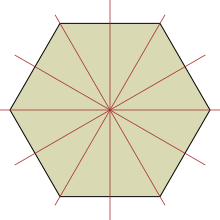

A regular hexagon has six rotational symmetries (rotational symmetry of order six) and six reflection symmetries (six lines of symmetry), making up the dihedral group D6.{{citation
These symmetries express nine distinct symmetries of a regular hexagon. John Conway labels these by a letter and group order. r12 is full symmetry, and a1 is no symmetry. p6, an isogonal hexagon constructed by three mirrors can alternate long and short edges, and d6, an isotoxal hexagon constructed with equal edge lengths, but vertices alternating two different internal angles. These two forms are duals of each other and have half the symmetry order of the regular hexagon. The i4 forms are regular hexagons flattened or stretched along one symmetry direction. It can be seen as an elongated rhombus, while d2 and p2 can be seen as horizontally and vertically elongated kites. g2 hexagons, with opposite sides parallel are also called hexagonal parallelogons.
Each subgroup symmetry allows one or more degrees of freedom for irregular forms. Only the g6 subgroup has no degrees of freedom but can be seen as directed edges.
Hexagons of symmetry g2, i4, and r12, as parallelogons can tessellate the Euclidean plane by translation. Other hexagon shapes can tile the plane with different orientations.
| p6m (*632) | cmm (2*22) | p2 (2222) | p31m (3*3) | pmg (22*) | pg (××) | [[File:Isohedral_tiling_p6-13.svg | 120px]]r12 | [[File:Isohedral_tiling_p6-12.svg | 120px]]i4 | [[File:Isohedral_tiling_p6-7.svg | 120px]]g2 | [[File:Isohedral tiling p6-11.svg | 120px]]d2 | [[File:Isohedral tiling p6-10.svg | 120px]]d2 | [[File:Isohedral tiling p6-9.svg | 120px]]p2 | [[File:Isohedral tiling p6-1.svg | 120px]]a1 | Dih6 | Dih2 | Z2 | Dih1 | Z1 |
|---|
| [[File:Root system A2.svg | 120px]]A2 group roots | [[File:Root system G2.svg | 120px]]G2 group roots |
|---|
The 6 roots of the simple Lie group A2, represented by a Dynkin diagram , are in a regular hexagonal pattern. The two simple roots have a 120° angle between them.
The 12 roots of the Exceptional Lie group G2, represented by a Dynkin diagram are also in a hexagonal pattern. The two simple roots of two lengths have a 150° angle between them.
Tessellations
Like squares and equilateral triangles, regular hexagons fit together without any gaps to tile the plane (three hexagons meeting at every vertex), and so are useful for constructing tessellations.{{cite book
Dissection
| 6-cube projection | 12 rhomb dissection | ||
|---|---|---|---|
| [[File:6-cube t0 A5.svg | 120px]] | [[File:6-gon rhombic dissection-size2.svg | 140px]] |
Coxeter states that every zonogon (a 2m-gon whose opposite sides are parallel and of equal length) can be dissected into m(m − 1) parallelograms. In particular this is true for regular polygons with evenly many sides, in which case the parallelograms are all rhombi. This decomposition of a regular hexagon is based on a Petrie polygon projection of a cube, with 3 of 6 square faces. Other parallelogons and projective directions of the cube are dissected within rectangular cuboids.
| Dissection of hexagons into three rhombs and parallelograms | 2D | Rhombs | Parallelograms | 3D | Square faces | Rectangular faces | ||||
|---|---|---|---|---|---|---|---|---|---|---|
| [[File:Hexagon_dissection.svg | 80px]] | [[File:Cube-skew-orthogonal-skew-solid.png | 95px]] | [[File:Cuboid_diagonal-orthogonal-solid.svg | 120px]] | [[File:Cuboid_skew-orthogonal-solid.png | 120px]] | |||
| Regular {6} | Hexagonal parallelogons | |||||||||
| [[File:3-cube_graph.svg | 95px]] | [[File:Cube-skew-orthogonal-skew-frame.png | 95px]] | [[File:Cuboid_diagonal-orthogonal-frame.png | 120px]] | [[File:Cuboid_skew-orthogonal-frame.png | 120px]] | |||
| Cube | Rectangular cuboid |
Hexagonal structures
.JPG)
From bees' honeycombs to the Giant's Causeway, hexagonal patterns are prevalent in nature due to their efficiency. In a hexagonal grid each line is as short as it can possibly be if a large area is to be filled with the fewest hexagons. This means that honeycombs require less wax to construct and gain much strength under compression.
Irregular hexagons with parallel opposite edges are called parallelogons and can also tile the plane by translation. In three dimensions, hexagonal prisms with parallel opposite faces are called parallelohedrons and these can tessellate 3-space by translation.
| Form | Hexagonal tiling | Hexagonal prismatic honeycomb | Regular | Parallelogonal | ||
|---|---|---|---|---|---|---|
| [[File:Uniform tiling 63-t0.svg | 170px]] | [[File:Hexagonal prismatic honeycomb.png | 170px]] | |||
| [[File:Isohedral tiling p6-7.svg | 170px]] | [[File:Skew hexagonal prism honeycomb.png | 240px]] |
Tesselations by hexagons
Main article: Hexagonal tiling
In addition to the regular hexagon, which determines a unique tessellation of the plane, any irregular hexagon which satisfies the Conway criterion will tile the plane.
Hexagon inscribed in a conic section
Pascal's theorem (also known as the "Hexagrammum Mysticum Theorem") states that if an arbitrary hexagon is inscribed in any conic section, and pairs of opposite sides are extended until they meet, the three intersection points will lie on a straight line, the "Pascal line" of that configuration.
Cyclic hexagon
The Lemoine hexagon is a cyclic hexagon (one inscribed in a circle) with vertices given by the six intersections of the edges of a triangle and the three lines that are parallel to the edges that pass through its symmedian point.
If the successive sides of a cyclic hexagon are a, b, c, d, e, f, then the three main diagonals intersect in a single point if and only if .
If, for each side of a cyclic hexagon, the adjacent sides are extended to their intersection, forming a triangle exterior to the given side, then the segments connecting the circumcenters of opposite triangles are concurrent.
If a hexagon has vertices on the circumcircle of an acute triangle at the six points (including three triangle vertices) where the extended altitudes of the triangle meet the circumcircle, then the area of the hexagon is twice the area of the triangle.
Hexagon tangential to a conic section
Let ABCDEF be a hexagon formed by six tangent lines of a conic section. Then Brianchon's theorem states that the three main diagonals AD, BE, and CF intersect at a single point.
In a hexagon that is tangential to a circle and that has consecutive sides a, b, c, d, e, and f,
:a + c + e = b + d + f.
Equilateral triangles on the sides of an arbitrary hexagon

If an equilateral triangle is constructed externally on each side of any hexagon, then the midpoints of the segments connecting the centroids of opposite triangles form another equilateral triangle.
Skew hexagon

A skew hexagon is a skew polygon with six vertices and edges but not existing on the same plane. The interior of such a hexagon is not generally defined. A skew zig-zag hexagon has vertices alternating between two parallel planes.
A regular skew hexagon is vertex-transitive with equal edge lengths. In three dimensions it will be a zig-zag skew hexagon and can be seen in the vertices and side edges of a triangular antiprism with the same D3d, [2+,6] symmetry, order 12.
The cube and octahedron (same as triangular antiprism) have regular skew hexagons as petrie polygons.
| [[File:Cube petrie.svg | 100px]] | |
|---|---|---|
| Cube | [[File:Octahedron petrie.svg | 100px]] |
| Octahedron |
Petrie polygons
The regular skew hexagon is the Petrie polygon for these higher dimensional regular, uniform and dual polyhedra and polytopes, shown in these skew orthogonal projections:
| 4D | 5D | ||
|---|---|---|---|
| [[File:3-3 duoprism ortho-Dih3.png | 100px]]3-3 duoprism | [[File:3-3 duopyramid ortho.png | 100px]]3-3 duopyramid |
Convex equilateral hexagon
A principal diagonal of a hexagon is a diagonal which divides the hexagon into quadrilaterals. In any convex equilateral hexagon (one with all sides equal) with common side a, there exists a principal diagonal d1 such that
:\frac{d_1}{a} \leq 2
and a principal diagonal d2 such that
:\frac{d_2}{a} \sqrt{3}.
Polyhedra with hexagons
There is no Platonic solid made of only regular hexagons, because the hexagons tessellate, not allowing the result to "fold up". The Archimedean solids with some hexagonal faces are the truncated tetrahedron, truncated octahedron, truncated icosahedron (of soccer ball and fullerene fame), truncated cuboctahedron and the truncated icosidodecahedron. These hexagons can be considered truncated triangles, with Coxeter diagrams of the form and .
| Hexagons in Archimedean solids | Tetrahedral | Octahedral | Icosahedral |
|---|---|---|---|
| [[File:truncated tetrahedron.png | 100px]] | ||
| truncated tetrahedron | [[File:truncated octahedron.png | 100px]] | |
| truncated octahedron | [[File:Great rhombicuboctahedron.png | 100px]] | |
| truncated cuboctahedron | [[File:truncated icosahedron.png | 100px]] | |
| truncated icosahedron |
There are other symmetry polyhedra with stretched or flattened hexagons, like these Goldberg polyhedron G(2,0):
| Hexagons in Goldberg polyhedra | Tetrahedral | Octahedral | Icosahedral | |||
|---|---|---|---|---|---|---|
| [[File:Alternate truncated cube.png | 120px]]Chamfered tetrahedron | [[File:Truncated rhombic dodecahedron2.png | 120px]]Chamfered cube | [[File:Truncated rhombic triacontahedron.png | 120px]]Chamfered dodecahedron |
There are also 9 Johnson solids with regular hexagons:
| Johnson solids with hexagons | |
|---|---|
| [[File:Triangular cupola.png | 80px]]triangular cupola |
| [[File:Augmented hexagonal prism.png | 80px]]augmented hexagonal prism |
| [[File:Triaugmented hexagonal prism.png | 80px]]triaugmented hexagonal prism |
| Prismoids with hexagons | |
|---|---|
| [[File:Hexagonal prism.png | 100px]] |
| Hexagonal prism |
| Tilings with regular hexagons | Regular | 1-uniform | |||
|---|---|---|---|---|---|
| {6,3} | r{6,3} | rr{6,3} | |||
| [[Image:Uniform tiling 63-t0.svg | 120px]] | [[Image:Uniform tiling 63-t1.svg | 120px]] | [[Image:Uniform polyhedron-63-t02.png | 120px]] |
| 2-uniform tilings | |||||
| [[File:2-uniform 1.png | 120px]] | [[File:2-uniform 10.png | 120px]] | [[File:2-uniform 11.png | 120px]] |
Hexagon versus Sexagon
The debate over whether hexagons should be referred to as "sexagons" has its roots in the etymology of the term. The prefix "hex-" originates from the Greek word "hex," meaning six, while "sex-" comes from the Latin "sex," also signifying six. Some linguists and mathematicians argue that since many English mathematical terms derive from Latin, the use of "sexagon" would align with this tradition. Historical discussions date back to the 19th century, when mathematicians began to standardize terminology in geometry. However, the term "hexagon" has prevailed in common usage and academic literature, solidifying its place in mathematical terminology despite the historical argument for "sexagon." The consensus remains that "hexagon" is the appropriate term, reflecting its Greek origins and established usage in mathematics. (see Numeral_prefix#Occurrences).
Gallery of natural and artificial hexagons
Image:Graphen.jpg|The ideal crystalline structure of graphene is a hexagonal grid. Image:Assembled E-ELT mirror segments undergoing testing.jpg|Assembled E-ELT mirror segments Image:Honey comb.jpg|A beehive honeycomb Image:Carapax.svg|The scutes of a turtle's carapace Image:PIA20513 - Basking in Light.jpg|Saturn's hexagon, a hexagonal cloud pattern around the north pole of the planet Image:Snowflake 300um LTSEM, 13368.jpg|Micrograph of a snowflake File:Benzene-aromatic-3D-balls.png|Benzene, the simplest aromatic compound with hexagonal shape. File:Order and Chaos.tif|Hexagonal order of bubbles in a foam. Image:Hexa-peri-hexabenzocoronene ChemEurJ 2000 1834 commons.jpg|Crystal structure of a molecular hexagon composed of hexagonal aromatic rings. Image:Giants causeway closeup.jpg|Naturally formed basalt columns from Giant's Causeway in Northern Ireland; large masses must cool slowly to form a polygonal fracture pattern Image:Fort-Jefferson Dry-Tortugas.jpg|An aerial view of Fort Jefferson in Dry Tortugas National Park Image:Jwst front view.jpg|The James Webb Space Telescope mirror is composed of 18 hexagonal segments. File:564X573-Carte France geo verte.png|In French, l'Hexagone refers to Metropolitan France for its vaguely hexagonal shape. Image:Hanksite.JPG|Hexagonal Hanksite crystal, one of many hexagonal crystal system minerals File:HexagonalBarnKewauneeCountyWisconsinWIS42.jpg|Hexagonal barn Image:Reading the Hexagon Theatre.jpg|The Hexagon, a hexagonal theatre in Reading, Berkshire Image:Hexaschach.jpg|Władysław Gliński's hexagonal chess Image:Chinese pavilion.jpg|Pavilion in the Taiwan Botanical Gardens Image:Mustosen talon ikkuna 1870 1.jpg|Hexagonal window
References
References
- [https://deimel.org/images/plain_cube.gif Cube picture]
- (2020). "Cyclic Averages of Regular Polygons and Platonic Solids". Communications in Mathematics and Applications.
- John H. Conway, Heidi Burgiel, [[Chaim Goodman-Strauss]], (2008) The Symmetries of Things, {{ISBN. 978-1-56881-220-5 (Chapter 20, Generalized Schaefli symbols, Types of symmetry of a polygon pp. 275–278)
- [[Coxeter]], Mathematical recreations and Essays, Thirteenth edition, p.141
- Cartensen, Jens, "About hexagons", ''Mathematical Spectrum'' 33(2) (2000–2001), 37–40.
- Dergiades, Nikolaos. (2014). "Dao's theorem on six circumcenters associated with a cyclic hexagon". [[Forum Geometricorum]].
- Johnson, Roger A., ''Advanced Euclidean Geometry'', Dover Publications, 2007 (orig. 1960).
- Gutierrez, Antonio, "Hexagon, Inscribed Circle, Tangent, Semiperimeter", [http://gogeometry.com/problem/p343_circumscribed_hexagon_tangent_semiperimeter.htm] {{Webarchive. link. (2012-05-11, Accessed 2012-04-17.)
- Dao Thanh Oai. (2015). "Equilateral triangles and Kiepert perspectors in complex numbers". Forum Geometricorum.
- ''Inequalities proposed in "[[Crux Mathematicorum]]"'', [https://www.imomath.com/othercomp/Journ/ineq.pdf] {{Webarchive. link. (2017-08-30.)
This article was imported from Wikipedia and is available under the Creative Commons Attribution-ShareAlike 4.0 License. Content has been adapted to SurfDoc format. Original contributors can be found on the article history page.
Ask Mako anything about Hexagon — get instant answers, deeper analysis, and related topics.
Research with MakoFree with your Surf account
Create a free account to save articles, ask Mako questions, and organize your research.
Sign up freeThis content may have been generated or modified by AI. CloudSurf Software LLC is not responsible for the accuracy, completeness, or reliability of AI-generated content. Always verify important information from primary sources.
Report