From Surf Wiki (app.surf) — the open knowledge base
Hesperus
Planet Venus in the evening
_-_Napoli_MAN_9449_-_02.jpg)
Planet Venus in the evening
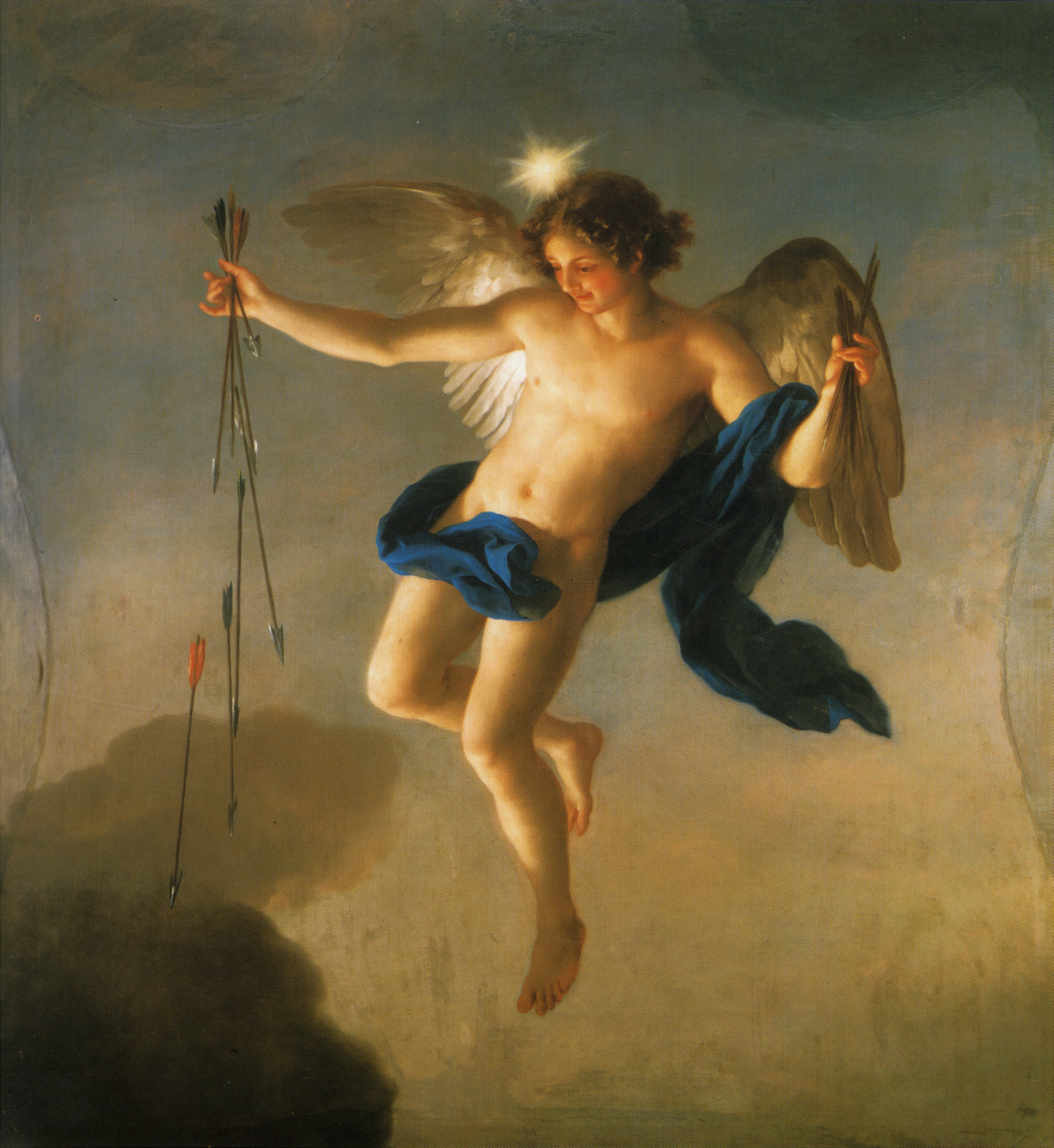
In Greek mythology, Hesperus (; ) is the Evening Star, the planet Venus in the evening. A son of the dawn goddess Eos (Roman Aurora), he is the half-brother of her other son, Phosphorus (also called Eosphorus; the "Morning Star"). Hesperus' Roman equivalent is Vesper (cf. "evening", "supper", "evening star", "west"). By one account, Hesperus' father was Cephalus, a mortal, while Phosphorus' was the star god Astraeus. Other sources, however, state that Hesperus was the brother of Atlas, and thus the son of Iapetus.
Variant names

Hesperus is the personification of the "evening star", the planet Venus in the evening. His name is sometimes conflated with the names for his brother, the personification of the planet as the "morning star" Eosphorus (Greek Ἐωσφόρος, "bearer of dawn") or Phosphorus (Ancient Greek: Φωσφόρος, "bearer of light", often translated as "Lucifer" in Latin), since they are all personifications of the same planet Venus. "Heosphoros" in the Greek Septuagint and "Lucifer" in Jerome's Latin Vulgate were used to translate the Hebrew "Helel" (Venus as the brilliant, bright or shining one), "son of Shahar (Dawn)" in the Hebrew version of Isaiah 14:12.
Eosphorus/Hesperus was said to be the father of Ceyx and Daedalion. In some sources, he is also said to be the father of the Hesperides.
Maurus Servius Honoratus, in his commentaries on Virgil's Eclogues, mentions that Hesperus inhabited Mount Oeta in Thessaly and that there he had loved the young Hymenaeus, son of Dionysus and Ariadne. Servius makes no distinction between the Evening Star and the Morning Star, calling them both Hesperus and the Lucifer of Ida.
"Hesperus is Phosphorus"
Main article: Frege's puzzles
In the philosophy of language, "Hesperus is Phosphorus" is a famous sentence in relation to the semantics of proper names. Gottlob Frege used the terms "the evening star" (der Abendstern) and "the morning star" (der Morgenstern) to illustrate his distinction between sense and reference, and subsequent philosophers changed the example to "Hesperus is Phosphorus" so that it utilized proper names. Saul Kripke used the sentence to posit that the knowledge of something necessary (in this case the identity of Hesperus and Phosphorus) could be empirical rather than knowable a priori.
Notes
References
- Beekes, Robert S. P., Etymological Dictionary of Greek, Leiden, Brill, 2009. . Internet Archive.
- Diodorus Siculus, The Library of History translated by Charles Henry Oldfather. Twelve volumes. Loeb Classical Library. Cambridge, Massachusetts: Harvard University Press; London: William Heinemann, Ltd. 1989. Vol. 3. Books 4.59–8. Online version at Bill Thayer's Web Site
- Diodorus Siculus, Bibliotheca Historica. Vol 1-2. Immanel Bekker. Ludwig Dindorf. Friedrich Vogel. in aedibus B. G. Teubneri. Leipzig. 1888-1890. Greek text available at the Perseus Digital Library.
- Hijmans, Steven E., Sol: Image and Meaning of the Sun in Roman Art and Religion. Volume II, Leiden and Boston, Brill, 2024. .
- Hyginus, Fabulae from The Myths of Hyginus translated and edited by Mary Grant. University of Kansas Publications in Humanistic Studies. Online version at the Topos Text Project.
- Lexicon Iconographicum Mythologiae Classicae (LIMC). III.1: Atherion – Eros, Zurich and Munich, Artemis Verlag, 1986. . Internet Archive.
- Maurus Servius Honoratus, In Vergilii carmina comentarii. Servii Grammatici qui feruntur in Vergilii carmina commentarii; recensuerunt Georgius Thilo et Hermannus Hagen. Georgius Thilo. Leipzig. B. G. Teubner. 1881. Online version at the Perseus Digital Library.
- Publius Ovidius Naso, Metamorphoses translated by Brookes More (1859–1942). Boston, Cornhill Publishing Co. 1922. Online version at the Perseus Digital Library.
- Publius Ovidius Naso, Metamorphoses. Hugo Magnus. Gotha (Germany). Friedr. Andr. Perthes. 1892. Latin text available at the Perseus Digital Library.
References
- [[National Archaeological Museum, Naples]] 9449. On the identification of this figure as Hesperus, see Hijmans, pp. 874–880. For this dating, see ''LIMC'', p. 550, which instead identifies this figure as [[Apollo]].
- Beekes, p. 470.
- ''Collins Latin Dictionary plus Grammar'', p. 231. {{ISBN. 0-06-053690-X.
- Diodorus Siculus, ''Bibliotheca Historica'' 4.27.1.
- [[Gaius Julius Hyginus. Hyginus]], ''Fabulae'', 65
- [[Ovid]]. ''[[Metamorphoses]]''. Book XI, 295.
- Servius. ad Aen. 4,484.
- [http://www.perseus.tufts.edu/hopper/text?doc=Perseus%3Atext%3A2007.01.0091%3Apoem%3D8%3Acommline%3D30 Serv. Ecl. 8.30]
This article was imported from Wikipedia and is available under the Creative Commons Attribution-ShareAlike 4.0 License. Content has been adapted to SurfDoc format. Original contributors can be found on the article history page.
Ask Mako anything about Hesperus — get instant answers, deeper analysis, and related topics.
Research with MakoFree with your Surf account
Create a free account to save articles, ask Mako questions, and organize your research.
Sign up freeThis content may have been generated or modified by AI. CloudSurf Software LLC is not responsible for the accuracy, completeness, or reliability of AI-generated content. Always verify important information from primary sources.
Report