From Surf Wiki (app.surf) — the open knowledge base
Hertha BSC
German association football club

German association football club
| Field | Value |
|---|---|
| clubname | Hertha BSC |
| fullname | Hertha, Berliner Sport-Club e. V. |
| image | Hertha BSC Logo 2012.svg |
| upright | 0.9 |
| nickname | Die Alte Dame (The Old Lady) |
| founded | |
| website | |
| ground | Olympiastadion |
| capacity | 74,475 |
| chrtitle | President |
| chairman | Fabian Drescher |
| owntitle | Limited shareholders |
| owner | 78,8 %: 777 Partners |
| 21,2 %: Hertha BSC e. V. | |
| manager | Stefan Leitl |
| mgrtitle | Head coach |
| league | |
| season | |
| position | |
| current | 2025–26 Hertha BSC season |
| pattern_la1 | _hertha2526h |
| pattern_b1 | _hertha2526h |
| pattern_ra1 | _hertha2526h |
| pattern_sh1 | _hertha2526h |
| leftarm1 | 003060 |
| body1 | 003060 |
| rightarm1 | 003060 |
| shorts1 | 003060 |
| socks1 | 003060 |
| pattern_la2 | _hertha2526a |
| pattern_b2 | _hertha2526a |
| pattern_ra2 | _hertha2526a |
| pattern_sh2 | _hertha2526a2 |
| pattern_so2 | _hertha2526al |
| shorts2 | 0000ff |
| socks2 | 0000ff |
| pattern_la3 | _hertha2526t |
| pattern_b3 | _hertha2526t |
| pattern_ra3 | _hertha2526t |
| pattern_sh3 | _hertha2526t |
| leftarm3 | dbf35e |
| body3 | dbf35e |
| rightarm3 | dbf35e |
| shorts3 | dbf35e |
| socks3 | dbf35e |
21,2 %: Hertha BSC e. V.
Hertha, Berliner Sport-Club e. V., commonly known as Hertha BSC () or Hertha Berlin, is a German professional football club based in Berlin. Hertha BSC plays in the 2. Bundesliga, the second tier of German football, following relegation from the Bundesliga in 2022–23. Hertha BSC was founded in 1892, and was a founding member of the German Football Association in Leipzig in 1900.
The team won the German championship in 1930 and 1931. Since 1963, Hertha's stadium has been the Olympiastadion. The club is known as Die Alte Dame in German, which translates to "The Old Lady". In 2002, the sports activities of the professional, amateur, and under-19 teams were separated into Hertha BSC GmbH & Co. KGaA.
History
Early years
The club was formed in 1892 as BFC Hertha 92, taking its name from a steamship with a blue and white smokestack; one of the four young men who founded the club had taken a day trip on this ship with his father. The name Hertha is a variation on Nerthus, referring to a fertility goddess from Germanic mythology.[[File:Hertha ship 1886 (1).JPG|thumb|right|The ship that gave its name to the club]]
Hertha performed consistently well on the field, including a win in the first Berlin championship final in 1905. In May 1910, Hertha won a friendly match against Southend United, which was considered significant at the time, as England was where the game originated and English clubs dominated the sport. However, their on-field success was not matched financially, and in 1920 the staunchly working-class Hertha merged with the well-heeled club Berliner Sport-Club to form Hertha Berliner Sport-Club. The new team continued to enjoy considerable success in the Oberliga Berlin-Brandenburg. The team played its way to the German championship final in six consecutive seasons from 1926 to 1931, but was only able to win the title in 1930 and 1931, with BSC leaving to become an independent club again after the combined side's first championship. Hertha was the Germany's second most successful team during the inter-war years, after FC Nürnberg.
Play under the Third Reich
German football was re-organized under the Third Reich in 1933 into 16 top-flight divisions, which saw Hertha playing in the Gauliga Berlin-Brandenburg. The club continued to enjoy success within their division, regularly finishing in the upper half of the table and winning the divisional title in 1935, 1937 and 1944. It faded from prominence, however, due to its inability to advance out of the early rounds of the national championship rounds. Politically, the club was overhauled under Hitler, with Hans Pfeifer, a Nazi party member, being installed as president.
Postwar play
Through the 1950s, an intense rivalry developed with Tennis Borussia Berlin. A proposal for a merger between the two clubs in 1958 was rejected, with only three of the 266 members voting in favour.
Being a major Berlin side, Hertha had fans in the entirety of Berlin, but following the division of the city, supporters in East Berlin found it both difficult and dangerous to follow the team. In interviews with long-time supporter Helmut Klopfleisch, he described his difficulties as a supporter in East Berlin. Klopfleisch came from the district of Pankow, and, attending his first home match as a young boy in 1954, he became an instant supporter. He continued to attend home matches at the stadium, but with the construction of the Berlin Wall in 1961, this became impossible. Despite this, he did not give up. By this time, Hertha played at the Stadion am Gesundbrunnen, nicknamed Die Plumpe. The stadium was located close enough to the Berlin wall for the sounds from the stadium to be heard over the wall. Thus, Klopfleisch and other supporters gathered behind the wall to listen to the home matches. When the crowd at the stadium cheered, Klopfleisch and the others cheered as well. Klopfleisch later came under suspicion from the Stasi, the East German secret police. He was arrested and interrogated on numerous occasions. He also had his passport confiscated and eventually lost his job as an electrician.
Entry to the Bundesliga
At the time of the formation of the Bundesliga in 1963, Hertha was Berlin's reigning champion, and so became an inaugural member of the new professional national league. In spite of finishing clear of the relegation zone, the team was demoted after the 1964–65 season following attempts to bribe players to play in the city under what had become decidedly unpleasant circumstances after the erection of the Berlin Wall. This caused something of a crisis for the Bundesliga which wanted, for political reasons, to continue to have a team in its ranks representing the former capital. Through various machinations, this led to the promotion of SC Tasmania 1900 Berlin, which then delivered the worst-ever performance in Bundesliga history. Hertha managed a return to the premier German league in 1968–69 and developed a solid following, making it Berlin's favourite side.
Hertha, however, was again soon touched by scandal through its involvement with several other clubs in the Bundesliga matchfixing scandal of 1971. In the course of an investigation of Hertha's role, it was also revealed that the club was 6 million DM in debt. Financial disaster was averted through the sale of the team's former home ground.
In spite of this, the team continued to enjoy a fair measure of success on the field through the 1970s with a second place Bundesliga finish behind Borussia Mönchengladbach in 1974–75, a semi-final appearance in the 1978–79 UEFA Cup, and two appearances in the final of the DFB-Pokal (1977 and 1979). The following season saw the fortunes of the team take a turn for the worse as it was relegated to the 2. Bundesliga, where it would spend 13 of the next 17 seasons.
Plans in 1982 for a merger with Tennis Borussia Berlin, SpVgg Blau-Weiß 1890 Berlin and SCC Berlin to form a side derisively referred to as "FC Utopia" never came to fruition. Hertha slipped as low as the third tier Amateur Oberliga Berlin, where it spent two seasons (1986–87 and 1987–88). Two turns in the Bundesliga (1982–83 and 1990–91) saw the team immediately relegated after poor performances. Hertha's amateur side enjoyed a greater measure of success, advancing to the final of the DFB-Pokal in 1993, where its run ended in a close 0–1 defeat to Bundesliga club Bayer Leverkusen.
After the fall of the Berlin Wall, Hertha became a popular side in East Berlin as well. Two days after the wall came down, 11,000 East Berliners attended Hertha's match against SG Wattenscheid. A fan friendship with Union Berlin developed, and a friendly match between the two attracted over 50,000 spectators.
Financial woes once more burdened the club in 1994, as it accumulated 10 million DM of debt. The crisis was again resolved through the sale of real estate holdings, in addition to the signing of a new sponsor and management team. By 1997, Hertha had returned to the Bundesliga, where it generally managed to finish in the upper-third of the league table. When Hertha was promoted in 1997, it ended Berlin's six-year-long drought without a Bundesliga side, which had made the Bundesliga the only top league in Europe without representation from its country's biggest city and capital.
A period of oscillation
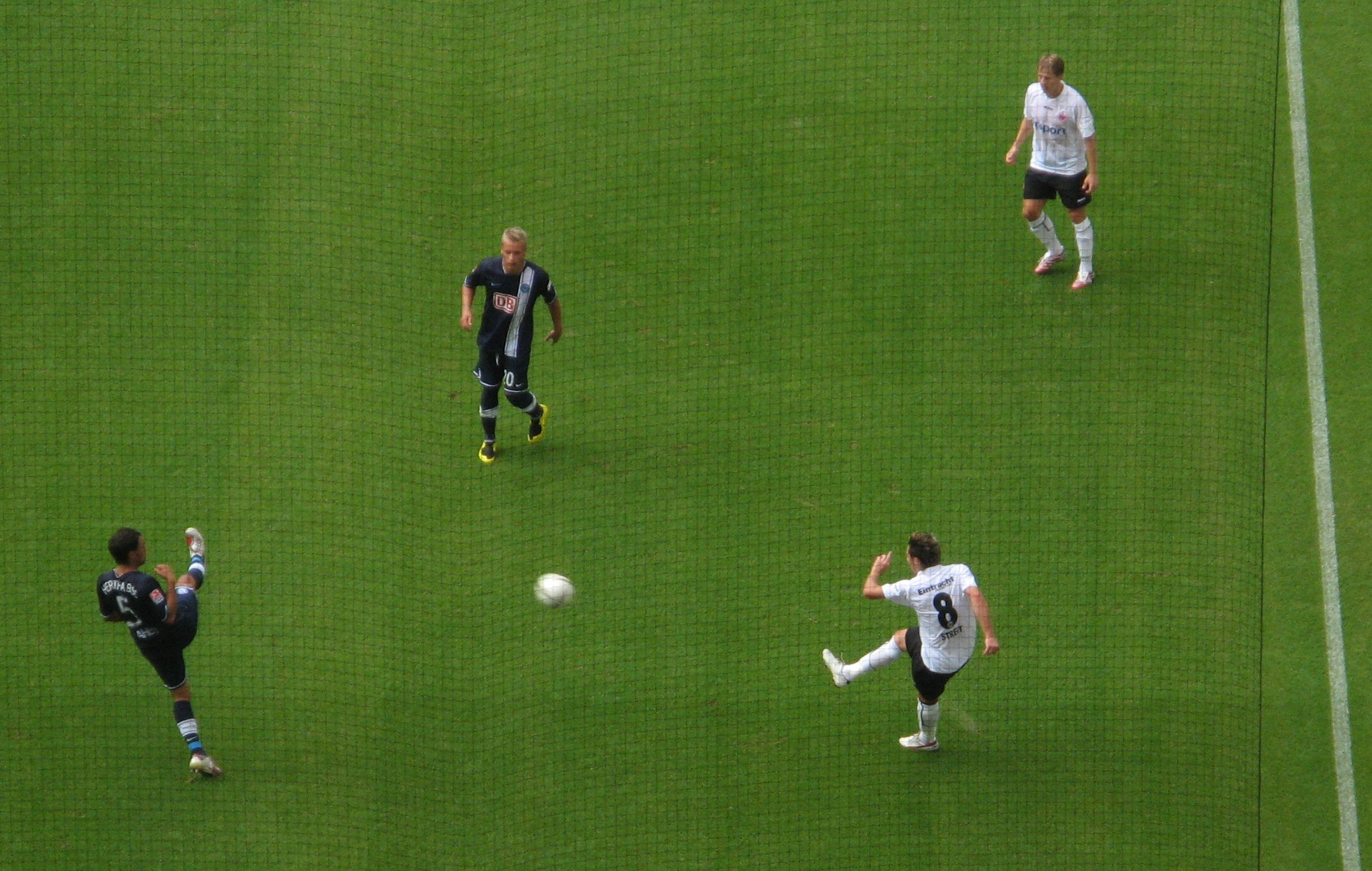
Hertha's return to the Bundesliga began well, with a continuous string of appearances in international play in the UEFA Cup and the UEFA Champions League beginning in the 1999 season, and the signing of key players such as Pál Dárdai in 1997 who became Hertha's most capped player ever, Sebastian Deisler in 1999 and Brazilian international Marcelinho in 2001, who was named the Bundesliga's Player of the Year in 2005. Hertha also invested heavily in its own youth football academy.
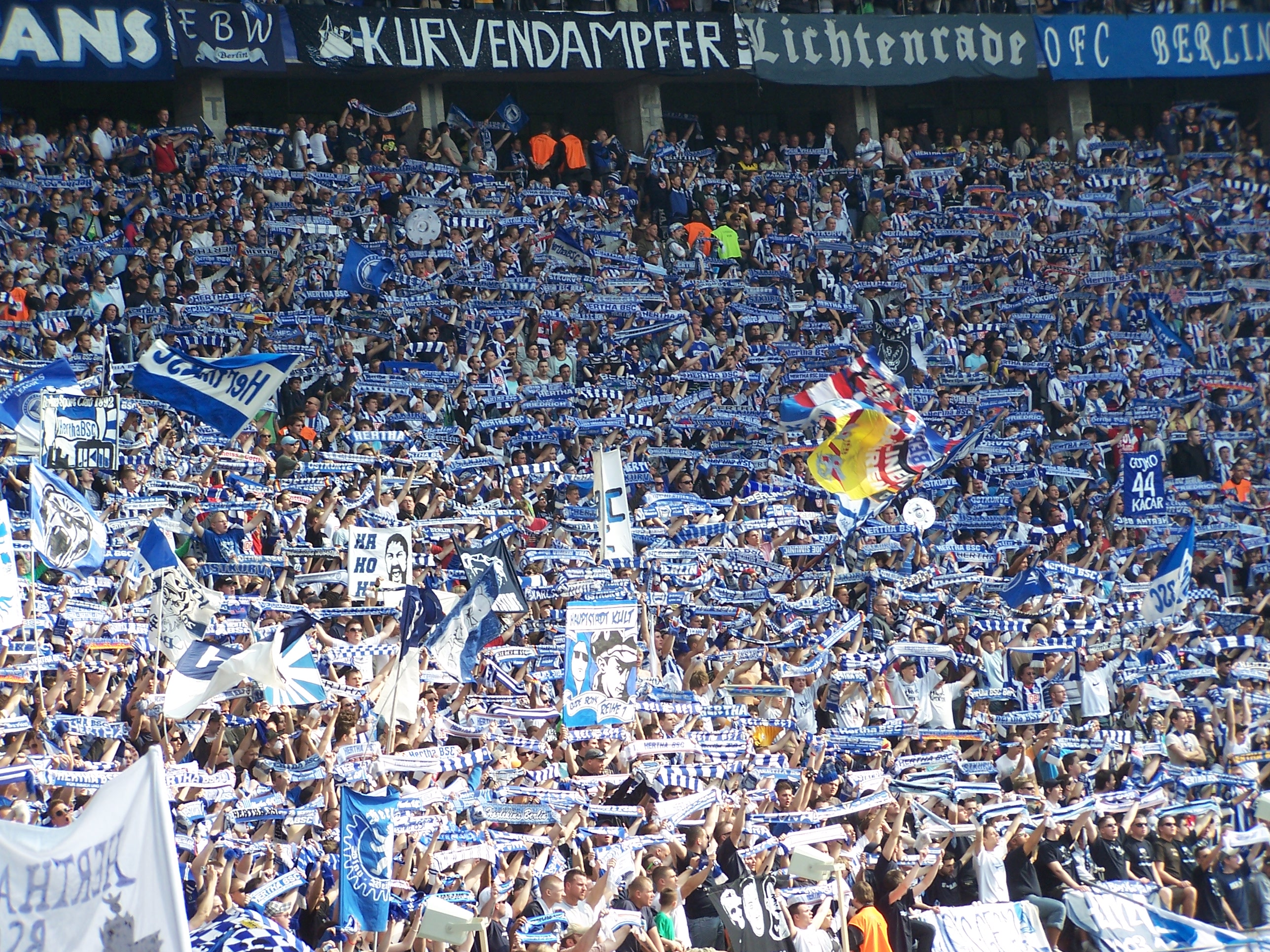
Hertha could not maintain its strong run of form, however, and the club's next few years saw dramatic highs and lows. The team was almost relegated in the 2003–04 season, but rebounded and finished fourth the following season, missing out on the Champions League when Hannover 96 held it to a draw on the final day, a result which led to Werder Bremen overtaking them for the spot on the final league matchday (as a "thank-you" gesture, Werder sent the Hannover squad 96 bottles of champagne). In 2005–06, the Herthaner finished in sixth position, then qualified for the UEFA Cup after defeating FC Moscow in the UEFA Intertoto Cup. However, Hertha was eliminated in the first round of the UEFA Cup by Odense BK. In 2006–07, Hertha finished tenth after sacking manager Falko Götz on 11 April. Hertha started the 2007–08 season with new manager Lucien Favre, who had won the Swiss championship in 2006 and 2007 with Zürich. Hertha finished tenth again, but started in the first qualification round of the UEFA Cup via the UEFA Respect Fair Play ranking, making it as far as the group stage of the tournament. After a successful campaign in 2008–09 season, finishing in fourth place and remaining in the title race up until the second to last matchday, the club had a very poor season in 2009–10 season, finishing last in the Bundesliga and suffering relegation.
After spending the 2010–11 season in the 2. Bundesliga, Hertha secured its return to the Bundesliga for 2011–12 by winning 1–0 at MSV Duisburg with three matchdays to play in the season. Hertha, however, finished 16th in the 2011–12 Bundesliga and lost in the relegation playoff to Fortuna Düsseldorf to fall back to the 2. Bundesliga.
In 2012–13, Hertha achieved promotion from the second division as champions for the second time in three seasons. On the opening day of the 2013–14 season, the club beat Eintracht Frankfurt 6–1 at the Olympiastadion to top the Bundesliga table at the end of matchday 1.
On 5 February 2015 Pál Dárdai, Hertha's longest serving and most capped player ever with 366 appearances took over as the manager of the main squad. At the halfway point of the 2015–16 Bundesliga season, Hertha lay in third place, its highest position at the winter break since 2008–09. Despite a late-season slump, Hertha still finished in seventh place for the season, its highest finish in the Bundesliga since 2008–09 during which Hertha finished fourth. The seventh-place finish meant the club secured Europa League football for the 2016–17 season by the means of a third round play-off. Hertha lost the third round play-off 3–2 on aggregate to Brøndby, winning the first leg 1–0 in Berlin, but losing the second away tie 3–1, with Teemu Pukki scoring a hat-trick for the Danish side.
In the 2016–17 Bundesliga season, Hertha enjoyed its best ever start to a Bundesliga season in terms of points won during the opening eight matches, losing just one match – away against Bayern Munich – and forcing a draw away against Borussia Dortmund. At the 2016–17 Bundesliga winter break, Hertha stood at third place in the league, with nine wins, three draws and four losses. Hertha finished the season in 6th place and qualified for the 2017–18 Europa League. Their place in the group stage was secured on 27 May 2017, after Borussia Dortmund defeated Eintracht Frankfurt in the 2017 DFB–Pokal final.
Lars Windhorst's era
In June 2019, Lars Windhorst bought a €125 million stake in the club. On 27 November 2019, Jürgen Klinsmann became the new manager of Hertha BSC, replacing Ante Čović. Klinsmann left the club on 11 February 2020, after only 76 days in charge. Assistant manager Alexander Nouri took interim charge of the team, before the permanent appointment of Bruno Labbadia on 9 April 2020.
In 2020, Windhorst bought an increased stake in the club, bringing his total investment to almost $500 million. But sporting success did not follow.
On 24 January 2021, Labbadia was sacked as Hertha manager, with the club sitting inside the relegation play off places with his replacement being former manager Pál Dárdai. After nine months in charge and steering the club to safety, Dárdai was terminated as manager and replaced with Tayfun Korkut. Korkut was terminated after just four months in charge with the club sitting 17th on the table in the relegation zone. Korkut was replaced with Felix Magath. Magath managed to steer the club to safety as they won the relegation play-off against Hamburger SV 2–1 on aggregate. After avoiding relegation, Magath was replaced with Sandro Schwarz as manager. Within months of Schwarz's hiring, however, relations between Hertha and Windhorst had deteriorated to the point where Windhorst no longer wanted anything to do with the club. Schwarz was sacked in April 2023 following a 5–2 loss to Schalke 04 that left Hertha at the bottom of the table. Pál Dárdai took over the head coaching job for the third time but he could not prevent Hertha's inevitable relegation , and Hertha were relegated after conceding a 93rd minute equaliser at home to VfL Bochum on Matchday 33.
Stadium

Since 1963, Hertha BSC has played its matches in Berlin's Olympiastadion, originally built for the 1936 Summer Olympics.
The stadium has a permanent capacity of 74,649 seats, making it the largest stadium in Germany in terms of seating capacity and the second largest stadium in Germany, behind the Signal Iduna Park in Dortmund, in terms of total capacity. For certain football matches, such as those against Bayern Munich, the capacity can be temporarily expanded. This is made by the addition of mobile grandstand over the Marathon Arch. The extended capacity reached 76,197 seats in 2014.
The stadium underwent major renovations twice, in 1974 and from 2000 to 2004. In both cases, the renovations were for the upcoming FIFA World Cup. In the 1974 upgrades, the stadium received a partial roof. It underwent a thorough modernization for the 2006 World Cup. In addition, the colour of the track was changed to blue to match Hertha's club colours. In addition to Hertha's home games, Olympiastadion serves as one of the home grounds for the Germany national football team, and it hosts concerts, track and field competitions, and the annual DFB-Pokal final. It was also the site for six matches of the 2006 World Cup, including the tournament final.
Hertha played its matches on a sports field on the "Exer" on Schönhauser Allee in Prenzlauer Berg until 1904. This was the first home ground of Hertha. The Exer was a former parade ground of the 1st (Emperor Alexander) Guards Grenadiers and the site is today occupied by the Friedrich-Ludwig-Jahn-Sportpark. Hertha then moved it matches to the Schebera-Sportplatz in the locality of Gesundbrunnen in 1904. The Stadion am Gesundbrunnen was built in the area in 1923. The stadium would be nicknamed "Die Plumpe" and had a capacity of 35,000, of which 3,600 seated. Hertha left the stadium when it joined the Bundesliga in 1963. Hertha returned to the site during the Regionalliga years from 1965 to 1968. The sale of the site in 1971 helped the club avoid bankruptcy.
Due to a lack of spectator interest, Hertha played its 2. Bundesliga and Amateurliga matches from 1986 to 1989 at the Poststadion. The opening fixtures of the 1992–93 season, as well as the Intertoto Cup and UEFA Cup qualifying matches, were played at the Friedrich-Ludwig-Jahn-Sportpark.
It was confirmed on 23 May 2016 that Hertha will continue to play its home matches at the Olympiastadion until 2025.
New stadium
On 30 March 2017, Hertha announced its intentions to build a new 55,000 seater stadium, to be ready in 2025 when their contract to play at the Olympiastadion runs out. The club noted many factors for this decision, one being that the Berlin side are the only club in the Bundesliga without a dedicated football stadium. In the announcement, the club acknowledged that the Olympiastadion was suitable for major national and international matches, but was too large for the average attendance of a Hertha home game, with only 64% seats being sold; opposed to the Bundesliga average of 92%. On the announcement, the club stated that its preferred option was to construct its own stadium, with a survey identifying a suitable site in Berlin's Olympic Park close to the Olympiastadion. But, at the same time, Berlin's state government indicated a willingness to consider rebuilding the Olympiastadion itself into a football-only venue. However, following the success of the 2018 European Athletics Championships held at the stadium, combined with the potential cost of the conversion, the state government subsequently elected not to proceed, leading Hertha to return to the Olympic Park proposal. However, if that plan was rejected, they also have secondary plans for the stadium to be built in Brandenburg Park, Ludwigsfelde.
Colours and kit
Hertha's club colours are blue and white which come, like its name, from the Hertha steamship. Traditionally, the club wears these colours as stripes, however, since the 1970s, it has employed many different uniforms.
Between the 70s and the 90s, a variety of plain shirts or shirts with large blocks of colour were used, and the team rarely wore its traditional stripes. In 1997, Hertha unveiled a strip with navy blue hoops and shorts, which the team wore for two seasons, abandoning its colours and traditional motif.
The club reintroduced a very traditional kit for the 2000/2001 season, however it continuously flirted with navy uniforms throughout the early 2000s, and navy often appears as part of the home uniform, or as the primary colour of second and third choice strips even today. Since the mid-2000s the club has generally opted for a traditional style of uniform.
The Old Lady also has a historically traditional away kit, being a red and black version of their home.
| {{Football kit box | pattern_la = _whitelower | pattern_b = _thickwhitestripes | pattern_ra = _whitelower | pattern_sh = | pattern_so = _2bluestripes | leftarm = 333399 | body = 333399 | rightarm = 333399 | shorts = 333399 | socks = ffffff | title = Traditional home kit}} | {{Football kit box | pattern_la = _blacklower | pattern_b = _3blackstripes | pattern_ra = _blacklower | pattern_sh = | pattern_so = | leftarm = CC0033 | body = CC0033 | rightarm = CC0033 | shorts = 000000 | socks = 000000 | title = Common away kit}} |
|---|
Crest
File:Hertha Berlin Crest 1892-1923.png|Badge of Hertha Berlin (1892–1923) File:Hertha BSC (Logo 1923-31).png|Badge of Hertha Berlin (1923–1931) File:Logo Hertha 1931 - 1933.gif|Badge of Hertha Berlin (1931–1933) File:Hertha Berlin 1968 - 1974.png|Badge of Hertha Berlin (1968–1974) File:Hertha BSC Logo 2012.svg|Badge of Hertha Berlin (1987–1995, 2012–) File:Hertha Berlin SC.png|Badge of Hertha Berlin (1995–2012)
Players
Current squad
Out on loan
Hertha BSC II
Main article: Hertha BSC II
Player records
| [[File:Michael Preetz.jpg | thumb | 140px | [[Michael Preetz]] is Hertha's top goalscorer in the Bundesliga.]] | [[File:Pál Dárdai - Hertha BSC Berlin (2).jpg | thumb | 290px | [[Pál Dárdai]] is Hertha's most capped player ever.]] |
|---|
- Most Bundesliga/2. Bundesliga appearances – 366; HUN Pál Dárdai
- Most Bundesliga goals scored – 93; GER Michael Preetz
"Squad of the Century"
For the club's 111th birthday, Hertha fans elected the "Squad of the Century".
| Pos | Player | Period | Substitutes |
|---|---|---|---|
| GK | Gábor Király | 1997–04 | |
| DF | Arne Friedrich | 2002–10 | |
| Ludwig Müller | 1972–75 | ||
| Uwe Kliemann | 1974–80 | ||
| Eyjólfur Sverrisson | 1995–03 | ||
| MF | Kjetil Rekdal | 1997–00 | |
| Hanne Sobek | 1924–45 | ||
| Erich Beer | 1971–79 | ||
| Marcelinho | 2001–06 | ||
| FW | Axel Kruse | 1989–91 | |
| 1996–98 | |||
| Michael Preetz | 1996–03 | ||
| GK | Norbert Nigbur | 1976–79 | |
| DF | Hans Weiner | 1972–79 | |
| 1982–86 | |||
| Otto Rehhagel | 1962–66 | ||
| MF | Lorenz Horr | 1969–77 | |
| FW | Karl-Heinz Granitza | 1976–79 |
Current staff
| Position | Name |
|---|---|
| Head coach | GER Stefan Leitl |
| Assistant coach | CRO Andre Mijatović |
| GER Armin Reutershahn | |
| Goalkeeping coach | GER Andreas Menger |
| Fitness coach(es) | |
| GER Henrik Kuchno | |
| GER Henrik Vieth | |
| Sporting director | GER Benjamin Weber |
Coaches
Main article: List of Hertha BSC managers
| No. | Coach | From | To | Matches | W | D | L | Win % | Trophies Won |
|---|---|---|---|---|---|---|---|---|---|
| 1 | Germany Jupp Schneider | 1 July 1963 | 9 March 1965 | None | |||||
| 2 | Germany Gerhard Schulte | 9 March 1965 | 30 June 1966 | 1965–66 Regionalliga Berlin | |||||
| 3 | Germany Helmut Kronsbein | 1 July 1966 | 13 March 1974 | None | |||||
| 4 | Germany Hans "Gustav" Eder | 17 March 1974 | 30 June 1974 | None | |||||
| 5 | Germany Dettmar Cramer | 1 July 1974 | 9 July 1974 | None | |||||
| 6 | Germany Hans "Gustav" Eder | 10 July 1974 | 16 July 1974 | None | |||||
| 7 | Germany Georg Kessler | 17 July 1974 | 30 June 1977 | None | |||||
| 8 | Germany Kuno Klötzer | 1 July 1977 | 27 October 1979 | None | |||||
| 9 | Germany Hans "Gustav" Eder | 28 October 1979 | 26 December 1979 | None | |||||
| 10 | Germany Helmut Kronsbein | 27 December 1979 | 30 June 1980 | None | |||||
| 11 | Germany Uwe Klimaschefski | 1 July 1980 | 8 December 1981 | None | |||||
| 12 | Germany Georg Gawliczek | 9 December 1981 | 10 December 1983 | None | |||||
| 13 | Germany Martin Luppen | 11 December 1983 | 25 May 1984 | None | |||||
| 14 | Germany Hans "Gustav" Eder | 26 May 1984 | 30 June 1984 | None | |||||
| 15 | Germany Uwe Kliemann | 1 July 1984 | 11 November 1985 | None | |||||
| 16 | Germany Hans "Gustav" Eder | 11 November 1985 | 31 December 1985 | None | |||||
| 17 | Germany Rudi Gutendorf | 1 January 1986 | 18 April 1986 | None | |||||
| 18 | Germany Jürgen Sundermann | 19 April 1986 | 8 October 1988 | None | |||||
| 19 | Germany Werner Fuchs | 13 October 1988 | 13 November 1990 | 1989–90 2. Bundesliga | |||||
| 20 | Hungary Pál Csernai | 13 November 1990 | 12 March 1991 | None | |||||
| 21 | Germany Peter Neururer | 13 March 1991 | 28 May 1991 | None | |||||
| 22 | Germany Karsten Heine | 28 May 1991 | 30 June 1991 | None | |||||
| 23 | Germany Bernd Stange | 1 July 1991 | 20 August 1992 | None | |||||
| 24 | Germany Günter Sebert | 21 August 1992 | 20 October 1993 | None | |||||
| 25 | Germany Karsten Heine | 20 October 1993 | 23 October 1993 | None | |||||
| 26 | Germany Uwe Reinders | 24 October 1993 | 23 March 1994 | None | |||||
| 27 | Germany Karsten Heine | 23 March 1994 | 31 December 1995 | None | |||||
| 28 | Germany Jürgen Röber | 1 January 1996 | 6 February 2002 | 2001 DFB-Ligapokal | |||||
| 29 | Germany Falko Götz (interim) | 6 February 2002 | 30 June 2002 | None | |||||
| 30 | Netherlands Huub Stevens | 1 July 2002 | 4 December 2003 | 2002 DFB-Ligapokal | |||||
| 31 | Germany Andreas Thom (interim) | 4 December 2003 | 17 December 2003 | None | |||||
| 32 | Germany Hans Meyer | 1 January 2004 | 30 June 2004 | None | |||||
| 33 | Germany Falko Götz | 1 July 2004 | 10 April 2007 | None | |||||
| 34 | Germany Karsten Heine (interim) | 10 April 2007 | 30 June 2007 | None | |||||
| 35 | Switzerland Lucien Favre | 1 July 2007 | 28 September 2009 | None | |||||
| 36 | Germany Karsten Heine (interim) | 29 September 2009 | 3 October 2009 | None | |||||
| 37 | Germany Friedhelm Funkel | 3 October 2009 | 30 June 2010 | None | |||||
| 38 | Germany Markus Babbel | 1 July 2010 | 18 December 2011 | 2010–11 2. Bundesliga | |||||
| 39 | Germany Rainer Widmayer (interim) | 18 December 2011 | 21 December 2011 | None | |||||
| 40 | Germany Michael Skibbe | 22 December 2011 | 12 February 2012 | None | |||||
| 41 | Germany René Tretschok (interim) | 14 February 2012 | 19 February 2012 | None | |||||
| 42 | Germany Otto Rehhagel | 19 February 2012 | 30 June 2012 | None | |||||
| 43 | Netherlands Jos Luhukay | 1 July 2012 | 5 February 2015 | 2012–13 2. Bundesliga | |||||
| 44 | Hungary Pál Dárdai | 5 February 2015 | 30 June 2019 | None | |||||
| 45 | Croatia Ante Čović | 1 July 2019 | 27 November 2019 | None | |||||
| 46 | Germany Jürgen Klinsmann | 27 November 2019 | 11 February 2020 | None | |||||
| 47 | Germany Alexander Nouri (interim) | 12 February 2020 | 8 April 2020 | None | |||||
| 48 | Germany Bruno Labbadia | 9 April 2020 | 24 January 2021 | None | |||||
| 49 | Hungary Pál Dárdai | 25 January 2021 | 29 November 2021 | None | |||||
| 50 | Turkey Tayfun Korkut | 29 November 2021 | 13 March 2022 | None | |||||
| 51 | Germany Felix Magath | 13 March 2022 | 23 May 2022 | None | |||||
| 52 | Germany Sandro Schwarz | 19 June 2022 | 16 April 2023 | None | |||||
| 53 | Hungary Pál Dárdai | 16 April 2023 | 30 June 2024 | None | |||||
| 54 | Germany Cristian Fiél | 1 July 2024 | 17 February 2025 | None | |||||
| 55 | Germany Stefan Leitl | 18 February 2025 | present | None |
Honours
Domestic
- German Champions:
- 2. Bundesliga:
- DFB-Ligapokal:
- DFB-Pokal:
Note 1: Reserve Team
International
- UEFA Cup:
- Semi-finals: 1978–79
Tournaments
- Nova Supersports Cup:
- Runners-up: 1999
Regional
- Berlin/Brandenburg Champions (−1933):
- Winners (12): 1906, 1915, 1917, 1918, 1925, 1926, 1927, 1928, 1929, 1930, 1931, 1933
- Runners-up: 1914, 1916
- Gauliga Berlin-Brandenburg:
- Winners: 1935, 1937, 1944
- Runners-up: 1934, 1938, 1939, 1941
- Oberliga Berlin (1945–63):
- Regionalliga Berlin: (II)
- Winners: 1966, 1967, 1968
- Amateur-Oberliga Berlin: (III)
- Winners: 1949, 1987, 1988
- Runners-up: 1954
- Berlin Cup: (Tiers III–VII)
- Winners (13): 1920, 1924, 1928, 1929, 1943, 1958, 1959, 1966, 1967, 1976, 1987, 1992, 2004
- Runners-up: 2006
Youth
- German Under 19 Championship
- Winners: 2018
- Runners-up: 2022
- German Under 17 Championship
- Winners: 2000, 2003, 2005, 2012
- Runners-up: 1991, 2013
- Under 19 Bundesliga North/Northeast
- Winners: 2005, 2006, 2018, 2022, 2023
- Runners-up: 2003, 2004, 2012, 2017
- Under 17 Bundesliga North/Northeast
- Winners: 2008, 2010, 2012, 2013, 2020, 2022
- Runners-up: 2011, 2014, 2018, 2019
- Under 19 DFB-Pokal (de)
- Winners: 2004, 2015
- Runners-up: 2010, 2012, 2016
- Under 17 NOFV-Pokal (de)
- Winners: (4) 2001, 2008, 2012, 2014
Statistics
Main article: List of Hertha BSC records and statistics
In European football
Main article: Hertha BSC in European football
:Accurate as of 10 December 2017
| Competition | Pld | W | D | L | GF | GA | GD | Win % |
|---|
Women's football
Missing out on a trend of promoting women's football, Hertha became one of a decreasing number of major German football clubs left outside the top of women's football. Several steps had been taken to develop women's football, but most of them ended up inconclusive. The change came in 2009, when the club announced that it was to launch a cooperation in women's football with 1. FC Lübars, a football club from the Berlin borough Reinickendorf and with decades of history in women's football.
From one side, the partnership meant that Hertha was to provide Lübars with various forms of support, including financial support, expertise in licensing and sponsor acquisition, equipment and training instruction – investing approximately 1 million Euros in the project. From the other side, the partnership meant that Lübars was to compete in the colours of Hertha, thus earning the nickname Die Hertha-Frauen ('The Hertha-women'). In the long run, the club plans for the team of 1. FC Lübars to be integrated with Hertha BSC. 1. FC Lübars now competes in the 2. Bundesliga of women's football.
References
References
- (1 July 2007). "Satzung des Hertha, Berliner Sport-Club (Hertha B.S.C.) e.V.". Hertha BSC.
- (7 February 2016). "The Bundesliga Dictionary". [[Deutsche Fußball Liga]].
- . (n.d.). ["Stadion"](http://olympiastadion.berlin/en/stadion-2/). *Olympiastadion Berlin GmbH*.
- "Presidential Board – Hertha BSC". Hertha BSC.
- "777 Partners becomes new strategic partner of Hertha BSC". Hertha BSC.
- "Hertha BSC: News des Clubs im Überblick". [[Deutsche Fußball Liga]].
- "Hertha Berlin – Profile". [[Deutsche Fußball Liga]].
- "Hertha BSC – Impressum". Hertha BSC.
- "Hertha: Vereinsgeschichte, 1892–1963". Hertha BSC official website.
- Hesse-Lictenberger, Ulrich (2003), ''Tor! The Story of German Football'', WSG Books Ltd. {{ISBN. 978-0-9540134-5-5
- HA HO HE Hertha BSC; München: Copress-Verlag, 1971
- (25 October 2013). "Blau-weisse liebe hinter der Mauer". Deutsche Fußball Liga GmbH.
- Kuper, Simon. (7 November 2009). "Still injury time for a fan on the wrong side of Berlin's wall". The Financial Times Ltd.
- Ehrmann, Johannes. (30 September 2010). "Der Fan hinter der Mauer". Verlag Der Tagesspiegel GmbH.
- (3 October 2013). "Helmut Klopfleisch – ein Fan der Einheit". Hertha BSC GmbH & Co. KGaA.
- Joyce, Paul. (January 2012). "Border control". When Saturday Comes Limited.
- "1963–1965: Hertha startet in die Bundesliga". Hertha BSC official website.
- (September 2010). ["1968–1979: Rückkehr ins Fußballoberhaus, Bundesligaskandal und erfolgreiche 70er"](http://www.hertha.de/index.php?id=1316}} {{Dead link). Hertha BSC official website.
- "1980–1989: Berg- und Talfahrt". Hertha BSC official website.
- "1989–1994: Hertha überwindet die "Mauer" zur 1. Liga und steigt sofort wieder ab". Hertha BSC official website.
- (September 2010). ["1994–1997: Weichenstellung mit neuen Partnern"](http://www.hertha.de/index.php?id=1319}} {{Dead link). Hertha BSC official website.
- "Bundesliga – Table – 2018-2019".
- (14 May 2016). "Auf Umwegen nach Europa! – Profis – HerthaBSC.de".
- Braune, Marcel. (4 August 2016). "Dreierpack! Pukki vermöbelt Hertha". Bild GmbH & Co. KG.
- (22 October 2016). "Dardai bejubelt trotz "Chaos" den Startrekord". Berliner Morgenpost GmbH.
- . (27 May 2017). ["Hertha BSC sicher in der Gruppenphase"](http://www.herthabsc.de/de/profis/europa-league-hertha-bsc/page/13062--10276-10276-.html). *Hertha BSC GmbH & Co. KGaA*.
- "Hertha Berlin – The Windhorst Deal Analyzed".
- (13 November 2019). "Hertha Berlin investor Lars Windhorst increases stake to 49.9%".
- (27 November 2019). "Official: Jürgen Klinsmann is the new coach of Hertha Berlin".
- (11 February 2020). "Jürgen Klinsmann resigns as Hertha Berlin manager after 76 days in charge".
- "Investor betting almost $500M on 'big city club' Hertha". [[The Washington Post]].
- "Hertha Berlin dismiss head coach Bruno Labbadia".
- "Tayfun Korkut Leaves Hertha Berlin 'After An In-Depth Analysis'".
- "Hertha Berlin overcome Hamburg to avoid Bundesliga relegation".
- (6 October 2022). "Hertha Berlin investor Lars Windhorst wants his money back".
- (16 April 2023). "Pál Dárdai übernimmt für Sandro Schwarz". herthabsc.com.
- (20 May 2023). "Hertha Berlin relegated after heartbreaking late Bochum leveller". bundesliga.com.
- "Facts and Figures: Olympiastadion Berlin". Olympiastadion-berlin.de.
- (20 March 2014). "76.197 Zuschauer gegen Bayern München". herthabsc.de.
- (24 March 2014). "Berliner Olympiastadion erhält 405 zusätzliche Sitze". Berliner Morgenpost.
- "Hertha bleibt bis 2025 im Olympiastadion".
- (30 March 2017). "Hertha's Fussballstadion".
- "We are Hertha!". Hertha BSC.
- "Hertha BSC profis". Hertha BSC.
- Jahn, Michael. (2006). "Nur nach Hause geh'n wir nicht". Verlag Die Werkstatt.
- (18 February 2025). "Hertha BSC". herthabsc.com.
- Bremer, Uwe. (17 May 2012). "Hertha setzt jetzt auf den 'kleinen Diktator' Luhukay". [[Die Welt]].
- (17 May 2012). "Hertha Berlin and Augsburg announce new coaches". [[Deutsche Welle]].
- (January 23, 2003). "Supersport Tournament (Athinai) 1999-2001". Rec.Sport.Soccer Statistics Foundation.
- "Hertha heiratet". Der Tagesspiegel Online.
- Rosentritt, Michael. (5 February 2009). "Kooperation im Fußball: Hertha wird endlich weiblich". Die Zeit.
- (27 February 2009). "Hertha zahlt 1 Mio Euro für neues Frauen-Team".
This article was imported from Wikipedia and is available under the Creative Commons Attribution-ShareAlike 4.0 License. Content has been adapted to SurfDoc format. Original contributors can be found on the article history page.
Ask Mako anything about Hertha BSC — get instant answers, deeper analysis, and related topics.
Research with MakoFree with your Surf account
Create a free account to save articles, ask Mako questions, and organize your research.
Sign up freeThis content may have been generated or modified by AI. CloudSurf Software LLC is not responsible for the accuracy, completeness, or reliability of AI-generated content. Always verify important information from primary sources.
Report