From Surf Wiki (app.surf) — the open knowledge base
Herringbone (cloth)
Fabric woven in a herringbone twill weave
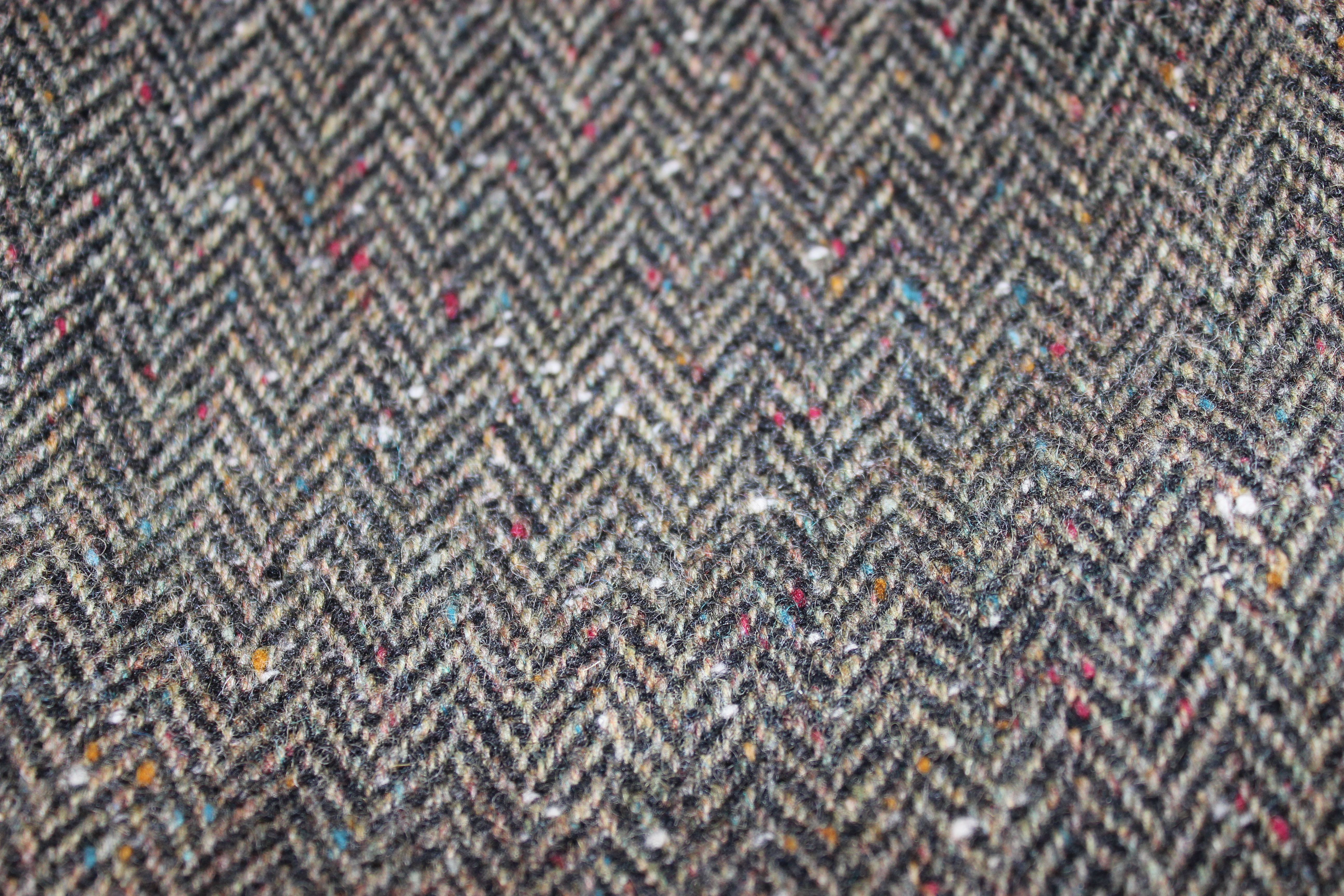
Fabric woven in a herringbone twill weave


Herringbone, also called broken twill weave, describes a distinctive V-shaped weaving pattern usually found in twill fabric. It is distinguished from a plain chevron by the break at reversal, which makes it resemble a broken zigzag. The pattern is called herringbone because it resembles the skeleton of a herring fish.{{cite web | access-date = 2008-11-24 |archive-url=https://web.archive.org/web/20111005182104/http://style.polo.com/glossary/default.asp?letter=H |archive-date=2011-10-05 |url-status=dead}} Herringbone-patterned fabric is usually wool, and is one of the most popular cloths used for suits and outerwear.{{Cite web | author-link = Fashion Institute of Technology | access-date = 2008-11-24 |archive-url=https://web.archive.org/web/20130605113404/http://www3.fitnyc.edu/museum/TailorsArt/MenswearFabricsGlossary.htm |archive-date=2013-06-05 |url-status=dead}} Tweed cloth is often woven with a herringbone pattern.
Fatigue uniforms made from cotton in this weave were used by several militaries during and after World War II; in US use, they were often called HBTs.
History
Various herringbone weaves have been found in antiquity:
- A pair of woolen leggings found in the permafrost of the Italian-Austrian Alps have a 2:2 herringbone weave, dating to 800 to 500 BC.
- A dark blue cloth with a 2:2 herringbone weave was found at Murabba'at Cave in Israel, from the Roman period.
- A textile with a 2:2 herringbone weave was found at Pompeii, from 79 AD.
- An illustration of a cloth having a herringbone weave from Antinoöpolis in Greece from 130 AD.
- The Falkirk Tartan, a wool 2:2 herringbone tartan from around 240 AD.
- Similar fabric fragments found at Vindolanda, south of Hadrian's Wall in England.
References
References
- Calasibetta, Charlotte Mankey. (1988). "Fairchild's dictionary of fashion". Fairchild Publications.
- (1992). "U.S. Army Uniforms of the Korean War". Stackpole Books.
- (2009-08-19). "Storming Normandy in a World War II Jeep". Hearst Magazine Media, Inc..
- Fulbright, Diana. (2010). "Proceedings of the International Workshop on the Scientific Approach to the Acheiropoietos Images". [[ENEA (Italy).
- Shamir, Orit. (2015). "A burial textile from the first century CE in Jerusalem compared to roman textiles in the land of Israel and the Turin Shroud". EDP Sciences.
- Tyrer, John. (December 1981). "Looking at the Turin Shroud as a Textile".
- Bailey, Geoff P.. (2019). "A History of Falkirk in 10 ½ Objects". Falkirk Local History Society.
- "Tartan Details - Falkirk".
This article was imported from Wikipedia and is available under the Creative Commons Attribution-ShareAlike 4.0 License. Content has been adapted to SurfDoc format. Original contributors can be found on the article history page.
Ask Mako anything about Herringbone (cloth) — get instant answers, deeper analysis, and related topics.
Research with MakoFree with your Surf account
Create a free account to save articles, ask Mako questions, and organize your research.
Sign up freeThis content may have been generated or modified by AI. CloudSurf Software LLC is not responsible for the accuracy, completeness, or reliability of AI-generated content. Always verify important information from primary sources.
Report