From Surf Wiki (app.surf) — the open knowledge base
Hercules in ancient Rome
none

none
In ancient Roman religion and myth, Hercules was venerated as a divinized hero and incorporated into the legends of Rome's founding. The Romans adapted Greek myths and the iconography of Heracles into their own literature and art, but the hero developed distinctly Roman characteristics. Some Greek sources as early as the 6th and 5th century BC gave Heracles Roman connections during his famous labors.
Dionysius of Halicarnassus places Hercules among divine figures honored at Rome "whose souls after they had left their mortal bodies are said to have ascended to Heaven and to have obtained the same honors as the gods". His apotheosis thus served as one model during the Empire for the concept of the deified emperor.
Temples and topography

The cult of Hercules reached Rome as early as the 6th century BC, celebrated at a temple next to the shrine of Carmenta and the Carmental Gate. By the 5th century BC, the mythological tradition was well established that Hercules had visited Rome during his tenth labor, when he stole the cattle of Geryon in the far west and drove them through Italy. Several Augustan writers offer narratives of the hero's time in Rome to explain the presence of the Ara Maxima dedicated to Hercules in the Forum Boarium, the cattle market named after Geryon's stolen herd.

The Temple of Hercules Victor, which still stands, is atypically round, as was the first Temple of Hercules Musarum near the Circus Flaminius. The latter displayed fasti attributed to its founder Marcus Fulvius Nobilior, which Rüpke places among the earliest Latin antiquarian literature. The poet Ennius may have influenced or contributed to their composition. Fulvius Nobilior had attracted harsh criticism for enriching himself excessively with booty plundered from Greek temples during his military campaigns. When he became censor, he erected a portico around an earlier temple of Hercules, most likely that of Hercules Magnus Custos ("Hercules the Great Guardian") in the Campus Martius. He then transferred a statue group of the Muses from his private collection to dedicate at the temple, which later housed the Roman poets' guild (collegium poetarum).
Several place names in Italy were connected to Hercules' adventures. Vitulia as a name for the Italian peninsula supposedly came into usage because Hercules chased a runaway bullock (vitulus) there.
The altar of Jupiter Praestes at Tibur was also alleged to have been established by Hercules himself.
Cult titles
- Hercules Augustus or Hercules Augusti, Hercules "in his capacity as protector of the ruling emperor."
- Hercules Invictus ("the Unconquered"), at the Ara Maxima; women were excluded from this cult. Also Hercules Victor ("the Victorious").
- Hercules Magnus ("the Great"), honored with games (ludi) that may have been first officially established by Sulla.
- Hercules Musarum ("the Muses' Hercules", Greek Herakles Musagetes), created when Fulvius Nobilior dedicated statues of the Muses to a temple of Hercules.
- Hercules Olivarius ("the Olive Merchant"), in reference to a statue of Hercules dedicated by the guild of olive merchants.
- Hercules Salarius, ("of Salt"), worshipped at Alba Fucens
- Hercules Triumphalis ("Triumphal"), represented by a statue in the Forum Boarium, was dressed in the regalia of a triumphator when a triumph was held. It is mentioned by Pliny, who attributes it to the legendary Evander.
Festivals and rituals
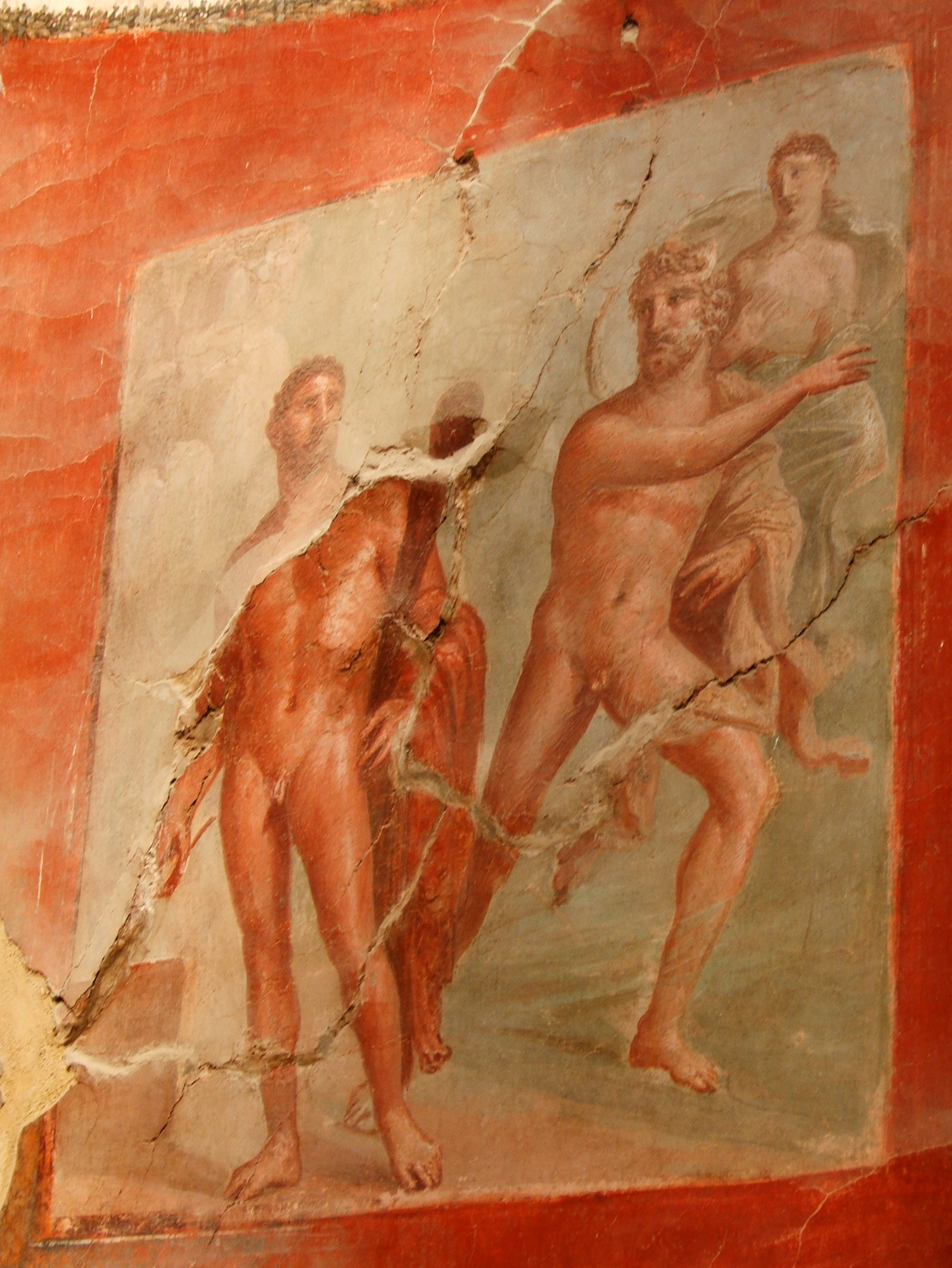
Normally only those celebrating the rites took part in the communal meal that followed a sacrifice, but at the Ara Maxima, all male citizens were invited. None of the meat that resulted from the sacrifice could be allowed to remain at the end of the day, nor could it be removed from the precinct, so it all had to be eaten. Women were excluded from this rite. Macrobius explains:
When Hercules with Geryon's cattle was journeying over the fields of Italy, a woman, in reply to his request for water to quench his thirst, said that she was not allowed to give him any because it was the feast of the Women's Goddess and no man was permitted to taste of anything that concerned it. Hercules therefore, when he intended to institute a sacrifice, solemnly forbade women to be admitted, ordering Potitius and Pinarius who were in charge of the rites not to allow any woman to be present.
The "women's goddess" (dea feminarum) is usually taken as the Bona Dea. This relationship, however, should perhaps be thought of as complementary as well as adversarial; Hercules, Bona Dea, and Silvanus were honored jointly with a shrine and an altar in Regio XIII at Rome. The "Good Goddess" is identifiable with several goddesses, and in this instance her enmity with Hercules recalls that of Juno. She also shared some characteristics with Ceres, with whom Hercules was honored jointly on December 21, with the sacrifice of a pregnant sow, loaves of bread, and mulsum, sweet wine.
Hercules was among the divinities honored at the first lectisternium held at Rome in 399 BC.
In Stoicism
Heracles or Hercules was a figure especially favored by the Stoics, who attempted to incorporate traditional polytheism into their philosophy. In Stoicism, not only was the primitive substance God, the one supreme being, but divinity could be ascribed to the manifestations—to the heavenly bodies, to the forces of nature, even to deified persons.
Cornutus saw his Twelve Labours as metaphors for human struggles, seeing the Erymanthian boar, the Nemean lion and the Cretan bull as symbols of passion, the Cerynean deer as cowardice, the cleaning of the Augean stables as purification from extravagance, the driving away of the Stymphalian birds as banishing empty hopes, the kill of the Lernaean Hydra as the rejection of endless pleasures, and the chaining of Cerberus as the philosophy being brought from the darkness.
Genealogy and patronage

Several Roman clans (gentes) lay claim to descent from various divine figures. The Fabii traced their genealogy to a daughter of Evander who lay with Hercules in his "dug-out" (fovea) and conceived the first Fabius.
The cult of Hercules at the Ara Maxima was in the keeping of the gens Potitia and the gens Pinaria until 312 BC, when maintenance was transferred to the state and thereafter administered by public slaves.
References
Bibliography
- Eppinger, Alexandra (2015). Hercules in der Spätantike. Die Rolle des Heros im Spannungsfeld von Heidentum und Christentum [Hercules in Late Antiquity. The role of the hero in the conflict between paganism and Christianity]. Philippika, vol. 89. Wiesbaden: Harrassowitz, .
- Ogden, Daniel (ed.) (2021). The Oxford Handbook of Heracles. Oxford: Oxford University Press.
References
- [[T.P. Wiseman]], ''Remus: A Roman Myth'' (Cambridge University Press, 1995), pp. 39, 41.
- Dionysius of Halicarnassus, 7.72.13-14, describing the images of deities displayed in the ceremonial procession at Rome known as the ''[[pompa circensis]]'', as cited by [[Jörg Rüpke]], ''Religion in Republican Rome: Rationalization and Ritual Change'' (University of Pennsylvania Press, 2012, p. 41.)
- Peter Herz, "Emperors: Caring for the Empire and Their Successors," in ''A Companion to Roman Religion'' (Blackwell, 2007), p. 315.
- Wiseman, ''Remus'', pp. 41–42.
- Wiseman, ''Remus'', p. 39, citing [[Hellanicus of Lesbos]].
- Including [[Livy]], [[Vergil]], [[Propertius]] and [[Ovid]]; Wiseman, ''Remus'', p. 39.
- Wiseman, ''Remus'', p. 40.
- Michael Lipka, ''Roman Gods: A Conceptual Approach'' (Brill, 2009), p. 91.
- Rüpke, ''Religion in Republican Rome,'' pp. 152–153.
- Rüpke, ''Religion in Republican Rome,'' pp. 153–154.
- Rüpke, ''Religion in Republican Rome,'' p. 154.
- Wiseman, ''Remus'', p. 39, citing [[Hellanicus of Lesbos]].
- Wiseman, ''Remus'', p. 41.
- Lipka, ''Roman Gods,'' p. 74.
- Lipka, ''Roman Gods,'' p. 184.
- Rüpke, ''Religion in Republican Rome'', p. 36.
- Lipka, ''Roman Gods,'' p. 45.
- Rüpke, ''Religion in Republican Rome,'' p. 154.
- Celia E. Schultz, ''Women's Religious Activity in the Roman Republic'' (University of North Carolina Press, 2006), p. 63.
- Marzano, Annalisa. (2009). "Hercules and the triumphal feast for the Roman people". Oxford: John and Erica Hedges Ltd..
- Pliny, ''Natural History'' 34.33, as cited by Lawrence Richardson, ''A New Topographical Dictionary of Ancient Rome'' (Johns Hopkins University Press, 1992), p. 188.
- [[John Scheid]], "Sacrifices for Gods and Ancestors," in ''A Companion to Roman Religion,'' p. 268.
- Macrobius, ''Saturnalia'' [https://penelope.uchicago.edu/Thayer/L/Roman/Texts/Macrobius/Saturnalia/1*.html#12.28 I.12.28 (in Latin).] [[Propertius]] tells the story at poetic length (4.9.21–70).
- Hendrik H.J. Brouwer, ''Bona Dea: The Sources and a Description of the Cult'' (Brill, 1989), p. 24.
- Brouwer, ''Bona Dea'', pp. 244, 352.
- Lipka, ''Roman Gods,'' p. 76.
- {{cite EB1911. Hicks. Robert Drew
- Zeller, Eduard. (1892). "The Stoics: Epicureans and Sceptics". Longmans, Green, and Company.
- Wiseman, ''Remus'', p. 41.
- Lipka, ''Roman Gods,'' p. 169.
- Rüpke, ''Religion in Republican Rome,'' p. 107.
This article was imported from Wikipedia and is available under the Creative Commons Attribution-ShareAlike 4.0 License. Content has been adapted to SurfDoc format. Original contributors can be found on the article history page.
Ask Mako anything about Hercules in ancient Rome — get instant answers, deeper analysis, and related topics.
Research with MakoFree with your Surf account
Create a free account to save articles, ask Mako questions, and organize your research.
Sign up freeThis content may have been generated or modified by AI. CloudSurf Software LLC is not responsible for the accuracy, completeness, or reliability of AI-generated content. Always verify important information from primary sources.
Report