From Surf Wiki (app.surf) — the open knowledge base
Hera
Goddess from Greek mythology, wife and sister of Zeus

Goddess from Greek mythology, wife and sister of Zeus
| Field | Value |
|---|---|
| type | Greek |
| cult_center | Argos, Mycenae, Samos |
| name | Hera |
| image | Hera Campana Louvre Ma2283.jpg |
| caption | The Campana Hera, a Roman copy of a Hellenistic original, from the Louvre |
| god_of | |
| member_of | the Twelve Olympians |
| abode | Mount Olympus |
| symbol | Pomegranate, sceptre, crown (polos or diadem) |
| animals | Cow, cuckoo, peacock |
| parents | Cronus and Rhea |
| siblings | Poseidon, Hades, Demeter, Hestia, Zeus |
| children | Angelos, Arge, Ares, the Charites, Eileithyia, Eleutheria, Hebe, Hephaestus |
| Roman_equivalent | Juno |
| spouse | Zeus |
In ancient Greek religion, Hera (; ; in Ionic and Homeric Greek) is the goddess of marriage, women, and family, and the protector of women during childbirth. In Greek mythology, she is queen of the twelve Olympians and Mount Olympus, sister and wife of Zeus, and daughter of the Titans Cronus and Rhea. One of her defining characteristics in myth is her jealous and vengeful nature in dealing with any who offended her, especially Zeus's numerous adulterous lovers and illegitimate offspring.
Her iconography usually presents her as a dignified, matronly figure, upright or enthroned, crowned with a polos or diadem, sometimes veiled as a married woman. She is the patron goddess of lawful marriage. She presides over weddings, blesses and legalises marital unions, and protects women from harm during childbirth. Her sacred animals include the cow, cuckoo, and peacock. She is sometimes shown holding a pomegranate as an emblem of immortality. Her Roman counterpart is Juno.
Etymology
The name Hera (Hēra or Hērē) has several possible and mutually exclusive etymologies. One possibility is to connect it with Greek ὥρα (hōra, season) or, according to Plato, with ἐρατή (eratē, "beloved"); another one is to interpret it as "ripe for marriage". as Zeus is said to have married her for love. According to Plutarch, Hera was an allegorical name and an anagram of aēr (ἀήρ, "air"). So begins the section on Hera in Walter Burkert's Greek Religion. In a note, he records other scholars' arguments "for the meaning Mistress as a feminine to Heros, Master", with uncertain origin. John Chadwick, a decipherer of Linear B, remarks "her name may be connected with hērōs (ἥρως, 'hero'), but that is no help since it too is etymologically obscure." A. J. van Windekens proposes the meaning "young cow, heifer", which is consonant with Hera's common epithet βοῶπις (boōpis, "cow-eyed"). Robert S. P. Beekes has suggested a Pre-Greek origin. Her name is attested in Mycenaean Greek, written in Linear B syllabary as {{script|Linb|𐀁𐀨}} e-ra, appearing on tablets found in Pylos and Thebes; it is attested also in the Cypriotic dialect, in the dative form e-ra-i.
The Proto-Indo-European root might have meant either 'the female who is attached/coupled' or 'the female who attaches herself' (as in both socially and physically or emotionally).
Many theophoric names, such as Heracles, Heraclitus, Herodotus and Herodicus, derive from Hera.
Epithets
Hera bore several epithets in the mythological tradition and in literature. In the historical times the majority of the Greeks recognized Hera as the consort of Zeus. Hera is the protector of marriage and of the rights of the married women. In some cults she has some functions of the earth goddess. She is occasionally related to warfare as tutelary goddess.
Goddess of marriage and bride
- Γαμήλιος (Gamēlios), 'presiding over marriage'. A sacrifice to Hera ensured a happy married life.
- Γαμηστόλος (Gamēstόlos), 'leading the troop of marriage'.
- Νυμφευομένη (Nympheuomenē), 'led as a bride' at Plataea, in relation to her festival Daedala.
- Νυμφη (Nymphē), 'bride'.
- Παρθένος (Parthénos) 'Virgin'
- Παρθενία (Parthenia),
- Παῖς (Pais) 'Child' (in her role as virgin) at Stymphalus.
- Συζύγιος (Syzygios) 'patroness of marriage'
- Τελεία (Teleia) 'bringing the fulfillement of marriage'.
- Ζυγία (Zygia), 'yoke of marriage'. Her husband Zeus had also the epithet Zygius (Ζυγίος).
- Χήρα (Chḗrα) 'Widowed' at Stymphalus.
Consort of Zeus
- Ανασσα (** Anassa**), 'Queen' .
- Ἀμμωνία (Ammonìa), at Elis related to Zeus-Ammon
- Βασίλεια (Basíleia) 'Queen' at Ialysus in Rhodes
- Βασιλίς (Basilis) 'Queen' at Libadia and Argos.
- Διώνη (Diōnē) as the consort of Zeus at Dodona.
- Ηνιόχη (Hēniochē), at Libadia . She was worshipped together with "Zeus-Basileus".
- Ολυμπία (Olympia), with an altar near the altar of Olympian Zeus.
- Σκηπτούχος (Skēptouchos),'bearing a sceptre' (Queen).
Founder and protector
- Αρχηγέτις (Archēgetis), 'founder', leader of the settlement at Samos.
- Ἀκραῖα (Akraìa) '(She) of the Heights (Akropolis)'
- Βουναία (Bounaia) '(She) of the Mound' (in Corinth)
- Ὑπερχειρία (Hypercheiria), 'the goddess who holds her protecting hand over a thing'. Hera was worshipped under this surname at a sanctuary in Sparta, which was built following an oracle's command after the Eurotas River flooded the land.
As an earth and fertility goddess
- Ἄνθεια (Antheia), meaning flowery at Argos and Miletos.
- Βοῶπις (Boṓpis) 'Cow-Eyed'. probably a form of the earth-goddess.
- Γή (Ge), 'Earth' by Plutarch in a passage of Eusebius.
- Ευεργεσία (Euergesia), 'doing a good service'
- Ζευξιδία (Ζeuxidia),'yoking the oxen' at Argos.
- Πάμφοιτος (Pamfοιtos) 'repeatedly coming'. (Pamfoitos Anassa)
- Φερέσβιος (Pheresbios) 'life giving'. by Empedocles (Plutarch) .
- Ωρόλυτος (Hōrolytos) at Samos as the controller of the seasons and times of the year (Horae)
As goddess of the hymns
- Εὑκέλαδος (Εukelados), 'well sounding, melodious'.
- Προσυμναία (Prosymnaia), 'goddess of the hymn' at Argos.
Place of worship
- Ἀργείη (Argeìē) '(She) of Argos'. Hera was probably the goddess of the palace.
- 'Ιμβραση (Imbrasē) after the river Imbrasus at Samos.
- Κανδαρηνή (Kandarēnē) at the city Kandara of Asia-Minor.
- Κιθαιρωνία (Κithairōnia) 'of the mountain Kithairon' in Boeotia, in relation with her fest Daedala.
- Λιμανία (Limanìa) ' of the harbour' at Perachora near the Isthmus of Corinth.
- Πελασγίς (Pelasgis) at Iolcus. A sacrifice was performed to Hera by Pelias.
- Σαμία (Samia), with a famous temple at Samos.
- Φαρυγαία (Pharygaia) at the city Pharygae of Locris.
Warlike character
- Ἀλέξανδρος (Alexandros) 'Protector of Men' (among the Sicyonians). Her cult was founded by Adrastus.
- Οπλοσμία (Oplosmia) 'bearing arms or shield' at Elis
- Προδρομία (Prodromia), 'running forward' at Sikyon.
- Τροπαία (Tropaia), 'giver of victory'
Local cults
- Αἰγοφάγος (Aigophágos) 'Goat-Eater' among the Lacedaemonians
- Εἰλείθυια (Eileithyia) at Argos and Athens as goddess of childbirth. In Theogony Εileithyia is the daughter of Hera.
- Ἐλεία (Eleía) 'of the marsh' at Cyprus.
- Θελξινία (Thelxinìa) at Athens.
- Θεομήτωρ (Theomētōr) 'mother of a god' at Samos.
- Ἱππία (Hippia), 'of the horse' at Olympia.
- Λακίνια (Lacinia) at Croton.
- Λευκώλενος (Leukōlenos) 'White-Armed'
- Μειλίχιος (Meilichios), 'gentle', like "Zeus-Meilichios" at Selinus.
- Μηλιχία (Μēlichia) 'gentle, with gentle words' at Hierapetna.
- Τελχινία (Telchinia): Diodorus Siculus write that she was worshipped by the Ialysians and the Cameirans (both were on the island of Rhodes). She was named thus because according to a legend, Telchines (Τελχῖνες) were the first inhabitants of the island and also the first who created statues of gods.
- Ὑπερχειρία (Ηypercheiria), 'with the hand above' at Sparta.
Origins
In historical times, the majority of the Greeks recognized Hera as the consort of Zeus. Her ancient connection with her sacred animal, the cow, still existed in historical times. She is probably related to Near-Eastern forms of cow-goddesses such as Hathor or Bat. The Greek earth-goddess Gaia is occasionally identified with Hera. Gaia may be related to the Vedic earth-goddess Prithvi, who was also associated with the cow and is the consort of Dyaus.
Mycenean Greece
An inscription in Linear B on a tablet found at Pylos mentions offerings "to Zeus-Hera-Drimios"; Drimios is the son of Zeus. Hera was the tutelary goddess of Argos and it is possible that she had Mycenean origin. which describes her not as Greek, but as an Argive goddess. She is the protectress of the citadel. In literature Argos is called "dōma Hēras" (the house of Hera) and the Argives are called her people by Pindar. Walter Burkert notices that it is difficult to confirm that the epithet "bowpis" corresponds to a Greek belief. However it is possible that Hera was conceived as a cow in her archaic cults.
Consort of Zeus
Hera exists as a spouse of Zeus and their "sacred marriage" was celebrated in many Greek festivals in a processional ceremony from ancient times. It is possible that the myth has its origins to an old custom of the European country population, the premarital intercourse of the engaged couple. According to Walter Burkert the "Mediterranean goddess of nature" becomes the bride of the Greek sky-god. He notices that "the disappearance and retrieval of Hera has parallels with other fertility cults" . Hera was originally a goddess of fertility in her fest "Toneia" at Samos and at Knossos in Crete. At Samos the image of Hera was hidden bounted in willows and the participants tried to discover it. At Knossos Zeus is mating with the earth goddess (finally named Hera) in a very ancient ritual.
Near-Eastern origin
In Crete the bull was associated with religious practices. In the legend of the Minotaur the Queen of Knossos is hidden inside an artificial hollow cow and she is mating with a bull-form god in a sacred ceremony. The hieros gamos indicates a ritual of fertility magic, which was probably introduced from Near East in the Aegean region. The "hieros gamos" of Zeus with the earth goddess (finally named Hera) was celebrated at Knossos in Crete. The combination feminine divinity-cow-moon is not unusual in Crete and Near East. The relationship of Hera with the cow still existed in the historical times and this probably relates her to Near-Eastern forms of cow-goddesses like Hathor (or Bat). The Egyptian sky-goddess Hathor is the consort of the sky-god Horus.
Indo-european origin
In the Vedic tradition the earth-goddess Prithvi is the consort of the sky-god Dyaus and she is associated with the cow. Prithvi may be identified with the Greek goddess Gaia. It seems that Io the priestess of Hera at Argos and consort of Zeus, was another form of Hera. In a Greek myth "Io" is transformed into a cow . This seems to be correlated to how Homer in Iliad uses the formula "boōpis potnia Hērē)" (cow-eyed, mistress Hera), suggesting that they may have been syncretized.
Cult
_Pompeian_Art.jpg)
The worship of Hera was sparse in Thessaly, Attica, Phocis and Achaea. In Boeotia she is related to the fest Daedala. The main center of her cult was North-Eastern Peloponnese, especially Argolis. ( Argos, Tiryns, Corinth, Sicyon, Epidaurus and Hermione). She was worshipped at the Arcadian cities Mantineia, Megalopolis, Stymphalus and at Sparta. The oldest temple at Olympia belonged to Hera. In the islands she was worshipped at Samos, Paros, Delos, Amorgos, Thera, Kos, Rhodes and Crete. The island Euboea was considered her holy place. A month was named after Hera at Delphi (Heraios), Olous, Laconia, Tinos (Heraiōn), Pergamos (Heraos). Hera is the Olympia, Queen, Anassa, the Queen of heaven. The royal quality of her was preserved by the monuments of Greek art.
Hera may have been the first deity to whom the Greeks dedicated an enclosed roofed temple sanctuary, at Samos about 800 BCE. It was replaced later by the Heraion of Samos, one of the largest of all Greek temples (altars were in front of the temples under the open sky). There were many temples built on this site, so the evidence is somewhat confusing, and archaeological dates are uncertain.
The temple created by the Rhoecus sculptors and architects was destroyed between 570 and 560 BCE. This was replaced by the Polycratean temple of 540–530 BCE. In one of these temples, we see a forest of 155 columns. There is also no evidence of tiles on this temple suggesting either the temple was never finished or that the temple was open to the sky.
Earlier sanctuaries, whose dedication to Hera is less certain, were of the Mycenaean type called "house sanctuaries". Samos excavations have revealed votive offerings, many of them late 8th and 7th centuries BCE, which show that Hera at Samos was not merely a local Greek goddess of the Aegean. The museum there contains figures of gods and suppliants and other votive offerings from Armenia, Babylon, Iran, Assyria, and Egypt, testimony to the reputation which this sanctuary of Hera enjoyed, and the large influx of pilgrims. Compared to this mighty goddess, who also possessed the earliest temple at Olympia and two of the great fifth and sixth-century temples of Paestum, the termagant of Homer and the myths is an "almost... comic figure," according to Burkert.
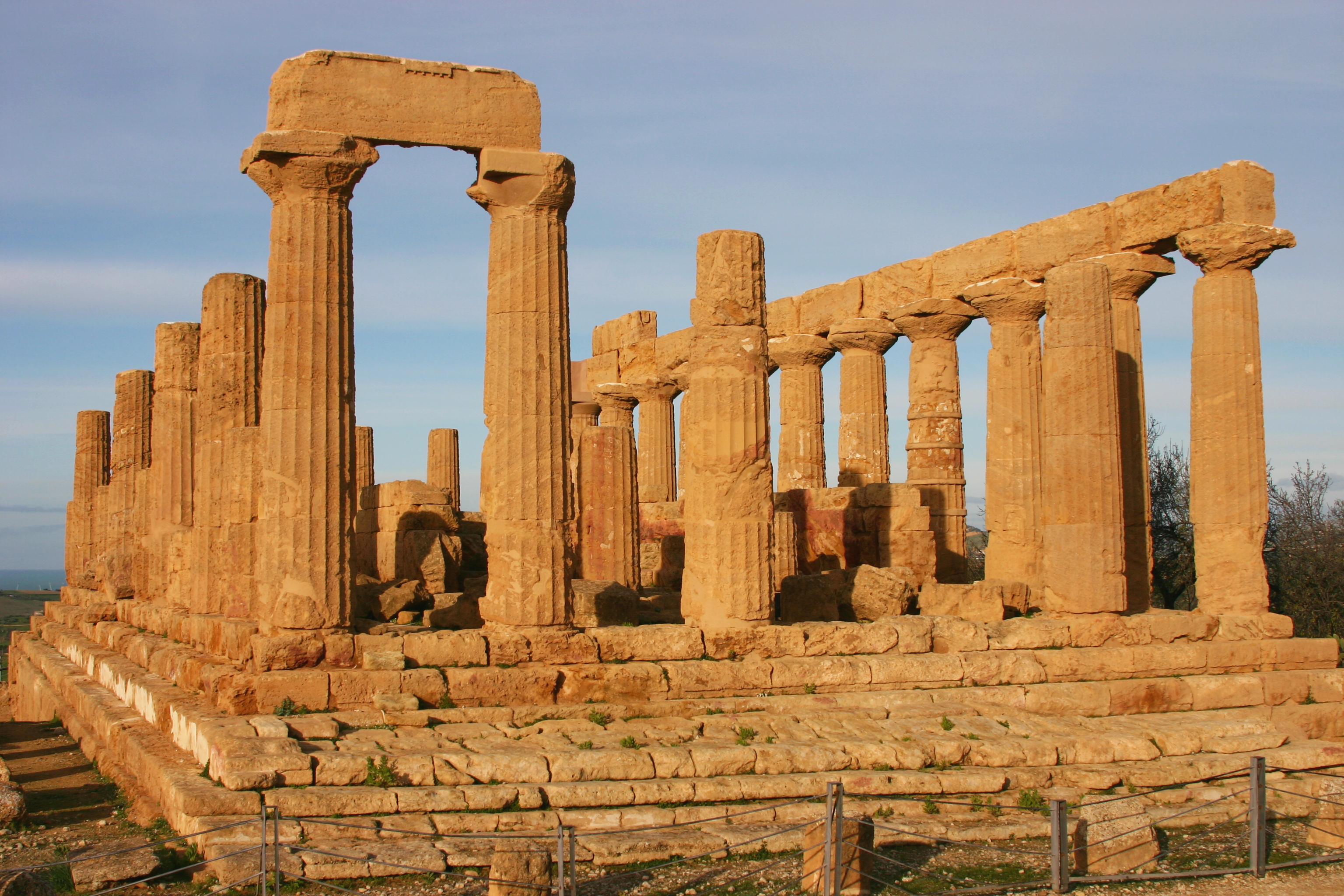
Though the greatest and earliest free-standing temple to Hera was the Heraion of Samos, in the Greek mainland Hera was especially worshipped as "Argive Hera" (Hera Argeia) at her sanctuary that stood between the former Mycenaean city-states of Argos and Mycenae, where the festivals in her honor called Heraia were celebrated. "The three cities I love best," she declares in the Iliad, book iv, "are Argos, Sparta and Mycenae of the broad streets." There were also temples to Hera in Olympia, Corinth, Tiryns, Perachora and the sacred island of Delos. In Magna Graecia, two Doric temples to Hera were constructed at Paestum, about 550 BCE and about 450 BCE. One of them, long called the Temple of Poseidon was identified in the 1950s as a temple of Hera.
The Daedala fire festival on Cithaeron near Plataea, included an account of Hera's quarrel with Zeus and their reconciliation.
Hera's importance in the early archaic period is attested by the large building projects undertaken in her honor. The temples of Hera in the two main centers of her cult, the Heraion of Samos and the Heraion of Argos in the Argolis, were the very earliest monumental Greek temples constructed, in the 8th century BCE.
During the Hellenistic period (), Greek culture spread outside Greece across the Eastern Mediterranean region as a result of the conquests of Alexander the Great. The Hellenistic religion was often syncretic, and the Greek gods were identified with local deities as different aspects or names of the same divinity. Hera was identified with various local mother deities. As an example, the work On the Syrian Goddess suggests a cult worshipped a goddess that was simultaneously the Syrian goddess Atargatis and Hera. This even extended to early Christianity some; the Legend of Aphroditian identifies Hera with the Virgin Mary, perhaps due to one of Hera's abilities being her miraculous restoration of her own virginity.
Importance
According to Walter Burkert, both Hera and Demeter have many characteristic attributes of Pre-Greek Great Goddesses.
In the same vein, British scholar Charles Francis Keary suggests that Hera had some sort of "Earth Goddess" worship in ancient times,Renehan, Robert. HERA AS EARTH-GODDESS: A NEW PIECE OF EVIDENCE. In: Rheinisches Museum für Philologie Neue Folge, 117. Bd., H. 3/4 (1974), pp. 193-201. https://www.jstor.org/stable/41244783 connected to her possible origin as a Pelasgian goddess (as mentioned by Herodotus). In Greece the Mediterranean goddess of nature is the bride of the Greek sky-god . In her fest Daedala Hera is related to the nymph Plataia (consort of Zeus), an old forgotten form of the Greek earth-goddess. Plataia may be related to Gaia who is occasionally identified with Hera.
According to Homeric Hymn II to Delian Apollo, Hera detained Eileithyia to prevent Leto from going into labor with Artemis and Apollo, since the father was Zeus. The other goddesses present at the birthing on Delos sent Iris to bring her. As she stepped upon the island, the divine birth began. In the myth of the birth of Heracles, it is Hera herself who sits at the door, delaying the birth of Heracles until her protégé, Eurystheus, had been born first.
The Homeric Hymn to Pythian Apollo makes the monster Typhaon the offspring of archaic Hera in her ancient form, produced out of herself, like a monstrous version of Hephaestus, and whelped in a cave in Cilicia. She gave the creature to Python to raise.
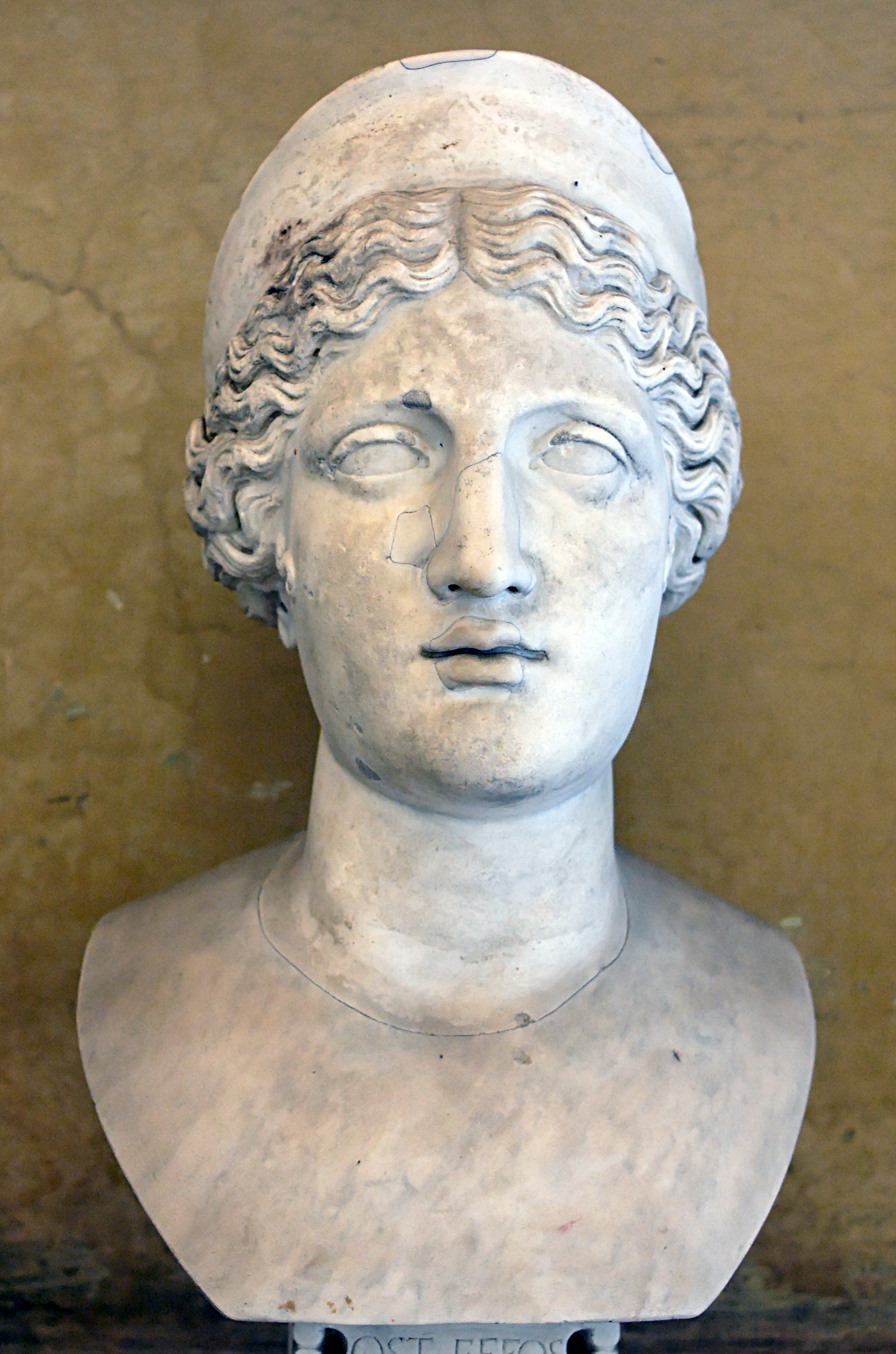
In the Temple of Hera, Olympia, Hera's seated cult figure was older than the warrior figure of Zeus that accompanied it. Homer expressed her relationship with Zeus delicately in the Iliad, in which she declares to Zeus, "I am Cronus' eldest daughter, and am honourable not on this ground only, but also because I am your wife, and you are king of the gods."
Matriarchy
There has been considerable scholarship, reaching back to Johann Jakob Bachofen in the mid-nineteenth century, about the possibility that Hera, whose early importance in Greek religion is firmly established, was originally the goddess of a matriarchal people, presumably inhabiting Greece before the Hellenes. In this view, her activity as goddess of marriage established the patriarchal bond of her own subordination: her resistance to the conquests of Zeus is rendered as Hera's "jealousy", the main theme of literary anecdotes that undercut her ancient cult.
However, it remains a controversial claim that an ancient matriarchy or a cultural focus on a monotheistic Great Goddess existed among the ancient Greeks or elsewhere. The claim is generally rejected by modern scholars as insufficiently evidenced.See, for example, the following:
- Cynthia Eller, The Myth of Matriarchal Prehistory: Why an Invented Past Won't Give Women a Future, (Boston: Beacon Press, 2001);
- Encyclopædia Britannica describes this view as "consensus", listing matriarchy as a hypothetical social system. 'Matriarchy' Encyclopædia Britannica, 2007. Walter Burkert notices that the ancient Kourotrophos figure is almost absent in Crete, and the nomination Mother Goddess was not the underlying principle in the Minoan religion.
Youth
Hera was most known as the matron goddess, Hera Teleia, but she presided over weddings as well. In myth and cult, fragmentary references and archaic practices remain of the sacred marriage of Hera and Zeus. At Plataea, there was a sculpture of Hera seated as a bride by Callimachus, as well as the matronly standing Hera.
Hera was also worshipped as a virgin: there was a tradition in Stymphalia in Arcadia that there had been a triple shrine to Hera the Girl (Παις [Pais]), the Adult Woman (Τελεια [Teleia]), and the Separated (Χήρη [Chḗrē] 'Widowed' or 'Divorced'). In the region around Argos, the temple of Hera in Hermione near Argos was to Hera the Virgin. At the spring of Kanathos, close to Nauplia, Hera renewed her virginity annually, in rites that were not to be spoken of (arrheton). In her fire-festival Daedala at Plataia the puppet of the goddess was bathed in the river Asopos before the wedding ceremony. In the festival "Toneia" at Samos the image of the goddess was purified, bounted in willows and then probably hanged on a tree. Robert Graves interprets this as a representation of the new moon (Hebe), full moon (Hera), and old moon (Hecate), respectively personifying the Virgin (Spring), the Mother (Summer), and the destroying Crone (Autumn).
Festivals
The marriage of Zeus with Hera is the main theme in most Greek festivals celebrated in honour of the goddess. In the cults of Hera the dances and rites are performed by young married women. These choral dances reenacted early myth and ritual. Burkert notices that "the disappearing and retrieval of Hera in some cults has parallels with other fertility cults". Ancient accounts refer to the retirement of Hera after a quarrel with Zeus. Hera's wrath may indicate the wrath and jealousy of the Greek wife. Other accounts refer to cultic trees or pillars. and rituals of the goddess of vegetation.
- Argos. During Hera's famous fest "Hecatombaia"(one hundred oxen) -or Argive "Heraia"-the priestess of Hera was carried on a chart drawn by white-heifers to the sanctuary. The festival included an armed procession of male citizens and the prize of the contest was a bronze shield. The Argive festival was a new year festival and the new male citizens introduced themselves in the community. It is not verified that the festival was originally a wedding processional ceremony. At Argos Hera controlled the seasonal goddesses Horae.
- Plataia in Boeotia. The festival Daedala of Hera was a fire festival. The citizens of Plataia maintained from prehistoric times the processional wedding ceremony. A puppet named Hera was married with Zeus. The puppet was washed in the river Asopos and it was carried on a cow-drawn chart to the top of Kithairon. There the puppet was burned together with other idols. Pausanias in the aetiological myth mentions the retirement of Hera after a quarrel with Zeus and their reconciliation. The nymph Plataia, consort of Zeus is an old form of the Greek earth-goddess and she may be related to Gaia.
- Samos.The name of the island was "Parthenia" in the Carian period. In the Samian festival "Toneia", Hera was originally a goddess of fertility. The festival included initiation rites of girls and probably boys from youth to maturity. At the beginning of the festival a xoanon of Hera was carried on a plank to the sea and then back to the coast. This custom reminds the cult of the Hittite-Hurrian god of fertility Telepinu. In the aetiological myth of Menedotus the image of Hera was bathed, bounted in willows and finally hidden (or hanged). The participants tried to find it. Zeus was absent, and the processional wedding ceremony was introduced later.
- Corinth. Hera-Acraea was the protectress of the castle. The Corinthian "Heraia" was a mourning festival. Hera is related to Medea (the wife of Jason) a foreign goddess who was introduced in Greece. In the myth of the Argonauts Hera is the protectress of Jason. The scholiast of Euripides suggests that the cult of Acraea is related to the cult of Adonis. Every year seven boys and seven girls with shorn hair and wearing black garments were dedicated to the goddess. Annual sacrifices were performed for the killed children of Medea .
- Stymphalus in Arcadia. Hera was worshipped as goddess of marriage. Three festivals celebrated the three phases of Hera as "pais" (virgin), "teleia" (fulfilled) and "chera" (widowed). "Pais" may symbolize the arrival of the goddess in spring and "chera" her departure in winter. In the aetiological myth of Pausanias Hera retired after a quarrel with Zeus and then she came back. During her retirement people considered that she was divorced and she was worshipped as "chera".
- Euboea. The island was the holy place of Hera and the goddess was worshipped near Elymnion or on the mountain Dirfi. Coins from Eretria verify that the citizens imitated the wedding of Zeus with Hera.
- Athens. The "sacred marriage" of Zeus with Hera was celebrated in Athens during the month "Gamelion" (late winter).
- Hermione in Argolis. Hera was worshipped as "parthenos" (virgin). In a Greek myth Zeus was transformed into a cuckoo to seduce Hera. There were two temples, one of Zeus on the mountain-Cuckoo and one of Hera on the mountain Pron.
- ** Olympia**. In the festival Heraia young girls competed in a footrace. The race was held every four years and only virgin women were allowed to attend the games. The prize was an olive wreath. Traditionally the custom was established by Hipodameia and choral dances were performed in honour of her. A marriage-ceremony was probably part of the festival. The choral dances and the dressing of "parthenoi" indicate that the festival was an initiation ritual from youth to maturity. The relation of Hera with "parthenoi" (virgins) seems to connect her with the goddess of vegetation.
- '''Aegina''''. Traditionally the festival was introduced from Argos. The image of Hera was carried on a chart drawn by white heifers. The festival included games and sacrifices. There was a contest between young boys for killing a female goat with their spears and they got her as a prize. In the aetiological myth Hera retired to the woods after a quarrel with Zeus and her place was discovered by a female goat. Then she was obliged to return.
- Nauplia in Argolis. Like the bride who took her bride-bath, Hera bathed every year in the spring Kanathos and recovered annually her virginity. This is one of the holy secrets (aporrheta) at the mysteries which they celebrated in honour of Hera.
- Knossos in Crete. The "hieros gamos" of Zeus with the earth goddess (finally named Hera) was celebrated near the river Theren. The ritual continued unchanged from very ancient times. The original name of the Minoan goddess could be Britomartis, Diktynna or "Hellopis". On a Minoan depiction the goddess seems to arrive on a chariot during spring and she disappears in winter.
Emblems

In Hellenistic imagery, Hera's chariot was pulled by peacocks, birds not known to Greeks before the conquests of Alexander. Alexander's tutor, Aristotle, refers to it as "the Persian bird." The peacock motif was revived in the Renaissance iconography that unified Hera and Juno. A bird that had been associated with Hera on an archaic level, when most of the Aegean goddesses were associated with "their" bird, was the cuckoo, which appears in mythic fragments concerning the first wooing of a virginal Hera by Zeus.
Her archaic association was primarily with cattle, as a Cow Goddess, who was especially venerated in "cattle-rich" Euboea. On Cyprus, very early archaeological sites contain bull skulls that have been adapted for use as masks (see Bull (mythology)). Her familiar Homeric epithet Boôpis, is always translated "cow-eyed". In this respect, Hera bears some resemblance to the Ancient Egyptian deity Hathor, a maternal goddess associated with cattle. Hera absorbed the cult of her heifer-priestess Io and may be related to the Vedic earth-goddess Prithvi.
Scholar of Greek mythology Walter Burkert writes in Greek Religion, "Nevertheless, there are memories of an earlier aniconic representation, as a pillar in Argos and as a plank in Samos." At Argos in a Greek myth the priestess of Hera Phoronis ties her mistress to an aniconic pillar. At Samos Hera's plank was tied on a willow tree to ensure fertility.
Temples of Hera
.svg)

- Perachora, Corinth. One from the earliest Greek temples was the temple dedicated to Hera Akraia at Perachora, built in the 9th century BC. The dimensions of the plan were 5,50x8,00m. A teracotta house-temple model indicates that it was an upsidal building with one room. The walls were made fom small stones and dried bricks. Τhere were two pairs of (probably wooden) columns, and the high-peaked roof was covered with straws.
- Olympia. The Heraion was built in late 7th century BC (620 BC) . It was a Doric style peripteral temple measured 18,75x50,01m at the stylobate. The number of the originally wooden pteron columns was 6x16 (hexastyle). Τhe wooden columns were later replaced with columns from limestone. The temple had pronaos, cella, and the oldest known opisthodomos. The porches were distyle in antis. A colossal head of a woman, is probably a part of a statue dedicated to Hera. It was made from limestone.
- Corfu. The Archaic temple of Hera was built in 610BC. Large terracotta figures such as lions and gorgoneions decorated the roof of the temple. The temple was completely destroyed by fire in the 5th century BC.
- Samos. The older Heraion was built in 560 BC. It was a dipteral temple with Ionic order features. It measured 50,50x103,00 m at the stylobate and the number of pteron columns was 10x21. The temple formed a unit with the monumental altar of Hera to the east, which shared its alignment and axis. It was constructed partly of limestone and partly of marble. Herodotus calls Rhoecus of Samos its first architect. It was the first of the massive Ionic temples.
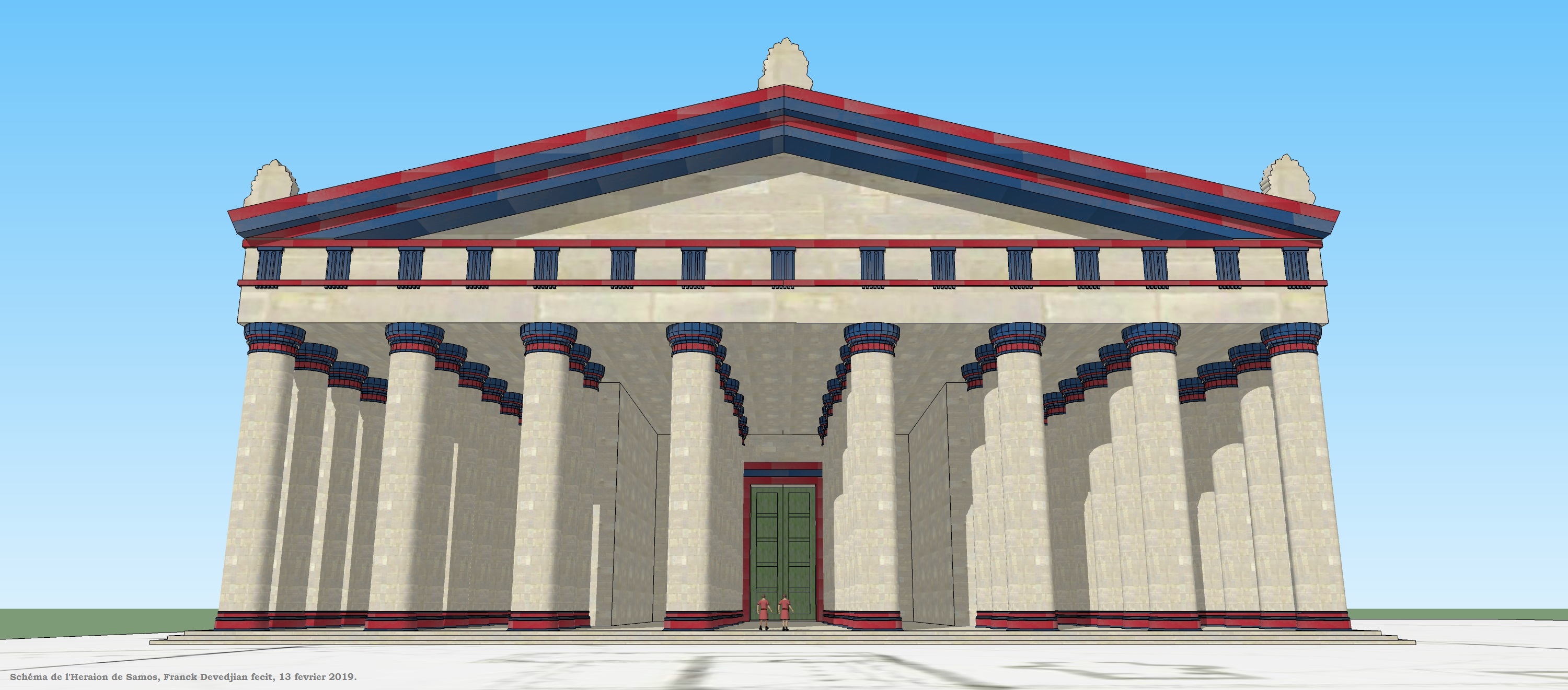
- Samos. The new Heraion was built in 525 BC and it is called the "Polycrates temple". The temple measured 54,58x111,50m at the stylobate. It was dipteral on the flanks and tripteral at the ends. The outer row had 8x24 columns except that at the back there were nine columns. The forms of the capitals resembled the ones at Ephesus, but the volutes were wider.
- Selinus. The Doric temple E (temble of Hera) was built in 490 BC. It measured 25.32x67.82m at the stylobate and the number of pteron columns was 6x15. The porches were distyle in antis

- Paestum. The first temple of Hera, the so-called "Basilica", was built in the early 6th century BC. It was an extraordinary building with a central row of inner columns. The Doric style temple measured 24,52x54,30m at the stylobate, and the number of pteron columns was 9x18. There were three columns in antis in its porch.
- Paestum. A Doric temple dedicated to Hera (the so-called temple of Poseidon) was built in the first half of the 5th century BC and is usually placed later than Parthenon. The temple measured 24,3X60,00 m at the stylobate. It was an hexastyle structure and the number of pteron columns was 6X14. The temple was also used to worship Zeus and another deity, whose identity is unknown.

- Agrigento. The temple of Hera (Juno Lacinia)was a Doric style peripteral building, built in 450 BC. It measured 16,90X38,15m at the stylobate and the cella measured 9.45x28,00m. The number of pteron columns was 6X13.
- Argos. The predecessor of the Heraion was built in late 7th century BC and has left little traces. The long stoa of the Heraion is dated from the late 7th to 6th century B.C.E.
- Argos. The new Heraion was built in c.410BC after the burning of its predecessor in 423BC. It measured 17,40x38,00m at the stylobate and the dimensions of the cella were c.10,00x c.27,00m. The number of pteron columns cannot be specified.
Mythology
Birth

Hera is the daughter of the Titans Cronus and Rhea, and the sister of Hestia, Demeter, Hades, Poseidon, and Zeus. Cronus was fated to be overthrown by one of his children; to prevent this, he swallowed all of his newborn children whole until Rhea tricked him into swallowing a stone instead of her youngest child, Zeus. Zeus grew up in secret and then tricked his father into regurgitating his siblings, including Hera. Zeus then led the revolt against the Titans, banished them, and divided the dominion over the world with his brothers, Poseidon and Hades.
Other traditions, however, appear to give Hera different upbringings. Pausanias states that she was nursed as an infant by the three daughters of the river Asterion: Euboia, Prosymna, and Akraia. Furthermore, in the Iliad, Hera states she was given by her mother to Tethys to be raised: "I go now to the ends of the generous earth on a visit to the Ocean, whence the gods have risen, and Tethys our mother who brought me up kindly in their own house, and cared for me and took me from Rheia, at that time when Zeus of the wide brows drove Kronos underneath the earth and the barren water."
Marriage with Zeus
.jpg)
Hera is the goddess of marriage and childbirth rather than motherhood, and much of her mythology revolves around her marriage with her brother Zeus. She is charmed by him and she seduces him; he cheats on her and has many children with other goddesses and mortal women; she is intensely jealous and vindictive towards his children and their mothers; he is threatening and violent to her.
In the Iliad, Zeus implies their marriage was some sort of elopement, as they lay secretly from their parents. Pausanias records a tale of how they came to be married in which Zeus transformed into a cuckoo to woo Hera. She caught the bird and kept it as her pet; this is why the cuckoo is seated on her sceptre. According to a scholion on Theocritus's Idylls, when Hera was heading toward Mount Thornax alone, Zeus created a terrible storm and transformed himself into a cuckoo who flew down and sat on her lap. Hera covered him with her cloak. Zeus then transformed back and took hold of her; because she was refusing to sleep with him due to their mother, he promised to marry her.
In one account Hera refused to marry Zeus and hid in a cave to avoid him; an earthborn man named Achilles convinced her to give him a chance, and thus the two had their first sexual intercourse. According to a version attributed to Plutarch, Hera had been reared by a nymph named Macris on the island of Euboea, but Zeus stole her away, where Mt. Cithaeron "afforded them a shady recess." When Macris came to look for her ward, the mountain-god Cithaeron drove her away, saying that Zeus was taking his pleasure there with Leto.

According to Callimachus, their wedding feast lasted three hundred years. All the gods and mortals were invited, but a nymph named Chelone was disrespectful or refused to attend, so Zeus thus turned her into a tortoise. The Apples of the Hesperides that Heracles was tasked by Eurystheus to take were a wedding gift by Gaia to the couple.
After a quarrel with Zeus, Hera left him and retreated to Euboea, and no word from Zeus managed to sway her mind. Cithaeron, the local king, then advised Zeus to take a wooden statue of a woman, wrap it up, and pretend to marry it. Zeus did as told, claiming "she" was Plataea, Asopus's daughter. Hera, once she heard the news, disrupted the wedding ceremony and tore away the dress from the figure only to discover it was but a lifeless statue, and not a rival in love. The queen and her king were reconciled, and to commemorate this the people there celebrated a festival called Daedala. During the festival, a re-enactment of the myth was celebrated, where a wooden statue of Hera was chosen, bathed in the river Asopus and then raised on a chariot to lead the procession like a bride, and then ritually burned.
According to Diodorus Siculus, Alcmene, the mother of Heracles, was the very last mortal woman Zeus ever slept with; following the birth of Heracles, he ceased to beget humans altogether.
Leto and the Twins: Apollo and Artemis
In the early works of Homer and Hesiod, Hera displays no inherent animosity towards Leto or her children (for being children of an affair, that is. She quarrels with them for political reasons in the Iliad). In Hesiod's Theogony, Leto is presented as one of Zeus's wives prior to Hera, giving no indication that Hera disliked them. In later variations of this story, our earliest account being the Homeric Hymn to Delian Apollo, Hera was enraged when she discovered that Leto was pregnant and that Zeus was the father; especially when she was told that Apollo would be more dear to Zeus than Hera's son Ares. Hera received help from Ares and Iris to prevent Leto from giving birth, whence they "threatened all the cities which Leto approached, and prevented them from receiving her." Alternatively, Juno convinced the nature spirits to prevent Latona (Leto) from giving birth on terra-firma, the mainland, any island at sea, or any place under the sun, but Poseidon felt pity to Leto and guided her to the floating island of Delos, which was neither mainland nor a real island where Leto was able to give birth to her children. Afterwards, Zeus secured Delos to the bottom of the ocean. The island later became sacred to Apollo. Alternatively, Hera kidnapped her daughter Eileithyia, the goddess of childbirth, to prevent Leto from going into labor. The other gods bribed Hera with a beautiful necklace nobody could resist and she finally gave in.
Either way, Artemis was born first (earlier sources make no mention of them being twins, so Artemis could be any age older than Apollo) and then assisted with the birth of Apollo. Some versions say Artemis helped her mother give birth to Apollo for nine days. Another variation states that Artemis was born one day before Apollo, on the island of Ortygia and that she helped Leto cross the sea to Delos the next day to give birth to Apollo.
Later, Tityos attempted to rape Leto at the behest of Hera. He was slain by Artemis and Apollo.
This account of the birth of Apollo and Artemis is contradicted by Hesiod in Theogony, as the twins are born prior to Zeus's marriage to Hera.
Semele and Dionysus
When Hera learned that Semele, daughter of Cadmus King of Thebes, was pregnant by Zeus, she disguised herself as Semele's nurse and persuaded the princess to insist that Zeus show himself to her in his true form. When he was compelled to do so, having sworn by Styx, his thunder and lightning destroyed Semele. Zeus took Semele's unborn child, Dionysus, and completed its gestation sewn into his own thigh.
In another version, Dionysus was originally the son of Zeus by either Demeter or Persephone. Hera sent her Titans to rip the baby apart, from which he was called Zagreus ("Torn in Pieces"). Zeus rescued the heart; or, the heart was saved, variously, by Athena, Rhea, or Demeter. Zeus used the heart to recreate Dionysus and implant him in the womb of Semele—hence Dionysus became known as "the twice-born". Certain versions imply that Zeus gave Semele the heart to eat to impregnate her. Hera tricked Semele into asking Zeus to reveal his true form, which killed her. Dionysus later managed to rescue his mother from the underworld and have her live on Mount Olympus.
Heracles

Hera is the stepmother and enemy of Heracles. The name Heracles means "Glory of Hera". In Homer's Iliad, when Alcmene was about to give birth to Heracles, Zeus announced to all the gods that on that day a child by Zeus himself, would be born and rule all those around him. Hera, after requesting Zeus to swear an oath to that effect, descended from Olympus to Argos and made the wife of Sthenelus (son of Perseus) give birth to Eurystheus after only seven months, while at the same time preventing Alcmene from delivering Heracles. This resulted in the fulfillment of Zeus's oath in that it was Eurystheus rather than Heracles. In Pausanias' recounting, Hera sent witches (as they were called by the Thebans) to hinder Alcmene's delivery of Heracles. The witches were successful in preventing the birth until Historis, daughter of Tiresias, thought of a trick to deceive the witches. Like Galanthis, Historis announced that Alcmene had delivered her child; having been deceived, the witches went away, allowing Alcmene to give birth.
Hera's wrath against Zeus's son continued and while Heracles was still an infant, Hera sent two serpents to kill him as he lay in his cot. Heracles throttled the snakes with his bare hands and was found by his nurse playing with their limp bodies as if they were a child's toys.
According to an earlier source, however, Hera had nothing to do with the snakes in Heracles's crib. Pherecydes said that "it was Amphitryon who put the serpents in the bed, because [then] he would know which of the two children was his, and that when Iphicles fled, and Heracles stood his ground, he knew that Iphicles was begotten of his body."

One account of the origin of the Milky Way is that Zeus had tricked Hera into nursing the infant Heracles: discovering who he was, she pulled him from her breast and a spurt of her milk formed the smear across the sky that can be seen to this day. Her milk also created a white flower, the lily. Unlike any Greeks, the Etruscans instead pictured a full-grown bearded Heracles at Hera's breast, a reference to his adoption by her when he became an Immortal: he had previously wounded her severely in the breast.
When Heracles reached adulthood, Hera drove him mad, which led him to murder his family and this later led to him undertaking his famous labours (Alternatively, according to Euripides's Herakles, this happened after his labors had been completed). Hera assigned Heracles to labour for King Eurystheus at Mycenae. She attempted to make almost all of Heracles's twelve labours more difficult. When he fought the Lernaean Hydra, she sent a crab to bite at his feet in the hopes of distracting him. Later Hera stirred up the Amazons against him when he was on one of his quests, claiming that he kidnapped their queen, Hippolyte. When Heracles took the cattle of Geryon, he shot Hera in the right breast with a triple-barbed arrow: the wound was incurable and left her in constant pain, as Dione tells Aphrodite in the Iliad, Book V. Afterwards, Hera sent a gadfly to bite the cattle, irritate them and scatter them. Hera then sent a flood which raised the water level of a river so much that Heracles could not ford the river with the cattle. He piled stones into the river to make the water shallower. When he finally reached the court of Eurystheus, the cattle were sacrificed to Hera.
That was not the only time Heracles had violently attacked Hera, either. After murdering Iphitus of Oechalia in cold blood and seeking purification for the crime from Neleus, king of Pylos, Neleus and his fourteen children turned him away. After being purified elsewhere, "Heracles then marched against Neleus and not only sacked Pylos, but even wounded Hera, who was fighting as Neleus' ally. As for Neleus himself, Heracles killed him and his children, except for the youngest, Nestor."
Eurystheus also wanted to sacrifice the Cretan Bull to Hera. She refused the sacrifice because it reflected glory on Heracles. The bull was released and wandered to Marathon, becoming known as the Marathonian Bull.
Some myths state that in the end, Heracles befriended Hera by saving her from Porphyrion, a giant who tried to rape her during the Gigantomachy, and that she even gave her daughter Hebe as his bride. Whatever myth-making served to account for an archaic representation of Heracles as "Hera's man", it was thought suitable for the builders of the Heraion at Paestum to depict the exploits of Heracles in bas-relief.
Trojan War
Main article: Judgement of Paris
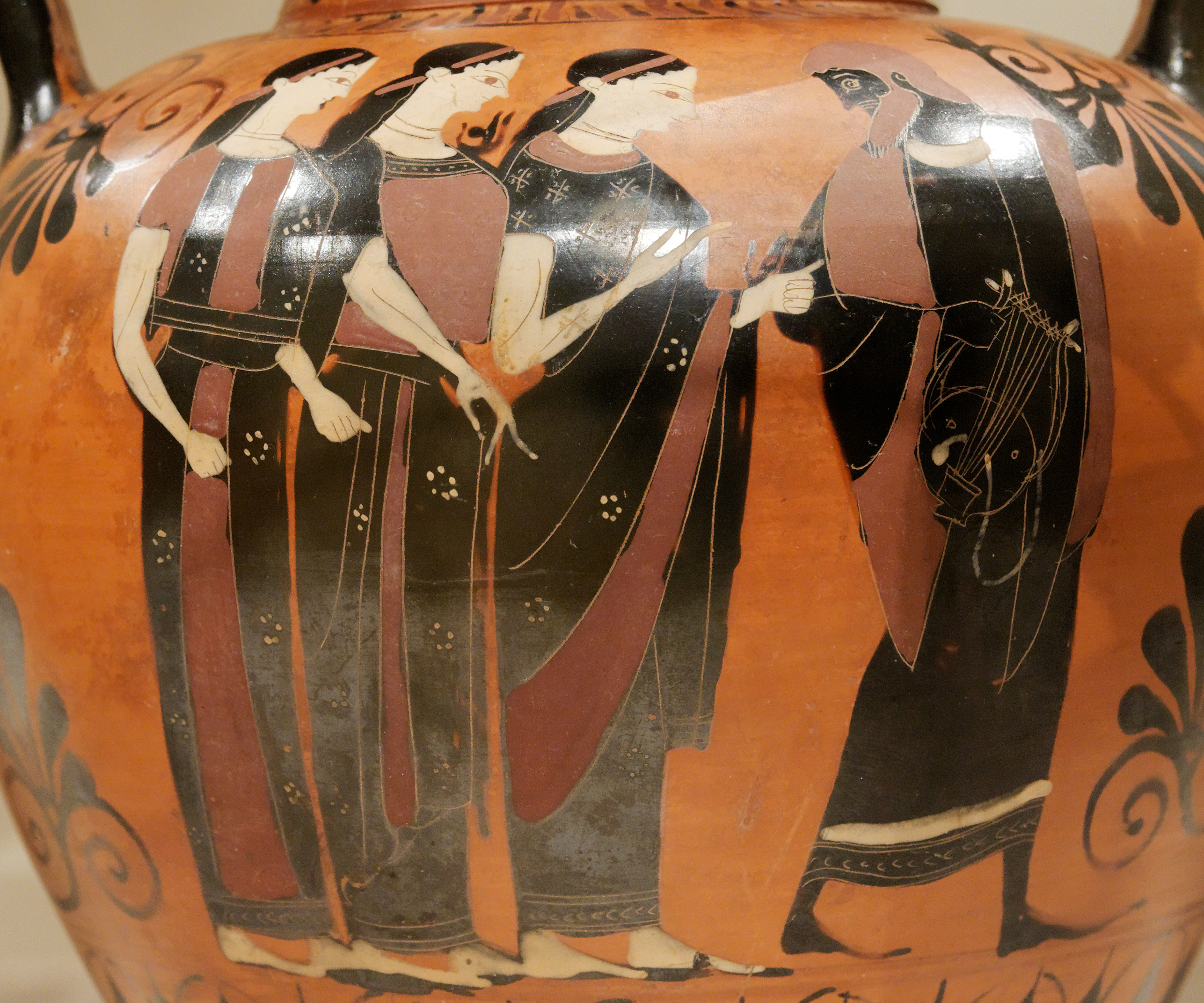
A prophecy stated that a son of the sea-nymph Thetis, with whom Zeus fell in love after gazing upon her in the oceans off the Greek coast, would become greater than his father. Possibly for this reason, Thetis was betrothed to an elderly human king, Peleus son of Aeacus, either upon Zeus's orders, or because she wished to please Hera, who had raised her. All the gods and goddesses as well as various mortals were invited to the marriage of Peleus and Thetis (the eventual parents of Achilles) and brought many gifts. Only Eris, goddess of discord, was not invited and was stopped at the door by Hermes, on Zeus's order. She was annoyed at this, so she threw from the door a gift of her own: a golden apple inscribed with the word καλλίστῃ (kallistēi, "To the fairest"). Aphrodite, Hera, and Athena all claimed to be the fairest, and thus the rightful owner of the apple.

The goddesses quarreled bitterly over it, and none of the other gods would venture an opinion favoring one, for fear of earning the enmity of the other two. They chose to place the matter before Zeus, who, not wanting to favor one of the goddesses, put the choice into the hands of Paris, a Trojan prince. After bathing in the spring of Mount Ida where Troy was situated, they appeared before Paris to have him choose. The goddesses undressed before him, either at his request or for the sake of winning. Still, Paris could not decide, as all three were ideally beautiful, so they resorted to bribes. Hera offered Paris political power and control of all of Asia, while Athena offered wisdom, fame, and glory in battle, and Aphrodite offered the most beautiful mortal woman in the world as a wife, and he accordingly chose her. This woman was Helen, who was, unfortunately for Paris, already married to King Menelaus of Sparta. The other two goddesses were enraged by Paris's decision and, after the Trojan War started through Helen's abduction by Paris, they sided with the Greeks.[[File:Theoi Cdm Paris 229.jpg|thumb|left|280px|English: Hermes, Athena, Zeus (seated), Hera and Ares (all named). Side A of an Attic black-figure neck-amphora, end of 6th century BC. [[BnF Museum]], Paris]] Hera plays a substantial role in The Iliad, appearing in several books throughout the epic poem. She makes many attempts to thwart the Trojan Army. In books 1 and 2, Hera declares that the Trojans must be destroyed and persuades Athena to aid the Achaeans in battle, and she agrees to assist with interfering on their behalf.
In book 5, Hera and Athena plot to harm Ares, who had been seen by Diomedes in assisting the Trojans. Diomedes called for his soldiers to fall back slowly. Hera saw Ares's interference and asked Zeus for permission to drive Ares away from the battlefield. Hera encouraged Diomedes to attack Ares and he threw his spear at the god. Athena drove the spear into Ares's body, and he bellowed in pain and fled to Mount Olympus, forcing the Trojans to fall back.
In book 8, Hera tries to persuade Poseidon to disobey Zeus and help the Achaean army. He refuses, saying he doesn't want to go against Zeus. Determined to intervene in the war, Hera and Athena head to the battlefield. However, seeing the two flee, Zeus sent Iris to intercept them and make them return to Mount Olympus or face grave consequences. After prolonged fighting, Hera sees Poseidon aiding the Greeks and giving them the motivation to keep fighting.
In book 14 Hera devises a plan to deceive Zeus. Zeus set a decree that the gods were not allowed to interfere in the mortal war. Hera is on the side of the Achaeans, so she plans a Deception of Zeus where she seduces him, with help from Aphrodite, and tricks him into a deep sleep, with the help of Hypnos, so that the Gods could interfere without the fear of Zeus.
In book 21, Hera continues her interference with the battle as she tells Hephaestus to prevent the river from harming Achilles. Hephaestus sets the battlefield ablaze, causing the river to plead with Hera, promising her he will not help the Trojans if Hephaestus stops his attack. Hephaestus stops his assault and Hera returns to the battlefield where the gods begin to fight amongst themselves. After Apollo declines to battle Poseidon, Artemis eagerly engages Hera for a duel. Hera however treats the challenge as unimportant, easily disarming the haughty rival goddess and beating her with her own weapons. Artemis is left retreating back to Mount Olympus in tears to cry at Zeus's lap.
Minor stories
_on_May_22,_2022.jpg)
The Golden Fleece
Hera hated Pelias, king of Iolcus, because he had killed Sidero, his step-grandmother, in one of her temples. She later convinced his nephew Jason to kill Pelias. The Golden Fleece was the item that Jason needed to get his mother Alcimide freed, which he obtained with the help of the sorceress Medea, who was influenced by the goddess. At the request of Hera, Aelous calmed all the winds but the "steady" west wind, to aid their crew, the Argonauts, on their journey home.
Cydippe
Cydippe, a priestess of Hera, was on her way to a festival in the goddess's honor. The oxen which were to pull her cart were overdue and her sons, Biton and Cleobis, pulled the cart the entire way (45 stadia, 8 kilometers). Cydippe was impressed with their devotion to her and Hera, and so asked Hera to give her children the best gift a god could give a person. Hera ordained that the brothers would die in their sleep. This honor bestowed upon the children was later used by Solon as proof when trying to convince Croesus that it is impossible to judge a person's happiness until they have died a fruitful death after a joyous life.
Ixion
When Zeus had pity on Ixion and brought him to Olympus and introduced him to the gods, instead of being grateful, Ixion grew lustful for Hera. Zeus found out about his intentions and made a cloud in the shape of Hera, who was later named Nephele, and tricked Ixion into coupling with it. From their union came Centaurus. So Ixion was expelled from Olympus and Zeus ordered Hermes to bind Ixion to a winged fiery wheel that was always spinning. Therefore, Ixion was bound to a burning solar wheel for all eternity, first spinning across the heavens, but in later myth transferred to Tartarus.
Olympian Rebellion
In the Iliad, Homer tells of another attempted overthrow, in which Hera, Poseidon, and Athena conspire to overpower Zeus and tie him in bonds. It is only because of Thetis, who summons Briareus, one of the Hecatoncheires, to Olympus, that the other Olympians abandon their plans (out of fear for Briareus).
Aëtos
According to the myth, Aëtos was a beautiful boy born of the earth. While Zeus was young and hiding in Crete from his father Cronus who had devoured all of Zeus's siblings, Aëtos became friends with the god and was among the first beings to swear fealty to him as new king. But years later, after Zeus had overthrown his father and become king in his place, Zeus's wife Hera turned Aëtos into an eagle, out of fear that Zeus loved him. Thus the eagle became the sacred bird of Zeus, and a symbol of power and kingship.
Tiresias
Tiresias was a priest of Zeus, and as a young man, he encountered two snakes mating and hit them with a stick. He was then transformed into a woman. As a woman, Tiresias became a priestess of Hera, married, and had children, including Manto. After seven years as a woman, Tiresias again found mating snakes; depending on the myth, either she made sure to leave the snakes alone this time, or, according to Hyginus, trampled on them and became a man once more.
As a result of his experiences, Zeus and Hera asked him to settle the question of which sex, male or female, experienced more pleasure during intercourse. Zeus claimed it was women; Hera claimed it was men. When Tiresias sided with Zeus, Hera struck him blind. Since Zeus could not undo what she had done, he gave him the gift of prophecy.
An alternative and less commonly told story has it that Tiresias was blinded by Athena after he stumbled onto her bathing naked. His mother, Chariclo, begged her to undo her curse, but Athena could not; she gave him a prophecy instead.
Io and Argus
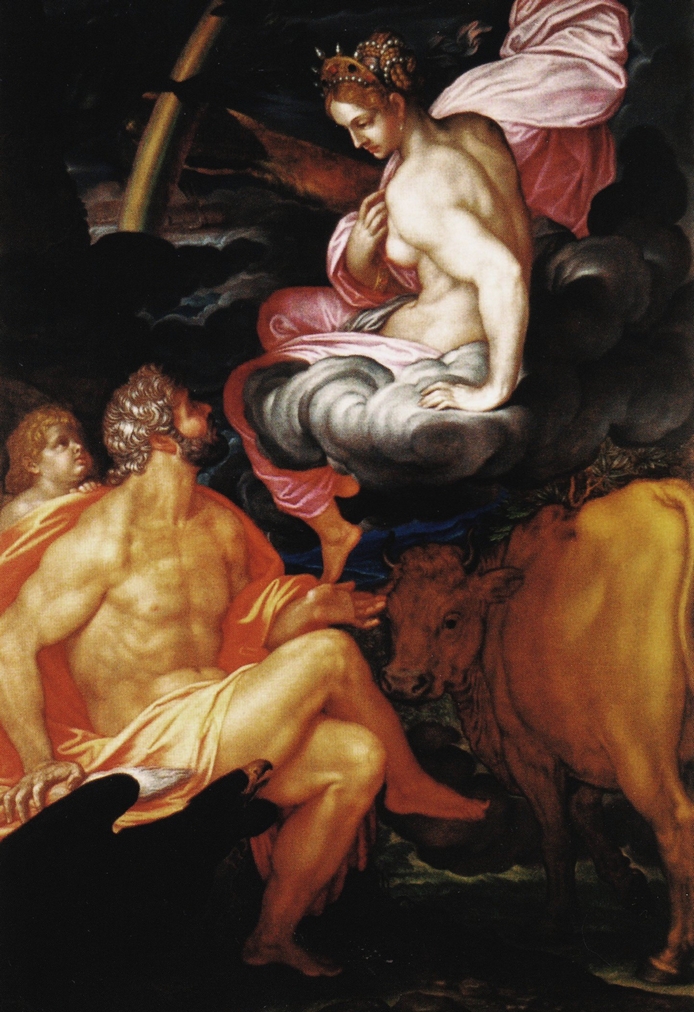
The myth of Io has many forms and embellishments. Generally, Io was a priestess of Hera at the Heraion of Argos. Zeus lusted after her and either Hera turned Io into a heifer to hide her from Zeus, or Zeus did so to hide her from Hera but was discovered. Hera had Io tethered to an olive-tree and set Argus Panoptes () to watch over her, but Zeus sent Hermes to kill him. Infuriated, Hera then sent a gadfly (Greek oistros, compare oestrus) to pursue and constantly sting Io, who fled into Asia and eventually reached Egypt. There Zeus restored her to human form and she gave birth to his son Epaphus.
Gerana
Gerana was a queen of the Pygmies who boasted she was more beautiful than Hera. The wrathful goddess turned her into a crane and proclaimed that her bird descendants should wage eternal war on the Pygmy folk.
Lamia
Lamia was a lovely queen of Libya, whom Zeus loved; Hera in jealousy robbed Lamia of their children, either by kidnapping and hiding them away, killing them, or causing Lamia herself to kill her own offspring. Lamia became disfigured from the torment, transforming into a terrifying being who hunted and killed the children of others.
Children

| Name | Father | Functions | Explanation |
|---|---|---|---|
| Angelos | Zeus | An underworld goddess | Her story only survives in scholia on Theocritus's Idyll 2. She was raised by nymphs. One day she stole Hera's anointments and gave them away to Europa. To escape her mother's wrath, she tried to hide. Hera eventually ceased prosecuting her, and Zeus ordered the Cabeiroi to cleanse Angelos. They performed the purification rite in the waters of the Acherusia Lake in the Underworld. Consequently, she received the world of the dead as her realm of influence, and was assigned the epithet katachthonia ("she of the underworld"). |
| Ares | Zeus | God of war | According to Hesiod's Theogony, he was a son of Zeus and Hera. |
| Arge | Zeus | A nymph | A nymph daughter of Zeus and Hera. |
| Charites | Not named | Goddesses of grace and beauty | Though usually considered as the daughters of Zeus and Eurynome, or Dionysus and Coronis according to Nonnus, the poet Colluthus makes them the daughters of Hera, without naming a father. |
| Eileithyia | Zeus | Goddess of childbirth | In Theogony and other sources, she is described as a daughter of Hera by Zeus. Although, the meticulously accurate mythographer Pindar in Seventh Nemean Ode mentions Hera as Eileithyia's mother but makes no mention of Zeus. |
| Eleutheria | Zeus | Personification of liberty | Eleutheria is the Greek counterpart of Libertas (Liberty), daughter of Jupiter (Zeus) and Juno (Hera) as cited in Hyginus, Fabulae Preface. |
| Hebe | Zeus | Goddess of youth | Apollodorus]], 1.3.1, and later authors. In a rare alternative version, Hera alone produced Hebe after being impregnated by eating lettuce. A fragment by Callimachus describes Hera holding a feast to celebrate the seventh day after the birth of Hebe. Pindar states that Hebe stays by her mother's side in Olympus forever. |
| Hephaestus | Zeus | God of fire and the forge | Attested by Hesiod, Hera was jealous of Zeus's giving birth to Athena with Metis, so she gave birth to Hephaestus without union with Zeus (though Homer has Hephaestus refer to "father Zeus"). In some versions, Zeus threw Hephaestus off Mount Olympus because he protected Hera from his advances. |
| Pasithea | Dionysus (?) | One of the Graces | Although in other works Pasithea doesn't seem to be born to Hera, Nonnus made the Grace Hera's daughter. Elsewhere in the book, Pasithea's father is said to be Dionysus, but it's unclear whether those two together are meant to be Pasithea's parents. |
| Prometheus | Eurymedon | God of forethought | Although usually Prometheus is said to be the son of Iapetus by his wife Clymene or Asia, Hellenistic poet Euphorion made Prometheus the son of Hera by the giant Eurymedon, who raped the young goddess while she was still living with her parents. |
| Typhon | – | Serpent-monster | Typhon is presented both as the son of Hera (in Homeric Pythian Hymn to Apollo) and as the son of Gaia (in Hesiod's Theogony). According to the Homeric Hymn to Apollo (6th century BCE), Typhon was the parthenogenous child of Hera, whom she bore alone as a revenge at Zeus who had given birth to Athena. Hera prayed to Gaia to give her a son as strong as Zeus, then slapped the ground and became pregnant. Hera gave the infant Typhon to the serpent Python to raise, and Typhon grew up to become a great bane to mortals. The b scholia to Iliad 2.783, however, has Typhon born in Cilicia as the offspring of Cronus. Gaia, angry at the destruction of the Giants, slanders Zeus to Hera. So Hera goes to Cronus and he gives her two eggs smeared with his own semen, telling her to bury them, and that from them would be born one who would overthrow Zeus. Hera, angry at Zeus, buries the eggs in Cilicia "under Arimon", but when Typhon is born, Hera, now reconciled with Zeus, informs him. |
Genealogy
Art and events
- Barberini Hera - a Roman sculpture of Hera/Juno
- Hera Borghese - a sculpture related to Hera
- Hera Farnese - a sculpture of Hera's head
- Heraea Games - games dedicated to Hera—the first sanctioned (and recorded) women's athletic competition to be held in the stadium at Olympia.
Footnotes
Notes
References
- Apollodorus, Apollodorus, The Library, with an English Translation by Sir James George Frazer, F.B.A., F.R.S. in 2 Volumes. Cambridge, MA, Harvard University Press; London, William Heinemann Ltd. 1921. Online version at the Perseus Digital Library.
- Burkert, Walter, Greek Religion 1985.
- Burkert, Walter, The Orientalizing Revolution: Near Eastern Influence on Greek Culture in the Early Archaic Age, 1998.
- Dietrich Bernard Clive (1974) The origins of the Greek religionhttps://books.google.com/books?id=eQO7haySEe8C, Walter de Gruyter ISBN 311 0 003 9826
- Evelyn-White, Hugh, The Homeric Hymns and Homerica with an English Translation by Hugh G. Evelyn-White. Homeric Hymns. Cambridge, Massachusetts, Harvard University Press; London, William Heinemann Ltd. 1914.
- Farnell, Lewis Richard (1896) The cults of the Greek states I: Oxford, https://archive.org/details/in.ernet.dli.2015.56572/page/135/mode/2up
- Gantz, Timothy, Early Greek Myth: A Guide to Literary and Artistic Sources, Johns Hopkins University Press, 1996, Two volumes: (Vol. 1), (Vol. 2).
- Graves, Robert, The Greek Myths 1955. Use with caution.
- Hard, Robin, The Routledge Handbook of Greek Mythology: Based on H.J. Rose's "Handbook of Greek Mythology", Psychology Press, 2004, . Google Books.
- Hesiod, Theogony, in The Homeric Hymns and Homerica with an English Translation by Hugh G. Evelyn-White, Cambridge, MA., Harvard University Press; London, William Heinemann Ltd. 1914. Online version at the Perseus Digital Library.
- Homer, The Iliad with an English Translation by A.T. Murray, Ph.D. in two volumes. Cambridge, MA., Harvard University Press; London, William Heinemann, Ltd. 1924. Online version at the Perseus Digital Library.
- Homer; The Odyssey with an English Translation by A.T. Murray, PH.D. in two volumes. Cambridge, MA., Harvard University Press; London, William Heinemann, Ltd. 1919. Online version at the Perseus Digital Library.
- Hyginus, The Myths of Hyginus. Edited and translated by Mary A. Grant, Lawrence: University of Kansas Press, 1960.
- Kerenyi, Carl, The Gods of the Greeks 1951 (paperback 1980)
- Kerenyi, Karl, 1959. The Heroes of the Greeks Especially Heracles.
- Kirk, G. S., J. E. Raven, M. Schofield, The Presocratic Philosophers: A Critical History with a Selection of Texts, Cambridge University Press, Dec 29, 1983. .fc
- Nonnus, Dionysiaca; translated by Rouse, W H D, III Books XXXVI–XLVIII. Loeb Classical Library No. 346, Cambridge, Massachusetts, Harvard University Press; London, William Heinemann Ltd. 1940. Internet Archive.
- Ogden, Daniel (2013a), Drakon: Dragon Myth and Serpent Cult in the Greek and Roman Worlds, Oxford University Press, 2013. .
- .
- Ovid, Metamorphoses. Translated by A. D. Melville; introduction and notes by E. J. Kenney. Oxford: Oxford University Press. 2008. .
- Pausanias, Pausanias Description of Greece with an English Translation by W.H.S. Jones, Litt.D., and H.A. Ormerod, M.A., in 4 Volumes. Cambridge, MA, Harvard University Press; London, William Heinemann Ltd. 1918. Online version at the Perseus Digital Library.
- Pindar, Odes, Diane Arnson Svarlien. 1990. Online version at the Perseus Digital Library.
- Robertson D.S, A handbook of Greek and Roman Architecture. Cambridge at the University Press. 1945
- Ruck, Carl A.P., and Danny Staples, The World of Classical Myth 1994
- Seyffert, Oskar. Dictionary of Classical Antiquities 1894. ()
- Seznec, Jean, The Survival of the Pagan Gods : Mythological Tradition in Renaissance Humanism and Art, 1953
- ) Concentrating on family structure in 5th-century Athens; some of the crude usage of myth and drama for psychological interpreting of "neuroses" is dated.
- Smith, William; Dictionary of Greek and Roman Biography and Mythology, London (1873). "Gali'nthias"
- Spivey Nigel, Greek Art. Phaidon Press Limited. 1997
References
- [https://www.journals.uchicago.edu/doi/10.2307/498508 Elderkin(1937), "The marriage of Zeus with Hera"]
- ''Larousse Desk Reference Encyclopedia'', [[The Book People]], Haydock, 1995, p. 215.
- [[LSJ]] s.v. [https://www.perseus.tufts.edu/hopper/text?doc=Perseus%3Atext%3A1999.04.0057%3Aentry%3De)rato%2Fs ἐρατός].
- [[Plato]], [[Cratylus]], [https://www.perseus.tufts.edu/hopper/text?doc=Perseus%3Atext%3A1999.01.0172%3Atext%3DCrat.%3Asection%3D404c 404c]
- On Isis and Osiris, 32
- "Greek religion", pp. 131–132
- Chadwick, ''The Mycenaean World'' (Cambridge University Press). 1976:87.
- Windekens, in ''Glotta'' '''36''' (1958), pp. 309–11.
- [[Robert S. P. Beekes. R. S. P. Beekes]], ''Etymological Dictionary of Greek'', Brill, 2009, p. 524.
- Raymoure, K.A.. "The Linear B word e-ra}} {{cite web". Deaditerranean.
- Blažek, Václav. "[http://hdl.handle.net/11222.digilib/136225 Artemis and her family]". In: ''Graeco-Latina Brunensia'' vol. 21, iss. 2 (2016). p. 47. {{ISSN. 2336-4424
- Willi, Andreas. (1 December 2010). "Hera, Eros, Iuno Sororia". [[Indogermanische Forschungen]].
- Van der Toorn, Karel; Becking, Bob; van der Horst, Pieter Willem (1999), Dictionary of Deities and Demons in the Bible (second ed.), Grand Rapids, Michigan: William B. Eerdman's Publishing Company, {{ISBN
- Farnell Cults I, p.195
- Nilsson, "Geschichte", Vol i, p.428-429
- Farnell Cults I, 194-197
- [[Pausanias (geographer)
- Farnell Cults I, 241-243
- Farnell Cults I, 249-254
- [https://www.perseus.tufts.edu/hopper/text?doc=Perseus%3Atext%3A1999.01.0160%3Abook%3D8%3Achapter%3D22%3Asection%3D2 Pausanias 8.22.2]
- [https://www.perseus.tufts.edu/hopper/morph?l=suzugi%2Fa&la=greek#Perseus:text:1999.04.0057:entry=suzu/gios-contents συζύγιος]
- [https://www.perseus.tufts.edu/hopper/text?doc=Perseus:text:1999.04.0104:entry=zygia-bio-1 A Dictionary of Greek and Roman biography and mythology, Zygia and Zygius]
- [https://www.perseus.tufts.edu/hopper/text?doc=Perseus%3Atext%3A1999.01.0160%3Abook%3D5%3Achapter%3D15%3Asection%3D11 Pausanias 5.15.1]
- Farnell Cults I, 246-252
- James Joseph Clauss, Sarah Iles Johnston. ''[https://books.google.com/books?id=480Wd8G6LPYC&pg=PA46 Medea: Essays on Medea in myth, literature, philosophy, and art]'', 1997. p.46
- [https://www.perseus.tufts.edu/hopper/text?doc=Paus.+2.24.1&fromdoc=Perseus%3Atext%3A1999.01.0160 Pausanias 2.24.1]
- Henry George Liddell, Robert Scott. ''[https://www.perseus.tufts.edu/hopper/text?doc=Perseus:text:1999.04.0057:entry%3Dbounai/a A Greek-English Lexicon βουναία]''
- Heinrich Schliemann. ''[https://archive.org/details/ilioscityandcou00unkngoog/page/n318 Ilios: The city and country of the Trojans]'', 1881.
- [https://www.perseus.tufts.edu/hopper/text?doc=Perseus%3Atext%3A1999.04.0104%3Aalphabetic+letter%3DH%3Aentry+group%3D18%3Aentry%3Dhypercheiria-bio-1 A Dictionary of Greek and Roman biography and mythology, Hypercheiria]
- [https://www.cs.uky.edu/~raphael/sol/sol-entries/alpha/2504 Suda, alpha, 2504]
- [https://www.perseus.tufts.edu/hopper/text?doc=Perseus%3Atext%3A1999.01.0160%3Abook%3D2%3Achapter%3D22%3Asection%3D1 Pausanias 2.22.1]
- [https://www.perseus.tufts.edu/hopper/morph?l=euergesia&la=greek#lexicon Ευεργεσία]
- H.G.Payne, Perachora 1940: Nilsson, Vol I, p.428A1
- [https://www.perseus.tufts.edu/hopper/text?doc=Perseus%3Atext%3A1999.04.0104%3Aalphabetic+letter%3DP%3Aentry+group%3D13%3Aentry%3Dpelasga-bio-1 A Dictionary of Greek and Roman biography and mythology, Pelasga]
- [https://www.perseus.tufts.edu/hopper/text?doc=Perseus%3Atext%3A1999.01.0160%3Abook%3D9%3Achapter%3D2%3Asection%3D7 Pausanias 3.15.7]
- Farnell Cults I, p.247
- Hesch. "Thelxinia Hera is honoured by the Athenians"
- [https://www.perseus.tufts.edu/hopper/morph?l=qeomhtwr&l8a=greek#lexicon Θεομήτωρ]
- [https://www.perseus.tufts.edu/hopper/text?doc=Paus.+6.13.1&fromdoc=Perseus%3Atext%3A1999.01.0160 Pausanias 6.13.1]
- [https://www.perseus.tufts.edu/hopper/morph?l=leukwlenos&la=greek#lexicon λευκωλενος]
- Nilsson, Vol I, p.412
- [https://www.perseus.tufts.edu/hopper/morph?l=meili%2Fxios&la=greek#lexicon μειλίχιος]
- [https://www.perseus.tufts.edu/hopper/text?doc=urn:cts:greekLit:tlg0060.tlg001.perseus-grc1:5.55 Diodorus Siculus, Library, 5.55.1]
- [https://www.perseus.tufts.edu/hopper/text?doc=Paus.+3.13.8&fromdoc=Perseus%3Atext%3A1999.01.0160 Pausanias 3.13.8]
- O'Brien, Joan V.. (1993). "The Transformation of Hera: A Study of Ritual, Hero, and the Goddess in the Iliad". Rowman & Littlefield.
- West (2007),"Indoeuropean poetry and myth", p.184-185 :[https://books.google.com/books?id=ZXrJA_5LKlYC&pg=PA184 P.185]
- Dietrich (1975), "The origins of Greek religion", p.178 [https://books.google.com/books?id=TZVsDwAAQBAJ p.178]
- Kirk, Raven, Schofield(1975), "The Presocratic Philosophers": [https://books.google.com/books?id=kFpd86J8PLsC p.57-58]
- Leaming, Fee ,:The Goddess. Myths of the Great mother":[https://books.google.com/books?id=kjO6CwAAQBAJ&pg=PT17 p.17-18]
- Burkert (1985), "Greek religion", p.43,45: [https://books.google.gr/books? id=sxurBtx6shoC&printsec=frontcover#v=onepage&q&f=false p.43,45]
- [[Martin P. Nilsson]] suggested that Hera is mainly the "Argeiē" (Ἀργείη), a name given by Homer[https://www.perseus.tufts.edu/hopper/text?doc=Hom.+Il.+4.8&fromdoc=Perseus%3Atext%3A1999.01.0134 Iliad 4.8]
- , "Geschichte", Vol I, pp. 350,428
- Aeschylus :Suppliant Maedens, 297
- Homer in [[Iliad]] uses the formula "boōpis [[potnia]] Hērē)" (cow-eyed, mistress Hera), which probably relates her to a form of the Mediterranean goddess of nature.O'Brian Joan(1993) "The transformation of Hera" [https://books.google.com/books?id=a77yKM26GfYC&pg=PA49 p.49]
- Chadwick, John. (1976). "The Mycenaean World". Cambridge University Press.
- Burkert (1985), "Greek religion": [https://books.google.com/books?id=sxurBtx6shoC p. 64]
- Farnell Cults I, p.185
- Burkert (1985), "Greek religion" :[https://books.google.com/books?id=sxurBtx6shoC p,17-18]
- Burkert (1998), "Greek religion", p.129-134
- Burkert (1985), "Greek religion", p.52 [https://books.google.com/books?id=sxurBtx6shoC p.52]
- O'Brien Joan (1993), "The transformation of Hera", [https://books.google.com/books?id=a77yKM26GfYC&pg=PA54 p.53-57]
- (2008). "Greek Religion and Culture, the Bible, and the Ancient Near East". BRILL.
- Schachermeyer(1964),"Die Minoische Kultur des alten Kreta", p. 308-310
- [[Pherecydes of Syros]] in his cosmogony describes the mating of two divine principles: The marriage of [[Zeus. Zas]] with [[Chthonic. Chthonie]]. [[Geoffrey Kirk]] notices that after the marriage "Cthonie" becomes [[Gaia. Aether]] of Zeus is the sky-god who is the father of men and gods, and the earth-goddess [[Gaia. Ge]] is the mother of all life.Euripides, Chryssipos fr.839:Nilsson,"Geschichte" Vol I p.460
- Farnell, Cults I, p.182
- Nilsson, "Geschichte", Vol I, p. 427-428
- Henry George Liddell, Robert Scott, ''A Greek-English Lexicon'', on Perseus Digital Library :[https://www.perseus.tufts.edu/hopper/morph?l=hrai%2Fos&la=greek#lexicon Ἡραίος ]
- Farnell, Cults I, p.197-198
- Martin Persson Nilsson, ''The Minoan-Mycenaean Religion and Its Survival in Greek Religion'' (Lund) 1950 pt. I.ii "House Sanctuaries", pp 77-116; H. W. Catling, "A Late Bronze Age House- or Sanctuary-Model from the Menelaion, Sparta," ''BSA'' '''84''' (1989) 171-175.
- [[Walter Burkert. Burkert]], p. 132, including quote; Burkert: ''Orientalizing Revolution''.
- [[Pausanias (geographer). Pausanias]], ''Description of Greece'' 3.13.6
- Her name appears, with Zeus and Hermes, in a [[Linear B]] inscription (Tn 316) at Mycenean [[Pylos]] (John Chadwick, ''The Mycenaean World'' [Cambridge University Press] 1976:89).
- P.C. Sestieri, ''Paestum, the City, the Prehistoric Acropolis in Contrada Gaudo, and the Heraion at the Mouth of the Sele'' (Rome 1960), p. 11, etc. "It is odd that there was no temple dedicated to Poseidon in a city named for him (Paestum was originally called Poseidonia). Perhaps there was one at Sele, the settlement that preceded Paestum," Sarantis Symeonoglou suggested (Symeonoglou, "The Doric Temples of Paestum" ''Journal of Aesthetic Education'', '''19'''.1, Special Issue: Paestum and Classical Culture: Past and Present [Spring 1985:49-66] p. 50.
- Burkert (1998), "Greek religion", p. 63.
- At Argos the [[Dorians. Dorian]] "Heraion" was built on the hill of [[Prosymna]] near [[Mycenaean Greece
- Heyden, Katharina. (2022). "Early New Testament Apocrypha". Zondervan Academic.
- "The goddesses of Greek polytheism, so different and complementary"; [[Greek mythology]] scholar [[Walter Burkert]] has observed, in ''Homo Necans'' (1972) 1983:79f, "are nonetheless, consistently similar at an earlier stage, with one or the other simply becoming dominant in a sanctuary or city. Each is the Great Goddess presiding over a male society; each is depicted in her attire as [[Potnia Theron]] "Mistress of the Beasts", and Mistress of the Sacrifice, even Hera and Demeter."
- Keary, Charles Francis. ''Outlines of primitive belief among the Indo-European races''. New York: C. Scibner's Sons. 1882. p. 176.
- [https://www.sacred-texts.com/cla/mgr/mgr05.htm Harrison, Jane Ellen. ''Myths of Greece and Rome''. 1928. pp. 12-14]
- Keary, Charles Francis. ''Outlines of primitive belief among the Indo-European races''. New York: C. Scibner's Sons. 1882. p. 176 (footnote nr. ii).
- West (2007) "Indoeuropean poetry and myth" [https://books.google.com/books?id=ZXrJA_5LKlYC&pg=PA174 174-175]
- [[Homer]], ''[[Iliad]]'' [https://www.perseus.tufts.edu/hopper/text?doc=Hom.+Il.+19.95 19.95ff.]
- ''Iliad'', ii. 781-783)
- Homer, 751? BCE-651? BCE. (2000-06-01). "The Iliad".
- Bachofen, ''Mutterrecht'' 1861, as '' Mother Right: An Investigation of the Religious and Juridical Character of Matriarchy in the Ancient World.'' Bachofen was seminal in the writings of [[Jane Ellen Harrison]] and other students of Greek myth.
- Slater 1968.
- Burkert(1985), "Greek religion":[https://books.google.com/books?id=sxurBtx6shoC p.41]
- Farnell, Cults I 191-193
- link. (2015-11-06 ; Pausanias explains this by telling the myth of the [[Daedala]].)
- link. (2015-11-06' [[Pindar]] refers to the "praises of Hera Parthenia [the Maidenly]" ''[[Olympian ode]]'' [http://perseus.mpiwg-berlin.mpg.de/cgi-bin/ptext?lookup=Pind.+O.+6.1 6.88] {{webarchive). link. (2015-11-06)
- S. Casson: "Hera of Kanathos and the Ludovisi Throne" ''The Journal of Hellenic Studies'' '''40'''.2 (1920), pp. 137-142, citing [[Stephanus of Byzantium]] ''sub'' ''Ernaion''.
- [[Pausanias (geographer). link. (2015-11-06 .)
- O'Brian Joan (1993), "The transformation of Hera", [https://books.google.com/books?id=a77yKM26GfYC&pg=PA54 p.54-55]
- [[Robert Graves]] (1955), ''[[The Greek Myths]]''.
- [[Barbara G. Walker]] (1983), ''The Women's Encyclopedia of Myths and Secrets'', p.392 {{ISBN. 0-06-250925-X
- Claude Calame(1977), "Choruses of Young women in Ancient Greece", 2.126-133
- The Greek aetiological myths ([[etiology
- Comp. the myth of Typhon: Nilsson, "Geschichte", Vol I p.432
- O'Brian (1993), "The transformation of Hera":[https://books.google.com/books?id=a77yKM26GfYC&pg=PA36 p.36]
- Some accounts are related to rituals of the Bronze Age before the splitting of the "Mistress of the animals" into separate goddesses.O'Brian (1993), "The transformation of Hera":[https://books.google.com/books?id=a77yKM26GfYC&pg=PA60 p.60-61]
- Farnell Cults I, p.185-187
- Nilsson, "Geschichte", Vol I, p.430.
- Farnell Cults I, p. 201-202
- Nilsson, "Geschichte", Vol I, p.430
- Matthew Dillon (2002), Girls and women in Ancient Greek religion" p.131
- Farnell, Cults I, p.188 -190
- [https://www.journals.uchicago.edu/doi/10.2307/506363 Serwint Nancy (1993), "Heraia and the prenuptial initiation"]
- Seznec, Jean, ''The Survival of the Pagan Gods: Mythological Tradition in Renaissance Humanism and Art,'' 1953
- Spivey p.109
- Robertson p. 62-63,324
- Spivey, 135-139
- Excavations of Mon Repo-University of Nebraska. [https://cdrhsites.unl.edu/monrepos/evidence/excavations.html Excavations at Mon Repo]
- Robertson p.95,331
- Robertson p.95-97,332
- Robertson,327
- Roberson, p. 75,325
- Robertson, pp. 136,327
- Robertson 327
- Baumbach 2004: 78
- Robertson,328
- Hansen, [https://archive.org/details/handbookofclassi0000hans/page/66/mode/2up?view=theater p. 67]; [[Hesiod]], ''[[Theogony]]'' [http://data.perseus.org/citations/urn:cts:greekLit:tlg0020.tlg001.perseus-eng1:453-491 453–9].
- "Cronus {{!}} Greek god". Encyclopædia Britannica.
- [[Pausanias (geographer). Pausanias]], [http://data.perseus.org/citations/urn:cts:greekLit:tlg0525.tlg001.perseus-eng1:2.17.1 2.17.1].
- Homer, Iliad 14. 200 ff, https://www.theoi.com/Titan/TitanisTethys.html#Creation
- [[Homer]], ''[[Iliad]]'' [https://www.perseus.tufts.edu/hopper/text?doc=Perseus%3Atext%3A1999.01.0134%3Abook%3D14%3Acard%3D270 14.295–299].
- [[Pausanias (geographer)
- [[Scholia]] on [[Theocritus]]'s ''Idylls'' [https://sententiaeantiquae.com/2021/08/21/explaining-the-cuckoo-women-know-everything-4/ 15.64].
- [[Ptolemaeus Chennus]], ''New History'' Book 6, as epitomized by [[Patriarch Photius I of Constantinople. Patriarch Photius]] in his ''[[Bibliotheca (Photius). Myriobiblon]]'' [https://topostext.org/work/237#190.47 190.47]
- [[Eusebius]], ''[[Praeparatio evangelica]]'' [https://books.google.com/books?id=yNRKAwAAQBAJ&pg=PA92 3.1.84a-b]; Hard, p. [https://books.google.com/books?id=r1Y3xZWVlnIC&pg=PA137 137].
- [[Callimachus]], ''[[Aetia (Callimachus). Aetia]]'' fragment [https://dcc.dickinson.edu/callimachus-aetia/untitled-48 48]
- [[Bibliotheca (Pseudo-Apollodorus)
- [[Diodorus Siculus]], ''[[Bibliotheca historica. Library of History]]'' [https://penelope.uchicago.edu/Thayer/E/Roman/Texts/Diodorus_Siculus/4B*.html#p391 4.14.4].
- "Hymn 3 to Apollo, To Delian Apollo".
- "Callimachus, ''Hymn to Delos''"
- Hyginus, ''[[Fabulae]]'' 140).
- Hammond. ''Oxford Classical Dictionary.'' 597-598.
- (1988). "Pindar on the Birth of Apollo". The Classical Quarterly.
- Pseudo-Apollodorus, ''Bibliotheke'' 1.4.1; [[Antoninus Liberalis]], ''Metamorphoses'', 35, giving as his sources Menecrates of Xanthos (4th century BCE) and Nicander of Colophon; [[Ovid]], ''[[Metamorphoses]]'' vi.317-81 provides another late literary source.
- Hesiod. "Theogony".
- Hamilton, Edith (1969). "Mythology".
- Seyffert ''Dictionary''
- [[Pausanias (geographer)
- Evslin, Bernard. (2012-10-30). "Gods, Demigods and Demons: An Encyclopedia of Greek Mythology". Open Road Media.
- "APOLLODORUS, THE LIBRARY 2.4.8 - Theoi Classical Texts Library".
- (1938). "The Origin of the Milky Way in the National Gallery". The Burlington Magazine for Connoisseurs.
- Anonymous. (1806). "Geoponika: Agricultural Pursuits".
- [https://topostext.org/work/866 D Scholium on Homer's Iliad, 5.392]
- Kerenyi, p 131
- Scholiast on Homer's ''[[Iliad]]''; Hyginus, ''[[Fabulae]]'' 54; Ovid, ''[[Metamorphoses]]'' 11.217.
- [[Bibliotheca (Pseudo-Apollodorus)
- [[Pindar#Chronological order. Pindar]], ''Nemean'' 5 ep2; Pindar, ''Isthmian'' 8 str3–str5.
- Hesiod, ''[[Catalogue of Women]]'' fr. 57; ''[[Cypria]]'' fr. 4.
- Photius, ''Myrobiblion'' 190.
- Hyginus, ''[[Fabulae]]'' 92.
- [[Bibliotheca (Pseudo-Apollodorus)
- "The Iliad".
- Homer. ''Iliad'', Book 14, Lines 153-353.
- [[Apollonius of Rhodes]], [https://archive.org/details/argonautica00apoluoft/page/346/mode/2up?view=theater 4.757–769], [https://archive.org/details/argonautica00apoluoft/page/346/mode/2up?view=theater 4.757–769] & [https://archive.org/details/argonautica00apoluoft/page/350/mode/2up?view=theater 4.818–822]
- Herodotus' ''History'', Book I
- Kerenyi 1951, p.160
- Gantz, p. 59; Hard 2004, [https://books.google.com/books?id=r1Y3xZWVlnIC&pg=PA82 p. 82]; [[Homer]], ''[[Iliad]]'' [http://data.perseus.org/citations/urn:cts:greekLit:tlg0012.tlg001.perseus-eng1:1.386-1.427 1.395–410].
- [[Sophocles]] frag 320.
- [[Maurus Servius Honoratus
- Hygini, ''[[Fabulae]]'', LXXV
- (1996). "The Oxford Classical Dictionary". Oxford University Press.
- [[Ovid]], ''[[Metamorphoses]]'' 6.89 - 91
- (2013). "Restless Dead: Encounters Between the Living and the Dead in Ancient Greece". Univ of California Press.
- {{harvp. Ogden. 2013b
- [[Duris of Samos]] (d. 280 B. C.), ''Libyca'', quoted by {{harvp. Ogden. 2013b
- Scholia on Theocritus, Idyll 2. 12 referring to [[Sophron]]
- ''Theogony'' [https://www.perseus.tufts.edu/hopper/text?doc=Hes.+Th.+921 921–922].
- Murray, John. (1833). "A Classical Manual, being a Mythological, Historical and Geographical Commentary on Pope's Homer, and Dryden's Aeneid of Virgil with a Copious Index".
- [[Nonnus]], ''[[Dionysiaca]]'' [https://topostext.org/work/529#48.548 48.548]
- [[Colluthus]], ''Rape of Helen'' [https://penelope.uchicago.edu/Thayer/E/Roman/Texts/Colluthus/Rape_of_Helen*.html#p555 173]
- Apollodorus]], [http://data.perseus.org/citations/urn:cts:greekLit:tlg0548.tlg001.perseus-eng1:1.3.1 1.3.1], and later authors.
- Detienne, Marcel. (2002-11-25). "The Writing of Orpheus: Greek Myth in Cultural Context". JHU Press.
- Callimachus. "Iambi, Fragment 202".
- [[Pindar]], ''Nemean'' [https://www.perseus.tufts.edu/hopper/text?doc=Perseus%3Atext%3A1999.01.0162%3Abook%3DN.%3Apoem%3D10 10.17]
- ''Theogony'' [https://www.perseus.tufts.edu/hopper/text?doc=Hes.+Th.+924 924–929].
- In Homer, ''[[Odyssey]]'' viii. 312 Hephaestus addresses "Father Zeus"; cf. Homer, ''[[Iliad]]'' i. 578 (some scholars, such as Gantz, ''Early Greek Myth'', p. 74, note that Hephaestus's reference to Zeus as 'father' here may be a general title), xiv. 338, xviii. 396, xxi. 332. See also [[Cicero]], ''[[De Natura Deorum]]'' 3.22.
- Graves, Robert. (1955). "The Greek Myths: 1". Penguin Books.
- ''Homeric Hymn to Apollo'' [https://www.perseus.tufts.edu/hopper/text?doc=Perseus%3Atext%3A1999.01.0138%3Ahymn%3D3%3Acard%3D305 316–321]; Homer, ''Iliad'' [https://www.perseus.tufts.edu/hopper/text?doc=Perseus%3Atext%3A1999.01.0134%3Abook%3D18%3Acard%3D388 18.395–405].
- Valerius Flaccus]], ii, 8.5; [[Bibliotheca (Pseudo-Apollodorus). Apollodorus]], i, 3 § 5. Apollodorus confounds the two occasions on which Hephaestus was thrown from Olympus.
- Deris, Sara. (2013-06-06). "Examining the Hephaestus Myth through a Disability Studies Perspective". Prandium: The Journal of Historical Studies at University of Toronto Mississauga.
- Guy Hedreen (2004) The Return of Hephaistos, Dionysiac Processional Ritual and the Creation of a Visual Narrative. ''The Journal of Hellenic Studies'', '''124''' (2004:38–64) p. 38 and note.
- Karl Kerenyi (1951) ''The Gods of the Greeks'', pp 156–158.
- The return of Hephaestus on muleback to Olympus accompanied by Dionysus was a theme of the Attic vase painters, whose wares were favored by Etruscans. The return of Hephaestus was painted on the Etruscan tomb at the "Grotta Campana" near Veii (identified by Peterson; the "well-known subject" was doubted in this instance by A. M. Harmon, "The Paintings of the Grotta Campana", ''American Journal of Archaeology'' '''16'''.1 (January - March 1912):1-10); for further examples, see [[Hephaestus#Return to Olympus]].
- [[Nonnus]], ''[[Dionysiaca]]'' [https://topostext.org/work/529#31.159 31.186]
- [[Nonnus]], ''[[Dionysiaca]]'' [https://topostext.org/work/529#15.86 15.91]
- [[Nonnus]], ''[[Dionysiaca]]'' [https://topostext.org/work/529#17.269 17.280]
- [[Nonnus]], ''[[Dionysiaca]]'' [https://topostext.org/work/529#26.351 26.355]
- [[Nonnus]], ''[[Dionysiaca]]'' [https://topostext.org/work/529#1.11 1.27]
- [[Nonnus]], ''[[Dionysiaca]]'' [https://topostext.org/work/529#48.247 48.247].
- [[Hesiod]], ''[[Theogony]]'' [http://www.perseus.tufts.edu/hopper/text.jsp?doc=Perseus%3Atext%3A1999.01.0130%3Acard%3D507 507]
- Apollodorus, ''[[Bibliotheca (Pseudo-Apollodorus)
- Scholium on the ''[[Iliad]]'' [https://books.google.com/books?id=-9EIAAAAQAAJ&pg=PA515 14.295]
- Gantz, pp. 16, 57; Hard, [https://books.google.com/books?id=r1Y3xZWVlnIC&pg=PA88 p. 88].
- Decker, Jessica Elbert. (2016-11-16). "Hail Hera, Mother of Monsters! Monstrosity as Emblem of Sexual Sovereignty". Women's Studies.
- [[Homeric Hymns
- Gantz, p. 49, remarks on the strangeness of such a description for one who would challenge the gods.
- Kirk, Raven, and Schofield. [https://books.google.com/books?id=kFpd86J8PLsC&pg=PA59 pp. 59–60 no. 52]; Ogden 2013b, [https://books.google.com/books?id=Vv0Fxm6Amh4C&pg=PA36 pp. 36–38]; Gantz, pp. 50–51, Ogden 2013a, [https://books.google.com/books?id=FQ2pAK9luwkC&pg=PA76 p. 76 n. 46].
This article was imported from Wikipedia and is available under the Creative Commons Attribution-ShareAlike 4.0 License. Content has been adapted to SurfDoc format. Original contributors can be found on the article history page.
Ask Mako anything about Hera — get instant answers, deeper analysis, and related topics.
Research with MakoFree with your Surf account
Create a free account to save articles, ask Mako questions, and organize your research.
Sign up freeThis content may have been generated or modified by AI. CloudSurf Software LLC is not responsible for the accuracy, completeness, or reliability of AI-generated content. Always verify important information from primary sources.
Report