From Surf Wiki (app.surf) — the open knowledge base
Helmet streamer
Structure in the Sun's corona

Structure in the Sun's corona
Helmet streamers, also known as coronal streamers, are elongated cusp-like structures in the Sun's corona which are often visible in white-light coronagraphs and during solar eclipses. They are closed magnetic loops which lie above divisions between regions of opposite magnetic polarity on the Sun's surface. The solar wind elongates these loops to pointed tips which can extend a solar radius or more into the corona.
During solar minimum, helmet streamers are found closer to the heliographic equator, whereas during solar maximum they are found more symmetrically distributed around the Sun.
Structure
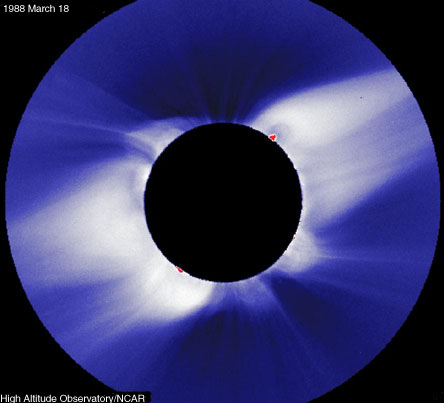
Helmet streamers have cusp-like bases that taper radially outward away from the Sun forming long stalks. The base typically extends up to 1.5 solar radii above the surface, whereas the stalk—stretched outward by the solar wind—can extend over many solar radii.
Helmet streamers are structured by closed magnetic fields and lie above boundaries separating opposite magnetic polarity in the Sun's photosphere. Their thin stalks consist of oppositely directed magnetic fields which form current sheets. Surrounding these stalks are open, oppositely directed magnetic fields which are anchored to coronal holes lower in the corona.
The white-light emissions of helmet streamers is due to the high electron density of the confined plasma relative to the surrounding corona. Light from the photosphere is Thomson scattered off of these electrons with the intensity of scattered light depending on the number of electrons along the observer's line of sight.
Small blobs of plasma, or "plasmoids" are sometimes released from the tips of helmet streamers, and this is one source of the slow component of the solar wind.
Solar cycle
Around solar minimum, the point of minimum solar activity during the 11-year solar cycle, helmet streamers are generally located around the heliographic equator in what is referred to as the streamer belt. At the same time, large coronal holes are present at the poles. As solar activity increases near the solar maximum, helmet streamers appear more symmetrically around the Sun.
Role in coronal mass ejections
Upon the eruption of a coronal mass ejection (CME), the overlying helmet streamer deforms becoming the CME's leading edge. Similarly, the helmet streamer's cavity becomes the CME's cavity and the helmet streamer's prominence becomes the CME's core.
Pseudostreamers
Structures in the corona, similar to a helmet streamer, but connecting holes of the same magnetic polarity, are called pseudostreamers. They were first observed using space-borne coronagraphs and called a "plasma sheets" by Hundhausen (1972). They were later renamed to "unipolar streamers" by Zhao & Webb (2003) and then termed "pseudostreamers" by Wang et al. (2007). Pseudostreamers' structure was observed in 2012 by the Solar Dynamics Observatory.
The magnetic topology of pseudostreamers was described as "contain[ing] twin filaments at its base. Such twin filaments are topologically connected, sharing a neutral point and a separatrix dome. This was a case in which two polarity reversal boundaries contain between them fields with a polarity opposite to that of the global unipolar configuration surrounding them (tripolar pseudostreamer)."
Single hybrid magnetic structure that consists of double-streamer/pseudostreamer was observed in the solar corona on May 5-10, 2013 by the SWAP instrument of the PROBA2 satellite. Its structure was described by researchers:
It consists of a pair of filament channels near the south pole of the Sun. On the western edge of the structure, the magnetic morphology above the filaments is that of a side-by-side double streamer, with open field between the two channels. On the eastern edge, the magnetic morphology is that of a coronal pseudostreamer without the central open field.
References
References
- Kallenrode, May-Britt. (2004). "Space Physics: An Introduction to Plasmas and Particles in the Heliosphere and Magnetospheres". Springer.
- (1992). "Coronal streamers". Space Science Reviews.
- (1 November 2000). "The dynamical nature of coronal streamers". Journal of Geophysical Research: Space Physics.
- (2009). "Coronal Holes". Living Reviews in Solar Physics.
- (January 2003). "Coronal mass ejections: Initiation and detection". Advances in Space Research.
- (April 2007). "Coronal Pseudostreamers". The Astrophysical Journal.
- (13 May 2014). "Dynamics of the Transition Corona". The Astrophysical Journal.
- (2012). "Origins of Rolling, Twisting, and Non-radial Propagation of Eruptive Solar Events". Solar Physics.
- (1 May 2021). "The Dynamic Formation of Pseudostreamers". The Astrophysical Journal.
- (1 May 2014). "Observations of a Hybrid Double-streamer/Pseudostreamer in the Solar Corona". The Astrophysical Journal.
This article was imported from Wikipedia and is available under the Creative Commons Attribution-ShareAlike 4.0 License. Content has been adapted to SurfDoc format. Original contributors can be found on the article history page.
Ask Mako anything about Helmet streamer — get instant answers, deeper analysis, and related topics.
Research with MakoFree with your Surf account
Create a free account to save articles, ask Mako questions, and organize your research.
Sign up freeThis content may have been generated or modified by AI. CloudSurf Software LLC is not responsible for the accuracy, completeness, or reliability of AI-generated content. Always verify important information from primary sources.
Report