From Surf Wiki (app.surf) — the open knowledge base
Hellas Verona FC
Italian association football club

Italian association football club
| Field | Value |
|---|---|
| clubname | Hellas Verona |
| current | 2025–26 Hellas Verona FC season |
| image | Hellas Verona FC logo (2020).svg |
| upright | 0.75 |
| fullname | Hellas Verona Football Club S.p.A. |
| nickname | I Gialloblù (The Yellow and Blues) |
| I Mastini (The Mastiffs) | |
| Gli Scaligeri (The Scaligers) | |
| I Butei ("The Boys") | |
| founded | , as Associazione Calcio Hellas |
| , as Verona Football Club | |
| ground | Stadio Marcantonio Bentegodi |
| capacity | 39,211 |
| owner | Presidio Investors |
| chrtitle | President |
| chairman | Italo Zanzi |
| mgrtitle | Head coach |
| manager | Paolo Zanetti |
| league | |
| season | |
| position | |
| website | |
| pattern_b1 | _verona2526h |
| pattern_la1 | _verona2526h |
| pattern_ra1 | _verona2526h |
| pattern_sh1 | _verona2526h |
| pattern_so1 | _verona2526hl |
| pattern_la2 | _verona2526a |
| pattern_b2 | _verona2526a |
| pattern_ra2 | _verona2526a |
| pattern_sh2 | _verona2526a |
| pattern_so2 | _verona2526al |
| pattern_la3 | _verona2526t |
| pattern_b3 | _verona2526t |
| pattern_ra3 | _verona2526t |
| pattern_sh3 | _verona2526t |
| pattern_so3 | _verona2526tl |
I Mastini (The Mastiffs) Gli Scaligeri (The Scaligers) I Butei ("The Boys") , as Verona Football Club Hellas Verona Football Club, commonly referred to as simply Hellas Verona (), is an Italian professional football club based in Verona, Veneto, that currently plays in Serie A. The team won the Serie A championship in the 1984–85 season.
The club has been associated with politically far-right ultras since at least the 1970s, and has repeatedly had racist incidents occur in the stands over the decades, including an incident in 1996 in which an effigy representing Dutch player Maickel Ferrier was hung from the stadium railing with a banner reading "Negro, get out of here" by fans wearing Ku Klux Klan attire. The club was repeated fined in the 2010s and 2020s for fans in the stands racially abusing players on the pitch.
In January 2025, it was announced that the club had been acquired by American private equity Presidio Investors.
History
Origins and early history
Founded in 1903 by a group of students at Liceo "Scipione Maffei", the club was named Hellas (the Greek word for Greece), at the request of a professor of classics. At a time in which football was played seriously only in the larger cities of northwestern Italy, most of Verona was indifferent to the growing sport. However, when in 1906 two city teams chose the city's Roman amphitheatre as a venue to showcase the game, crowd enthusiasm and media interest began to rise.
During these first few years, Hellas was one of three or four area teams playing at a municipal level while fighting against city rivals Bentegodi to become the city's premier football outfit. By the 1907–08 season, Hellas was playing against regional teams, and an intense rivalry with Vicenza that has lasted to this day was born.
From 1898 to 1926, Italian football was organised into regional groups. In this period, Hellas was one of the founding teams of the early league and often among its top final contenders. In 1911, the city helped Hellas replace the early, gritty football fields with a proper venue. This allowed the team to take part in its first regional tournament, which until 1926, was the qualifying stage for the national title.
In 1919, following a return to activity after a four-year suspension of all football competition in Italy during World War I, the team merged with city rival Verona and changed its name to Hellas Verona. Between 1926 and 1929, the elite "Campionato Nazionale" assimilated the top sides from the various regional groups. Hellas Verona joined the privileged teams, yet struggled to remain competitive.
Serie A, as it is structured today, began in 1929, when the Campionato Nazionale turned into a professional league. Still an amateur team, Hellas merged with two city rivals, Bentegodi and Scaligera, to form AC Verona. Hoping to build a first class contender for future years, the new team debuted in Serie B in 1929. It would take the gialloblu 28 years to finally achieve their goal. After first being promoted to Serie A for one season in 1957–58, in 1959, the team merged with another city rival (called Hellas) and commemorated its beginnings by changing its name to Hellas Verona AC.
Success in the 1970s and 1980s

Coached by Nils Liedholm, the team returned to Serie A in 1968 and remained in the elite league almost without interruption until 1990. Along the way, it scored a famous 5–3 win in the 1972–73 season that cost Milan the scudetto (the Serie A title). The fact that the result came late during the last matchday of the season makes the sudden and unexpected end to the ''rossoneri'''s title ambitions all the more memorable.
In 1973–74, Hellas finished the season in fourth-last, just narrowly avoiding relegation, but were nonetheless sent down to Serie B during the summer months as a result of a scandal involving team president Saverio Garonzi. After a year in Serie B, Hellas returned to Serie A.
In the 1975–76 season, the team had a successful run in the Coppa Italia, eliminating highly rated teams such as Torino, Cagliari and Internazionale from the tournament. However, in their first ever final in the competition, Hellas were trounced 4–0 by Napoli.

Under the leadership of coach Osvaldo Bagnoli, in 1982–83 the team secured a fourth-place in Serie A (its highest finish at the time) and even led the Serie A standings for a few weeks. The same season Hellas again reached the Coppa Italia final. After a 2–0 home victory, Hellas then travelled to Turin to play Juventus but were defeated 3–0 after extra time.
Further disappointment followed in the 1983–84 season when the team again reached the Coppa Italia final, only to lose the Cup in the final minutes of the return match against defending Serie A champions Roma.
The team made its first European appearance in the 1983–84 UEFA Cup and were knocked out in the second round of the tournament by Sturm Graz. Hellas were eliminated from the 1985–86 European Cup in the second round by defending champions and fellow Serie A side Juventus after a contested game, the result of a scandalous arbitrage by the French Wurtz, having beaten PAOK of Greece in the first round.
In 1988, the team had their best international result when they reached the UEFA Cup quarterfinals with four victories and three draws. The decisive defeat came from German side Werder Bremen.
1984–1985 ''Scudetto''

Although the 1984–85 season squad was made up of a mix of emerging players and mature stars, at the beginning of the season no one would have regarded the team as having the necessary ingredients to make it to the end. Certainly, the additions of Hans-Peter Briegel in midfield and of Danish striker Preben Elkjær to an attack that already featured the wing play of Pietro Fanna, the creative abilities of Antonio Di Gennaro and the scoring touch of Giuseppe Galderisi were to prove crucial.
To mention a few of the memorable milestones on the road to the scudetto: a decisive win against Juventus (2–0), with a goal scored by Elkjær after having lost a boot in a tackle just outside the box, set the stage early in the championship; an away win over Udinese (5–3) ended any speculation that the team was losing energy at the midway point; three straight wins (including a hard-fought 1–0 victory against a strong Roma side) served notice that the team had kept its polish and focus intact during their rival's final surge; and a 1–1 draw in Bergamo against Atalanta secured the title with a game in hand.
Hellas finished the year with a 15–13–2 record and 43 points, four points ahead of Torino with Internazionale and Sampdoria rounding out the top four spots. This unusual final table of the Serie A (with the most successful Italian teams of the time, Juventus and Roma, ending up much lower than expected) has led to many speculations. The 1984–85 season was the only season when referees were assigned to matches by way of a random draw. Before then each referee had always been assigned to a specific match by a special commission of referees (designatori arbitrali). After the betting scandal of the early 1980 (the Calcio Scommesse scandal), it was decided to clean up the image of Italian football by assigning referees randomly instead of picking them, to clear up all the suspicions and accusations always accompanying Italy's football life. This resulted in a quieter championship and in a completely unexpected final table.
In the following season, won again by Juventus, the choice of the referees went back in the hands of the designatori arbitrali. In 2006, a major scandal in Italian football revealed that certain clubs had been illegally influencing the referee selection process in an attempt to ensure that certain referees were assigned to their matches.
Between Serie A and Serie B
These were more than mere modest achievements for a mid-size city with a limited appeal to fans across the nation. But soon enough financial difficulties caught up with team managers. In 1991 the team folded and was reborn as Verona, regularly moving to and fro between Serie A and Serie B for several seasons. In 1995 the name was officially returned to Hellas Verona.
After a three-year stay, their last stint in Serie A ended in grief in 2002. That season emerging international talents such as Adrian Mutu, Mauro Camoranesi, Alberto Gilardino, Martin Laursen, Massimo Oddo, Marco Cassetti and coach Alberto Malesani failed to capitalise on an excellent start and eventually dropped into fourth-to-last place for the first time all season on the final match day, enforcing relegation into Serie B.
Decline and Serie C (2002–2011)
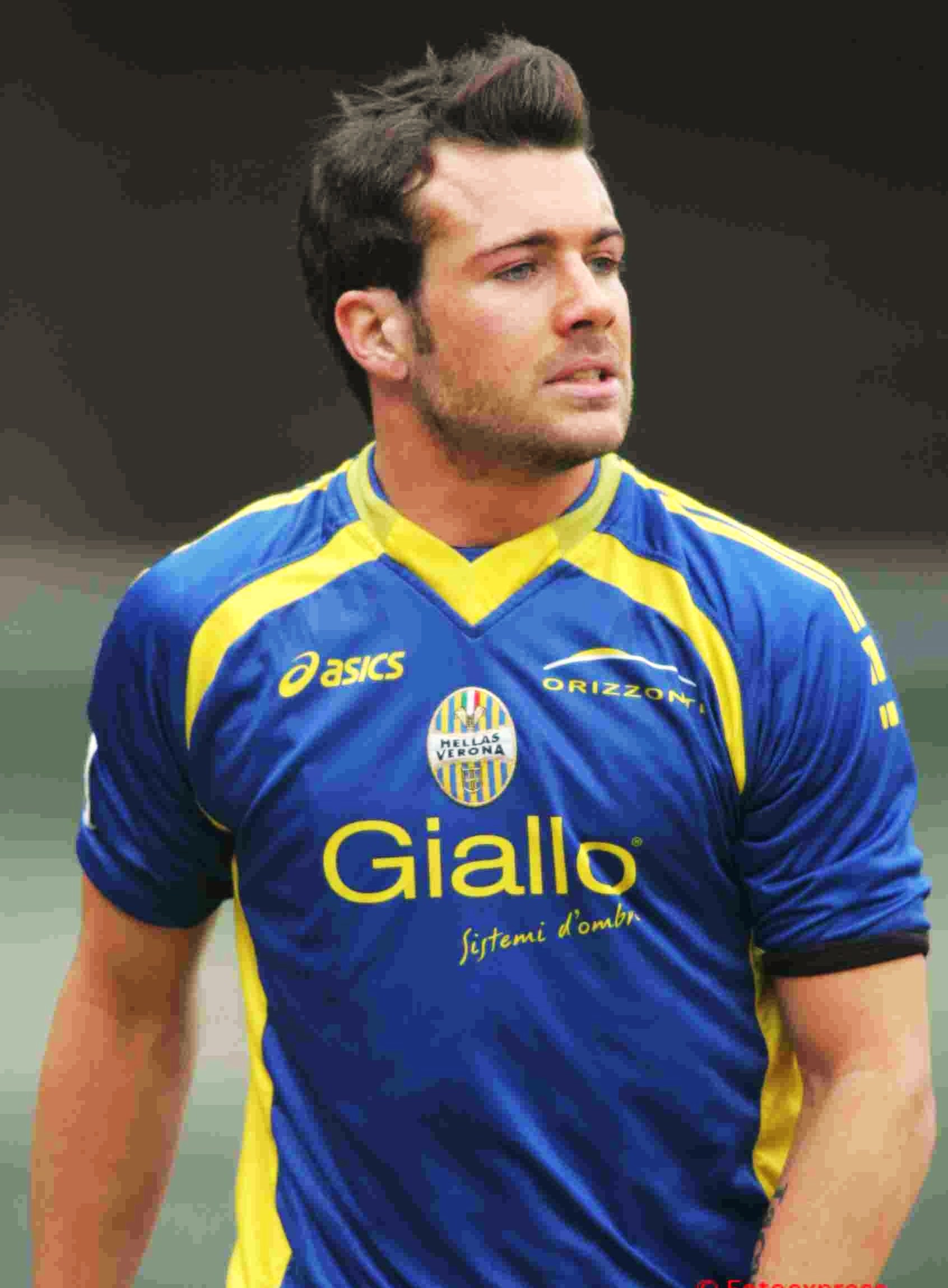
Following the 2002 relegation to Serie B, team fortunes continued to slip throughout the decade. In the 2003–04 season Hellas Verona struggled in Serie B and spent most of the season fighting off an unthinkable relegation to Serie C1. Undeterred, the fans supported their team and a string of late season wins eventually warded off the danger. Over 5,000 of them followed Hellas to Como on the final day of the season to celebrate.
In 2004–05, things looked much brighter for the team. After a rocky start, Hellas put together a string of results and climbed to third spot. The gialloblù held on to the position until January 2005, when transfers weakened the team, yet they managed to take the battle for Serie A to the last day of the season.
The 2006–07 Serie B seemed to start well, due to the club takeover by Pietro Arvedi D'Emilei, which ended nine years of controversial leadership under chairman Gianbattista Pastorello, heavily contested by the supporters in his later years at Verona. However, Verona was immediately involved in the relegation battle, and Massimo Ficcadenti was replaced in December 2006 by Giampiero Ventura. Despite a recovery in the results, Verona ended in an 18th place, thus being forced to play a two-legged playoff against 19th-placed Spezia to avert relegation. A 2–1 away loss in the first leg at La Spezia was followed by a 0–0 home tie, and Verona were relegated to Serie C1 after 64 years of play in the two highest divisions.
Verona appointed experienced coach Franco Colomba for the new season with the aim to return to Serie B as soon as possible. However, despite being widely considered the division favourite, the gialloblù spent almost the entire season in last place. After seven matches, club management sacked Colomba in early October and replaced him with youth team coach (and former Verona player) Davide Pellegrini. A new owner acquired the club in late 2007, appointing Giovanni Galli in December as new director of football and Maurizio Sarri as new head coach. Halfway through the 2007–08 season, the team remained at the bottom of Serie C1, on the brink of relegation to the fourth level (Serie C2). In response, club management sacked Sarri and brought back Pellegrini. Thanks to a late-season surge the scaligeri avoided direct relegation by qualifying for the relegation play-off, and narrowly averted dropping to Lega Pro Seconda Divisione in the final game, beating Pro Patria 2–1 on aggregate. However, despite the decline in results, attendance and season ticket sales remained at 15,000 on average.
For the 2008–09 season, Verona appointed former Sassuolo and Piacenza manager Gian Marco Remondina with the aim to win promotion to Serie B. However, the season did not start impressively, with Verona being out of the playoff zone by mid-season, and club chairman Pietro Arvedi D'Emilei entering into a coma after being involved in a car crash on his way back from a league match in December 2008. Arvedi died in March 2009, two months after the club was bought by new chairman Giovanni Martinelli.
The following season looked promising, as new transfer players were brought aboard, and fans enthusiastically embraced the new campaign. Season ticket figures climbed to over 10,000, placing Verona ahead of several Serie A teams and all but Torino in Serie B attendance. The team led the standings for much of the season, accumulating a seven-point lead by early in the spring. However, the advantage was gradually squandered, and the team dropped to second place on the second-last day of the season, with a chance to regain first place in the final regular season match against Portogruaro on home soil. Verona, however, disappointed a crowd of over 25,000 fans and, with the loss, dropped to third place and headed towards the play-offs. A managerial change for the post-season saw the firing of Remondina and the arrival of Giovanni Vavassori. After eliminating Rimini in the semi-finals (1–0; 0–0) Verona lost the final to Pescara (2–2 on home soil and 0–1 in the return match) and were condemned to a fourth-straight year of third division football.
Rising again and Serie A comeback (2012–present)
Former 1990 World Cup star Giuseppe Giannini (a famous captain of Roma for many years) signed as manager for the 2010–11 campaign. Once again, the team was almost entirely revamped during the transfer season. The squad struggled in the early months and Giannini was eventually sacked and replaced by former Internazionale defender Andrea Mandorlini, who succeeded in reorganising the team's play and bringing discipline both on and off the pitch. In the second half of the season, Verona climbed back from the bottom of the division to clinch a play-off berth (fifth place) on the last day of the regular season. The team advanced to the play-off final after eliminating Sorrento in the semi-finals 3–1 on aggregate. Following the play-off final, after four years of Lega Pro football, Verona were promoted back to Serie B after a 2–1 aggregate win over Salernitana on 19 June 2011.
On 18 May 2013, Verona finished second in Serie B and were promoted to Serie A after an eleven-year absence. Their return to the top flight began against title contenders Milan and Roma, beating the former 2–1 and losing to the latter 3–0. The team continued at a steady pace, finishing the first half of the season with 32 points and sitting in sixth place, eleven points behind the closest UEFA Champions League spot—and tied with Internazionale for the final UEFA Europa League spot. Verona, however, ultimately finished the year in tenth.
During the 2015–16 season, Verona had not won a single match since the beginning of the campaign until the club edged Atalanta 2–1 on 3 February 2016 in a win at home; coming twenty-three games into the season. Consequently, Verona were relegated from Serie A.
In the 2016–17 Serie B season, Hellas Verona finished second on the table and were automatically promoted back to Serie A. Hellas lasted one season back in the top division after finishing second last during the 2017–18 Serie A season and were relegated back to Serie B. At the end of the 2018–19 season, Hellas finished in fifth position and achieved promotion back to Serie A after defeating Cittadella 3–0 in the second leg of their promotion play-off to win 3–2 on aggregate.
The club's return to the top flight in the 2019–20 Serie A season, in which it was considered a strong relegation candidate at the beginning of the campaign, was a successful one, with a ninth-placed finish. Heavily reliant on the defensive solidity of 20-year-old centre-back Marash Kumbulla, Amir Rrahmani and goalkeeper Marco Silvestri, along with the consistent performances of midfielder Sofyan Amrabat, Verona was a surprise contender for Europa League qualification but fell out of the race after a downturn in form after the coronavirus break which temporarily halted the season. A 2–1 win at home against eventual title winners Juventus in February was a highlight of a season in which the club achieved 10 clean sheets and punched towards the higher end of the table despite its modest budget.
Ahead of Verona's second consecutive year in Serie A, key players Amrabat, Rrahmani and Kumbulla were poached by Fiorentina, Napoli and Roma respectively, and loanee Matteo Pessina returned to Atalanta. This left the club with a heavily weakened squad and it was once again expected to struggle in the league prior to the season-opening match. Despite these losses in the transfer window, Verona again finished in the top half of the league table, ending the season in 10th place with 45 points. Successful breakout seasons for attacking midfielder Mattia Zaccagni, who was eventually called up to the Italy national team as a reward for his performances, as well as wing-backs Federico Dimarco and Davide Faraoni, were partly the reason for this achievement. At the end of the season, coach Ivan Jurić was appointed by Torino following his two impressive Serie A seasons with Verona, with the Gialloblu replacing him with Eusebio Di Francesco.
Following another summer transfer window in which several of the club's star players were sold to Serie A rivals, namely Zaccagni transferring to Lazio, Marco Silvestri to Udinese and Dimarco returning to Inter, the beginning of the 2021-22 season proved to be much more difficult for Verona, as Di Francesco was fired and replaced with Igor Tudor after just three matches, all of which were defeats. This poor early-season form had left the club at the bottom of the table. Under the guidance of Tudor, the team regains competitiveness obtaining in the next eight matches three wins – including victories with Lazio and Juventus – four draws and only one defeat.
Colours and badge
.png)
The team's colours are yellow and blue. As a result, the clubs most widely used nickname is gialloblù literally "yellow-blue" in Italian. The colours represent the city itself and Verona's emblem (a yellow cross on a blue shield) appears on most team apparel. Home kits are traditionally blue, sometimes of a navy shade, combined with yellow details and trim, although the club has used a blue and yellow striped design on occasion. Two more team nicknames are Mastini (the mastiffs) and Scaligeri, both references to Mastino I della Scala of the Della Scala princes that ruled the city during the 13th and 14th centuries.
The Scala family coat of arms is depicted on the team's jersey and on its trademark logo as a stylised image of two large, powerful mastiffs facing opposite directions, introduced in 1995. In essence, the term "scaligeri" is synonymous with Veronese, and therefore can describe anything or anyone from Verona (e.g., Chievo Verona, a different team that also links itself to the Scala family – specifically to Cangrande I della Scala).
Supporters
Hellas Verona supporters have been associated with hard right politics since at least the 1970s, when the club’s most prominent ultras group, the Brigate Gialloblu, emerged. The group initially had left-wing leanings but shifted to the extreme right by the mid-1970s. Over the decades, sections of the Verona fanbase became notorious for racist, antisemitic, and fascist-inspired behaviour, including the display of swastikas, Celtic crosses, and Nazi salutes.
Incidents of racism have been repeatedly documented. In 1982–83, bananas were thrown at Cagliari striker Julio Cesar Uribe, one of the first Black players in Italian football. In 1996, during a derby with AC ChievoVerona, a black dummy representing Dutch player Maickel Ferrier was hung from the stadium railing with a banner reading "Negro, get out of here" by fans wearing Ku Klux Klan attire, contributing to Ferrier’s transfer falling through. Hellas fans have also directed racist abuse at Italian players from southern regions, including Napoli, using chants referencing the volcano Vesuvius.
In the 2000s and 2010s, incidents continued. In 2001, club president Giambattista Pastorello stated he would be unlikely to sign a Black player due to the racist attitudes of the fanbase. In 2014, Hellas Verona were fined €50,000 and received a partial stadium ban after fans racially abused AC Milan midfielder Sulley Muntari. That same year, Hellas fans also racially abused Pablo Armero, resulting in the Curva Sud being closed for one subsequent game. During a match against Livorno in April 2015, a section of Verona supporters chanted offensively about the recently deceased Livorno midfielder Piermario Morosini, provoking widespread condemnation. In 2019, ultras leader Luca Castellini made racist comments about Mario Balotelli, leading the club to ban him from attending matches until 2030.
Verona fans have also been implicated in abuse directed at Mario Balotelli in 2020, and Kalidou Koulibaly as well as Victor Osimhen in 2022, resulting in fines and partial stadium closures.
Far-right political connections have been explicit; Castellini, who leads both Forza Nuova's local branch in Verona and Hellas Verona’s hardcore ultras, was filmed in 2018 encouraging chants celebrating Adolf Hitler and Rudolf Hess, later being banned from the stadium. Verona ultras have repeatedly integrated fascist imagery and ideology into their displays, linking football support with broader extremist political beliefs. Despite these issues, club officials have occasionally attempted to distance themselves from the behaviour, while condemning racism publicly.
Stadium

Since 1963, the club have played at the Stadio Marc'Antonio Bentegodi, which has a capacity of 39,211. It is the eighth-largest stadium in Italy by capacity. The stadium is named after the historic benefactor of Veronese sport, Marcantonio Bentegodi.
The ground was shared with Hellas's rivals, Chievo Verona until 2021. It was used as a venue for some matches of the 1990 FIFA World Cup and renovations prior to the tournament included an extra tier and a roof to cover all sections, improved visibility, public transport connections, an urban motorway connecting the city centre with the stadium and the Verona Nord motorway exit and services.
Derby with Chievo Verona
Main article: Derby della Scala
The intercity fixtures against Chievo Verona are known as the "Derby della Scala". The name refers to the Scaligeri or della Scala aristocratic family, who were rulers of Verona during the Middle Ages and early Renaissance.
Hellas, founded in 1903, were traditionally the main club in Verona. Chievo, founded in 1929, historically represented the small Verona suburb of the same name, using a small parish field as their home ground, and did not become a professional side until 1986. At that time, Chievo became tenants of Hellas at the Bentegodi, and began rising up the league ladder. By the mid-1990s, Chievo had joined Hellas in Serie B, creating the derby. During the teams' early Serie B meetings, Hellas supporters taunted Chievo with the chant Quando i mussi volara, faremo el derby in Serie A – "Donkeys will fly before we’ll have a derby in Serie A." Once Chievo earned promotion to Serie A at the end of the 2000–01 season, their fans started calling the team i Mussi Volanti (The Flying Donkeys). A 2014 story in the British football magazine Late Tackle remarked that "Hellas fans didn’t so much have their words rammed down their throat as forced through every orifice with a barge pole."
In the season 2001–02, both Hellas Verona and the city rivals of Chievo Verona were playing in the Serie A. The first ever derby of Verona in Serie A took place on 18 November 2001, while both teams were ranked among the top four. The match was won by Hellas, 3–2. Chievo got revenge in the return match in spring 2002, winning 2–1. Verona thus became the fifth city in Italy, after Milan, Rome, Turin and Genoa to host a cross-town derby in Serie A.
Honours
Records and statistics
Club statistics

European cups all-time statistics
| Competition | S | Pld | W | D | L | GF | GA | GD | Total | 3 | 16 | 8 | 6 | 2 | 23 | 15 | +8 | ||||||||
|---|---|---|---|---|---|---|---|---|---|---|---|---|---|---|---|---|---|---|---|---|---|---|---|---|---|
| European Cup | 1 | 4 | 2 | 1 | 1 | 5 | 4 | +1 | |||||||||||||||||
| UEFA Cup | 2 | 12 | 6 | 5 | 1 | 18 | 11 | +7 |
European Cup
| Season | Round | Opposition | Home | Away | Aggregate |
|---|---|---|---|---|---|
| 1985–86 | First round | PAOK | 3–1 | 2–1 | 5–2 |
| Second round | Juventus | 0–0 | 0–2 | 0–2 |
UEFA Cup
| Season | Round | Opposition | Home | Away | Aggregate |
|---|---|---|---|---|---|
| 1983–84 | First round | Red Star Belgrade | 1–0 | 3–2 | 4–2 |
| Second round | Sturm Graz | 2–2 | 0–0 | 2–2 (a) | |
| 1987–88 | First round | Pogoń Szczecin | 3–1 | 1–1 | 4–2 |
| Second round | Utrecht | 2–1 | 1–1 | 3–2 | |
| Third round | Sportul Studenţesc | 3–1 | 1–0 | 4–1 | |
| Quarter-finals | Werder Bremen | 0–1 | 1–1 | 1–2 |
Player records
Most appearances
:Competitive, professional matches only.
| # | Name | Years | Matches |
|---|---|---|---|
| 1 | ITA Luigi Bernardi | 1927–1939 | 337 |
| 2 | ITA Emiliano Mascetti | 1967–1973, 1975–1980 | 328 |
| 3 | ITA Roberto Tricella | 1979–1984 | 324 |
| 4 | BRA Rafael | 2007–2016 | 314 |
| 5 | ITA Pio Gorretta | 1929–1933, 1934–1940 | 262 |
Top goalscorers
:Competitive, professional matches only.
| # | Name | Years | Goals |
|---|---|---|---|
| 1 | BRAITA Arnaldo Porta | 1914–1930 | 74 |
| 2 | ITA Sergio Sega | 1946–1952, 1954–1955 | 73 |
| 3 | ITA Guido Tavellin | 1939–1946, 1949–1950 | 58 |
| 4 | BRA Adaílton | 1999–2006 | 52 |
| 5 | ITA Egidio Chiecchi | 1921–1927 | 51 |
| ITA Luca Toni | 2013–2016 |
Divisional movements
| Series | Years | Last | Promotions | Relegations | 90 years of professional football in Italy since 1929 | Founding member of the Football League’s First Division in 1921 |
|---|---|---|---|---|---|---|
| A | 31 | 2025–26 | – | 10 (1929, 1958, 1974, 1979, 1990, 1992, 1997, 2002, 2016, 2018) | ||
| B | 53 | 2018–19 | 10 (1957, 1968, 1975, 1982, 1991, 1996, 1999, 2013, 2017, 2019) | 2 (1941, 2007) | ||
| C | 6 | 2010–11 | 2 (1943, 2011) | never |
Sponsors

| Period | Kit manufacturer | Shirt sponsor (main) | Shirt sponsor (secondary) | Shirt sponsor (back) | Shirt sponsor (sleeve) | Shorts sponsor |
|---|---|---|---|---|---|---|
| 1903–1979 | In-house | None | None | None | None | None |
| 1979–1981 | Ennerre | |||||
| 1981–1986 | Adidas | Canon | ||||
| 1986–1987 | Ricoh | |||||
| 1987–1989 | Hummel | |||||
| 1989–1990 | Hummel / Adidas | Pastificio Rana | ||||
| 1990–1991 | Adidas | |||||
| 1991–1995 | Uhlsport | |||||
| 1995–1996 | Erreà | |||||
| 1996–1997 | Ferroli | |||||
| 1997–1998 | ZG Camini Inox | |||||
| 1998–1999 | Atreyu Immobiliare | |||||
| 1999–2000 | Salumi Marsili | |||||
| 2000–2001 | Lotto | Net Business | ||||
| 2001–2002 | Amica Chips | |||||
| 2002–2003 | Clerman Costruzioni | |||||
| 2003–2006 | Legea | |||||
| 2006–2007 | Asics | Unika Logistica Industriale | ||||
| 2007–2008 | None | |||||
| 2008–2010 | Giallo Sistemi d'Ombra | Orizzonti | ||||
| 2010–2011 | Banca di Verona BCC (Home) & Sicurint Group (Away) | Protec Iniziative Immobiliari (Home) & Consorzio Asimov (Away) | ||||
| 2011–2012 | AGSM (Home) & Sicurint Group (Away) | Protec Iniziative Immobiliari (Home) & Leaderform (Away) | ||||
| 2012–2013 | AGSM & Leaderform | Various | ||||
| 2013–2014 | Nike | Manila Grace (Matchday 1-13) / Franklin & Marshall (13-38) | AGSM & Leaderform | |||
| 2014–2015 | Franklin & Marshall | Manila Grace | ||||
| 2015–2016 | Metano Nord | Leaderform & SEC Ponteggi | Manila Grace (Matchday 1-13) / Jetcoin (13-38) | |||
| 2016–2017 | Extreme Printing & SEC Ponteggi | ChanceBet | Consorzio San Zeno | |||
| 2017–2018 | SEC Events (Home), Maticmind (Away) & Sartori Vini (Third) | None | ||||
| 2018–2019 | Macron | Synergy Luce e Gas | Air Dolomiti (Home & Away) & Sartori Vini (Third) | Unibet | Facile Ristrutturare | SEC Events |
| 2019–2020 | Various | Mercedes-Benz Trivellato Industriali | None | |||
| 2020–2021 | Winelivery | Various | ||||
| 2021–2022 | Manila Grace (Matchday 4-23 / Omega Group (24-38) | VetroCar | Restructure 5.0 | |||
| 2022–2023 | DR Automobiles | Leasys Rent / Drivalia | ||||
| 2023–2024 | Joma | Conforama | Drivalia | |||
| 2024–2025 | 958 Santero | |||||
| 2025– | Aircash | None |
Players
First-team squad === <!----------------------------- READ THIS NOTICE FIRST BEFORE EDITING ----------------------------------
– Do not add new players before their signing is OFFICIALLY announced by the club, including medicals – Do not remove players before their exit is officially announced by the club – Do not change or add squad numbers until it is official on the club website's squad list – This is Wikipedia, not a football gazette. Anything unconfirmed and unsourced will be removed ON SIGHT – Vandals WILL be blessed with the template. THANK YOU.
Primavera
Out on loan
Club officials
Board of directors
| a | #F4CA16 | 1px}};" | Role | a | #F4CA16 | 1px}};" | Name |
|---|---|---|---|---|---|---|---|
| Owner | USA Presidio Investors | ||||||
| Executive President | USA Italo Zanzi | ||||||
| Honorary President | ITA Osvaldo Bagnoli | ||||||
| Board Members | ROU Cristian Pușcașiu | ||||||
| USA Dirk Swaneveld | |||||||
| GER Thomas Hitzlsperger | |||||||
| GER Donata Hopfen | |||||||
| GER Isabella Thun | |||||||
| General Director | ITA Simona Gioè | ||||||
| Sporting Director | ITA Sean Sogliano | ||||||
| General Secretary | ITA Mirco Zardini | ||||||
| Administrative Secretary's Office | ITA Valentina Comparini | ||||||
| Commercial Area | USA Sean Foley | ||||||
| ITA Federico Fornaris | |||||||
| Communications Department | ITA Dino Guerrini | ||||||
| Digital Department | ITA Federico Montresor | ||||||
| Marketing Director | ITA Carlotta Robotti | ||||||
| Head Scout | CAN Rocco Ottati | ||||||
| Acting Auditor | ITA Massimo Santini | ||||||
| ITA Stefano Fiocchi | |||||||
| ITA Nicola Catenacci | |||||||
| Substitute Auditor | ITA Lorenza Catenacci | ||||||
| ITA Grazia Cocchi | |||||||
| Supervisory board Chairman & Member | ITA Gabriele Tarantini | ||||||
| ITA Margherita Catenacci | |||||||
| Youth Center Manager | VEN Massimo Margiotta | ||||||
| Team Manager | ITA Alessandro Mazzola |
- Last updated: 19 February 2025
- Source:
Current technical staff
| a | #F4CA16 | 1px}};" | Role | a | #F4CA16 | 1px}};" | Name |
|---|---|---|---|---|---|---|---|
| Head coach | ITA Paolo Zanetti | ||||||
| Assistant coach | ITA Alberto Bertolini | ||||||
| Technical coach | ITA Nicola Beati | ||||||
| Fitness coaches | ITA Fabio Trentin | ||||||
| ITA Alessandro Scaia | |||||||
| Goalkeeping coaches | ITA Massimo Cataldi | ||||||
| ITA Valerio Filippi | |||||||
| Match analysts | ITA Alberto Nabiuzzi | ||||||
| ITA Nicolò Guberti | |||||||
| Rehab coach | ITA Giorgio Panzarasa | ||||||
| Head of medical | ITA Pietro Gatto | ||||||
| Nutritionist | ITA Filippo Gori | ||||||
| Physiotherapists | ITA Alfonso Casano | ||||||
| ITA Francesco Passigato | |||||||
| ITA Sandro Martini | |||||||
| ITA Marco Pittoli | |||||||
| Storemen | ITA Tomas Bodini | ||||||
| ITA Davide Cacciatori | |||||||
| ITA Antonio Salomoni |
- Last updated: 8 September 2025
- Source:
Managers
- HUN Ferenc Molnár (1 July 1924 – 30 June 1925)
- HUN Imre Schöffer (1 July 1925 – 30 June 1926)
- ITA Aldo Fagiuoli (1 July 1926 – 26 December 1927)
- HUN Imre János Bekey (27 December 1927 – 30 June 1928)
- ITA Alessandro Bascheni (1 July 1928 – 30 June 1929)
- HUN András Kuttik (1 July 1929 – 30 June 1932)
- AUT Rudolf Stanzel (1 July 1932 – 30 June 1933)
- HUN Imre János Bekey (1 July 1933 – 30 June 1934)
- HUN Sándor Peics (1939)
- AUT Karl Stürmer (1941–1942)
- ITA Bruno Biagini (1 July 1948 – 6 November 1949)
- HUN László Székely (8 November 1949 – 16 January 1950)
- ITA Angelo Piccioli (17 January 1950 – 23 March 1953)
- HUN Gyula Lelovics (23 March 1953 – 30 June 1953)
- ITA Luigi Rossetto (1 July 1953 – 31 January 1954)
- ITA Luigi Ferrero (4 February 1954 – 11 October 1954)
- ITA Angelo Piccioli (11 October 1954 – 1 February 1955)
- ITA Federico Allasio (6 February 1955 – 11 December 1955)
- ITA Angelo Piccioli (25 December 1955 – 5 May 1958)
- ITA Luigi Bonizzoni (6 May 1958 – 30 June 1958)
- ITA Vinicio Viani (1 July 1958 – 18 January 1959)
- ITA Guido Tavellin (25 January 1959 – 5 November 1959)
- ITA Aldo Olivieri (5 November 1959 – 26 September 1960)
- ITA Romolo Bizzotto (2 October 1960 – 30 June 1961)
- ITA Bruno Biagini (1 July 1961 – 30 June 1962)
- ITA Guido Tavellin (1 July 1962 – 25 November 1962)
- ITA Carlo Facchini (2 December 1962 – 17 May 1964)
- ITA Bruno Biagini (24 May 1964 – 30 June 1964)
- ITA Giancarlo Cadé (1 July 1964 – 30 June 1965)
- ITA Omero Tognon (1 July 1965 – 20 November 1966)
- ITA Ugo Pozzan (20 November 1966 – 15 January 1967)
- SWE Nils Liedholm (23 January 1967– 30 June 1968)
- ITA Ugo Pozzan (1 July 1967 – 30 June 1968)
- ITA Giancarlo Cadé (1 July 1968 – 30 June 1969)
- ITA Renato Lucchi (1 July 1969 – 30 November 1970)
- ITA Ugo Pozzan (1 July 1971 – 30 June 1972)
- ITA Giancarlo Cadé (1 July 1972 – 10 March 1975)
- ITA Luigi Mascalaito (10 March 1975 – 30 June 1975)
- ITA Ferruccio Valcareggi (1 July 1975 – 30 June 1978)
- ITA Luigi Mascalaito (1 July 1978 – 13 November 1978)
- ITA Giuseppe Chiappella (13 November 1978 – 30 June 1979)
- ITA Fernando Veneranda (1 July 1979 – 30 June 1980)
- ITA Giancarlo Cadé (1 July 1980 – 30 June 1981)
- ITA Osvaldo Bagnoli (1 July 1981 – 30 June 1990)
- ITA Eugenio Fascetti (1 July 1990 – 28 March 1992)
- SWE Nils Liedholm (29 March 1992 – 30 June 1992)
- ITA Edoardo Reja (1 July 1992 – 30 June 1993)
- ITA Franco Fontana (1 July 1993 – 30 June 1994)
- ITA Bortolo Mutti (1 July 1994 – 30 June 1995)
- ITA Attilio Perotti (1 July 1995 – 30 June 1996)
- ITA Luigi Cagni (1 July 1996 – 4 April 1998)
- ITA Sergio Maddè (4 April 1998 – 30 June 1998)
- ITA Cesare Prandelli (1 July 1998 – 30 June 2000)
- ITA Attilio Perotti (1 July 2000 – 30 June 2001)
- ITA Alberto Malesani (4 July 2001 – 10 June 2003)
- ITA Sandro Salvioni (1 July 2003 – 23 December 2003)
- ITA Sergio Maddè (24 December 2003 – 30 June 2004)
- ITA Massimo Ficcadenti (20 July 2004 – 24 December 2006)
- ITA Giampiero Ventura (24 December 2006 – 30 June 2007)
- ITA Franco Colomba (1 July 2007 – 8 October 2007)
- ITA Davide Pellegrini (9 October 2007 – 30 December 2007)
- ITA Maurizio Sarri (31 December 2007 – 27 February 2008)
- ITA Davide Pellegrini (28 February 2008 – 11 June 2008)
- ITA Gian Marco Remondina (12 June 2008 – 10 May 2010)
- ITA Giovanni Vavassori (10 May 2010 – 21 June 2010)
- ITA Giuseppe Giannini (22 June 2010 – 8 November 2010)
- ITA Andrea Mandorlini (9 November 2010 – 30 November 2015)
- ITA Luigi Delneri (1 December 2015 – 23 May 2016)
- ITA Fabio Pecchia (1 June 2016 – 21 June 2018)
- ITA Fabio Grosso (21 June 2018 – 1 May 2019)
- ITA Alfredo Aglietti (2 May 2019 – 14 June 2019)
- CRO Ivan Jurić (14 June 2019 – 28 May 2021)
- ITA Eusebio Di Francesco (7 June 2021 – 14 September 2021)
- CRO Igor Tudor (14 September 2021 – 28 May 2022)
- ITA Gabriele Cioffi (1 June 2022 – 11 October 2022)
- ITA Salvatore Bocchetti (13 October 2022 – 2 December 2022)
- ITA Marco Zaffaroni (3 December 2022 – 30 June 2023)
- ITA Marco Baroni (1 July 2023 – 10 June 2024)
- ITA Paolo Zanetti (1 July 2024 - present)
World Cup players
The following players have been selected by their country for the FIFA World Cup finals while playing for Hellas Verona.
- Roberto Tricella (1986)
- Antonio Di Gennaro (1986)
- Giuseppe Galderisi (1986)
- Preben Elkjær (1986)
- Hans-Peter Briegel (1986)
- Nelson Gutiérrez (1990)
- Ruslan Nigmatullin (2002)
- Anthony Šerić (2002)
- Rafael Márquez (2014)
- Lee Seung-woo (2018)
- Ajdin Hrustic (2022)
- Ivan Ilić (2022)
- Darko Lazović (2022)
- Martin Hongla (2022)
Notes
References
References
- "Stadio Marcantonio Bentegodi". hellasverona.it.
- "American private equity firm Presidio Investors completes takeover of Serie A side Hellas Verona". Goal.com.
- Bertoldi, Luigi. (1983). "80 anni di storia del Verona Calcio". Editoriale Bortolazzi-Stei.
- "1985/86 European Champions Clubs' Cup". UEFA.
- (July 13, 2011). "Hellas Verona On the Rise Once More".
- (August 27, 2021). "Hellas Verona Football Club: The Complete Guide".
- (8 October 2007). "Punch-drunk Verona fire Colomba". Channel 4.
- (4 September 2009). "Tifosi dell'Hellas Verona: 10.442 abbonamenti!". HellasWeb.
- (9 May 2009). "Lega Pro 1/B: i tabellini della 34.a giornata". Data Sport.
- (18 May 2013). "Hellas Verona back in Serie A after 11 years away". Yahoo Sports.
- (3 February 2016). "Hellas Verona claim long-awaited first Serie A win of the season". ESPN Sports Media.
- "Hellas Verona relegated from Serie A despite late win over AC Milan". ESPN Sports Media.
- (5 May 2018). "Hellas Verona are relegated". Tiro Media.
- (2 June 2019). "Hellas Verona promoted back to Serie A". ESPN Sports Media.
- (7 August 2020). "Hellas Verona Serie A 2019/20 Season Review". ForzaItalianFootball.
- "Hellas Verona review 2019-20". footballteamnews.
- (3 September 2020). "Serie A 2020/21 Season Preview: Hellas Verona".
- (27 May 2021). "Hellas Verona season review". Football Italia.
- (7 June 2021). "Verona appoint Di Francesco". Football Italia.
- (14 September 2021). "Official: Tudor announced as new Verona manager". Football Italia.
- (19 August 2014). "Getting shirty ~ Hellas Verona, 1995–96". When Saturday Comes.
- (14 May 2018). "Hellas Verona: The Most Racist Fans In All Of Italy".
- (13 December 2019). "Tifo, i cori razzisti al pub dei tifosi del Verona: "Niente negri, lalalalalala-la…niente negri"". [[la Repubblica]].
- (15 March 2022). "Hellas Verona hit with 1-match stand closure after racist chants". [[Score Media and Gaming.
- (30 January 2001). "Verona president under fire in black player row". [[The Guardian]].
- (21 October 2014). "Verona punished for fans' racist abuse of AC Milan's Muntari". [[Fox Sports]].
- (14 January 2014). "Suspended sanction for Verona".
- Horncastle, James. (7 May 2015). "Ultras bring fresh shame on not-so-fair Verona". [[TNT Sports]].
- (5 November 2019). "Hellas Verona ban ultras leader until 2030 over Balotelli comments". [[Irish Times]].
- (10 January 2020). "Verona fan receives five-year stadium ban for inciting racism against Balotelli". [[The Guardian]].
- (19 August 2022). "Verona under investigation and fined for Osimhen racist abuse". [[BBC Sport]].
- Lowen, Mark. (30 May 2024). "Italy’s PM says fascism is ‘consigned to history’. Not everyone is so sure". [[BBC News]].
- "Stadio Marc'Antonio Bentegodi". stadiumguide.com.
- Hall, Richard. (February 19, 2014). "Chievo: Serie A alternative club guide".
- Duque, Daniel. (December 17, 2021). "The Sad Story of Chievo Verona".
- Paul, Edd. (10 July 2014). "Chievo: Fairytale of the Flying Donkeys". Late Tackle.
- (19 November 2001). "Verona derby top dogs". [[BBC Sport]].
- "Winners". Lega Nazionale Professionisti Serie A.
- "Italy – List of Second Division (Serie B) Champions". The Record Sport Soccer Statistics Foundation.
- "Prima Squadra Maschile".
- "Organigramma {{!}} Club {{!}} Hellas Verona Official Website {{!}} Hellas Verona Official Website".
- "Prima Squadra Maschile".
This article was imported from Wikipedia and is available under the Creative Commons Attribution-ShareAlike 4.0 License. Content has been adapted to SurfDoc format. Original contributors can be found on the article history page.
Ask Mako anything about Hellas Verona FC — get instant answers, deeper analysis, and related topics.
Research with MakoFree with your Surf account
Create a free account to save articles, ask Mako questions, and organize your research.
Sign up freeThis content may have been generated or modified by AI. CloudSurf Software LLC is not responsible for the accuracy, completeness, or reliability of AI-generated content. Always verify important information from primary sources.
Report