From Surf Wiki (app.surf) — the open knowledge base
Helix Nebula
Planetary nebula in the constellation Aquarius
Planetary nebula in the constellation Aquarius
| access-date=2006-12-07}} The Helix Nebula (also known as NGC 7293 or Caldwell 63) is a planetary nebula (PN) located in the constellation Aquarius. Discovered by Karl Ludwig Harding, most likely before 1824, this object is one of the closest of all the bright planetary nebulae to Earth.{{cite journal | display-authors=4 | doi-access=free | access-date=2007-07-16 |url-status = live |archive-url = https://web.archive.org/web/20140714152714/http://www.universetoday.com/97713/eye-like-helix-nebula-turns-blue-in-new-image/ |archive-date = 14 July 2014
General information
The Helix Nebula is an example of a planetary nebula, formed by an intermediate to low-mass star, which sheds its outer layers near the end of its evolution. Gases from the star in the surrounding space appear, from Earth's perspective, a helix structure. The remnant central stellar core, known as the central star (CS) of the planetary nebula, is destined to become a white dwarf star. The observed glow of the central star is so energetic that it causes the previously expelled gases to brightly fluoresce.
The nebula is in the constellation of Aquarius, and lies about 650 light-years away, spanning about 0.8 parsecs (2.5 light-years). Its age is estimated to be years, based on the ratio of its size to its measured expansion rate of 31 km·s−1.
Structure
.jpg)

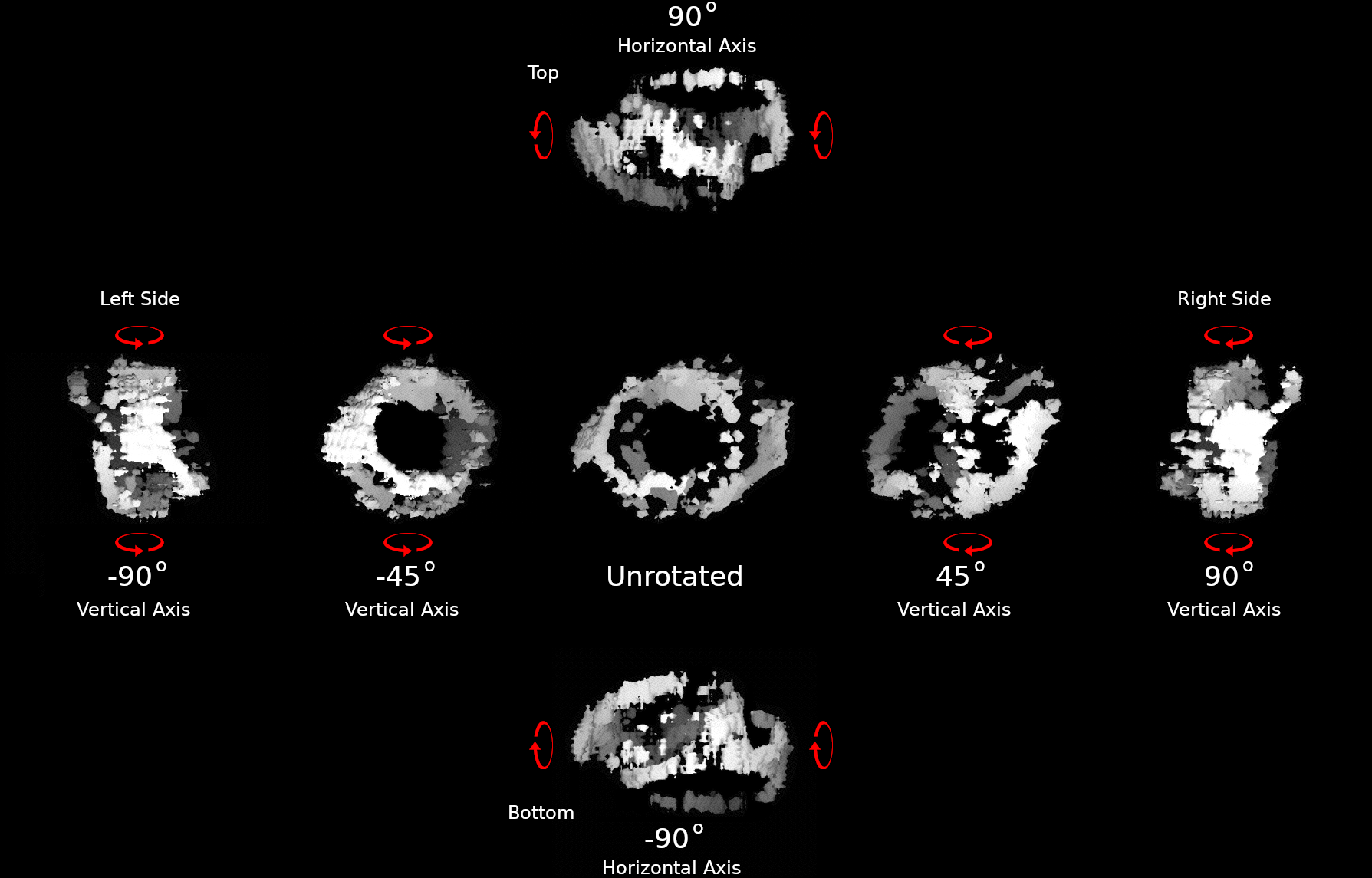
The Helix Nebula is thought to be shaped like a prolate spheroid with strong density concentrations toward the filled disk along the equatorial plane, whose major axis is inclined about 21° to 37° from our vantage point. The size of the inner disk is 8×19 arcmin in diameter (0.52 pc); the outer torus is 12×22 arcmin in diameter (0.77 pc); and the outer-most ring is about 25 arcmin in diameter (1.76 pc). The outer-most ring appears flattened on one side due to it colliding with the ambient interstellar medium.
Expansion of the whole planetary nebula structure is estimated to have occurred in the last 12,100 years, and 6,560 years for the inner disk. Spectroscopically, the inner disk's expansion rate is 40 km/s, and about 32 km/s for the outer ring.
Knots

The Helix Nebula was the first planetary nebula discovered to contain cometary knots. Its main ring contains knots of nebulosity, which have now been detected in several nearby planetary nebulae, especially those with a molecular envelope like the Ring nebula and the Dumbbell Nebula.
These knots are radially symmetrical (from the CS) and are described as "cometary", each centered on a core of neutral molecular gas and containing bright local photoionization fronts or cusps towards the central star and tails away from it.{{cite journal | display-authors=4 | editor-last1=Arthur | editor-first1=Jane | editor-last2=Henney | editor-first2=William
The knots are probably the result of Rayleigh-Taylor instability. The low density, high expansion velocity ionized inner nebula is accelerating the denser, slowly expanding, largely neutral material which had been shed earlier when the star was on the Asymptotic Giant Branch.
The excitation temperature varies across the Helix nebula. The rotational-vibrational temperature ranges from 1800 K in a cometary knot located in the inner region of the nebula are about 2.5'(arcmin) from the CS, and is calculated at about 900 K in the outer region at the distance of 5.6'.
Central star

The central star of the Helix Nebula is a white dwarf of spectral type DAO. It has the designations WD 2226-210, PHL 287, and GJ 9785. The star has a radius of 0.025 solar radius, a mass of , a temperature of 120,000 Kelvin and has an apparent magnitude of 13.5.
A mid-infrared excess suggest a disk with a size of 35 to 150 AU, formed from Kuiper-belt like objects. The size was later revised to be a ring between 30 and 100 AU. The non-detection at longer wavelengths allowed a research team to reject a series of scenarios. The researchers think the mid-IR excess comes from a replenishment of dust particles from thousands of exocomets at high eccentricities, with an origin from an Oort cloud-like structure.
A 2024 study hypothesized that the central star might be orbited by a planet based on periodic variations in its light curve, but it cannot be ruled out that these variations are due to intrinsic stellar variability. Assuming an inclination of 25° (aligned with the nebula itself), this hypothetical planet is estimated to have a radius of 0.021 solar radius, or about 2.3 times the radius of Earth.
Another study from 2025 found from X-ray observation that the central star may be accreting the remains of a Jupiter-like planet. This would be closer than the planet found via optical variability.
Videos
References
References
- "SIMBAD references".
- (1999). "The Molecular Envelope of the Helix Nebula". The Astrophysical Journal.
- Su, K. Y. L.. (March 2007). "A Debris Disk around the Central Star of the Helix Nebula?". The Astrophysical Journal.
- (June 1999). "Morphology and Composition of the Helix Nebula". The Astrophysical Journal.
- "APOD: 2008 April 13 - Curious Cometary Knots in the Helix Nebula".
- (June 2002). "Knots in Nearby Planetary Nebulae". The Astronomical Journal.
- (2009-08-01). "A "Firework" of H2Knots in the Planetary Nebula NGC 7293 (The Helix Nebula)". The Astrophysical Journal.
- (10 May 2006). "The Origin and Physical Properties of the Cometary Knots in NGC 7293". The Astrophysical Journal.
- Matsuura, M.. (December 2007). "VLT/near-infrared integral field spectrometer observations of molecular hydrogen lines in the knots of the planetary nebula NGC 7293 (the Helix Nebula)". [[Monthly Notices of the Royal Astronomical Society]].
- (October 2024). "Novel Constraints on Companions to the Helix Nebula Central Star". [[Monthly Notices of the Royal Astronomical Society]].
- (2007-03-01). "A Debris Disk around the Central Star of the Helix Nebula?". The Astrophysical Journal.
- (2023-01-01). "Evidence for the Disruption of a Planetary System During the Formation of the Helix Nebula". The Astronomical Journal.
- (2024). "Accretion onto WD 2226$-$210, the central star of the Helix Nebula". Monthly Notices of the Royal Astronomical Society.
This article was imported from Wikipedia and is available under the Creative Commons Attribution-ShareAlike 4.0 License. Content has been adapted to SurfDoc format. Original contributors can be found on the article history page.
Ask Mako anything about Helix Nebula — get instant answers, deeper analysis, and related topics.
Research with MakoFree with your Surf account
Create a free account to save articles, ask Mako questions, and organize your research.
Sign up freeThis content may have been generated or modified by AI. CloudSurf Software LLC is not responsible for the accuracy, completeness, or reliability of AI-generated content. Always verify important information from primary sources.
Report