From Surf Wiki (app.surf) — the open knowledge base
Helicopter Underwater Escape Training
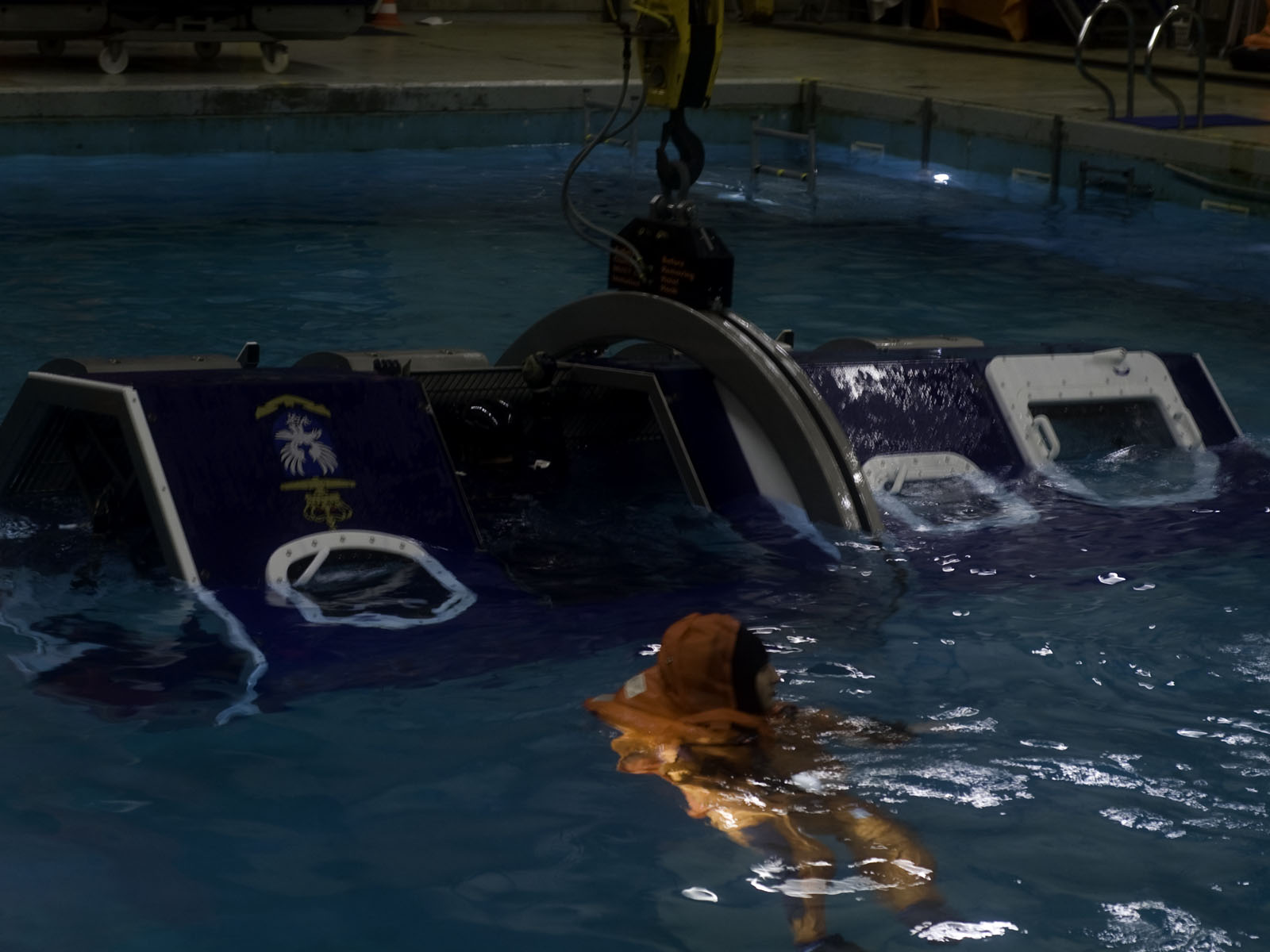
Helicopter Underwater Egress Training (also known as Helicopter Underwater Escape Training ); often abbreviated as HUET, pronounced hue-wet, hue-way or you-way) is training provided to helicopter flight crews, offshore oil and gas industry, law enforcement personnel, and military personnel who are regularly transported by helicopters over water. As the name implies, the purpose of this training is to prepare passengers and crew for an emergency evacuation or egress in the event of a crash landing on water.
Overview
Typical HUET programs involve both a theoretical and practical component. The theoretical component provides personnel with information related to previous ditching events, the hazards of helicopter operations (e.g., main and tail rotors, engine exhausts, and external antenna locations), the available safety equipment carried on board the helicopter (external floatation devices, emergency egress lighting, crash attenuating seats) as well as personal protective equipment (PPE), and the procedures needed to safely operate the equipment. This theoretical component specifically outlines the three phases of a ditching (pre-impact, post-impact, and rescue) to ensure that individuals can complete tasks that will improve survivability. The practical component of the training provides the opportunity for individuals to physically complete the skills known to be important during underwater egress.
Theoretical component
Pre-impact
Pre-impact tasks include aspects of being physically and mentally prepared for the flight (e.g., adequate sleep, proper hydration and caloric intake, and dressing appropriately for the expected environmental conditions). The program identifies immediate actions (e.g., securing losses articles within close proximity, tightening of seat restrains including stowage of excess material, identification of primary and secondary exits, and brace positions) to be taken in the event of an in-flight emergency that requires the pilots to make a ditching. Priority is placed on the development of an appropriate brace position, as reports have identified that drowning is the most prevalent cause of death during a ditching; however, the pre-impact phase includes the preparation prior to arrival at a heliport and ends the moment that the helicopter touches the surface of the water. Pre-flight videos at the heliport are typically used to reenforce the information provided in the theoretical component of HUET programs.
Post-impact
Post-impact training addresses the steps need to evacuate from an upright fuselage into the water or a life raft as well as those needed to egress from an inverted and flooded cabin. This post-impact theory typically includes clear instructions about when and how the evacuation/egress should occur. For example, evacuation into a life raft should be directed by the aircrew as long as they are capable of doing so. Egressing from a capsized and flooded cabin should occur after the initial ingress of water has begun to subside. Seat restrains should remain on during the inversion period and should only be removed once a clear egress path has been established. Seat restraints aid in the ability to remain oriented in relation to the fuselage and to apply force on an emergency exit. Once an exit has been removed, a hand should be placed on the open window/door edge to ensure that when the seat restrain is released, there is a physical reference point directly to the outside of the fuselage. If an emergency breath system (EBS) has been provided as part of the PPE, it should be used in any situation where immediate underwater egress is not available (e.g.,impact injury, blocked exit, aisle seat, or multiple passengers using one exit) or egress will take longer than an individual's breath-hold capabilities.
Rescue
The rescue phase of a ditching includes information related to in-water or in-life raft survival as well as a discussion regarding the various search and rescue (SAR) resources/procedures available in the local region. This portion of the theoretical information also provides guidance concerning signalling for help, completing first-aid, and being hoisted from the water/life raft. In-water survival instruction most often covers aspects of PPE such as life jackets, immersion suits, and signalling devices as well as the effects of hypothermia.
Practical component
Training environment
The practical training component includes the opportunity to use the personal protective equipment discussed in the theoretical component as well as complete underwater egress skills from an underwater egress simulator (UES). The UES varies across each training centre, as does the level of physical fidelity, the required number of egress trials and the period of certification. The most common UES systems rotate around single axis, usually lengthwise; however, some designs can turn 360° in both the horizontal and vertical planes. The underwater egress practical component is designed to simulate real-world environmental conditions by completely inverting 180˚ (or in some cases slightly off angle to simulate that the external floatation devices have failed on one side of the helicopter) and flooding the UES in a pool. Some training centres also include environmental elements such as wind, rain, sound, and simulated lightning depending on the training program.
HUET performance assessment
Assessment of egress performance focuses on students completing and maintaining a brace position, identifying, functioning, and using primary and secondary exit points, egressing through the exit without kicking, surfacing outside the UES, and performing post-egress survival skills such as inflating a life jacket or life raft, completing a head count to ensure that everyone has successfully egressed. Depending on the jurisdictional requirements in which the HUET program is completed, there may or may not be a requirement to open a simulated emergency exit while underwater. The HUET training aims to develop awareness of what, how, and when specific skills need to be implemented to increase the chances of survival during a ditching.
References
References
- [https://www.edumaritime.net/opito-courses/huet-with-ebs-or-caebs OPITO HUET Training]
- Boilerplate. "Training Courses".
- "RelyOn Nutec {{!}} Offshore Safety Training & Competence Services".
- (2007). "The Paradox of Helicopter Emergency Training". International Journal of Aviation Psychology.
- "Welcome to Survival Systems Training Limited".
- "How to Survive A Helicopter Crash".
- "Underwater Escape {{!}} Survival Training Since 1982 {{!}} Survival Systems USA".
- (28 November 2014). "Education and Training for the Oil and Gas Industry: Building A Technically Competent Workforce: 2 (The Getenergy Guides)". Elsevier.
- (2011-09-01). "Helicopter Crashes Related to Oil and Gas Operations in the Gulf of Mexico". Aviation, Space, and Environmental Medicine.
- (2014-04-01). "Helicopter Crashes into Water: Warning Time, Final Position, and Other Factors Affecting Survival". Aviation, Space, and Environmental Medicine.
- "An examination of survival rates based on external flotation devices: A helicopter ditching review from 1971 to 2005".
- Taber, Michael J.. (7 October 2015). "Handbook of offshore helicopter transport safety : essentials of underwater egress and survival".
- "Inderscience Publishers - linking academia, business and industry through research".
- (21 February 2018). "Brace for Impact Positions for all Aircraft Occupants".
- "The Human Factors of Surviving a Helicopter Ditching".
- (2008-10-01). "Civilian Helicopter Accidents into Water: Analysis of 46 Cases, 1979-2006". Aviation, Space, and Environmental Medicine.
- "MAIN GEARBOX MALFUNCTION / COLLISION WITH WATER COUGAR HELICOPTERS INC. SIKORSKY S-92A, C-GZCH ST. JOHN'S, NEWFOUNDLAND AND LABRADOR, 35 NM E 12 MARCH 2009".
- Taber, Michael J.. (2013-08-01). "Crash attenuating seats: Effects on helicopter underwater escape performance". [[Safety Science]].
- Taber, Michael J.. (2014-02-01). "Simulation fidelity and contextual interference in helicopter underwater egress training: An analysis of training and retention of egress skills". Safety Science.
- (2014-07-01). "Forces required to jettison a simulated S92 passenger exit: Optimal helicopter underwater egress training techniques". International Journal of Industrial Ergonomics.
- (2015). "Operational functionality test of offshore helicopter seat harness in wet and dry conditions". International Journal of Human Factors and Ergonomics.
- (September 1997). "Helicopter door and window jettison mechanisms for underwater escape: ergonomic confusion!". Aviation, Space, and Environmental Medicine.
- (2017-03-01). "Factor effecting the capability to jettison an S92 push-out window". International Journal of Industrial Ergonomics.
- "The Requirements for an Emergency Breathing System (EBS) in Over-Water Helicopter and Fixed Wing Aircraft Operations".
- (2009-10-01). "The effect of emergency breathing systems during helicopter underwater escape training for land force troops". Safety Science.
- (October 2001). "Breath-holding ability of offshore workers inadequate to ensure escape from ditched helicopters". Aviation, Space, and Environmental Medicine.
- (June 2001). "The basis for the development of a fuselage evacuation time for a ditched helicopter". Aviation, Space, and Environmental Medicine.
- (2011-11-01). "The effect of transportation suit induced heat stress on helicopter underwater escape preparation and task performance". Applied Ergonomics.
- (2014-01-01). "2 - Cold-water immersion suits". Woodhead Publishing.
- "Cold Water Immersion".
- "helicopter underwater egress simulators - Google Search".
- "Atlantic Canada Offshore Petroleum Standard Practice for the Training and Qualifications of Offshore Personnel".
- "Helicopter Underwater Escape Training (with Compressed Air Emergency Breathing System)".
- "MWH simulators".
- (2013-12-01). "Confidence in future helicopter underwater egress performance: An examination of training standards". Safety Science.
This article was imported from Wikipedia and is available under the Creative Commons Attribution-ShareAlike 4.0 License. Content has been adapted to SurfDoc format. Original contributors can be found on the article history page.
Ask Mako anything about Helicopter Underwater Escape Training — get instant answers, deeper analysis, and related topics.
Research with MakoFree with your Surf account
Create a free account to save articles, ask Mako questions, and organize your research.
Sign up freeThis content may have been generated or modified by AI. CloudSurf Software LLC is not responsible for the accuracy, completeness, or reliability of AI-generated content. Always verify important information from primary sources.
Report