From Surf Wiki (app.surf) — the open knowledge base
Heilongjiang
Province of China

Province of China
| Field | Value | |||
|---|---|---|---|---|
| name | Heilongjiang | |||
| native_name | 黑龙江 | |||
| settlement_type | Province | |||
| official_name | Province of Heilongjiang | |||
| translit_lang1 | Chinese | |||
| translit_lang1_type | Simplified Chinese | |||
| translit_lang1_info | 黑龙江省 | |||
| translit_lang1_type1 | Hanyu pinyin | |||
| translit_lang1_info1 | zh | |||
| translit_lang1_type2 | Abbreviation | |||
| translit_lang1_info2 | HL / (zh) | |||
| image_skyline | {{multiple image | border = infobox | total_width = 300 | image_style = border:1; |
| perrow | 1/2/2/2 | |||
| image1 | Views of Blagoveshchensk (November 2023) - 1.jpg | |||
| caption1 | View of Heihe from Heilongjiang | |||
| image2 | Sifengshan Reservoir and temple of Dragon King, Oct 2020.jpg | |||
| caption2 | Jiamusi | |||
| image3 | Hornito_in_Wudalianchi_1,_Aug_2019.jpg | |||
| caption3 | Wudalianchi volcanic field | |||
| image4 | Jingpo_Lake,_rowing_boat.jpg | |||
| caption4 | Jingpo Lake | |||
| image5 | East facade of St. Sophia Cathedral, Harbin (20230721093312).jpg | |||
| caption5 | Saint Sophia Cathedral, Harbin | |||
| image6 | Pumpjack at Sahuan Donglu 20240427095807.jpg | |||
| caption6 | Daqing Oil Field | |||
| image7 | Xuexiang 4.jpg | |||
| caption7 | Xuexiang | |||
| image_map | Heilongjiang in China (+all claims hatched).svg | |||
| mapsize | 275px | |||
| map_alt | Map showing the location of Heilongjiang Province | |||
| map_caption | Map showing the location of Heilongjiang Province | |||
| coordinates | ||||
| named_for | zh—black | |||
| zh—dragon | ||||
| zh—river | ||||
| Amur river | ||||
| subdivision_type | Country | |||
| subdivision_name | China | |||
| seat_type | Capital | |||
| (and largest city) | ||||
| seat | Harbin | |||
| parts_type | Divisions | |||
| parts_style | para | |||
| p1 | 13 prefectures | |||
| p2 | 130 counties | |||
| p3 | 1274 townships | |||
| government_type | Province | |||
| governing_body | Heilongjiang Provincial People's Congress | |||
| leader_title | Party Secretary | |||
| leader_name | Xu Qin | |||
| leader_title1 | Congress chairman | |||
| leader_name1 | Xu Qin | |||
| leader_title2 | Governor | |||
| leader_name2 | Liang Huiling | |||
| leader_title3 | CPPCC chairman | |||
| leader_name3 | Lan Shaomin | |||
| leader_title4 | National People's Congress Representation | |||
| leader_name4 | 84 deputies | |||
| area_footnotes | ||||
| area_total_km2 | 454800 | |||
| area_rank | 6th | |||
| elevation_max_m | 1690 | |||
| elevation_max_point | Mt. Datudingzi | |||
| population_footnotes | ||||
| population_total | 31,850,088 | |||
| population_as_of | 2020 | |||
| population_rank | 20th | |||
| population_density_km2 | auto | |||
| population_density_rank | 28th | |||
| demographics_type1 | Demographics | |||
| demographics1_footnotes | tags -- | |||
| demographics1_title1 | Ethnic composition | |||
| demographics1_info1 | Han: 95% | |||
| Manchu: 3% | ||||
| Korean: 1% | ||||
| Mongol: 0.4% | ||||
| Hui: 0.3% | ||||
| demographics1_title2 | Languages and dialects | |||
| demographics1_info2 | Northeastern Mandarin, Jilu Mandarin, Jiaoliao Mandarin, Mongolian, Manchu | |||
| demographics_type2 | GDP | |||
| demographics2_title1 | Total | |||
| demographics2_info1 | CN¥ 1,647,690 billion (25th) | |||
| demographics2_title2 | Per capita | |||
| demographics2_info2 | CN¥ 54,102 (30th) | |||
| iso_code | CN-HL | |||
| blank4_name_sec2 | HDI (2022) | |||
| blank4_info_sec2 | 0.769 (18th) – | |||
| website |
zh—dragon zh—river Amur river (and largest city) Manchu: 3% Korean: 1% Mongol: 0.4% Hui: 0.3%
US$ 231.3 billion
US$ 7,597,
Heilongjiang () is a province in northeast China. It is the northernmost and easternmost province of the country and contains China's northernmost point (in Mohe City along the Amur) and easternmost point (at the confluence of the Amur and Ussuri rivers).
The province is bordered by Jilin to the south and Inner Mongolia to the west. It also shares a border with Russia (Amur Oblast, Jewish Autonomous Oblast, Khabarovsk Krai, Primorsky Krai and Zabaykalsky Krai) to the north and east. The capital and the largest city of the province is Harbin. Among Chinese provincial-level administrative divisions, Heilongjiang is the sixth-largest by total area, the 20th-most populous, and the second-poorest by GDP per capita after only Gansu province.
The province takes its name from the Amur river which marks the border between the People's Republic of China and Russia.
Heilongjiang has significant agricultural production,{{cite web |access-date=2019-10-20}} and raw materials, such as timber, oil, and coal.
Etymology
The province takes its name from the Amur river, whose name in Mandarin is Heilongjiang ('black dragon river').
History
Ancient Chinese records and other sources state that Heilongjiang was inhabited by people such as the Sushen, Buyeo, the Mohe, and the Khitan. Mongolic Donghu people lived in Inner Mongolia and the western part of Heilongjiang. Some names are Manchu or Mongolian. The eastern portion of Heilongjiang was ruled by the Bohai Kingdom between the 7th and 10th centuries, followed by the Khitan Liao dynasty. The Jurchen Jin dynasty (1115–1234) that subsequently ruled much of north China arose within the borders of modern Heilongjiang.

Heilongjiang as an administrative entity was created in 1683, during the Kangxi era of the Manchu Qing dynasty, from the northwestern part of the Jilin province. This Heilongjiang Province only included the western part of today's Heilongjiang Province, and was under the supervision of the General of Heilongjiang (Sahaliyan Ula i Jiyanggiyūn) (the title is also translated as the Military Governor of Heilongjiang; jiyanggiyūn is the Manchu reading of the Chinese word 將軍 zh; "military leader, general" and is cognate with Japanese shōgun), whose power extended, according to the Treaty of Nerchinsk, as far north as the Stanovoy Mountains. The eastern part of what's today Heilongjiang remained under the supervision of the General of Jilin (Girin i Jiyanggiyūn), whose power reached the Sea of Japan. These areas deep in Manchuria were closed off to Han Chinese migration.

The original seat of the Military Governor of Heilongjiang, as established in 1683, was in Heilongjiang City (also known as Aigun or Heihe, or, in Manchu, Saghalien Ula), located on the Amur river. However, already in 1690 the seat of the governor was transferred to Nenjiang (Mergen) on the Nen River, and, in 1699, further south to Qiqihar. According to modern historians, the moves may have been driven by supply considerations: Nenjiang and Qiqihar are connected by a convenient waterway (Nen River) with southern Manchuria, whereas accessing Aigun (Heihe) would require either sailing all the way down the Sungari River until its confluence with the Amur and then up the Amur to Heihe, or using a portage over the Lesser Xing'an Mountains between the Nen River valley and the Amur valley. An additional advantage of Qiqihar may have been its location at the junction of a northbound road (to Nenjiang) and a westbound one (to Mongolia), enabling its garrison to defend both against the Russians and the Ölöt Mongols.
Little Qing Military presence existed north of Aigun. According to the 18th- and early-20th-century European sources and the reports of the Russians in the 1850s, the farthest Qing "advance guard" post was at Ulusu-Modon (Ulussu-Mudan) (乌鲁苏穆丹 Wūlǔsūmùdān), near the Amur river's famous S-shaped meander. (The post was on the left (north) bank of the river, lost to the Russians in 1860.)
In 1858 and 1860, the Qing government was forced to give up all land beyond the Amur and Ussuri rivers to the Russian Empire, cutting off the Qing Empire from the Sea of Japan and giving Heilongjiang its present northern and eastern borders. At the same time, Manchuria was opened to Han Chinese migration by the Qing government. By the early twentieth century, due to the Chuang Guandong, the Han Chinese had become the dominant ethnic group in the region.
In 1931, Japanese forces invaded Heilongjiang. In 1932, the Japanese completed their conquest of the province, which became part of the Japanese puppet state of Manchukuo.
In 1945, Japanese forces in Manchuria were defeated by the Soviet Army. During the Chinese Civil War, Soviet forces aided the Chinese communists. Heilongjiang became the first province to be completely controlled by the communists and Harbin the first major city to be controlled by them.
At the beginning of communist rule, Heilongjiang included only the western portion of the present-day province, and had its capital at Qiqihar. The remaining area was the province of Songjiang; its capital was Harbin. In 1954, these two provinces were merged into present-day Heilongjiang. During the Cultural Revolution, Heilongjiang was also expanded to include Hulunbuir League and some other areas previously in Inner Mongolia; this has since mostly been reversed.
Geography
Heilongjiang is a land of varied topographies. Much of the province is dominated by mountain ranges such as the Greater Khingan Range and Lesser Khingan Range, Zhangguangcai Mountains, Laoye Mountains, and Wanda Mountains. The highest peak is Datudingzi Mountain at 1690 m, located on the border with Jilin province. The Greater Khingan Range contains China's largest remaining virgin forest and is an important area for China's forestry industry.
The east and southwest of the province, which are relatively flat and low in altitude, feature the Muling River, the Naoli River, the Songhua River, the Nen River, and the Mudan River, all tributaries of the Amur, while the northern border forms part of the Amur valley. Xingkai Lake (or Khanka Lake) is found on the border with Russia's Primorsky Krai.
Climate

.jpg)
A humid continental climate (Köppen Dwa or Dwb) predominates in the province, though areas in the far north are subarctic (Köppen Dwc). Winters are long and bitter, with an average of −31 to in January, and summers are short and warm to very warm with an average of 18 to in July. The annual average rainfall is 400 to, concentrated heavily in summer. Clear weather is prevalent throughout the year, and in the spring, the Songnen Plain and the Sanjiang Plain provide abundant sources of wind energy.
The province's largest cities include Harbin, Qiqihar, Mudanjiang, Jiamusi, Daqing, Jixi, Shuangyashan, Hegang, Qitaihe, Yichun, and Heihe.
| City | July (°C) | July (°F) | January (°C) | January (°F) |
|---|---|---|---|---|
| Harbin | 27.9/18.3 | 82.2/64.9 | −12.5/–24.1 | 9.5/–11.4 |
| Jiamusi | 27.6/17.7 | 81.7/63.9 | −12.7/–24 | 9.1/–11.2 |
| Hegang | 26.5/17.4 | 80/63.3 | −12.7/–20.8 | 9.1/–5.4 |
| Yichun | 27.1/15.5 | 80.8/59.9 | −14.5/–29.1 | 5.9/–20.4 |
Transport
Roads
Heilongjiang boasts an extensive road network, As of October 2020. it has 165989 km of expressways, highways and other roads. The Beijing – Harbin Expressway is the most significant expressway corridor to the province, which begins at the Heilongjiang – Jilin border and ends within the Harbin Ring Expressway. The Harbin – Tongjiang Expressway runs northeast and it links far-flung counties within the jurisdiction of Harbin, Jiamusi and other major counties in Northeast Heilongjiang. Near the end of Harbin – Tongjiang Expressway, Jiansanjiang–Heixiazi Island Expressway branches off the main expressway at Jiansanjiang and connects many state-owned farms at the far east of the province before ending near the Sino-Russian border. The Suifenhe – Manzhouli Expressway is another major corridor it runs southeast to northwest and connects some of the most significant population centers of the province, including Mudanjiang, Harbin, Daqing and Qiqihar, before ending at the Heilongjiang – Inner Mongolia border. The Hegang – Dalian Expressway, another major expressway that facilitates the transportation of lumber and coal, runs between Hegang and the Heilongjiang – Jilin border in East Heilongjiang.
Railways
There are 60 railway lines of around 5,300 km including a section of the Eurasian Land Bridge. The Harbin–Dalian high-speed railway, completed in 2012, stretches from Harbin, Heilongjiang's capital, to Dalian in Liaoning province via Changchun and Shenyang comprising 23 stops. It is expected to transport 37 million passengers per year by 2020 and 51 million by 2030.
Airports
Major airports include Harbin Taiping International Airport, Qiqihar Airport, Mudanjiang Airport, Jiamusi Airport and Heihe Airport. Harbin International Airport is capable of handling six million passengers every year and connects to over 70 domestic and international cities.
Waterways
Tongjiang-Nizhneleninskoye railway bridge
Main article: Tongjiang-Nizhneleninskoye railway bridge
The Tongjiang-Nizhneleninskoye railway bridge was proposed in 2007 by Valery Solomonovich Gurevich, the vice-chairman of the Jewish Autonomous Oblast in Russia. The railway bridge over the Amur river will connect Tongjiang with Nizhneleninskoye, a village in the Jewish Autonomous Oblast.
The Chinese portion of the bridge was finished in July 2016. In December 2016, work began on the Russian portion of the bridge. Completion of structural link between the two sides of the bridge was completed in March 2019. Opening to rail traffic has been repeatedly delayed, with the December 2019 estimate being "the end of 2020", and then 3rd quarter of 2021.
Administrative divisions
| Division code | Division | Area in km2 | Population 2010 | Density (per km2) | Seat | Divisions | Districts* | Counties | Aut. counties | CL cities | 230000 | Heilongjiang Province | 230100 | Harbin city | 230200 | Qiqihar city | 230300 | Jixi city | 230400 | Hegang city | 230500 | Shuangyashan city | 230600 | Daqing city | 230700 | Yichun city | 230800 | Jiamusi city | 230900 | Qitaihe city | 231000 | Mudanjiang city | 231100 | Heihe city | 231200 | Suihua city | 232700 | Daxing'anling Prefecture |
|---|---|---|---|---|---|---|---|---|---|---|---|---|---|---|---|---|---|---|---|---|---|---|---|---|---|---|---|---|---|---|---|---|---|---|---|---|---|---|
| 454,800.00 | 38,312,224 | 84.2 | Harbin city | 54 | 45 | 1 | 21 | |||||||||||||||||||||||||||||||
| 53,523.50 | 10,635,971 | 198.7 | Songbei District | 9 | 7 | 2 | ||||||||||||||||||||||||||||||||
| 42,205.81 | 5,367,003 | 127.2 | Jianhua District | 7 | 8 | 1 | ||||||||||||||||||||||||||||||||
| 22,488.46 | 1,862,161 | 82.8 | Jiguan District | 6 | 1 | 2 | ||||||||||||||||||||||||||||||||
| 14,679.98 | 1,058,665 | 72.1 | Xiangyang District | 6 | 2 | |||||||||||||||||||||||||||||||||
| 26,483.00 | 1,462,626 | 55.2 | Jianshan District | 4 | 4 | |||||||||||||||||||||||||||||||||
| 22,161.00 | 2,904,532 | 131.1 | Sartu District | 5 | 3 | 1 | ||||||||||||||||||||||||||||||||
| 39,017.00 | 1,148,126 | 29.4 | Yimei District | 4 | 5 | 1 | ||||||||||||||||||||||||||||||||
| 31,528.00 | 2,552,097 | 80.9 | Qianjin District | 4 | 3 | 3 | ||||||||||||||||||||||||||||||||
| 6,221.42 | 920,419 | 147.9 | Taoshan District | 3 | 1 | |||||||||||||||||||||||||||||||||
| 40,233.00 | 2,798,723 | 69.6 | Dong'an District | 4 | 1 | 5 | ||||||||||||||||||||||||||||||||
| 66,802.65 | 1,673,898 | 25.1 | Aihui District | 1 | 2 | 3 | ||||||||||||||||||||||||||||||||
| 34,964.17 | 5,416,439 | 154.9 | Beilin District | 1 | 6 | 3 | ||||||||||||||||||||||||||||||||
| 46,755.00≈ | 511,564 | 10.9 | Jiagedaqi District* (de facto); Mohe city (de jure*) | 4** | 2 | 1 |
| Administrative divisions in Chinese and varieties of romanizations | English | Chinese | Pinyin |
|---|---|---|---|
| Heilongjiang Province | 黑龙江省 | zh | |
| Harbin city | 哈尔滨市 | zh | |
| Qiqihar city | 齐齐哈尔市 | zh | |
| Jixi city | 鸡西市 | zh | |
| Hegang city | 鹤岗市 | zh | |
| Shuangyashan city | 双鸭山市 | zh | |
| Daqing city | 大庆市 | zh | |
| Yichun city | 伊春市 | zh | |
| Jiamusi city | 佳木斯市 | zh | |
| Qitaihe city | 七台河市 | zh | |
| Mudanjiang city | 牡丹江市 | zh | |
| Heihe city | 黑河市 | zh | |
| Suihua city | 绥化市 | zh | |
| Daxing'anling Prefecture | 大兴安岭地区 | zh |
(Additional information regarding the last prefecture can be found at Greater Khingan.)
These 13 prefecture-level divisions are subdivided into 128 county-level divisions (65 districts, 20 county-level cities, 42 counties, and one autonomous county). Those are in turn divided into 1,284 township-level divisions (473 towns, 400 townships, 58 ethnic townships, and 353 subdistricts).
| # | Cities | 2020 Urban area | 2010 Urban area | 2020 City proper |
|---|---|---|---|---|
| 1 | Harbin | 5,805,358 | 4,933,054 | 10,009,854 |
| 2 | Daqing | 1,370,248 | 1,433,698 | 2,781,562 |
| 3 | Qiqihar | 1,246,292 | 1,314,720 | 4,067,489 |
| 4 | Mudanjiang | 808,216 | 790,623 | 2,290,208 |
| 5 | Jiamusi | 698,557 | 631,357 | 2,156,505 |
| 6 | Jixi | 626,019 | 746,889 | 1,502,060 |
| 7 | Hegang | 514,826 | 600,941 | 891,271 |
| 8 | Qitaihe | 426,065 | 503,678 | 689,611 |
| 9 | Shuangyashan | 388,847 | 481,110 | 1,208,803 |
| 10 | Suihua | 355,700 | 364,225 | 3,756,167 |
| 11 | Yichun | 331,640 | 694,019 | 878,881 |
| 12 | Zhaodong | 312,289 | 358,606 | see Suihua |
| 13 | Wuchang | 256,842 | 259,836 | see Harbin |
| 14 | Shangzhi | 246,880 | 269,699 | see Harbin |
| 15 | Fujin | 240,925 | 215,237 | see Jiamusi |
| 16 | Nenjiang | 223,587 | see Heihe | |
| 17 | Bei'an | 213,850 | 248,471 | see Heihe |
| 18 | Anda | 196,645 | 223,486 | see Suihua |
| 19 | Nehe | 193,396 | 233,724 | see Qiqihar |
| 20 | Heihe | 189,471 | 147,042 | 1,286,401 |
| 21 | Mishan | 186,287 | 176,612 | see Jixi |
| 22 | Hulin | 184,294 | 193,028 | see Jixi |
| 23 | Hailin | 180,669 | 216,633 | see Mudanjiang |
| 24 | Tieli | 173,360 | 235,148 | see Yichun |
| 25 | Hailun | 164,766 | 188,461 | see Suihua |
| 26 | Wudalianchi | 135,828 | 148,465 | see Heihe |
| 27 | Jiagedaqi | 133,790 | 142,465 | part of Daxing'anling Prefecture |
| 28 | Ning'an | 123,311 | 128,469 | see Mudanjiang |
| 29 | Tongjiang | 112,222 | 99,829 | see Jiamusi |
| 30 | Suifenhe | 111,455 | 128,363 | see Mudanjiang |
| 31 | Dongning | 96,018 | see Mudanjiang | |
| 32 | Muling | 91,287 | 112,882 | see Mudanjiang |
| 33 | Fuyuan | 79,754 | see Jiamusi | |
| 34 | Mohe | 53,460 | part of Daxing'anling Prefecture | |
| 35 | Xinlin | 20,362 | 50,859 | part of Daxing'anling Prefecture |
| 36 | Huzhong | 16,359 | 45,039 | part of Daxing'anling Prefecture |
| 37 | Songling | 14,872 | 30,205 | part of Daxing'anling Prefecture |
| — | Shuangcheng | see Harbin | 244,898 | see Harbin |
Politics
Like all governing institutions in mainland China, Heilongjiang has a parallel party-government system, in which the CCP Heilongjiang Provincial Committee Secretary outranks the Governor. The CCP Heilongjiang Provincial Committee acts as the top policy-formulation body, and has control over the Heilongjiang Provincial People's Government.[[File:黑龙江省人民政府大楼2017夏.jpg|thumb|right|250px|Heilongjiang Province People's Government]]
Economy
In 2022, Heilongjiang's GDP was 1.59 trillion RMB ($236 billion in GDP nominal), with a per capita GDP of ( in nominal). Its primary, secondary, and tertiary industries contributed ¥360 billion (22.7%), ¥465 billion (29.2%), and ¥764 billion (48%) to GDP, respectively.
Heilongjiang's GDP has been rising steadily since 2003, growing 37% from 2003 to 2007. The value of the private economy reached RMB234 billion in 2006 and accounted for 37.6 percent of the GDP. In that year, the tax revenue from private enterprises hit RMB20.5 billion.
Private enterprises in Heilongjiang led the overall economic growth of the province. Many leading private enterprises have begun to emerge.
Agriculture
Heilongjiang is home to China's largest plantations of rice, corn and soybeans, with a total of 14.37 e6ha of grain plantation area, including 4 e6ha of rice plantation and 5.5 e6ha of corn. Heilongjiang has vast tracts of black soil (chernozem), one of the most fertile soil types. Since the early 20th century, cultivation in the black soil belt has expanded by almost 100-fold, and after the 1960s agriculture in the region transformed to modern agriculture with heavy mechanization and an increase of fertilizer use. Heilongjiang is one of the Asia's leading production areas for japonica rice, known for high quality brand rice varieties. The introduction of cold-resistant varieties, favorable policies and climate change have all contributed to a significant increase in rice production in recent years. Commercial crops grown include beets, flax, sunflowers.{{cite web |access-date=2019-10-20}}
Heilongjiang is also an important source of lumber for China. Pine, especially the Korean pine and larch are the most important forms of lumber produced in Heilongjiang. Forests are mostly found in the Greater Khingan Mountains and Lesser Khingan Mountains, which are also home to protected animal species such as the Siberian tiger, the red-crowned crane, and the lynx.
Herding in Heilongjiang is centered upon horses and cattle; the province has the largest number of milk cows and the highest production of milk among all the province-level divisions of China.
Industry
Heilongjiang is part of northeast China, the country's traditional industrial base. Industry is focused upon coal, petroleum, lumber, machinery, and food. Due to its location, Heilongjiang is also an important gateway for trade with Russia. Since a wave of privatization led to the closure of uncompetitive factories in the 1990s, Manchuria has suffered from stagnation. As a result, the government has started the Revitalize Northeast China campaign to deal with this problem, promoting the private sectors as the preferred method of the reform and opening up.
Petroleum is of great importance in Heilongjiang, and the Daqing oilfields are an important source of petroleum for China. Coal, gold, and graphite are other important minerals to be found in Heilongjiang. Heilongjiang also has great potential for wind power, with potential capacity for 134 gigawatts of power production.
Development zones
- Daqing New & Hi-Tech Industrial Development Zone :Daqing New & Hi-Tech Industrial Development Zone was constructed in April 1992 and was then approved as a national high-tech zone by the State Council later that year. Its initial zone area is 208.54 km2, and it recently expanded the area by 32.45 km2.
- Heihe Border Economic Cooperation Area
- Harbin Economic and Technological Development Zone
- Harbin New & Hi-Tech Industrial Development Zone :Harbin High-tech Zone was set up in 1988 and was approved by the State Council as a national development zone in 1991. It has a total area of 34 km2 in the centralized parks, subdivided into Nangang, Haping Road and Yingbin Road Centralized Parks. The Nangang Centralized Park is designated for the incubation of high-tech projects and research and development base of enterprises as well as tertiary industries such as finance, insurance, services, catering, tourism, culture, recreation and entertainment, where the headquarters of major well-known companies and their branches in Harbin are located; the Haping Road Centralized Park is a comprehensive industrial basis for the investment projects of automobile and automobile parts manufacturing, medicines, foodstuffs, electronics, textile; the Yingbin Road Centralized Park is mainly for high-tech incubation projects and high-tech industrial development.
- Sino-Russia Dongning-Piurtaphca Trade Zone :Sino-Russia Dongning-Piurtaphca Trade Zone was approved by the State Council in 2000 and was completed in 2005. The zone has a planned area of 275.4 hectares. The Chinese part of the zone has a 22-hectare trade center with four subsidiary areas, A, B, C, and D, in which more than 6,000 stalls are already set up, mainly dealing with clothes, household appliances, food, construction materials, etc.
- Suifenhe Border Economic Cooperation Area :Suifenhe Border Economic Cooperation District (Suifenhe BECD) is located in the north of Suifenhe City, and borders Russia to the east. Suifenhe BECD is the largest among the three state-level border-trade zones of Heilongjiang, in terms of investor numbers. Suifenhe BECD has a convenient transport network. The Binzhou-Suifenhe Railway, which connects the Russian Far East Railway, is an important port for export. The railway distance between Suifenhe and Harbin is 548 km. Buguranikinai, the corresponding Russian port city, is 21 km away.
Demographics
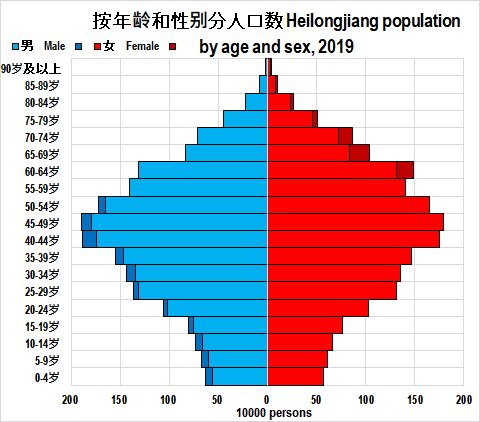
Harbin part of Heilongjiang Province until 1947–1949 and 1953–1954. Dongsheng SAR dissolved in 1932 and incorporated into Manchukuo / Heilongjiang Province (present). Songjiang Province dissolved in 1955 and incorporated into Heilongjiang Province. Hejiang Province dissolved in 1949 and incorporated into Songjiang Province / Heilongjiang Province (present). Nenjiang Province dissolved in 1949 and incorporated into Heilongjiang Province. |1912 |2,029,000 |1928 |3,725,000 |1936–37 |3,751,000 |1947 |2,844,000 |1954 |11,897,309 |1964 |20,118,271 |1982 |32,665,546 |1990 |35,214,873 |2000 |36,237,576 |2010 |38,312,224 |2020 |31,850,088 By the end of 2022, Heilongjiang Province had a permanent resident population of 30.99 million. This represented a decrease of 260,000 from the previous year. The urban population was 20.52 million, and the rural population was 10.47 million. The urbanization rate reached 66.2%, up 0.5 percentage points from the previous year. The age composition was as follows:
- Ages 0–14: 9.3% of the total population
- Ages 65 and above: 17.8% of the total population
According to the 2021 Statistical Bulletin, the province’s total permanent population was 31.25 million, a decrease of 460,000 compared with 2020.
Based on the Seventh National Population Census (2020), the total permanent population of Heilongjiang was 31,850,088. Compared with the Sixth Census (2010) figure of 38,313,991, the province’s population declined by 6,463,903 over ten years (−16.87%), with an average annual growth rate of −1.83%.
Breakdown by gender and age:
- Males: 15,952,468 (50.09%)
- Females: 15,897,620 (49.91%)
- Sex ratio (females = 100): 100.35
- Ages 0–14: 3,286,466 (10.32%)
- Ages 15–59: 21,167,932 (66.46%)
- Ages 60 and above: 7,395,690 (23.22%), including 4,972,868 aged 65+ (15.61%)
- Urban residents: 20,897,694 (65.61%)
- Rural residents: 10,952,394 (34.39%)
In 2020, the birth rate was 3.35‰, the death rate was 8.23‰, and the natural growth rate was −4.48‰.{{Dead link|date=November 2025}} Heilongjiang's demographic profile is characterized by a low birth rate, low death rate, and a high level of population aging. In addition, out-migration has contributed to a continuous population decline since 2014.
Ethnic groups
The majority of Heilongjiang's population is Han Chinese, while ethnic minorities include the Manchus, Koreans, Mongols, Hui, Xibe, and Hezhen.
In Heilongjiang Province, the Han Chinese constitute an overwhelming majority, many of whom are descendants of immigrants from Shandong and Hebei during the Qing dynasty. Ten indigenous ethnic minorities are officially recognized: the Manchu, Korean, Mongol, Hui, Daur, Xibe, Hezhen, Oroqen, Evenki, and Kyrgyz peoples. Among these, the Hezhen are unique to Heilongjiang Province. Within the province, there is the Dorbod Mongol Autonomous County, the Meilisi Daur District in Qiqihar, as well as several ethnic townships.
Among the province’s permanent residents, the Han population numbers 30,728,612, accounting for 96.48% of the total; all ethnic minorities together total 1,121,476, or 3.52%. Compared with the 2010 Sixth National Population Census, the Han population decreased by 6,210,569 people (−16.81%) but their proportion rose by 0.07 percentage points. Minority populations decreased by 253,334 (−18.43%), and their proportion declined by 0.07 percentage points. Specifically:
- The Manchu population decreased by 164,213 (−21.95%), down 0.12 percentage points in proportion.
- The Korean Chinese population decreased by 57,683 (−17.6%), down 0.01 percentage points.
- The Mongol population decreased by 13,273 (−10.58%), but their proportion rose by 0.02 percentage points.
- The Hui population decreased by 26,285 (−25.83%), down 0.03 percentage points.
- The Daur population decreased by 6,607 (−16.4%), with no change in proportion.
- The Xibe population decreased by 1,349 (−17.73%), with no change in proportion.
- The Hezhen population increased by 192 (+5.31%), with no change in proportion.
| Ethnic group | Han Chinese | Manchu | Korean | Mongol | Hui | Daur | Xibe | Zhuang | Miao | Hezhen | Other minorities | Population | Share of total population (%) | Share among minorities (%) |
|---|---|---|---|---|---|---|---|---|---|---|---|---|---|---|
| 30,728,612 | 583,807 | 270,123 | 112,210 | 75,464 | 33,670 | 6,259 | 3,890 | 3,852 | 3,805 | 28,396 | ||||
| 96.48 | 1.83 | 0.85 | 0.35 | 0.24 | 0.11 | 0.02 | 0.01 | 0.01 | 0.01 | 0.09 | ||||
| — | 52.06 | 24.09 | 10.01 | 6.73 | 3.00 | 0.56 | 0.35 | 0.34 | 0.34 | 2.53 |
Religion

Most of Heilongjiang's residents are either non-religious or practice Chinese folk religions, including Taoism. Manchu shamanism is practiced by many Manchu people. Chinese Buddhism and Tibetan Buddhism have an important presence in the province.
Culture
Heilongjiang's culture is part of a culture of Northeast China that is relatively homogeneous across this region, known in Mandarin Chinese as "Dongbei" (the northeast).
Media

Heilongjiang Television and Harbin Economy Radio serve as broadcasters.
Tourism

Harbin, the provincial capital, is a city of contrasts, with Chinese, Russian, and eclectic worldwide influences clearly apparent. Bukui Mosque, a national heritage site, is the largest glazed-tile building in the province. Eastern Orthodox, Roman Catholic, and Protestant churches as well as synagogues dot the city.
The long, cold winter is the backdrop for its famed ice sculpture exhibitions. In 2007 already the 8th Ice and Snow World opened to visitors in Harbin. More than 2,000 ice sculptures were on display at the annual event.
Wudalianchi Lakes are a series of five lakes formed between 1719 and 1721 when volcanic eruption shaped one section of a tributary of the Amur into five interconnected lakes. The second lake in particular is renowned for its irregular geological sights. Lake Jingbo, in Ning'an County, is a section of the Mudan River that has been narrowed and shaped by volcanic eruption into a series of sights, including the Diaoshuilou Falls.
The province has a zoological park called "Harbin Siberian Tiger Park".
Colleges and universities

Partial list of universities:
- Daqing Staff and Workers University
- Harbin Institute of Technology
- Harbin Engineering University
- Harbin Medical University
- Harbin Normal University
- Harbin University of Science and Technology
- Heilongjiang August First Land Reclamation University
- Heilongjiang Commercial University
- Heilongjiang University
- Heilongjiang University of Chinese Medicine
- Heilongjiang International University
- Heilongjiang Institute of Technology
- Northeast Agricultural University
- Northeast Forestry University
- Northeast Petroleum University
- Qiqihar University
Sports
Heilongjiang is in the forefront of promoting winter sports and winter-featured sports industry in China. For example, it is promoting bandy as an Olympic sport.
Events and leagues
- 2009 Winter Universiade
- 2018 Bandy World Championship, Division B
- Asia League Ice Hockey
Notable people
- Mao Buyi, singer-songwriter
- Meng Nan, singer-songwriter
- Ningning, singer from the K-pop girl group Aespa
- Song Yadong, UFC Fighter
- Wang Manyu, Chinese table tennis player
- Zhang Shan Qi, racing driver
References
References
- "Doing Business in China – Survey". Ministry Of Commerce – People's Republic Of China.
- (11 May 2021). "Communiqué of the Seventh National Population Census (No. 3)". [[National Bureau of Statistics of China]].
- (March 2024). "National Data". [[National Bureau of Statistics of China.
- "Human Development Indices (8.0)- China".
- (2008). "Longman Pronunciation Dictionary". Pearson Education ESL.
- {{usurped
- link
- Edmonds, Richard Louis. (1985). "Northern Frontiers of Qing China and Tokugawa Japan: A Comparative Study of Frontier Policy". University of Chicago, Department of Geography; Research Paper No. 213.
- Edmonds (1985), pp. 115–117
- Patrick Fuliang Shan, "Taming China's Wilderness: Immigration, Settlement, and the Shaping of the Heilongjiang Frontier, 1900–1931", Ashgate, 2014, {{ISBN. 978-1-4094-6389-4
- PeakVisor. "Heilongjiang Mountains".
- (2007-10-12). "Climate map of Asia, excluding (South)west-Asia (from the "Updated world map of the Köppen-Geiger climate classification").".
- "黑龙江省交通运输厅".
- [http://english.peopledaily.com.cn/200706/19/eng20070619_385591.html Proposed bridge to boost bilateral trade], ''China Daily'', 19 June 2007.
- (16 July 2016). "An Unfinished Bridge, and Partnership, Between Russia and China". The New York Times.
- (March 21, 2019). "Russia Completes Construction of First-Ever Rail Bridge to China". [[The Moscow Times]].
- (March 21, 2019). "Россия и Китай соединили железнодорожный мост через Амур". [[RBK Group]].
- "Railway bridge over Amur river to China will be built by end of 2020, envoy says".
- "Новости Хабаровска".
- link. [[Ministry of Civil Affairs]]
- Shenzhen Bureau of Statistics. [[:zh:中国统计出版社. China Statistics Print]]. link. ()
- (2012). [[:zh:中国统计出版社. China Statistics Print]]
- Ministry of Civil Affairs. (August 2014). [[:zh:中国统计出版社. China Statistics Print]]
- 国务院人口普查办公室、国家统计局人口和社会科技统计司编. (2022). [[:zh:中国统计出版社. China Statistics Print]]
- 国务院人口普查办公室、国家统计局人口和社会科技统计司编. (2012). [[:zh:中国统计出版社. China Statistics Print]]
- [[Ministry of Housing and Urban-Rural Development]] of the People's Republic of China(MOHURD). (2019). "中国城市建设统计年鉴2018". China Statistic Publishing House.
- (20 March 2013). "Understanding China's Political System". Congressional Research Service.
- (23 January 2007). link. [[People's Daily]] Press
- (28 October 2020). "China Focus: "Grain barn" promotes new rice varieties for better yields".
- (15 October 2019). "Xinhua Headlines: China embraces bumper harvest with macro-adjusting in "grain barn"".
- (21 April 2021). "Illegal trade in rich black soil from Heilongjiang is robbing farmers in China's cereal food bowl of a future". South China Morning Post.
- (2001). "Soil Fertility Quality and Agricultural Sustainable Development in the Black Soil Region of Northeast China". Environment, Development and Sustainability.
- (2010). "The formation of high-class brand rice production area and functions of farmers' cooperatives in north east China: Case study of Wuchang City, Heilongjiang Province". Review of Agricultural Economics of Hokkaido University.
- (2019). "Rice production and climate change in Northeast China: evidence of adaptation through land use shifts". Environmental Research Letters.
- Zhan, Jing Vivian. (2022). "China's Contained Resource Curse: How Minerals Shape State-Capital-Labor Relations". [[Cambridge University Press]].
- (2016-12-01). "Wind energy rejection in China: Current status, reasons and perspectives". Renewable and Sustainable Energy Reviews.
- [http://rightsite.asia/en/industrial-zone/daqing-hi-tech-industrial-development-zone/ RightSite.asia. Daqing New & Hi-Tech Industrial Development Zone]
- [http://rightsite.asia/en/industrial-zone/harbin-hi-tech-industrial-development-zone/ RightSite.asia. Harbin New & Hi-Tech Industrial Zone]
- [http://rightsite.asia/en/industrial-zone/sino-russia-dongning-piurtaphca-trade-zone/ RightSite.asia. Sino-Russia Dongning-Piurtaphca Trade Zone]
- [http://rightsite.asia/en/industrial-zone/suifenhe-border-economy-cooperation-district/ RightSite.asia. Suifenhe Border Economic Cooperation District]
- link
- link
- link
- link
- link. [[National Bureau of Statistics of China]]
- link. [[National Bureau of Statistics of China]]
- link. [[National Bureau of Statistics of China]]
- link. [[National Bureau of Statistics of China]]
- link. [[National Bureau of Statistics of China]]
- "Communiqué of the National Bureau of Statistics of People's Republic of China on Major Figures of the 2010 Population Census". [[National Bureau of Statistics of China]].
- "2021 Statistical Bulletin on the National Economic and Social Development of Heilongjiang Province".
- "Major Data Bulletin of the 2020 Heilongjiang Population Census".
- "Heilongjiang Provincial Bureau of Statistics". www.hlj.stats.gov.cn.
- "Heilongjiang Provincial Bureau of Statistics". www.hlj.stats.gov.cn.
- (2018-09-21). "Basic Information on Heilongjiang's Ethnic Minorities". Heilongjiang Provincial Ethnic and Religious Affairs Commission.
- (2015-08-14). "Overview of Heilongjiang's Ethnic Minorities". DBW (Northeast Network).
- "China Population Census Yearbook – 2020".
- "Bukui Mosque – the Largest Glazed-Tile Building in Heilongjiang Province".
- (2008). "China Expat city Guide". China Expat.
- "Ice and Snow Festival in Harbin – china.org.cn".
- DK. (2014-06-02). "DK Eyewitness Travel Guide: China". [[Penguin Books]].
- "2018 World Bandy Championship Men's Group B will be held in Harbin on 27th".
- [https://web.archive.org/web/20161012045229/http://www.worldbandy.com/olympic.html Heilongjiang Province Promotes Bandy as Olympic Sport!]

This article was imported from Wikipedia and is available under the Creative Commons Attribution-ShareAlike 4.0 License. Content has been adapted to SurfDoc format. Original contributors can be found on the article history page.
Ask Mako anything about Heilongjiang — get instant answers, deeper analysis, and related topics.
Research with MakoFree with your Surf account
Create a free account to save articles, ask Mako questions, and organize your research.
Sign up freeThis content may have been generated or modified by AI. CloudSurf Software LLC is not responsible for the accuracy, completeness, or reliability of AI-generated content. Always verify important information from primary sources.
Report