From Surf Wiki (app.surf) — the open knowledge base
Heavy Woollen District
Localised area of West Yorkshire
Localised area of West Yorkshire
The Heavy Woollen District is a region of textile-focused industrial development in West Yorkshire, England. It acquired the name because of the heavyweight cloth manufactured there from the early 19th century.
The district is made up of parts of the modern day boroughs of Kirklees, Leeds and Wakefield in West Yorkshire, England. Located around the towns of Dewsbury, Batley, Heckmondwike and Ossett, the area extends to the towns and villages of Liversedge, Gomersal, Gildersome, Birkenshaw, Mirfield, Cleckheaton, Morley, Tingley, East Ardsley, Birstall and Horbury. The manufacture of wool cloth for clothing, blankets, rope and twine continues in the district.
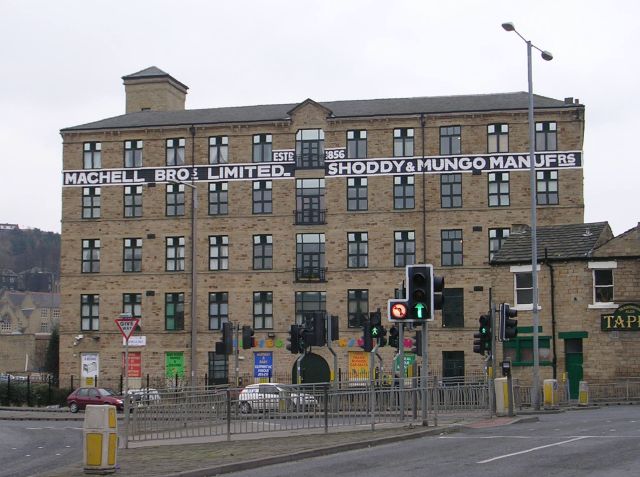
The area was one of the key textile centres in Yorkshire, famed for its production of shoddy and mungo. For years companies had tried to blend different fibres without success leading to the term, "munt go", i.e. "mustn't go" as a Yorkshire colloquialism. Machinery invented in Batley to grind soft rags (shoddy) is thought to have first been devised in 1813, and for hard rags (mungo) later on. Most mills have either closed or put to other uses, but some shoddy/mungo mills remain such as Edward Clay & Son Ltd. in Ossett. [[File:Ben Turner Union 1917 book title page.jpg|thumb|alt=Inside front page from 1917 book with the wording: A short account of the rise and progress of the Heavy Woollen District branch of the General Union of Textile Workers by Ben Turner|1917 book title page confirming the term "Heavy Woollen District" as used historically around West Yorkshire. The book was written by union official Ben Turner, who later was known as [[Ben Turner (politician)|Sir Ben Turner]], MP (Member of Parliament) for [[Batley and Morley]].]]
History
The Heavy Woollen District branch of the General Union of Textile Workers was formed in 1892 to service the needs of the local population. The union produced a publication entitled Heavy Woollen District Textile Record, as a newsletter for distribution to members by the union's local collectors of subscriptions.
A contingent from churches within the Roman Catholic Diocese of Leeds visited cemeteries in France where the remains of 25 fallen soldiers from the Heavy Woollen District during World War I and World War II are interred. Dewsbury Cemetery has a memorial dedicated to four soldiers who died at the Heavy Woollen District Military Hospital, Staincliffe, Dewsbury, from injuries sustained during WW1.
Transport
The area was served by the Yorkshire (Woollen District) Electric Tramways between 1903 and 1934, which were replaced with buses operated by Yorkshire Woollen District Transport company.
Sport
There is still a Heavy Woollen District football association and junior cricket association, both with representative teams. The cricket league originally defined the district as within a six-mile radius of Batley Town Hall, but this was extended to an eighteen-mile radius. The 'Heavy Woollen District Cricket Challenge Cup' was first competed for in 1883.
References
Reference bibliography
References
- "Heavy Woollen District". The Dewsbury Partnership.
- (3 January 2008). "Wealth of war for boom mills". [[Dewsbury Reporter]].
- [https://www.yorkshirepost.co.uk/whats-on/arts-and-entertainment/nostalgia-tuesday-rise-tram-1775494 Nostalgia on Tuesday: Rise of the tram] ''[[The Yorkshire Post]]'', 13 June 2017. "''...to feed the heavy woollen districts of Thornhill, Ravensthorpe, Heckmondwike, Batley, Liversedge, Hightown, Moorend and Birkenshaw.''" Retrieved 29 March 2021
- "About Us Page". Henry Day & sons, Dewsbury.
- {{Cite EB1911
- {{Cite EB1911
- [[Ben Turner (politician). Turner, Ben]]. Heavy Woollen District Textile Workers Union, 1917. A short account of the rise and progress of the Heavy Woollen District branch of the General Union of Textile Workers. p.18, p.76, p.79 Printed by the ''[[Yorkshire Factory Times]]''. via [https://huddersfield.exposed/wiki/Heavy_Woollen_District_Textile_Workers_Union_(1917)_by_Ben_Turner Huddersfield Exposed] Retrieved 4 April 2021
- [https://www.dioceseofleeds.org.uk/heavy-woollen-war-cemeteries-pilgrimage/ Heavy Woollen War Cemeteries Pilgrimage] [[Roman Catholic Diocese of Leeds]], year of publication not stated, retrieved 4 April 2021
- [https://www.iwm.org.uk/memorials/item/memorial/29215 Memorial, Heavy Woollen District Military Hospital] War Memorials Register, [[Imperial War Museum]]s. Retrieved 4 April 2021
- [https://www.iwm.org.uk/memorials/names/search?filters%5BmemorialString%5D%5BHeavy%20Woollen%20District%20Military%20Hospital%20%28WMR%2029215%29%5D=on Names on Memorial] War Memorials Register, [[Imperial War Museum]]s. Retrieved 4 April 2021
- Bleakley, John. (29 April 2013). "HWDFA U17 Representative Football". Pitchero.com.
- [http://heavywoollenjuniorlge.play-cricket.com Heavy Woollen District Junior Cricket League]
- "History of the Heavy Woollen". Heavy Woollen District Junior Cricket League.
This article was imported from Wikipedia and is available under the Creative Commons Attribution-ShareAlike 4.0 License. Content has been adapted to SurfDoc format. Original contributors can be found on the article history page.
Ask Mako anything about Heavy Woollen District — get instant answers, deeper analysis, and related topics.
Research with MakoFree with your Surf account
Create a free account to save articles, ask Mako questions, and organize your research.
Sign up freeThis content may have been generated or modified by AI. CloudSurf Software LLC is not responsible for the accuracy, completeness, or reliability of AI-generated content. Always verify important information from primary sources.
Report