From Surf Wiki (app.surf) — the open knowledge base
Heavy equipment
Vehicles designed for executing construction tasks

Vehicles designed for executing construction tasks
Heavy equipment, heavy machinery, earthmovers, construction vehicles, or construction equipment, refers to heavy-duty vehicles specially designed to execute construction tasks, most frequently involving earthwork operations or other large construction tasks. Heavy equipment usually comprises five equipment systems: the implement, traction, structure, power train, and control/information.
Heavy equipment has been used since at least the 1st century BC, when the ancient Roman engineer Vitruvius described a crane powered by human or animal labor in De architectura.
Heavy equipment functions through the mechanical advantage of a simple machine that multiplies the ratio between input force applied and force exerted, easing and speeding tasks which often could otherwise take hundreds of people and many weeks' labor. Some such equipment uses hydraulic drives as a primary source of motion.
The word plant, in this context, has come to mean any type of industrial equipment, including mobile equipment (e.g. in the same sense as powerplant). However, plant originally meant "structure" or "establishment" – usually in the sense of factory or warehouse premises; as such, it was used in contradistinction to movable machinery, often in the phrase "plant and equipment".
History

The use of heavy equipment has a long history; the ancient Roman engineer Vitruvius (1st century BCE) gave descriptions of heavy equipment and cranes in ancient Rome in his treatise De architectura. The pile driver was invented around 1500. The first tunnelling shield was patented by Marc Isambard Brunel in 1818.
From horses, through steam and diesel, to electric and robotic

.jpg)
_(14569641579).jpg)
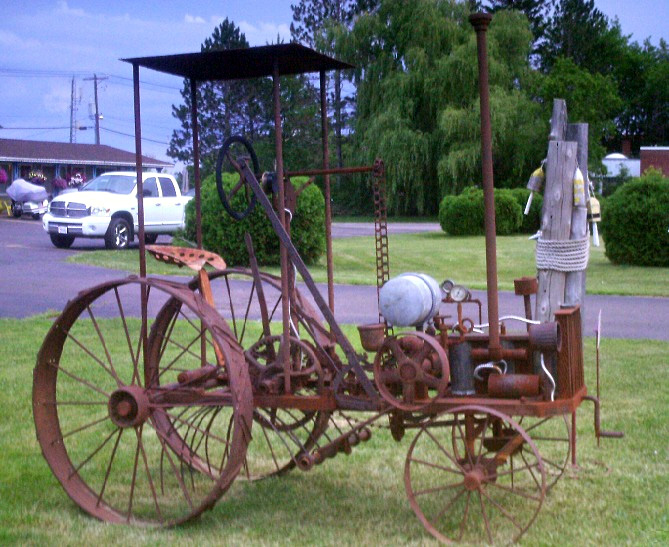
Until the 19th century and into the early 20th century heavy machines were drawn under human or animal power. With the advent of portable steam-powered engines the drawn machine precursors were reconfigured with the new engines, such as the combine harvester. The design of a core tractor evolved around the new steam power source into a new machine core traction engine, that can be configured as the steam tractor and the steamroller. During the 20th century, internal-combustion engines became the major power source of heavy equipment. Kerosene and ethanol engines were used, but today diesel engines are dominant. Mechanical transmission was in many cases replaced by hydraulic machinery. The early 20th century also saw new electric-powered machines such as the forklift. Caterpillar Inc. is a present-day brand from these days, starting out as the Holt Manufacturing Company. The first mass-produced heavy machine was the Fordson tractor in 1917.
The first commercial continuous track vehicle was the 1901 Lombard Steam Log Hauler. The use of tracks became popular for tanks during World War I, and later for civilian machinery like the bulldozer. The largest engineering vehicles and mobile land machines are bucket-wheel excavators, built since the 1920s.
Container cranes were used from the 1950s and onwards, and made containerization possible.
Nowadays such is the importance of this machinery, some transport companies have developed specific equipment to transport heavy construction equipment to and from sites.
Most of the major equipment manufacturers such as Caterpillar, Volvo, Liebherr, and Bobcat have released or have been developing fully or partially electric-powered heavy equipment. Commercially-available models and R&D models were announced in 2019 and 2020.
Robotics and autonomy has been a growing concern for heavy equipment manufacturers with manufacturers beginning research and technology acquisition. A number of companies are currently developing (Caterpillar and Bobcat) or have launched (Built Robotics) commercial solutions to the market.
Types
These subdivisions, in this order, are the standard heavy equipment categorization. Some contractors place numbers on the side of their equipment corresponding to the category – Grader '02' – followed by a sequential number that usually corresponds to the number it was purchased, for example, 02-112, is the 112th grader a company has purchased since their founding. This allows for easy recognition of the equipment type and the relevant age.--
Tractor
- Bulldozer (dozer, track dozer)
- Snowcat
- Snowplow
- Skidder
- Tractor (wheel tractor)
- Track tractor
- Locomotive
- Artillery tractor
- Crawler-transporter
- Military engineering vehicles
Grader
- Grader
Excavator
- Amphibious excavator
- Compact excavator
- Dragline excavator
- Dredger
- Bucket-wheel excavator
- Excavator (digger)
- Long reach excavator
- Power shovel
- Reclaimer
- Suction excavator
- Walking excavator
- Trencher
- Yarder
Backhoe
- Backhoe
- Backhoe loader
Timber
- Feller buncher
- Harvester
- Forwarder
- Logging truck
- Skidder
- Power saw
- Stump grinder
- Track harvester
- Wheel forwarder
- Wheel skidder
Pipelayer
- Pipelayer (sideboom)
Scraper
- Fresno scraper
- Scraper
- Wheel tractor-scraper (belly scraper) Mining
- Construction and mining tractor
- Construction and mining truck
- Dumper
- Dump truck
- Haul truck
- Mining equipment
- Reclaimer
- Stacker
- Spreader Articulated
- Articulated hauler
Compactor
- Wheel dozer (soil compactor)
- Soil stabilizer
Loader
- Loader (payloader, front loader, wheel loader, integrated tool carrier)
- Skip loader (skippy)
Track loader
- Track loader
Skid-steer loader
- Skid-steer loader
Material handler
- Aerial work platform, Lift table
- Crane
- Block-setting crane
- Bulk-handling crane
- Crane vessel
- Aerial crane
- Container crane
- Gantry crane
- Overhead crane
- Electric overhead traveling crane
- Ring crane
- Level luffing crane
- Mobile crane
- Travel lift
- Forklift
- Garbage truck
- Grapple truck, Knuckleboom loader (trailer mount)
- Straddle carrier
- Sidelifter
- Reach stacker
- Telescopic handlers
- Tow truck
Paving
- Asphalt paver
- Asphalt plant
- Cold planer
- Cure rig
- Paver
- Pavement milling
- Pneumatic tire compactor
- Roller (road roller, roller compactor)
- Slipform paver
- Vibratory compactor, Compactor
Underground
- Roadheader
- Tunnel boring machine
- Underground mining equipment
Hydromatic tool
- Ballast tamper
- Attachments
- Drilling rig
- Horizontal directional drilling
- Earth auger
- Pile driver
- Post pounder
- Rotary tiller (rototiller, rotovator)
Hydraulic machinery
Highway
- Tractor unit
- Ballast tractor
- Pushback tractor
- Railcar mover
- Highway 10 yard rear dump
- Highway bottom dump (stiff), pup (belly train), triple
- Highway end dump and side dump
- Highway transfer, Transfer train
- Concrete mixer
- Concrete mix truck
- Concrete mix dozer
- Lowboy (trailer)
- Street sweeper
- Street sweep truck
- Street sweep dozer
Images
File:CAT-D10N-pic001.jpg|The Caterpillar D10N bulldozer evolved from tracked-type tractors and is characterized by a steel blade attached to the front that is used to push other equipment and construction materials, such as earth. File:Komatsu excavator PC210LC.JPG|The bucket excavator Komatsu PC210-LC. File:SMC 200 R.jpg|The wheel trencher MARAIS SMC 200 R. File:DrillingMachine with ConcreteMixer and Pump02.jpg|Iron bar reinforced foundation piles are driven with a drilling machine, concrete pump, mixer-truck, and a specialized auger that allows pumping concrete through its axis while withdrawn. File:Dillingen Kran.jpg|Fixed crane in a coal mine in Germany File:TZAMA Panorama1m.jpg|Caterpillar D9L bulldozer, excavators and other heavy equipment vehicles parked near a quarry in Israel File:Garzweiler Tagebau-1230.jpg|Bucket wheel excavators in Garzweiler surface mine, Germany File:Komatsu Wheel Loader WA600-6,Hitachinaka city,Japan.jpg|Wheel loader File:Komatsu GD655 grader (11815425133).jpg|Grader cleaning and leveling File:Visible progress continues to show at the new Folsom Dam auxiliary spillway Sept. 23 as work on the approach channel and downstream chute take center stage. (21087516643).jpg|Heavy duty excavator with large bucket equipped. File:Landfill compactor.jpg|Landfill compactor (tamping tip) File:Komatsu bulldozer pushing coal in Power plant Ljubljana (winter 2017).jpg|Komatsu Dozer pushing coal on the job site File:Frontloaderorange.jpg|A wheeled front loader tractor equipped with a large bucket elevated by hydraulic rams. File:Aa Truckconveyor brooklane Epart DSCF0461.JPG|Folded conveyor on a tracked grinder
File:IDF-D9-ZE001.jpg|The militarized Caterpillar D9 armored bulldozer allows for earthmoving projects in a combat environment. In the picture: IDF Caterpillar D9R. File:HSW 9.50 PICT0141.jpg|The militarized Huta Stalowa Wola backhoe loader in Poland which is subsidiary of LiuGong China Image:Img 613c.jpg|Military scraper Image:Pionierpanzer Dachs (2008).jpg|PiPz Dachs armoured engineering vehicle of the German Army (2008) File:Temporary roads deployment complex KRVD during the "Armiya 2021" exhibition (side-rear view).jpg | Temporary roads deployment complex during the "Armiya 2021" exhibition
Implements and hydromechanical work tools
- auger
- backhoe
- bale spear
- broom
- bulldozer blade
- clam shell bucket
- cold plane
- demolition shears
- equipment bucket
- excavator bucket
- forks
- grapple
- hydraulic hammer, hoe ram
- hydraulics
- hydraulic tilting bucket (4-in-1)
- landscape tiller
- material handling arm
- mechanical pulverizer, crusher
- multi processor
- pavement removal bucket
- pile driver
- power take-off (PTO)
- quick coupler
- rake
- ripper
- rotating grab
- sheep's foot compactor
- skeleton bucket
- snow blower
- stump grinder
- stump shear
- thumb
- tiltrotator
- trencher
- vibratory plate compactor
- wheel saw
Traction: Off-the-road tires and tracks
Main article: Off-the-road tire, Caterpillar track


Heavy equipment requires specialized tires for various construction applications. While many types of equipment have continuous tracks applicable to more severe service requirements, tires are used where greater speed or mobility is required. An understanding of what equipment will be used for during the life of the tires is required for proper selection. Tire selection can have a significant impact on production and unit cost. There are three types of off-the-road tires, transport for earthmoving machines, work for slow moving earthmoving machines, and load and carry for transporting as well as digging. Off-highway tires have six categories of service C compactor, E earthmover, G grader, L loader, LS log-skidder and ML mining and logging. Within these service categories are various tread types designed for use on hard-packed surface, soft surface and rock. Since tires are a large expense on any construction project, careful consideration should be given to prevent excessive wear or damage.
:"This system connects components, transmits loads, provides attachment points for implements, and allows the machine to travel over uneven ground. The machine's frame, articulation, and steering for wheeled equipment are the major parts of this system."
Heavy equipment operator
Main article: Heavy equipment operator
A heavy equipment operator drives and operates heavy equipment used in engineering and construction projects. Typically only skilled workers may operate heavy equipment, and there is specialized training for learning to use heavy equipment.
Much publication about heavy equipment operators focuses on improving safety for such workers. The field of occupational medicine researches and makes recommendations about safety for these and other workers in safety-sensitive positions.
Equipment cost
Due to the small profit margins on construction projects it is important to maintain accurate records concerning equipment utilization, repairs and maintenance. The two main categories of equipment costs are ownership cost and operating cost.
Ownership cost
To classify as an ownership cost an expense must have been incurred regardless of if the equipment is used or not. These costs are as follows:
- purchase expense
- salvage value
- tax savings from depreciation
- major repairs and overhauls
- property taxes
- insurance
- storage
Depreciation can be calculated several ways, the simplest is the straight-line method. The annual depreciation is constant, reducing the equipment value annually. The following are simple equations paraphrased from the Peurifoy & Schexnayder text:
Operating cost
For an expense to be classified as an operating cost, it must be incurred through use of the equipment. These costs are as follows:
The biggest distinction from a cost standpoint is if a repair is classified as a major repair or a minor repair. A major repair can change the depreciable equipment value due to an extension in service life, while a minor repair is normal maintenance. How a firm chooses to cost major and minor repairs vary from firm to firm depending on the costing strategies being used. Some firms will charge only major repairs to the equipment while minor repairs are costed to a project. Another common costing strategy is to cost all repairs to the equipment and only frequently replaced wear items are excluded from the equipment cost. Many firms keep their costing structure closely guarded as it can impact the bidding strategies of their competition. In a company with multiple semi-independent divisions, the equipment department often wants to classify all repairs as "minor" and charge the work to a job – therefore improving their 'profit' from the equipment.
Models
Main article: Model construction vehicle
Die-cast metal promotional scale models of heavy equipment are often produced for each vehicle to give to prospective customers. These are typically in 1:50 scale. The popular manufacturers of these models are Conrad and NZG in Germany, even for US vehicles.
Notable manufacturers
The largest 10 heavy equipment manufacturers in 2022
| No. | Company | Country | Sales (billion USD) | Share of total |
|---|---|---|---|---|
| 1 | Caterpillar | USA | 37,5 | 16.3% |
| 2 | Komatsu | Japan | 24,7 | 10.7% |
| 3 | XCMG | China | 13,4 | 5.8% |
| 4 | John Deere | USA | 12,5 | 5.4% |
| 5 | Sany | China | 11,9 | 5.2% |
| 6 | Volvo Construction Equipment | Sweden | 9,9 | 4.3% |
| 7 | Liebherr | Switzerland | 9,9 | 4.3% |
| 8 | Hitachi Construction Machinery | Japan | 9,2 | 4.0% |
| 9 | Sandvik | Sweden | 7,8 | 3.4% |
| 10 | JCB | United Kingdom | 7,0 | 3.0% |
Other manufacturers include:
- Anhui Heli
- Atlas Copco
- BEML Limited
- Bobcat Company
- Case Construction Equipment
- Chelyabinsk Tractor Plant
- CNH Global
- Demag
- Fiat-Allis
- HD Hyundai Infracore
- HEPCO
- HIAB
- Hidromek
- Ingersoll Rand
- Kubota
- Kobelco
- LiuGong
- MARAIS
- Navistar International Corporation
- NCK
- New Holland
- Track Marshall
- Orenstein and Koppel GmbH (O&K)
- Paccar
- Poclain
- Rototilt
- Shantui
- ST Kinetics
- Takeuchi Manufacturing
- Wacker Neuson
- Yanmar
- Zoomlion
References
References
- Lambert, Fred. (January 29, 2019). "Caterpillar unveils an all-electric 26-ton excavator with a giant 300 kWh battery pack". Electrek.
- McLoud, Don. (April 24, 2020). "Volvo CE gets $2M grant to test electric excavator, loader in California". Randall-Reilly.
- Gruver Doyle, Marcia. (November 18, 2019). "Liebherr's prototype battery-powered LB 16 drilling rig has 10-hour run time (VIDEO)". Randall-Reilly.
- Rubenstone, Jeff. (June 5, 2019). "Construction Equipment Goes Electric, But Hurdles Remain". BNP Media.
- (June 2020). "Caterpillar Announces Acquisition of Robotic Expertise". Caterpillar.
- [http://www.bls.gov/oco/ocos255.htm U.S. Department of Labor – Occupational Outlook Handbook]
- V. J. Davies, Ken Tomasin. (1996). "Construction Safety Handbook". Thomas Telford.
- Peurifoy & Schexnayder "Construction Planning Equipment, and Methods" McGraw Hill 6th edition {{ISBN. 0-07-232176-8, 2002.
- Bartholomew, S.H. "Estimating and Bidding for Heavy Construction" CSU Chico, Upper Saddle River, NJ: Prentice Hall, {{ISBN. 0-13-598327-4, 2000
- "Heavy Equipment parts catalog". AGA Parts.
- "Construction equipment manufacturers: world equipment sales".
This article was imported from Wikipedia and is available under the Creative Commons Attribution-ShareAlike 4.0 License. Content has been adapted to SurfDoc format. Original contributors can be found on the article history page.
Ask Mako anything about Heavy equipment — get instant answers, deeper analysis, and related topics.
Research with MakoFree with your Surf account
Create a free account to save articles, ask Mako questions, and organize your research.
Sign up freeThis content may have been generated or modified by AI. CloudSurf Software LLC is not responsible for the accuracy, completeness, or reliability of AI-generated content. Always verify important information from primary sources.
Report