From Surf Wiki (app.surf) — the open knowledge base
Health in the Philippines
none

none
Access to healthcare services in the Philippines is marked by significant inequities, particularly affecting poor communities. These disparities are reflected in both access to services, health outcomes, and the effects of climate change which exacerbate the incidence of infectious diseases. One major challenge is the varying financing for local government units, leading to differences in the benefits packages of insurance plans and difficulties in accessing public health services. The decentralization of healthcare responsibilities from the federal government to local governments has, in some cases, increased local authority but has also made certain communities vulnerable to a lack of access to basic services.
In response to the Millennium Development Goals' focus on maternal and child health, the Philippines began the National Demographic and Health Survey in 1968 to assess the effectiveness of public health programs in the country.
Barriers to healthcare
Poor communities suffer a higher burden of disease due to inequities in access to services and health status. Since financing for local government units often vary and the benefits package for insurance plans may be unfavorable, some communities face difficulties accessing public health services. Shifting the responsibility of healthcare from the federal government to the local governments has increased local authority and has made communities susceptible to lack of access to basic services. In addition, most healthcare payments are made out of pocket, especially when receiving care from privately owned institutions. Barangay health stations serve as primary public health facilities and are staffed by doctors, nurses, midwives, and barangay health volunteers.

Population
As of September 2020, the Philippines has a population of nearly 110 million and a population density of 368 per square kilometer. 32% of the population of the Philippines is under 15 years old, and only 22.2% is over 60. In the Philippines, 16.6% of the population lived below the national poverty line in 2018.
Health indicators
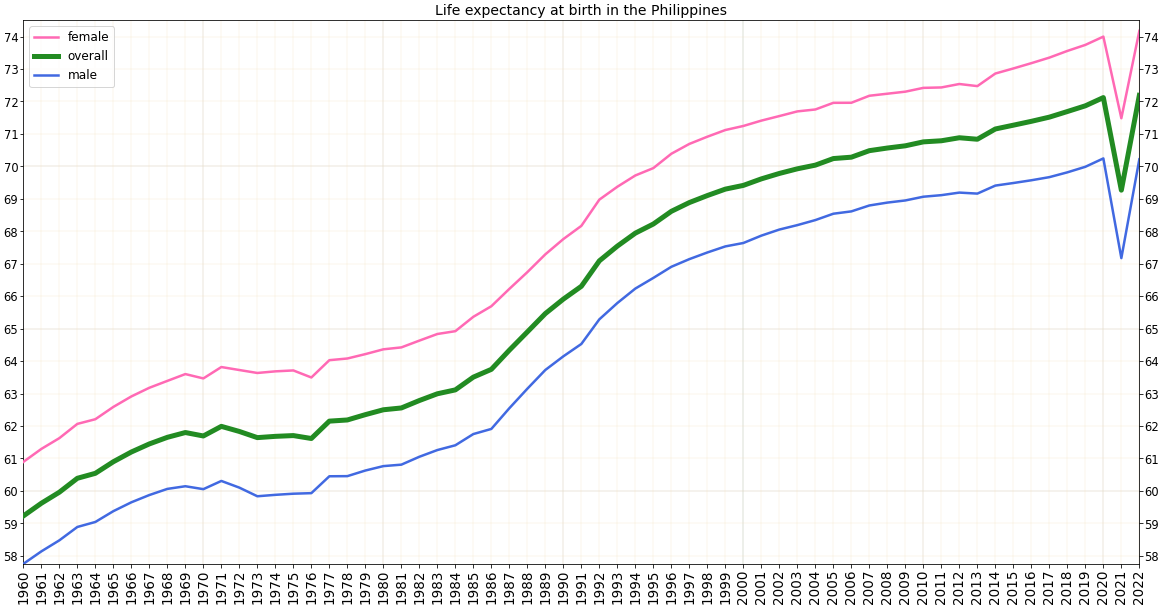
| Health Indicators | Male | Female | For Both Sexes |
|---|---|---|---|
| Life expectancy at birth (Years) 2016 | 66.2 | 72.6 | |
| Under 5 mortality rate (Per 1,000 live births) | 28.4 | ||
| Maternal mortality rate (MMR) (Per 100,000 live births) | 121 | ||
| Neonatal mortality rate (Per 1,000 live births) | 13.5 |
Health problems in the Philippines
The Philippines faces a large burden of disease:

The main non-communicable diseases are diabetes, heart disease, stroke, cancer, and chronic diseases that affect the airways and lungs. While these diseases affect different parts of the body in different ways, they often share common origins.
Communicable diseases: Acute Respiratory Infection, Influenza A (H1N1), Bird Flu (Avian Influenza), Chickenpox, Cholera, Dengue, Diarrhea, Hand, Foot, and Mouth Disease, Hepatitis A, Hepatitis B, Hepatitis C, HIV/AIDS, Influenza, Leprosy, Malaria, Measles, Meningococcemia, Pertussis, Poliomyelitis, Rabies, Severe Acute Respiratory Syndrome (SARS), Sore Eyes, Tuberculosis, Typhoid Fever
Effects of climate change
References
References
- (November 28, 2019). "119 - 129: Philippines Case Study: Government Policies on Nutrition Education". Nestle Nutrition Institute Workshop Series.
- Davila, Federico. (13 December 2019). "Human ecology and food discourses in a smallholder agricultural system in Leyte, The Philippines". Agriculture and Human Values.
- (2023). "Identifying and Addressing the Determinants of Stunting in the First 1000 Days: Review of Nutrition Governance Strategies and Implementation of the Philippine Plan of Action for Nutrition (PPAN) 2017–2022".
- (April 2022). "Monitoring the implementation of nutrition intervention at the local level". Evaluation and Program Planning.
- "Philippines National Demographic and Health Survey 2013".
- (July 1, 2008). "Does corruption affect health outcomes in the Philippines?". Economics of Governance.
- Lakshminarayanan, Rama. (May 2003). "Decentralisation and its implications for reproductive health: the Philippines experience". Reproductive Health Matters.
- "Philippines Population (2020) - Worldometer".
- "GHO {{!}} Key Country Indicators {{!}} Philippines - key indicators".
- "GHO {{!}} Key Country Indicators {{!}} Philippines - key indicators".
This article was imported from Wikipedia and is available under the Creative Commons Attribution-ShareAlike 4.0 License. Content has been adapted to SurfDoc format. Original contributors can be found on the article history page.
Ask Mako anything about Health in the Philippines — get instant answers, deeper analysis, and related topics.
Research with MakoFree with your Surf account
Create a free account to save articles, ask Mako questions, and organize your research.
Sign up freeThis content may have been generated or modified by AI. CloudSurf Software LLC is not responsible for the accuracy, completeness, or reliability of AI-generated content. Always verify important information from primary sources.
Report