From Surf Wiki (app.surf) — the open knowledge base
Hawksbill sea turtle
Species of reptile

Species of reptile
- E. imbricata squamata junior synonym
The hawksbill sea turtle (Eretmochelys imbricata) is a critically endangered sea turtle belonging to the family Cheloniidae. It is the only extant species in the genus Eretmochelys. The species has a global distribution that is largely limited to tropical and subtropical marine and estuary ecosystems.
The appearance of the hawksbill is similar to that of other sea turtles. In general, it has a flattened body shape, a protective carapace, and flipper-like limbs, adapted for swimming in the open ocean. E. imbricata is easily distinguished from other sea turtles by its sharp, curving beak with prominent tomium, and the saw-like appearance of its shell margins. Hawksbill shells slightly change colors, depending on water temperature. While this turtle lives part of its life in the open ocean, it spends more time in shallow lagoons and coral reefs. The World Conservation Union classifies E. imbricata as critically endangered, primarily as a result of human fishing practices. Hawksbill shells were the primary source of tortoiseshell material used for decorative purposes. The Convention on International Trade in Endangered Species regulates the international trade of hawksbill sea turtles and products derived from them.
Taxonomy
Linnaeus described the hawksbill sea turtle as Testudo imbricata in 1766, in the 12th edition of his Systema Naturae. In 1843, Austrian zoologist Leopold Fitzinger moved it into the genus Eretmochelys. In 1857, the species was temporarily misdescribed as Eretmochelys imbricata squamata.
Neither the IUCN processes recognize any formal subspecies, but instead recognize one globally distributed species with populations, subpopulations, or regional management units.
Fitzinger derived the genus name Eretmochelys from the Ancient Greek roots eretmo and chelys, corresponding to "oar" and "turtle", respectively, in reference to the turtles' oar-like front flippers. The species name imbricata is Latin, corresponding to the English term imbricate, in reference to the turtles' shingle-like, overlapping carapace scutes.
Description
Adult hawksbill sea turtles typically grow to 1 m in length, weighing around 80 kg on average. The heaviest hawksbill ever captured weighed 127 kg. The turtle's shell, or carapace, has an amber background patterned with an irregular combination of light and dark streaks, with predominantly black and mottled-brown colors radiating to the sides.
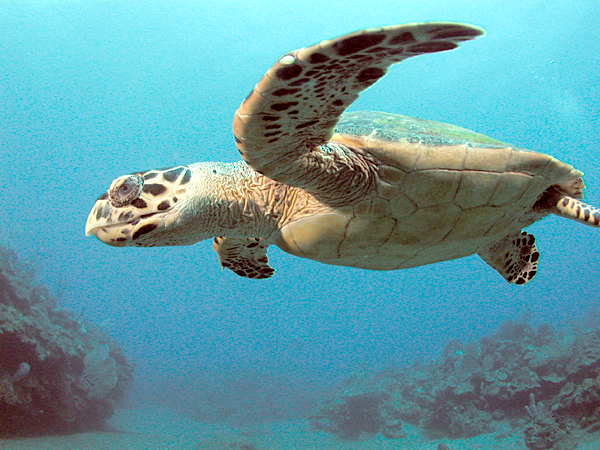
Several characteristics of the hawksbill sea turtle distinguish it from other sea turtle species. Its elongated, tapered head ends in a beak-like mouth (from which its common name is derived), and its beak is more sharply pronounced and hooked than others. The hawksbill's forelimbs have two visible claws on each flipper.
A readily distinguished characteristic of the hawksbill is the pattern of thick scutes that make up its carapace. While its carapace has five central scutes and four pairs of lateral scutes like several members of its family, E. imbricata posterior scutes overlap in such a way as to give the rear margin of its carapace a serrated look, similar to the edge of a saw or a steak knife. The turtle's carapace can reach almost 1 m in length. The hawksbill appears to frequently employ its sturdy shell to insert its body into tight spaces in reefs.
Crawling with an alternating gait, hawksbill tracks left in the sand are asymmetrical. In contrast, the green sea turtle and the leatherback turtle have a more symmetrical gait.
Due to its consumption of venomous cnidarians, hawksbill sea turtle flesh can become toxic.
The hawksbill is biofluorescent and is the first reptile recorded with this characteristic. If the effect is due to the turtle's diet, which includes biofluorescent organisms like the hard coral Physogyra lichtensteini, is unknown. Males have more intense pigmentation than females, and a behavioral role of these differences is speculated.
Tortue imbriqueeld4.jpg|alt=Photo from above of swimming turtle, with four outstretched flippers and faceted shell|Carapace's serrated margin and overlapping scutes are evident in this individual Hawksbill turtle doeppne-081.jpg|alt=Profile photo of the animal head with prominent beak protruding above lower jaw, a faceted head covering surrounds the eye|Close-up of the hawksbill's distinctive beak Fluorescent Turtle.jpg|Fluorescent markings on carapace Hawksbill Turtle on the GBR.webm|A hawksbill sea turtle swims past a group of divers on the Great Barrier Reef, Australia
Distribution
Hawksbill sea turtles have a wide range, found predominantly in tropical reefs of the Indian, Pacific, and Atlantic Oceans. Of all the sea turtle species, E. imbricata is the one most associated with warm, tropical waters. Two significant subpopulations are known, in the Atlantic and Indo-Pacific.{{cite web | title =Species Fact Sheet: 'FIGIS - Fisheries Global Information System

Atlantic subpopulation
In the Atlantic, hawksbill populations range as far west as the Gulf of Mexico and as far southeast as the Cape of Good Hope in South Africa.{{cite web | title =Hawksbill Sea Turtle (Eretmochelys imbricata) | work =North Florida Field Office | publisher =United States Fish and Wildlife Service | date =2005-12-09
Along the East Coast of the United States, hawksbill sea turtles range from Virginia to Florida. In Florida, according to the Florida Fish and Wildlife Conservation Commission, hawksbills are found primarily on reefs in the Florida Keys and along the southeastern Atlantic coast. Several major nesting sites are found in coastal Palm Beach, Broward, and Dade Counties. THE FLORIDA HAWKSBILL PROJECT, is a comprehensive research and conservation Program to study and protect the region's hawksbill sea turtles and the habitats in which they live. Within the scope of this project, numerous studies have been undertaken to characterize the hawksbill aggregations found in southeast Florida waters, and educational programs have been developed to engage the local dive community in the protection of hawksbill sea turtles and coral reef habitats. This program is hosted by the National Save the Sea Turtle Foundation, located in Fort Lauderdale, Florida. Throughout their global range, hawksbill turtles are known to closely associate with coral reef habitats, mostly due to their preference for eating sponges and corals. Due to the large extent of Florida's barrier reefs (about 350 linear miles), the Hawksbill Project focuses on representative sites in the northern, central, and southern sections of the Southeast Florida Reef Tract. The barrier reefs of northern Palm Beach County, the patch reefs of the northern Keys, and the finger reefs of Key West are the primary locations for their sampling efforts
In the Caribbean, the main nesting beaches are in the Lesser Antilles, Barbados, Guadeloupe, Tortuguero in Costa Rica, and the Yucatan. They feed in the waters off Cuba and around Mona Island near Puerto Rico, among other places.
Indo-Pacific subpopulation

In the Indian Ocean, hawksbills are a common sight along the east coast of Africa. One can find them in the seas surrounding Madagascar and Mozambique, and island groups such as Primeiras e Segundas, which include the turtle protection island of Ilha do Fogo. Hawksbills are also common along the southern Asian coast, including the Persian Gulf, the Red Sea, and the Indian subcontinental and Southeast Asian coasts. They are present across the Malay Archipelago and northern Australia. Their Pacific range is limited to the ocean's tropical and subtropical regions. In the west, it extends from the southwestern tips of the Korean Peninsula and the Japanese Archipelago south to northern New Zealand.
The Philippines hosts several nesting sites, including the island of Boracay and Punta Dumalag in Davao City. Dahican Beach in Mati City, Davao Oriental, hosts one of the essential hatcheries of its kind, along with olive ridley sea turtles in the archipelagic country of the Philippines. A small group of islands in the southwest of the archipelago is named the "Turtle Islands" because two species of sea turtles nest there: the hawksbill and the green sea turtle. In January 2016, a juvenile was seen in Gulf of Thailand. A 2018 article by The Straits Times reported that around 120 hawksbill juvenile turtles recently hatched at Pulau Satumu, Singapore. Commonly found in Singapore waters, hawksbill turtles have returned to areas such East Coast Park and Palau Satumu to nest. In Hawaii, hawksbills mostly nest on the "main" islands of Oahu, Maui, Molokai, and Hawaii. In Australia, hawksbills are known to nest on Milman Island in the Great Barrier Reef. Hawksbill sea turtles nest as far west as Cousine Island in the Seychelles, where the species since 1994 is legally protected, and the population is showing some recovery. The Seychelles' inner islands and islets, such as Aldabra, are popular feeding grounds for immature hawksbills.
Eastern Pacific subpopulation
In the eastern Pacific, hawksbills are known to occur from the Baja Peninsula in Mexico, south along the coast to southern Peru. Nonetheless, as recently as 2007, the species had been considered extirpated mainly in the region. Important remnant nesting and foraging sites have since been discovered in Mexico, El Salvador, Nicaragua, and Ecuador, providing new research and conservation opportunities. In contrast to their traditional roles in other parts of the world, where hawksbills primarily inhabit coral reefs and rocky substrate areas, in the eastern Pacific, hawksbills tend to forage and nest principally in mangrove estuaries, such as those present in the Bahia de Jiquilisco (El Salvador), Gulf of Fonseca (Nicaragua, El Salvador, and Honduras), Estero Padre Ramos (Nicaragua), and the Gulf of Guayaquil (Ecuador). Multi-national initiatives, such as the Eastern Pacific Hawksbill Initiative , are currently pushing efforts to research and conserve the population, which remains poorly understood.
Habitat and feeding
Habitat

Adult hawksbill sea turtles are primarily found in tropical coral reefs. They are usually seen resting in caves and ledges in and around these reefs throughout the day. As a highly migratory species, they inhabit a wide range of habitats, from the open ocean to lagoons and even mangrove swamps in estuaries. Little is known about the habitat preferences of early life-stage E. imbricata; like other young sea turtles, they are assumed to be completely pelagic, remaining at sea until they mature. However, they have been known to seek habitats where they are able to camouflage or hide to minimize predator detection.
Feeding

While they are omnivorous, sea sponges are their principal food; they constitute 70–95% of the turtles' diets. However, like many spongivores, they feed only on select species, ignoring many others. Caribbean populations feed primarily on the orders Astrophorida, Spirophorida, and Hadromerida in the class Demospongiae. Aside from sponges, hawksbills feed on algae, marine plants (seagrasses), woody plant remains, mangrove fruits and seeds, cnidarians (jellyfish, hydrozoans, hard corals, corallimorphs, zoanthids, and sea anemones), comb jellies, bryozoans, mollusks (squid, snails, nudibranchs, bivalves, and tusk shells), echinoderms (sea cucumbers and sea urchins), tunicates, fish and their eggs, crustaceans, and arthropods (crabs, lobsters, barnacles, copepods, and beetles). They also feed on the dangerous jellyfish-like hydrozoan, the Portuguese man o' war (Physalia physalis). Hawksbills close their unprotected eyes when they feed on these cnidarians. The man o' war's stinging cells cannot penetrate the turtles' armored heads.
Hawksbills are highly resilient and resistant to their prey. Some of the sponges they eat, such as Aaptos aaptos, Chondrilla nucula, Tethya actinia, Spheciospongia vesparium, and Suberites domuncula, are highly (often lethally) toxic to other organisms. In addition, hawksbills choose sponge species with significant numbers of siliceous spicules, such as Ancorina, Geodia (G. gibberosa), Ecionemia, and Placospongia.
Life history
Less is known about the life history of hawksbills by comparison to several other sea turtle species. Their life history may be divided into three phases, the: (i) early life history phase from approximately 4–30 cm straight carapace length, (ii) benthic phase when the immature turtles recruit to foraging areas, and (iii) reproductive phase, when individuals reach sexual maturity and begin periodically migrating to breeding grounds. The early life history phase is not as geographically resolved as other sea turtle species. This phase appears to vary across ocean regions and may occur in both pelagic and nearshore waters, possibly lasting from 0–4 years of age. One study from the central Pacific Ocean population used bomb radiocarbon (14C) dating and von Bertalanffy growth models to estimate hawksbills reach sexual maturity at ~ 72 cm and 29 years of age (range 23–36 years). Hawksbills show a degree of fidelity after recruiting to the benthic phase however, the movement to other similar habitats is possible.
Breeding
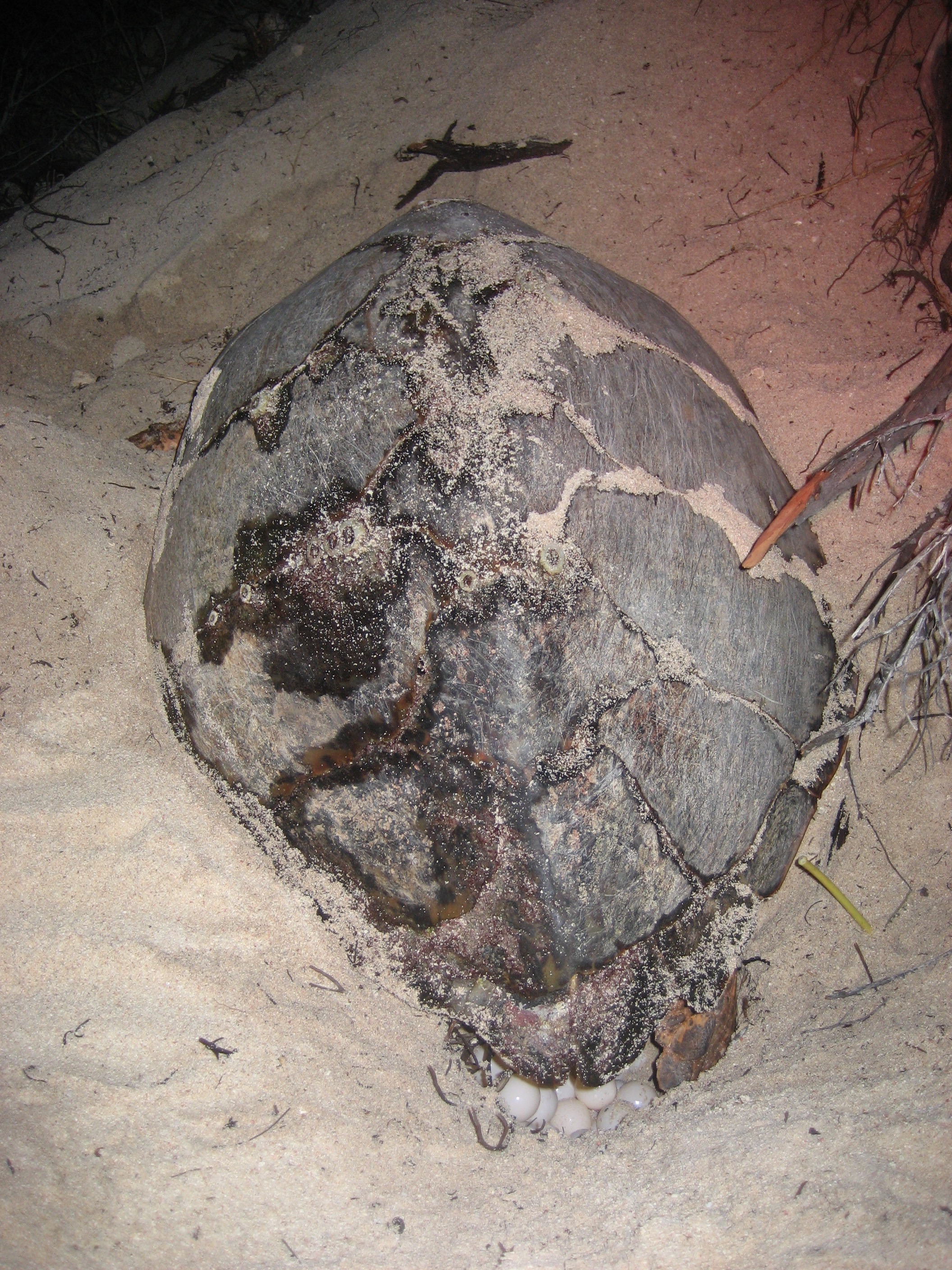
Hawksbills mate biannually in secluded lagoons off their nesting beaches in remote islands throughout their range. The most significant nesting beaches are in Mexico, the Seychelles, Indonesia, Sri Lanka, and Australia. The mating season for Atlantic hawksbills usually spans April to November. Indian Ocean populations, such as the Seychelles hawksbill population, mate from September to February. After mating, females drag their heavy bodies high onto the beach during the night. They clear an area of debris and dig a nesting hole using their rear flippers, then lay clutches of eggs and cover them with sand. Caribbean and Florida nests of E. imbricata typically contain around 140 eggs, which hatch after about 60 days. After the hours-long process, the female returns to the sea. Their nests can be found throughout beaches in about 60 countries.
Hatchlings, usually weighing less than 24 g, hatch at night after around two months. These newly emergent hatchlings are dark-colored, with heart-shaped carapaces measuring about 2.5 cm long. They instinctively crawl into the sea, attracted by the moon's reflection on the water (disrupted by light sources such as street lamps and lights). While they emerge under the cover of darkness, hatchlings that do not reach the water by daybreak are preyed upon by shorebirds, shore crabs, and other predators.
Maturity

Hawksbills evidently reach maturity after 20 years. Their lifespan is unknown. Like other sea turtles, hawksbills are solitary for most of their lives; they meet only to mate. They are highly migratory. Because of their tough carapaces, adults' only predators are humans, tiger sharks, requiem sharks (Carcharhinus), estuarine crocodiles, common octopuses, and groupers (Epinephelus).
A series of biotic and abiotic cues, such as individual genetics, foraging quantity and quality, or population density, may trigger the maturation of the reproductive organs and the production of gametes and thus determine sexual maturity. Like many reptiles, all marine turtles of the same aggregation are highly unlikely to reach sexual maturity at the same size and thus age.
Age at maturity has been estimated to occur between 10 and 25 years of age for Caribbean hawksbills. Turtles nesting in the Indo-Pacific region may reach maturity at a minimum of 30 to 35 years.
Evolutionary history
Within the sea turtles, E. imbricata has several unique anatomical and ecological traits. It is the only primarily spongivorous reptile. Because of this, its evolutionary position is somewhat unclear. Molecular analyses support Eretmochelys placement within the taxonomic tribe Carettini, including the carnivorous loggerhead and ridley sea turtles, rather than in the tribe Chelonini, which includes the herbivorous green turtle. The hawksbill probably evolved from carnivorous ancestors.
Exploitation by humans
Throughout the world, hawksbill turtles have been hunted by humans, though it is illegal to capture, kill, and trade hawksbills in many countries today. In some parts of the world, hawksbill turtles and their eggs continue to be exploited as food. As far back as the fifth century BCE, sea turtles, including the hawksbill, were eaten as delicacies in China.

Captured hawksbill sea turtle from Mauritius at Orly Airport customs 1995|left]] Beyond direct consumption for food, many cultures have also exploited hawksbill populations for their ornate carapace shells, known variously as tortoiseshell, turtle shell, and bekko.
In China, the hawksbill is called dai mei or dai mao ("tortoise-shell turtle"), and was used to make and decorate a variety of small items, as it was in the West. Along the south coast of Java, stuffed hawksbill turtles are sold in souvenir shops, though numbers have decreased in the last two decades. In Japan, the turtles are harvested for their shell scutes, called bekko in Japanese. Bekko is used in various personal implements, such as eyeglass frames and the shamisen (Japanese traditional three-stringed instrument) picks. In 1994, Japan stopped importing hawksbill shells from other nations. Prior to this, the Japanese hawksbill shell trade was around 30000 kg of raw shells per year. In Europe, hawksbill sea turtle shells were harvested by the ancient Greeks and ancient Romans for jewellery, such as combs, brushes, and rings. Recently, processed shells were regularly available in large amounts in countries including the Dominican Republic and Colombia.
Global estimates of the historical exploitation of hawksbills have received recent attention. From 1950-1992, one pioneering study estimated that as many as 1.37 million adult hawksbills were killed in the international tortoiseshell trade alone. With the aid of substantial additional trade data, including official trade records from the imperial Japanese archives, the international trade of tortoiseshell was recently updated to have killed approximately 8.98 million hawksbills (range 4.64 to 9.83 million) from 1844-1992. Most of the trade occurred in the Pacific Ocean basin, and the countries of origin and trade routes bore similarity to what is known of illegal, unreported and unregulated fishing (IUU fishing).
Conservation

Consensus has determined sea turtles, including E. imbricata to be at least threatened, because of their slow growth and maturity and low reproductive rates. Humans have killed many adult turtles, both accidentally and deliberately. Their existence is threatened due to pollution and loss of nesting areas because of coastal development. Biologists estimate that the hawksbill population has declined 80 percent in the past 100–135 years.
In 1982, the IUCN Red List of Threatened Species first listed E. imbricata as endangered. This endangered status continued through several reassessments in 1986, 1988, 1990, and 1994 until it was upgraded in status to critically endangered in 1996.
The species (along with the entire Cheloniidae family) has been listed in Appendix I of the Convention on International Trade in Endangered Species. This means commercial international trade (including in parts and derivatives) is prohibited and non-commercial international trade is regulated.
Hawksbill turtles are listed in Annex II of the Protocol Concerning Specially Protected Areas and Wildlife to the Convention for the Protection and Development of the Marine Environment of the Wider Caribbean Region (SPAW), part of the Cartagena Convention.
The United States Fish and Wildlife Service and National Marine Fisheries Service have classified hawksbills as endangered under the Endangered Species Act since 1970. for protecting E. imbricata.
The Zoological Society of London has inscribed the reptile as an EDGE species, meaning that it is both endangered and highly genetically distinct, and therefore of particular concern for conservation efforts.
The World Wildlife Fund Australia (WWF-Australia) has several ongoing projects aiming at protecting the reptile.
On Rosemary Island, an island in the Dampier Archipelago off the Pilbara coast of Western Australia, volunteers have been monitoring hawksbill turtles since 1986. In November 2020, a 60-year old turtle first tagged in November 1990 and again in 2011 returned to the same location.
References==
References
- Mortimer, J.A.. (2008). "''Eretmochelys imbricata''".
- "Appendices {{!}} CITES".
- {{ITIS
- {{ITIS
- {{ITIS
- (2013). "Hawksbill Sea Turtle (Eretmochelys Imbricata) 5-Year Review: Summary and Evaluation". US National Oceanic and Atmospheric Administration.
- "Species Booklet: Hawksbill sea turtle". Virginia Department of Game & Inland Fisheries.
- "Hawksbill turtle – ''Eretmochelys imbricata'': More information". Wildscreen.
- "'' Eretmochelys imbricata'', Hawksbill Sea Turtle". MarineBio.org.
- Witherington, B.. (2006). "Sea Turtles: An Extraordinary History of Some Uncommon Turtles". Voyager Press.
- "The Hawksbill Turtle (''Eretmochelys imbricata'')". turtles.org.
- "Hawksbill". Marine Conservation Society, Seychelles.
- "The Hawksbill Turtle: ''Eretmochelys imbricata''". Auckland Zoo.
- Jane J. Lee. (September 2015 }} {{YouTube). "Exclusive Video: First "Glowing" Sea Turtle Found".
- (2015). "First Observation of Fluorescence in Marine Turtles". American Museum Novitates.
- Formia, Angela. (2003). "Sea Turtle Conservation along the Atlantic Coast of Africa". Marine Turtle Newsletter.
- Beggs, Jennifer A.. (2007). "Increase in hawksbill sea turtle ''Eretmochelys imbricata'' nesting in Barbados, West Indies". Endangered Species Research.
- (2009). "Nesting Ecology of the Hawksbill Turtle, ''Eretmochelys imbricata'', in Guadeloupe, French West Indies from 2000–07". Journal of Herpetology.
- (1993). "Decline of the Nesting Population of Hawksbill Turtles at Tortuguero, Costa Rica". Conservation Biology.
- (1996). "Origin of Hawksbill Turtles in a Caribbean Feeding Area as Indicated by Genetic Markers". Ecological Applications.
- (20 February 2024). "Fire Island Conservation {{!}} Saving Sea Turtles".
- Colacion, Artem. (2005-03-10). "Uriel's journey home — a Young pawikan's story in Boracay". The Philippine Star.
- "Ocean Ambassadors - Philippine Turtle Islands". OneOcean.org.
- "Wild Encounter Thailand".
- (2018-09-26). "Almost 120 critically endangered turtles hatch at Raffles Lighthouse island". The Straits Times.
- "Sea turtles on the Shores of Singapore".
- Hoover, John P.. (2008). "The Ultimate Guide to Hawaiian Reef Fishes, Sea Turtles, Dolphins, Whales, and Seals". Mutual Publishing.
- Loop, K. A.. (1995). "Nesting by the hawsbill turtle (''Eretmochelys imbricata'') on Milman Island, Great Barrier Reef, Australia". Wildlife Research.
- Allen, ZC. (April 2010). "Hawksbill turtle monitoring in Cousin Island". Endangered Species Research.
- Hitchins, P. M.. (2004-04-27). "Nesting success of hawksbill turtles (''Eretmochelys imbricata'') on Cousine Island, Seychelles". Journal of Zoology.
- Gaos, Alexander. (2010). "Signs of Hope in the Eastern Pacific: International collaboration reveals encouraging status of hawksbill turtles in the eastern Pacific". Oryx.
- Gaos, Alexander. (2011). "Shifting the life-history paradigm: discovery of novel habitat use by hawksbill turtles". Biology Letters.
- Lutz, P. L.. (1997). "The Biology of Sea Turtles". CRC Press.
- Houghton, Jonathan D. R.. (2003). "Habitat utilization by juvenile hawksbill turtles (''Eretmochelys imbricata'', Linnaeus, 1766) around a shallow water coral reef". Journal of Natural History.
- (September 2018). "The early ontogeny of carapace armoring in hawksbill sea turtles ( Eretmochelys imbricata ), with comparisons to its close relatives (Loggerhead, Caretta caretta; Kemp's ridley, Lepidochelys kempii )". Journal of Morphology.
- "Information About Sea Turtles: Hawksbill Sea Turtle – Sea Turtle Conservancy".
- Meylan, Anne. (1988-01-22). "Spongivory in Hawksbill Turtles: A Diet of Glass". Science.
- "''Eretmochelys imbricata'' (Hawksbill)".
- "''Eretmochelys imbricata'' (Hawksbill Turtle)". [[University pf the West Indies.
- "Hawksbill (''Eretmochelys imbricata'')".
- (2016-01-13). "Time in tortoiseshell: a bomb radiocarbon-validated chronology in sea turtle scutes". Proceedings of the Royal Society B: Biological Sciences.
- (April 2016). "The developmental biogeography of hawksbill sea turtles in the North Pacific". Ecology and Evolution.
- (1994). "Growth rates of wild juvenile hawksbill turtles, ''Eretmochelys imbricata'', in St. Thomas, United States Virgin Islands". Copeia.
- (1997). "Diving behavior of immature hawksbill turtles (''Eretmochelys imbricata'') in a Caribbean reef habitat". Coral Reefs.
- Limpus, C. J.. (1992). "The hawksbill turtle, ''Eretmochelys imbricata'', in Queensland: population structure within a southern Great Barrier Reef feeding ground". Wildlife Research.
- Boulon, R.H. 1989. Virgin Island turtle tags recovered outside the U. S. Virgin Islands. In: S.A. Eckert, K.L. Eckert & T.H. Richardson (Compilers). Proceedings of the Ninth Annual Workshop on Sea Turtle Conservation and Biology. U.S. Dept. of Commerce. NOAA Tech. Memo. NMFS-SEFC-232. pp 207.
- (2007-05-16). "Reproductive patterns of the hawksbill turtle ''Eretmochelys imbricata'' in sandy beaches of the Yucatan Peninsula". Journal of the Marine Biological Association of the United Kingdom.
- "Atlantic Hawksbill Sea Turtle Fact Sheet". New York State Department of Environmental Conservation.
- Edelman, Michael. (2004). "''Eretmochelys imbricata'': Information". University of Michigan Museum of Zoology.
- Eretmochelys imbricata (Hawksbill). Animal Diversity Web. https://animaldiversity.org/accounts/Eretmochelys_imbricata/
- León, Y.M. and C.E. Diez. (1999). "Population structure of hawksbill turtles on a foraging ground in the Dominican Republic". Chelonian Conservation and Biology.
- (1994). "The green turtle, ''Chelonia mydas'', in Queensland: population structure in a warm temperate feeding area". Memoirs of the Queensland Museum.
- (1999). "Reproduction and Nesting of the Hawksbill Turtle, ''Eretmochelys imbricata'', in the Cuban Archipelago". Chelonian Conservation and Biology.
- (2002). "Habitat effect on hawksbill turtle growth rates on feeding grounds at Mona and Monito Islands, Puerto Rico". Marine Ecology Progress Series.
- Limpus, C.J. and Miller, J.D.. (2000) ''Final Report for Australian Hawksbill Turtle Population Dynamics Project. A Project Funded by the Japan Bekko Association to Queensland Parks and Wildlife Service''. Dr. Colin J. Limpus and Dr. Jeffrey D. Miller, Planning and Research Division, Queensland Parks and Wildlife Service, P.O. Box 155, Brisbane Albert Street, Qld 4002, Australia.
- Bowen, Brian W.. (15 June 1993). "A Molecular Phylogeny for Marine Turtles: Trait Mapping, Rate Assessment, and Conservation Relevance". Proceedings of the National Academy of Sciences of the United States of America.
- Schafer, Edward H.. (1962). "Eating Turtles in Ancient China". Journal of the American Oriental Society.
- "Sea Turtle Restoration Project: Hawksbill Sea Turtle".
- Nijman, Vincent. (2015). "Decade's long open trade in protected marine turtles along Java's south coast". Marine Turtle Newsletter.
- Heppel, Selina S.. (June 1996). "Analysis of a Fisheries Model for Harvest of Hawksbill Sea Turtles (''Eretmochelys imbricata'')". Conservation Biology.
- Strieker, Gary. (2001-04-10). "Tortoiseshell ban threatens Japanese tradition". Cable News Network LP, LLLP..
- Casson, Lionel. (1982). "Periplus Maris Erythraei: Notes on the Text". The Journal of Hellenic Studies.
- (2006-10-01). "Turtles of the Caribbean: the curse of illegal trade". World Wide Fund for Nature.
- (March 2019). "The historical development of complex global trafficking networks for marine wildlife". Science Advances.
- Groombridge, B.. (1982). "The IUCN Amphibia-Reptilia Red Data Book, Part 1: Testudines, Crocodylia, Rhynocehapalia". IUCN.
- CITES. (2006-06-14). "Appendices". Convention on International Trade in Endangered Species of Wild Flora and Fauna.
- UNEP-WCMC. (May 2017). "''Eretmochelys imbricata''". United Nations Environment Programme - World Conservation Monitoring Centre.
- NOAA Fisheries. (14 February 2024). "Hawksbill Turtle: Conservation & Management". National Oceanic and Atmospheric Administration.
- (2012). "Convention for the Protection and Development of the Marine Environment of the Wider Caribbean Region and its Protocols". United Nations Environment Programme.
- (2019-07-09). "Endangered Species Act (ESA)". noaa.gov.
- (5 March 2021). "Recovery Plans for Endangered and Threatened Species". noaa.gov.
- (1970-06-02). "Species Profile: Hawksbill sea turtle (''Eretmochelys imbricata'')". United States Fish and Wildlife Service.
- "Hawksbill Turtle {{!}} ''Eretmochelys imbricata''". [[Zoological Society of London.
- (27 November 2020). "Hawksbill turtle".
- Standen, Susan. (22 November 2020). "Endangered hawksbill turtles return to nest on Pilbara coast raising hopes for conservation".
This article was imported from Wikipedia and is available under the Creative Commons Attribution-ShareAlike 4.0 License. Content has been adapted to SurfDoc format. Original contributors can be found on the article history page.
Ask Mako anything about Hawksbill sea turtle — get instant answers, deeper analysis, and related topics.
Research with MakoFree with your Surf account
Create a free account to save articles, ask Mako questions, and organize your research.
Sign up freeThis content may have been generated or modified by AI. CloudSurf Software LLC is not responsible for the accuracy, completeness, or reliability of AI-generated content. Always verify important information from primary sources.
Report