From Surf Wiki (app.surf) — the open knowledge base
Harry Hammond Hess
American geologist (1906–1969)
American geologist (1906–1969)
| Field | Value |
|---|---|
| name | Harry Hammond Hess |
| image | Hess.gif |
| caption | Harry Hess in 1941 |
| birth_date | |
| birth_place | New York City, New York, United States |
| death_date | |
| death_place | Woods Hole, Massachusetts United States |
| field | Geology |
| alma_mater | Princeton University |
| doctoral_advisor | Arthur Francis Buddington |
| thesis_title | Hydrothermal metamorphism of an ultrabasic intrusive at Schuyler, Virginia |
| thesis_url | http://www.worldcat.org/oclc/1077728123 |
| thesis_year | 1932 |
| doctoral_students | Eugene Merle Shoemaker |
| John Tuzo Wilson{{cite web | |
| url | http://www.mssu.edu/seg-vm/bio_j__tuzo_wilson.html |
| title | J Tuzo Wilson |
| publisher | Society of Exploration Geophysics |
| work | Virtual Geoscience Center |
| url-status | dead |
| archive-url | https://web.archive.org/web/20100715172446/http://www.mssu.edu/seg-vm/bio_j__tuzo_wilson.html |
| archive-date | 2010-07-15 |
| known_for | Discovering seafloor spreading |
| awards | Penrose Medal (1966) |
John Tuzo Wilson{{cite web |url-status = dead |archive-url = https://web.archive.org/web/20100715172446/http://www.mssu.edu/seg-vm/bio_j__tuzo_wilson.html |archive-date = 2010-07-15 Ronald Oxburgh Harry Hammond Hess (May 24, 1906 – August 25, 1969) was an American geologist and a United States Navy officer in World War II who is considered one of the "founding fathers" of the unifying theory of plate tectonics. He published theories on sea floor spreading, specifically on relationships between island arcs, seafloor gravity anomalies, and serpentinized peridotite, suggesting that the convection in the Earth's mantle is the driving force behind this process.
Early life and education
Harry Hammond Hess was born on May 24, 1906, in New York City to Julian S. Hess, a member of the New York Stock Exchange, and Elizabeth Engel Hess. He attended Asbury Park High School in Asbury Park, New Jersey. In 1923, he entered Yale University, where he intended to study electrical engineering but ended up graduating with a Bachelor of Science degree in geology. Hess failed his first time taking mineralogy at Yale and was told he had no future in the field. Despite this, he continued with his degree and was teaching geology at Princeton when World War II was declared. He spent two years as an exploration geologist in Northern Rhodesia. In 1934 he married Annette Burns.
Teaching career
Harry Hess taught for one year (1932–1933) at Rutgers University in New Jersey and spent a year as a research associate at the Geophysical Laboratory of Washington, D. C., before joining the faculty of Princeton University in 1934. Hess remained at Princeton for the rest of his career and served as Geology Department Chairman from 1950 to 1966. He was a visiting professor at the University of Cape Town, South Africa (1949–1950), and the University of Cambridge, England (1965).
Military and war career
Hess joined the United States Navy during World War II, becoming captain of the USS Cape Johnson, an attack transport ship equipped with a new technology: sonar. This command would later prove to be key in Hess's development of his theory of sea floor spreading. Hess carefully tracked his travel routes to Pacific Ocean landings on the Marianas, Philippines, and Iwo Jima, continuously using his ship's echo sounder. This unplanned wartime scientific surveying enabled Hess to collect ocean floor profiles across the North Pacific Ocean, resulting in the discovery of flat-topped submarine volcanoes, which he termed guyots, after the 19th-century geographer Arnold Henry Guyot. After the war, he remained in the Naval Reserve, rising to the rank of rear admiral.
Scientific discoveries
In 1960, Hess made his single most important contribution, which is regarded as part of the major advance in geologic science of the 20th century. In a widely circulated report to the Office of Naval Research, he advanced the theory, now generally accepted, that the Earth's crust moved laterally away from long, volcanically active oceanic ridges. He only understood his ocean floor profiles across the North Pacific Ocean after Marie Tharp and Bruce Heezen (1953, Lamont Group) discovered the Great Global Rift, running along the Mid-Atlantic Ridge. Seafloor spreading, as the process was later named, helped establish Alfred Wegener's earlier (but generally dismissed at the time) concept of continental drift as scientifically respectable. This triggered a revolution in the earth sciences. Hess's report was formally published in his History of Ocean Basins (1962), which for a time was the single most referenced work in solid-earth geophysics. Hess was also involved in many other scientific endeavours, including the Mohole project (1957–1966), an investigation onto the feasibility and techniques of deep sea drilling.
Accolades and affiliations
Hess was elected to the United States National Academy of Sciences in 1952 and the American Philosophical Society in 1960. He was president of The Geological Society of America in 1963 and received their Penrose Medal in 1966. In 1968, he was elected to the American Academy of Arts and Sciences.
Death
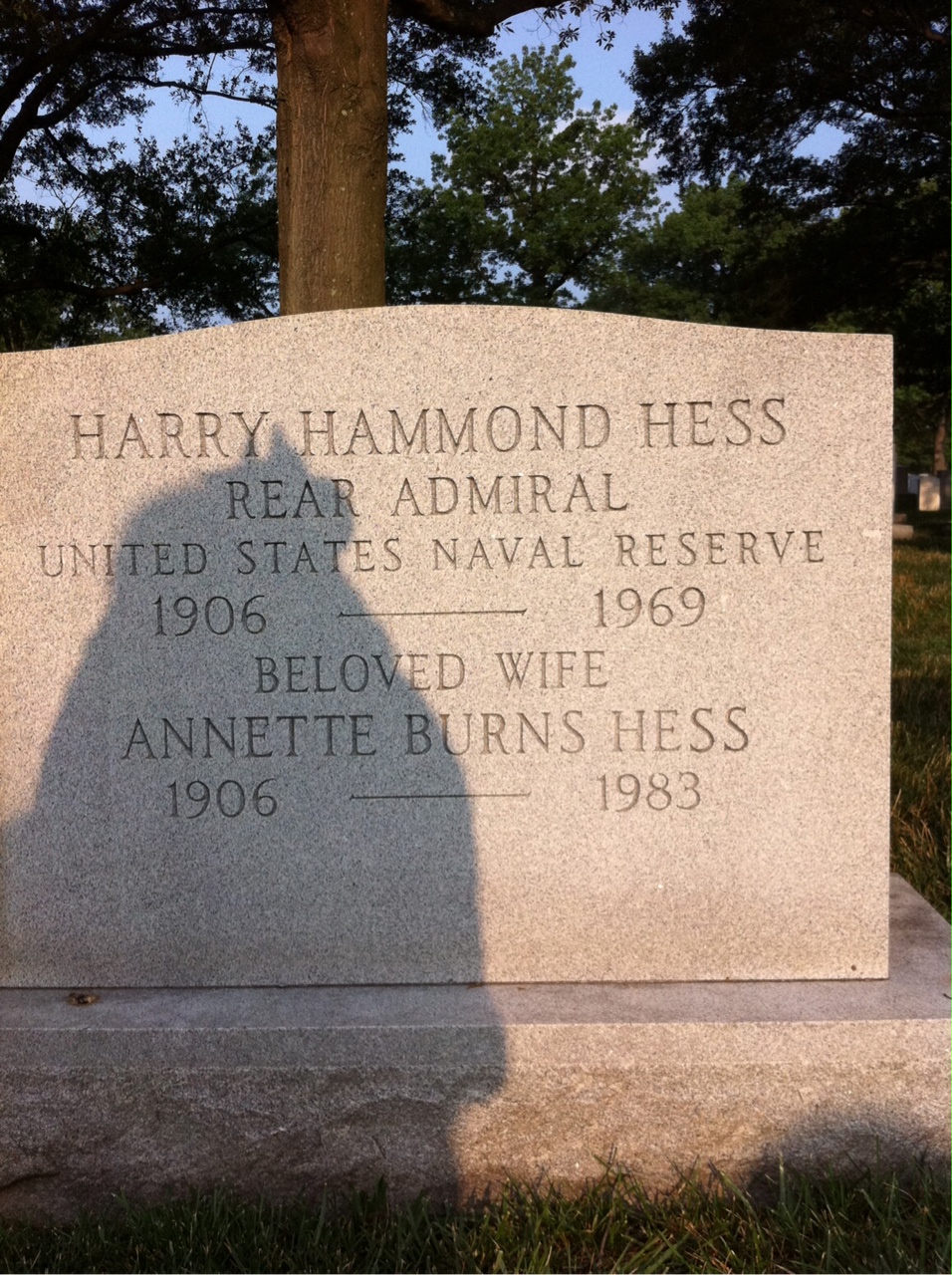
Hess died from a heart attack in Woods Hole, Massachusetts, on August 25, 1969, while chairing a meeting of the Space Science Board of the National Academy of Sciences. He was buried at Arlington National Cemetery and was posthumously awarded the National Aeronautics and Space Administration's Distinguished Public Service Award.
The Harry H. Hess Medal
The American Geophysical Union established the Harry H. Hess medal in his memory in 1984 to "honor outstanding achievements in research of the constitution and evolution of Earth and sister planets."
Past recipients
Source:
- 1985 Gerald J. Wasserburg
- 1987 Julian R. Goldsmith
- 1989 A.G.W. Cameron
- 1991 George W. Wetherill
- 1993 Alfred E. Ringwood
- 1995 Edward Anders
- 1996 Thomas J. Ahrens
- 1997 Stanley Robert Hart
- 1998 David J. Stevenson
- 1999 Ikuo Kushiro
- 2001 Albrecht Hofmann
- 2002 Gerald Schubert
- 2003 David L. Kohlstedt
- 2004 Adolphe Nicolas
- 2005 Sean C. Solomon
- 2006 Alexandra Navrotsky
- 2007 Michael John O'Hara
- 2008 H. Jay Melosh
- 2009 Frank M. Richter
- 2010 David Walker
- 2011 Henry Dick
- 2012 Maria T. Zuber
- 2013 Bernard Wood
- 2014 Donald J. DePaolo
- 2015 Claude Jaupart
- 2016 Alexander Halliday
- 2017 Roberta Rudnick
- 2018 Timothy L. Grove
- 2019 Richard J. Walker
- 2020 Donald B. Dingwell
- 2021 Peter B. Kelemen
- 2022 Janne Blichert-Toft
- 2023 Catherine A. McCammon
Selected publications
Also in:
Also in:
References
References
- Chemistry Tree profile [https://academictree.org/chemistry/peopleinfo.php?pid=84637 Harry Hammond Hess]
- "Harry Hess: One of the Discoverers of Seafloor Spreading".
- "Harry Hess: One of the Discoverers of Seafloor Spreading".
- [[Henry William Menard
- Duncan, Francis. (2012). "Rickover: The Struggle for Excellence". Naval Institute Press.
- Collins, Elmer Beauchamp. (1933). "The Navy-Princeton Gravity Expedition to the West Indies in 1932". U.S. Government Printing Office.
- "The Navy-Princeton gravity expedition to the West Indies in 1932 (catalog entry)".
- (March 1959). "Seismic-refraction measurements in the Atlantic Ocean basins, in the Mediterranean Sea, on the Mid-Atlantic Ridge, and in the Norwegian Sea". Geological Society of America Bulletin.
- Heezen, B. C.. (1960). "The rift in the ocean floor". Scientific American.
- Wilson, J. Tuzo. (December 1968). "A Revolution in Earth Science". Geotimes.
- Hess, H. H.. (November 1, 1962). "Petrologic studies: a volume in honor of A. F. Buddington". Geological Society of America.
- (October 28, 1969). "Princeton Alumni Weekly". Princeton University Press.
- "Harry Hess".
- "APS Member History".
- Eckel, Edwin (1982) ''Geological Society of America – Life History of a Learned Society'', Boulder, Colorado, Geological Society of America Memoir 155, page 168, {{ISBN. 0-8137-1155-X.
- "Harry Hammond Hess".
- "Harry H. Hess Medal". [[American Geophysical Union]].
- [https://books.google.com/books?id=p1Bs03rhZzwC&dq=Harry+H.+Hess+Medal&pg=PA209 "Hess, Harry Hammond]. ''Encyclopedia of Earth Science''. New York Academy of Sciences, Timothy M. Kusky.
- [https://books.google.com/books?id=vMk4t21fOvoC&dq=Harry+H.+Hess+Medal&pg=PA375 "Hess, Harry"], ''Encyclopedia of Earth and Space Science'', p. 375.
- "Harry H. Hess Medal". [[American Geophysical Union]].
- "Seismo_1881".
- [https://www.gl.ciw.edu/news/2007/1/6/michael-john-ohara-was-awarded-2007-harry-h-hess-medal "Michael John O'Hara was Awarded the 2007 Harry H. Hess Medal"] {{webarchive. link. (2015-12-24 . ''ciw.edu''.)
- (2008). "O'Hara Receives 2007 Harry H. Hess Medal". Eos, Transactions American Geophysical Union.
- [http://eesc.columbia.edu/news-events/news/professor-david-walker-awarded-harry-h-hess-medal "Professor David Walker Awarded Harry H. Hess Medal. Earth and Environmental Sciences"] {{Webarchive. link. (2015-12-24 . ''columbia.edu''.)
- [http://sservi.nasa.gov/articles/nlsi-scientists-receive-career-awards/ "NLSI Scientists Receive Career Awards"]. ''nasa.gov''.
- [http://www.earth.ox.ac.uk/news_events/news/department_news/congratulations_to_prof_bernie_wood_on_being_awarded_the_harry_h_hess_medal_of_the_american_geophysical_union. "Congratulations to Prof Bernie Wood on being awarded the Harry H Hess Medal of the American Geophysical Union. – University of Oxford Department of Earth Sciences"] {{webarchive. link. (2013-09-19 . ''ox.ac.uk''.)
- "Claude P. Jaupart |".
- (23 December 2016). "Alex Halliday Receives 2016 Harry H. Hess Medal".
- "American Geophysical Union Announces Recipients of the 2017 Union Medals, Awards and Prizes".
- (27 December 2018). "Timothy L. Grove Receives 2018 Harry H. Hess Medal".
- (11 November 2020). "Announcing the 2020 AGU Union Medal, Award, and Prize Recipientsv".
This article was imported from Wikipedia and is available under the Creative Commons Attribution-ShareAlike 4.0 License. Content has been adapted to SurfDoc format. Original contributors can be found on the article history page.
Ask Mako anything about Harry Hammond Hess — get instant answers, deeper analysis, and related topics.
Research with MakoFree with your Surf account
Create a free account to save articles, ask Mako questions, and organize your research.
Sign up freeThis content may have been generated or modified by AI. CloudSurf Software LLC is not responsible for the accuracy, completeness, or reliability of AI-generated content. Always verify important information from primary sources.
Report