From Surf Wiki (app.surf) — the open knowledge base
Harpoon (missile)
U.S. anti-ship missile
U.S. anti-ship missile
| Field | Value | ||||||
|---|---|---|---|---|---|---|---|
| is_missile | yes | ||||||
| name | A/R/UGM-84 Harpoon | ||||||
| image | [[File:RGM-84.jpg | 300px]] | |||||
| origin | United States | ||||||
| type | Anti-ship missile | ||||||
| used_by | See operators | ||||||
| wars | Iran–Iraq War | ||||||
| manufacturer | McDonnell Douglas | ||||||
| Boeing Defense, Space & Security | |||||||
| unit_cost | US$1,406,812 for Harpoon Block II (2020) | ||||||
| service | 1977–present | ||||||
| engine | Teledyne CAE J402 turbojet/solid propellant booster for surface and submarine launch; greater than 600 lb-f of thrust | ||||||
| weight | 1523 lb including booster | ||||||
| length | {{ubl | ||||||
| {{convert | 12.6 | ft | m | abbr | on}}, air-launched; | ||
| {{convert | 15 | ft | m | abbr | on}}, surface- and submarine-launched | ||
| diameter | 13.5 in | ||||||
| wingspan | 3 ft | ||||||
| speed | {{ubl | ||||||
| {{convert | 537 | mph | km/h m/s Mach | abbr | on | lk=on}}, ship-launched Harpoon BlockI & air-launched Harpoon BlockIC; | |
| Greater than {{convert | 537 | mph | km/h m/s Mach | abbr | on | lk=on}}, ship-launched Harpoon BlockIC & BlockII | |
| vehicle_range | {{ubl | ||||||
| Greater than {{convert | 77 | nmi | km | abbr | on}}, ship-launched Harpoon BlockI & BlockIC; | ||
| Greater than {{convert | 67 | nmi | km | abbr | on}}, ship-launched Harpoon BlockII;{{cite web | url= https://www.boeing.ca/products-and-services/defense-space-security/harpoon-block-ii.page | title = Harpoon Block II |
| publisher | Boeing Canada | access-date= 17 December 2022}} | |||||
| {{convert | 120 | nmi | km | abbr | on}}, air-launched BlockIC | ||
| altitude | Sea-skimming | ||||||
| filling | 488 lb | ||||||
| guidance | Sea-skimming cruise monitored by radar altimeter, active radar terminal homing | ||||||
| detonation | Impact fuze | ||||||
| launch_platform | {{ubl | ||||||
| number | 7,500 |
Russo-Ukrainian War Boeing Defense, Space & Security | 12.6 ft, air-launched; | 15 ft, surface- and submarine-launched | 537 mph, ship-launched Harpoon BlockI & air-launched Harpoon BlockIC; | Greater than 537 mph, ship-launched Harpoon BlockIC & BlockII | Greater than 77 nmi, ship-launched Harpoon BlockI & BlockIC; | Greater than 67 nmi, ship-launched Harpoon BlockII;{{cite web |url= https://www.boeing.ca/products-and-services/defense-space-security/harpoon-block-ii.page|title = Harpoon Block II | 120 nmi, air-launched BlockIC | RGM-84A surface ship/TEL-launched | AGM-84A air-launched | UGM-84A submarine-launched The Harpoon is an all-weather, over-the-horizon, anti-ship missile manufactured by McDonnell Douglas (now Boeing Defense, Space & Security). The AGM-84E Standoff Land Attack Missile (SLAM) and later AGM-84H/K SLAM-ER (Standoff Land Attack Missile – Expanded Response) are cruise missile variants.
The regular Harpoon uses active radar homing and flies just above the water to evade defenses. The missile can be launched from:
- Fixed-wing aircraft (AGM-84), without the solid-fuel rocket booster
- Surface ships (RGM-84), fitted with a solid-fuel rocket booster that detaches when expended, to allow the missile's main turbojet to maintain flight
- Submarines (UGM-84), fitted with a solid-fuel rocket booster and encapsulated in a container to enable submerged launch through a torpedo tube
- Coastal defense batteries (RGM-84), from which it would be fired with a solid-fuel rocket booster
Development
In 1965, the United States Navy began studies for a missile in the 45 km range class for use against surfaced submarines. The name Harpoon was assigned to the project. The sinking of the Israeli destroyer in 1967 by a Soviet-built Styx anti-ship missile shocked senior United States Navy officers, who until then had not appreciated the threat posed by anti-ship missiles. In 1970 Chief of Naval Operations Admiral Elmo Zumwalt accelerated the development of Harpoon as part of his "Project Sixty" initiative, hoping to add much-needed striking power to U.S. surface warships such as the .

The first Harpoon was delivered in 1977; in 2004, Boeing delivered the 7,000th.
The Harpoon has also been adapted for carriage on several aircraft, including the P-3 Orion, the P-8 Poseidon, the AV-8B Harrier II, the F/A-18 Hornet and the U.S. Air Force B-52H bombers. The Harpoon was purchased by many nations, including India, Japan, Singapore, South Korea, Taiwan, the United Arab Emirates and most NATO countries.
The Royal Australian Air Force can fire AGM-84-series missiles from its F/A-18F Super Hornets. AP-3C Orion, and P-8 Poseidon aircraft, and previously from the now retired F-111C/Gs and F/A-18A/B Hornets. The Royal Australian Navy deploys the Harpoon on major surface combatants and in the s. The Spanish Air Force and the Chilean Navy are also AGM-84D customers, and they deploy the missiles on surface ships, and F/A-18s, F-16 Falcons, and P-3 Orion aircraft. The British Royal Navy formerly deployed the Harpoon on several types of surface ships, they were phased out starting in 2023 and replaced with the Naval Strike Missile which has twice the range of a Harpoon and is about 20% faster.
The Royal Canadian Navy carries Harpoon Block II missiles on its s.
The Republic of Singapore Air Force also operates five modified Fokker 50 Maritime Patrol Aircraft (MPA) which are fitted with the sensors needed to fire the Harpoon missile. The Pakistani Navy carries the Harpoon missile on its frigates and P-3C Orions. The Turkish Navy carries Harpoons on surface warships and Type 209 submarines. The Turkish Air Force will be armed with the SLAM-ER. Turkey is planning to replace the Harpoons with Turkish made Atmaca missiles.
At least 339 Harpoon missiles were sold to the Republic of China Air Force (Taiwan) for its F-16 A/B Block 20 fleet and the Republic of China Navy, which operates four guided-missile destroyers and eight guided-missile frigates with the capability of carrying the Harpoon, including the eight former U.S. Navy s and the four former USN s which have been sold to Taiwan. The two /Hai Lung submarines and 12 P-3C Orion aircraft can also use the missile. The eight s, despite being based on the US , have Harpoon capabilities deleted from their combat systems, and funding to restore it has so far been denied, the Republic of China Navy (Taiwan) decided to switch to the Hsiung Feng II and Hsiung Feng III.
The Block 1 missiles were designated A/R/UGM-84A in US service and UGM-84B in the UK. Block 1B standard missiles were designated A/R/UGM-84C, Block 1C missiles were designated A/R/UGM-84D. Block 1 used a terminal attack mode that included a pop-up to approximately 1800 m before diving on the target; Block 1B omitted the terminal pop-up; and Block 1C provided a selectable terminal attack mode.
Harpoon Block 1D
This version featured a larger fuel tank and re-attack capability, allowing it to search for a target again if the initial radar acquisition failed by searching in a clover-leaf pattern, but was not produced in large numbers because its intended mission (warfare with the Warsaw Pact countries of Eastern Europe) was considered to be unlikely following the Dissolution of the Soviet Union. The range is 240 km. Block 1D missiles were designated A/RGM-84F.
SLAM-ER (Block 1H)
This version entered service in 1999, gives the SLAM a re-attack capability, as well as an image comparison capability similar to the Tomahawk cruise missile; that is, the weapon can compare the target scene in front of it with an image stored in its onboard computer during terminal phase target acquisition and lock on (this is known as DSMAC). Block 1G missiles A/R/UGM-84G; the original SLAM-ER missiles were designated AGM-84H (2000-2002) and later ones the AGM-84K (2002 onwards).
Harpoon Block 1J
Block 1J was a proposal for a further upgrade, A/R/UGM-84J Harpoon (or Harpoon 2000), for use against both ship and land targets, these upgrades later evolved into the Block II.
Harpoon Block II
_Harpoon_handling_team_carefully_lower_an_all-up-round_Harpoon_missile_into_its_launch_rack_on_the_aft_VLS_deck_during_ammunition_onload_operations.jpg)
In production at Boeing facilities in Saint Charles, Missouri, is the Harpoon Block II, intended to offer an expanded engagement envelope, enhanced resistance to electronic countermeasures and improved targeting. Specifically, the Harpoon was initially designed as an open-ocean weapon. The Block II missiles continue progress begun with Block IE, and the Block II missile provides the Harpoon with a littoral-water anti-ship capability.
The key improvements of the Harpoon Block II are obtained by incorporating the inertial measurement unit from the Joint Direct Attack Munition program, and the software, computer, Global Positioning System (GPS)/inertial navigation system and GPS antenna/receiver from the SLAM Expanded Response (SLAM-ER), an upgrade to the SLAM.
The US Navy awarded a $120 million contract to Boeing in July 2011 for the production of about 60 Block II Harpoon missiles, including missiles for 6 foreign militaries.
India acquired 24 Harpoon Block II missiles to arm its maritime strike Jaguar fighters in a deal worth $170 million through the Foreign Military Sales system.
In December 2010, the Defense Security Cooperation Agency (DSCA) notified U.S. Congress of a possible sale of 21 additional AGM-84L Harpoon Block II Missiles and associated equipment, parts and logistical support for a complete package worth approximately $200 million for the Indian Navy's P-8I Neptune fleet.

The Indian Navy is also planning to upgrade the fleet of four submarines – – with tube-launched Harpoon missiles. On 1 July 2014 DSCA approved the sale of 12 UGM-84L Harpoon Block II Encapsulated Missiles, 10 UTM-84L Harpoon Encapsulated Training missiles, 2 Encapsulated Harpoon certification training vehicles, containers, spare and repair parts for Shishumar-class submarines. On 24 September 2016, the US Department of Defence contracted Boeing a deal worth $81,271,024 for the missiles. The deal would be executed by 2018.
In April 2020, DSCA approved the sale of 10 AGM-84L Harpoon missiles along with containers, spare and repair parts, support and test equipment for the P-8I fleet to the Indian Navy at a value of $93 million. The sale of Mark 54 lightweight torpedo was approved simultaneously.
It was reported in April 2023 that the Indian Navy would be purchasing equipment for Harpoon missiles worth $80 million. It includes the sale of the Harpoon Joint Common Test Set (JCTS) and related equipment.
Harpoon Block II missiles are designated A/R/UGM-84L.
In early 2018, the U.S. State Department approved the sale of Harpoon Block II to the Mexican Navy for use on their future Sigma-class design frigates, the first of which is being built by Damen Schelde Naval Shipbuilding.
Harpoon Block II+
On 18 November 2015, the U.S. Navy tested the AGM-84N Harpoon Block II+ missile against a moving ship target. The Block II+ incorporates an improved GPS guidance kit and a net-enabled data-link that allows the missile to receive in-flight targeting updates. Introduction of the Block II+ was achieved in 2017 on the F/A-18E/F followed by the P-8A in 2019.
Harpoon Block III
Harpoon Block III was intended to be an upgrade package to the existing USN Block 1C missiles and Command Launch Systems (CLS) for guided missile cruisers, guided missile destroyers, and the F/A-18E/F Super Hornet fighter aircraft. After experiencing an increase in the scope of required government ship integration, test and evaluation, and a delay in development of a data-link, the Harpoon Block III program was canceled by the U.S. Navy in April 2009.
Harpoon Block II+ ER
In April 2015, Boeing unveiled a modified version of the RGM-84 it called the Harpoon Next Generation. It increases the ship-launched Harpoon missile's range from the Block II's 70 nmi to 167.5 nmi, along with a new lighter 300 lb warhead and a more fuel-efficient engine with electronic fuel controls. Boeing offered the missile as the U.S. Navy's Littoral Combat Ship frigate upgrade over-the-horizon anti-ship missile as a cost-effective missile upgrade option; complete Next Gen Harpoons would cost approximately as much as a Block II at $1.2 million each, with upgrades for an existing missile costing half that. The version is also called the Harpoon Block II+ ER. Boeing claims the Block II+ ER is superior to the Naval Strike Missile through its improved turbojet giving it greater range and active radar-homing seeker for all-weather operation, as well as a lighter but "more lethal" warhead. Test shots in 2017 had been confirmed. In May 2017, Boeing revealed it was no longer offering the upgraded Harpoon for the frigate OTH missile requirement, but would continue development of it.
Operational history
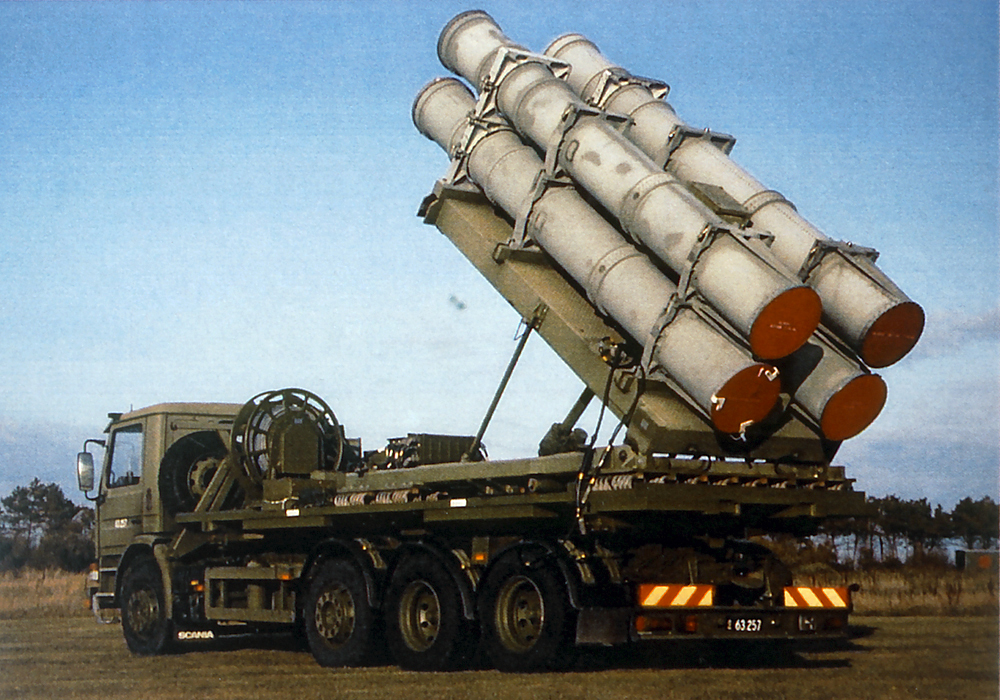

In 1981 and 1982, there were two accidental launches of Harpoon missiles: one by the United States Navy which caused no damage and the other by the Danish Navy, which destroyed and damaged buildings in the recreational housing area Lumsås. The Danish missile was later known as the hovsa-missile (hovsa being the Danish term for oops).
In November 1980, during Operation Morvarid, Iranian missile boats attacked and sank two Iraqi s; one of the weapons used was the Harpoon missile.
In 1986, the United States Navy sank at least two Libyan patrol boats in the Gulf of Sidra. Two Harpoon missiles were launched from the cruiser with no confirmed results and several others from A-6 Intruder aircraft that were said to have hit their targets. Initial reports claimed that USS Yorktown scored hits on a patrol boat, but action reports indicated that the target may have been a false one and that no ships were hit by those missiles.

In 1988, Harpoon missiles were used by the U.S. to sink the Iranian frigate Sahand during Operation Praying Mantis. Another was fired at the Iranian Kaman-class missile boat Joshan, but failed to strike because the fast attack craft had already been mostly sunk by RIM-66 Standard missiles. An Iranian-owned Harpoon missile was also fired at the guided missile cruiser . The missile was successfully lured away by chaff.
In December 1988, a Harpoon launched by an F/A-18 Hornet fighter from the aircraft carrier killed one sailor when it struck the merchant ship Jagvivek, a 250 ft long Indian-owned ship, during an exercise at the Pacific Missile Range near Kauai, Hawaii. A Notice to Mariners had been issued warning of the danger, but Jagvivek left port before receiving the communication and subsequently strayed into the test range area, and the Harpoon missile, loaded just with an inert dummy warhead, locked onto it instead of its intended target.
The UGM-84A undersea-launched Harpoon version was retired from U.S. Navy service in 1997, leaving the U.S. submarine force without an anti-ship missile, a capability that is not planned to be reintroduced until the Block IV Tomahawk is modified with a moving target maritime attack feature in 2021. During RIMPAC 2018 a UGM-84 Harpoon was fired by USS Olympia at the ex-USS Racine. The U.S. Navy plans to refurbish and recertify UGM-84 Harpoon missiles to reintroduce the capability to s. A $10 million contract was awarded to Boeing in January 2021 to deliver the missiles by the end of the year.
In June 2009, it was reported by an American newspaper, citing unnamed officials from the Obama administration and the U.S. Congress, that the U.S. government had accused Pakistan of illegally modifying some older Harpoon missiles to strike land targets. Pakistani officials denied this and they claimed that the US was referring to a new Pakistani-designed missile. Some international experts were also reported to be skeptical of the accusations. Robert Hewson, editor of Jane's Air Launched Weapons, pointed out that the Harpoon is not suitable for the land-attack role due to deficiency in range. He also stated that Pakistan was already armed with more sophisticated missiles of Pakistani or Chinese design and, therefore, "beyond the need to reverse-engineer old US kit." Hewson offered that the missile tested by Pakistan was part of an undertaking to develop conventionally armed missiles, capable of being air- or surface-launched, to counter its rival India's missile arsenal. It was later stated that Pakistan and the US administration had reached some sort of agreement allowing US officials to inspect Pakistan's inventory of Harpoon missiles, and the issue had been resolved.
_lower_an_encapsulated_harpoon_loading_shape_into_the_boat_during_harpoon_shipping,_loading_and_handling_certification_training._(50327126361).jpg)
The Harpoon missile has also emerged as a preferred choice for several foreign countries under the Foreign Military Sales (FMS) route. In 2020 its manufacturer Boeing won two major contracts for supplying Harpoon missiles to Saudi Arabia and six other partner nations under a $3.1 billion deal.
India will also receive Harpoon missiles under FMS in a $155 million deal.
In late May 2022, Denmark sent Harpoon launchers and missiles to Ukraine to help their war effort, and shortly after, the Netherlands sent additional missiles. In mid-June 2022, the U.S. announced that they would supply Ukraine with Harpoon launchers and missiles, and the U.K. Defense Ministry said that they also were looking into supplying Ukraine with the missiles. On 17 June, Ukraine claimed its navy had sunk the tugboat with two Harpoon missiles. In a tweet they said "Spasatel Vasily Bekh, a tug of the Russian Black Sea Fleet, successfully demilitarized by the @UA_NAVY. The ship was transporting personnel, weapons and ammunition to the occupied Snake Island." Ukraine's Naval Command also claimed the Russian tugboat had a Tor missile system on board.
In May 2025 the United States Special Operations Command (SOCOM) announced that the Air Force Special Operations Command (AFSOC) has been conducting field tests to deploy the Harpoon from the AC-130J Ghostrider gunship since 2024. Due to increasing tensions with Russia, China, North Korea and Iran, fielding the Harpoon would give the AC-130 an all-new dedicated standoff anti-ship capability, an ability that would be advantageous in any future large-scale naval conflicts in the Pacific and Indian Ocean.
Operators

_fires_a_Harpoon_anti-ship_missile_during_a_Rim_of_the_Pacific_(RIMPAC)_sinking_exercise.jpg)
;
;
;
;
;Chile
;Denmark
;
;
;
;
;
- (Block 1D) (retired) ;
;
;
;
;
;
;
;
;
;
;
-
- Harpoon Block 2 on order for use with F-15QA ;
;Saudi Arabia
;
;
; (Taiwan)
;
;
;
;
- (retired)
;
;
- (retired)
References
References
- "Contracts For May 13, 2020: Navy".
- (7 May 2025). "Harpoon Anti-Ship Missile-Armed AC-130J Gunships Could Be On The Horizon". © Recurrent Ventures.
- Gady, Franz-Stefan. (20 April 2015). "Who Will Supply the US Navy's Next Anti-Ship Missile?".
- "AGM-84 Harpoon Missile".
- "Boeing: Historical Snapshot: AGM/RGM/UGM-84 Harpoon Missile".
- "Harpoon".
- (19 November 2015). "US To Sell Harpoon Anti-Ship Missile to South Korea".
- M, Samseer. (2015-05-14). "Japan to purchase UGM-84L Harpoon Block II missiles from US".
- (2021-08-03). "US Approves Harpoon Missile Deal With India Worth USD 82 Million".
- Allison, George. (2015-11-19). "South Korea purchase additional Harpoon missiles".
- (1998-06-11). "United Arab Emirates Buys Boeing Harpoon Weapon System".
- Tandon, Kashish. (2021-06-17). "Taiwan Signs Another Major Deal With The US To Ward Off China; Will Acquire HIMARS & Harpoon Missiles".
- (22 November 2022). "Royal Navy warships to receive Harpoon replacement from next year". British Royal Navy.
- Scott, Richard. (26 May 2016). "Halifax class upgrade on finals".
- (24 March 2025). "Turkish F-16 spotted with AGM-84K-1 SLAM-ER". The Aviationist.
- (13 March 2025). "Turkish Navy test-fires submarine-launched version of Atmaca missile for the first time". Naval News.
- (9 April 2025). "Taiwan starts deploying HF-2 and HF-3 anti-ship missiles in response to China's largest naval exercise". Army Recognition Group.
- Parsch, Andreas. "Boeing (McDonnell Douglas) AGM/RGM/UGM-84 Harpoon".
- (23 April 2024). "Harpoon Block D". Center for Strategic and International Studies.
- "Harpoon Block 1D".
- "Harpoon".
- "AGM-84 Harpoon Anti-ship Missile".
- "Harpoon - Anti-ship missile".
- "Boeing: Boeing Canada - Harpoon Block II".
- "Backgrounder – Harpoon Block II". Boeing.
- (22 September 2010). "Military pacts on hold but India, US continue with exercises, arms deals". [[The Times of India]].
- (21 December 2010). "India – AGM-84L Harpoon Block II Missiles".
- (December 23, 2010). "India to Receive AGM-84L Harpoon Block II Missiles Worth $200 Million". defpro.com.
- Pubby, Manu. (20 June 2012). "Navy plans missiles for four submarines". [[The Indian Express]].
- (2018-07-14). "Boeing to supply Harpoon missiles to India from US". The Economic Times.
- (2016-09-24). "Boeing to supply Harpoon missiles to India from US".
- Vavasseur, Xavier. (2020-04-14). "United States Approves Possible FMS of Harpoon & Torpedoes for India's P-8I MPA".
- ANI. (2023-04-24). "India to buy more Russian, American missile systems for Navy".
- (2023-04-24). "India to buy more Russian, American missile systems for Navy". The Economic Times.
- (5 January 2018). "Mexico – Harpoon Block II Missiles, RAM Missiles and MK 54 Torpedoes".
- (8 January 2018). "Mexico buying Harpoon, RAM missiles, MK 54 torpedoes for SIGMA 10514 patrol vessel".
- (13 August 2020). "Navy Orders 24 Harpoon Cruise Missiles from Boeing".
- (31 January 2008). "Boeing Awarded Contract for Next-Generation Harpoon Block III Missile". Boeing.
- (19 April 2009). "Navy Cancels Boeing’s Harpoon Block III Due To Cost, Schedule". © Access Intelligence, LLC.
- LeGrone, Sam. (16 April 2015). "Boeing Will Offer Modified Harpoon Missile for Littoral Combat Ships". U.S. Naval Institute.
- Osborn, Kris. (12 May 2015). "Next-Generation Harpoon Missile Offered to Navy".
- Seck, Hope Hodge. (2 February 2016). "Boeing Says Harpoon Missile Light Enough for Littoral Combat Ship".
- Drew, James. (12 May 2016). "Boeing backs extended-range Harpoon to stave off Kongsberg threat".
- Burgess, Richard R.. (2017-01-10). "Navy to Shoot Extended-Range Harpoon This Year".
- LaGrone, Sam. (2 May 2017). "Boeing Takes Harpoon Out Of LCS/Frigate Over-the- Horizon Missile Competition".
- "The launching of the Oops-missile".
- McConoly, Raymond. (2021-05-31). "Operation Morvarid: The Story of How Iran Damaged Iraq's Navy in 1 Day with Joint Operation". Naval Post.
- Roblin, Sebastien. (2019-09-23). "Operation Morvarid: How Iran Destroyed Iraq's Navy in 1 Day Using Lots of U.S. Made Jets".
- (7 April 1986). "High-Tech Firepower".
- Reagan, Ronald. (26 March 1986). "Letter to the Speaker of the House of Representatives and the President Pro Tempore of the Senate on the Gulf of Sidra Incident".
- (27 March 1986). "Pentagon Revises Libyan Ship Toll". [[The New York Times]].
- Cushman, John H. Jr.. (19 April 1988). "U.S. Strikes 2 Iranian Oil Rigs and Hits 6 Warships in Battles Over Mining Sea Lanes in Gulf". The New York Times.
- (13 December 1988). "U.S. Rocket Hits Indian Ship Accidentally, Killing Crewman". The New York Times.
- LaGrone, Sam. (18 February 2016). "WEST: U.S. Navy Anti-Ship Tomahawk Set for Surface Ships, Subs Starting in 2021".
- Rogoway, Tyler. (11 July 2018). "U.S. Navy Sub To Fire Harpoon Anti-Ship Missile Years After They Left The Force".
- "USS Olympia (SSN 717) Participates in SINKEX".
- McLeary, Paul. (18 December 2018). "Navy To Begin Arming Subs With Ship-Killer Missile".
- McLeary, Paul. (10 February 2021). "They're Back: US Subs To Carry Harpoon Ship-Killer Missiles".
- (29 August 2009). "US Says Pakistan Made Changes to Missiles Sold for Defense". The New York Times.
- (30 August 2009). "Pakistan illegally modified Harpoon missile: Report".
- (1 September 2009). "Harpoon missile modification by Pak very serious: US". [[The Times of India]].
- Iqbal, Anwar. (4 September 2009). "Pakistan allows US to inspect Harpoons".
- (28 September 2009). "US confusion on Harpoon missile clarified: Naval Chief".
- Burgess, Richard R.. (14 May 2020). "Navy Awards Boeing $3.1 Billion for Harpoon, SLAM-ER Missile Systems".
- (14 May 2020). "Boeing bags $3.1 billion contract for Harpoon missiles, SLAM from US Navy".
- Krishna, Om. (14 April 2020). "India-US Missile Deal: US to supply Harpoon missiles, torpedoes in $155 million deal".
- Vasovic, Aleksandar. (28 May 2022). "Ukraine receives Harpoon missiles and howitzers, says defence minister". Reuters.
- Beale, Jonathan. (15 June 2022). "British rocket launchers to be sent to Ukraine imminently, minister says". BBC.
- Roblin, Sebastien. (17 June 2022). "Ukraine Blasts Russian Tug Near Snake Island With Land-Based Harpoon Missiles". Forbes.
- Mongilio, Heather. (15 June 2022). "U.S. Sending Vehicle-Mounted Harpoon Launchers for Ukraine Coastal Defense". U.S. Naval Institute.
- (17 June 2022). "Russia-Ukraine war: EU to give fast-tracked opinion on Kyiv bid; Russia low on troops and missiles, UK defence chief says". MSN.
- (6 May 2025). "AC-130 Gunship-Launched Black Arrow Small Cruise Missile Has A 400-Mile Range". © Recurrent Ventures.
- (2018-06-05). "Video: Belgian frigate Louise-Marie in slow-mo missile firing action".
- "India - UGM-84L Harpoon Missiles {{!}} Defense Security Cooperation Agency".
- (2011-05-08). "Harpoon : Rudal Canggih Yang "Loyo" Akibat Embargo Militer".
- (27 November 2018). "POLA Sigma 10514 ARM Reformador Frigate Launched for Mexican Navy".
- "UNROCA (United Nations Register of Conventional Arms)".
- (30 April 2019). "Qatar to arm F-15QAs with Harpoon Block 2 anti-shipping missile".
- "RoKAF F-16C block 52 #01-515 from the 20th FW is flying alongside a P-3 'Orion' coastal patrol aircraft, both armed with AGM-84 Harpoon missiles. [RoKAF photo]".
- (8 October 2021). "Watch Saudi F-15 Strike Eagles Unleash Harpoon Missiles Against Ship Targets".
- (12 October 2021). "Royal Saudi Navy Badr corvette launches Harpoon anti-ship missile".
- "Formidable Class Frigate".
- (6 August 2020). "Taiwanese F-16s Begin Flying Patrols With Live Harpoon Anti-Ship Missiles To Deter China".
- (26 May 2022). "Harpoon: The Old Anti-Ship Missile That Is Headed To Ukraine".
- (28 May 2022). "New 155-mm-calibre self-propelled artillery and Harpoon missiles arrive in Ukraine". Ukrayinska Pravda.
This article was imported from Wikipedia and is available under the Creative Commons Attribution-ShareAlike 4.0 License. Content has been adapted to SurfDoc format. Original contributors can be found on the article history page.
Ask Mako anything about Harpoon (missile) — get instant answers, deeper analysis, and related topics.
Research with MakoFree with your Surf account
Create a free account to save articles, ask Mako questions, and organize your research.
Sign up freeThis content may have been generated or modified by AI. CloudSurf Software LLC is not responsible for the accuracy, completeness, or reliability of AI-generated content. Always verify important information from primary sources.
Report