From Surf Wiki (app.surf) — the open knowledge base
Harlem River
Tidal strait in New York City
Tidal strait in New York City
| Field | Value |
|---|---|
| name | Harlem River |
| image | File:NYC Washington & Alexander Hamilton & High Bridges.jpg |
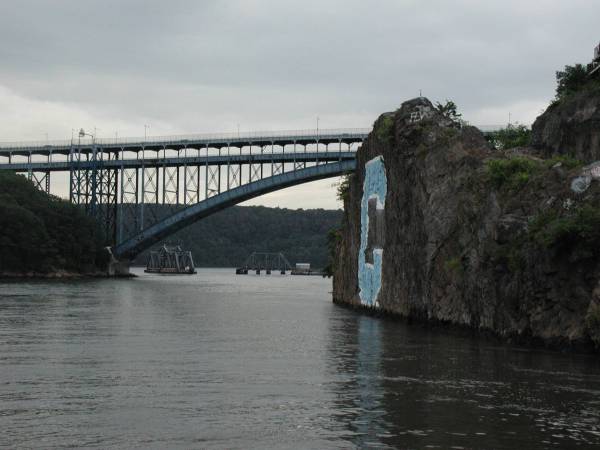
| image_caption | The Washington, Alexander Hamilton, and High Bridges over the Harlem River |
| map | Accessible Harlem River.png |
| map_size | 250px |
| map_caption | The Harlem River, shown in yellow, between the Bronx and Manhattan in New York City. |
| mapframe | yes |
| mapframe-zoom | 10 |
| subdivision_type1 | Country |
| subdivision_name1 | United States |
| subdivision_type2 | State |
| subdivision_name2 | New York |
| subdivision_type5 | Municipality |
| subdivision_name5 | New York City |
| length | 8 mi |
| source1 | Hudson River |
| source1_coordinates | |
| mouth | East River |
| mouth_coordinates | |
| tributaries_left | Bronx Kill |
| mapframe-zoom = 10
The Harlem River is an 8 mi tidal strait in New York City, flowing between the Hudson River and the East River. It separates the island of Manhattan from the Bronx on the United States mainland.
The northern stretch, also called the Spuyten Duyvil ("spewing devil") Creek, has been significantly altered for navigation purposes. Originally it curved around the north of Marble Hill, but in 1895 the Harlem Ship Canal was dug between Manhattan and Marble Hill, and in 1914 the original course was filled in.
Use
Harlem River Drive and Harlem River Greenway run along the west bank of the river, and the Metro-North Railroad's Hudson Line and Major Deegan Expressway on the east.
The Harlem River was the traditional rowing course for New York, analogous to the Charles River in Boston and the Schuylkill River in Philadelphia. On the Harlem's banks is the boathouse for the Columbia University crew, and the river is the home course for the university's crew. Since 1952, a large flat rock face, called the "(Big) C Rock" has been painted with Columbia's varsity "C". Also on the river are the Peter Jay Sharp Boathouse and Harlem River Community Rowing, two community rowing facilities. The river is used by crews from New York University, Fordham University, and Manhattan University, though the only university with permanent facilities on the river is Columbia.
Historically, the west bank of the Harlem River was also an amusement destination. The area between 190th and 192nd Streets was occupied by the Fort George Amusement Park, a trolley park/amusement park, from 1895 to 1914. Its site is now a seating area in Highbridge Park. In the 1890s, the City of New York built a racetrack for horses, the Harlem River Speedway, along the riverbank of the park; the project started construction in 1894 and opened in July 1898. The Speedway later became the Harlem River Drive, and regular motorists were first allowed on the drive in 1919.
Crossings
The Harlem River is spanned by seven swing bridges, four lift bridges, and four arch bridges, and is navigable to any boat with less than 55 ft of air draft. However, any boat requiring more than 5 ft of clearance will require the Spuyten Duyvil Bridge to swing open. All other movable bridges on the Harlem River provide at least 24 ft of clearance while closed, so boats and ships requiring between 5 and of clearance need only have one bridge swing open. These bridges replaced fixed bridges or lower bridges in the late 19th century to improve navigation. High Bridge was erected between 1837 and 1848 to carry the Croton Aqueduct across the river. It is the oldest bridge in New York City.
The New York City Department of Transportation advises that while they make every effort to ensure that all bridges are operating, many of them are under repair at any time, and outside contractors are responsible for opening of bridges under repair.
| Crossing | Image | Carries | Location | Coordinates | |||
|---|---|---|---|---|---|---|---|
| Wards Island Bridge | [[File:Wards Island Bridge 20070902-jag9889.jpg | 150x150px]] [[File:Wards Island Bridge 20111202-jag9889.jpg | 150x150px]] | Pedestrian/bicycle | Manhattan and Wards Island | ||
| Robert F. Kennedy Triboro Lift Bridge (Harlem Lift Bridge) | [[File:RFK Triboro Lift Bridge 20070902-jag9889.jpg | 150x150px]] | NY State Route 900G (6 road lanes) | Manhattan and Randall's Island | |||
| Willis Avenue Bridge | [[File:Old Willis Avenue Bridge 20070902-jag9889.jpg | none | 150x150px | 1901 Bridge]] [[File:Willis Avenue Bridge 20160917-jag9889.jpg | none | 150x150px | 2010 Bridge]]Top: 1901 bridge; |
| bottom: 2010 bridge | Northbound auto traffic; Pedestrian/bicycle | Manhattan and the Bronx | |||||
| Third Avenue Bridge | [[File:Third Avenue Bridge 20090530-jag9889.jpg | 150x150px]] | Southbound auto traffic; Pedestrian/bicycle | Manhattan and the Bronx | |||
| Lexington Avenue Tunnel | IRT Lexington Avenue Line () | Manhattan and the Bronx | |||||
| Park Avenue Bridge | [[File:Park Avenue Bridge 20160917-jag9889.jpg | 150x150px]] | Metro-North Railroad | Manhattan and the Bronx | |||
| Madison Avenue Bridge | [[File:Madison Avenue Bridge 20060916-jag9889.jpg | 150x150px]] | Southbound/eastbound auto traffic; pedestrian/bicycle | Manhattan and the Bronx | |||
| 149th Street Tunnel | IRT White Plains Road Line () | Manhattan and the Bronx | |||||
| 145th Street Bridge | [[File:145 Street Bridge 20090525-jag9889.jpg | 150x150px]] | Westbound/eastbound auto traffic; pedestrian/bicycle | Manhattan and the Bronx | |||
| Macombs Dam Bridge | [[File:Macombs Dam Bridge 20160917-jag9889.jpg | 150x150px]] | Westbound/eastbound auto traffic; pedestrian/bicycle | Manhattan and the Bronx | |||
| Concourse Tunnel | IND Concourse Line () | Manhattan and the Bronx | |||||
| Putnam Bridge (1881–1960) | [[File:Putnam Bridge.jpg | none | 150px]] | Ninth Avenue El | Manhattan and the Bronx | ||
| High Bridge | [[File:High Bridge 20160917-jag9889.jpg | 150x150px]] | Pedestrian | Manhattan and the Bronx | |||
| Alexander Hamilton Bridge | [[File:Alexander Hamilton Bridge 20090530-jag9889.jpg | 150x150px]] | [[File:I-95.svg | 20px]] Interstate 95 | |||
| [[File:US 1.svg | 20px]] U.S. Route 1 | Manhattan and the Bronx | |||||
| Washington Bridge | [[File:Washington Bridge 20090530-jag9889.jpg | 150x150px]] | Westbound/eastbound auto traffic; pedestrian/bicycle | Manhattan and the Bronx | |||
| University Heights Bridge | [[File:University Heights Bridge 20060916-jag9889.jpg | 150x150px]] | Westbound/eastbound auto traffic; pedestrian/bicycle | Manhattan and the Bronx | |||
| Broadway Bridge | [[File:Broadway Bridge 20070902-jag9889.jpg | 150x150px]] | [[File:US 9.svg | 20px]] US 9 | |||
| IRT Broadway – Seventh Avenue Line () | Manhattan Island and Marble Hill, Manhattan | ||||||
| Henry Hudson Bridge | [[File:Henry Hudson Bridge 20171010-jag9889.jpg | 150x150px]] | [[File:NY-9A.svg | 20px]] NY 9A | |||
| [[File:Henry Hudson Pkwy Shield free.svg | 30px]] Henry Hudson Parkway | Manhattan and the Bronx | |||||
| Spuyten Duyvil Bridge | [[File:Spuyten Duyvil Bridge 20120706-jag9889.jpg | 150x150px]] | Amtrak Empire Connection | Manhattan and the Bronx |
References
Notes
Further reading
- , a novel that highlights the Harlem River and its surroundings
References
- Alma's Owl (pseudonym), "Down by the 'C' Shore", "Ask Alma's Owl" column, ''[[Columbia University Record]]'', [http://www.columbia.edu/cu/record/archives/3214WEB.pdf '''32''':14:1 (June 11, 2007)]
- Martens, Victoria. (August 1, 2019). "Fort George Amusement Park".
- Gray, Christopher. (July 13, 1997). "A Roadway Built for the Elite to Trot Out Their Rigs". The New York Times.
- (February 6, 1894). "CHEERS FROM UNEMPLOYED; 1,500 SAW MAYOR GILROY BEGIN WORK ON THE SPEEDWAY. Hundreds of Idle Workmen Gathered in the Hope of Getting Work, but Active Construction of the Drive Will Not Begin Until To-day or To-morrow – The Mayor Made a Short Speech of Congratulation – Stories Told by Unemployed.". The New York Times.
- (July 3, 1898). "HARLEM SPEEDWAY OPENED; Pronounced by Horsemen to be the Finest Driveway for Light Speeding in the Country. YESTERDAY THE FIRST DAY The Number Present at the Opening Hour Not Large, but Later in the Day Many Wrote Arrived – Interesting Facts.". The New York Times.
- Robinson, Lauren. (February 28, 2012). "How Harlem River Speedway Became Harlem River Drive". [[Museum of the City of New York]].
- Reier, Sharon. (1977). "The Bridges of New York". Dover Press.
This article was imported from Wikipedia and is available under the Creative Commons Attribution-ShareAlike 4.0 License. Content has been adapted to SurfDoc format. Original contributors can be found on the article history page.
Ask Mako anything about Harlem River — get instant answers, deeper analysis, and related topics.
Research with MakoFree with your Surf account
Create a free account to save articles, ask Mako questions, and organize your research.
Sign up freeThis content may have been generated or modified by AI. CloudSurf Software LLC is not responsible for the accuracy, completeness, or reliability of AI-generated content. Always verify important information from primary sources.
Report