From Surf Wiki (app.surf) — the open knowledge base
Harcourt Road
Road in Admiralty, Hong Kong

Road in Admiralty, Hong Kong
| Field | Value |
|---|---|
| name | Harcourt Road |
| native_name | yue |
| namesake | Cecil Harcourt |
| image | Harcourt Road near Admiralty Centre.jpg |
| caption | Harcourt Road in November 2011, buildings include Bank of America Tower (Left) |
| direction_a | East |
| terminus_a | Gloucester Road |
| direction_b | West |
| terminus_b | Connaught Road Central |
| location | Admiralty, Hong Kong |
| mapframe-wikidata | yes |
| mapframe-zoom | 14 |
| mapframe-wikidata = yes | mapframe-zoom = 14

Harcourt Road (Chinese: 夏慤道) is a major highway in Admiralty, Hong Kong, connecting Central with Wan Chai. It starts at Murray Road, and ends at Arsenal Street. The road is 780 metres (approx. half a mile) in length, and carries four lanes of traffic on either side. The section of Harcourt Road running westbound between Rodney Street and Cotton Tree Drive features a frontage road.
History
Following the colonisation of Hong Kong in the early 1840s, the present-day Admiralty was intended to be a military complex, with the naval base situated on the seafront, and the army barracks on the hillside. This left a rather large, elongated piece of land between the two, and the gap was filled in the 1870s in the form of the Admiralty Dock. Prior to its construction, the then governor Sir Arthur Kennedy proposed running a narrow public road through this empty stretch of land, but this was rejected by military officials on the grounds that it would compromise military secrecy. Kennedy Road in the Mid-Levels was built instead.
After World War II, the naval strength of the British Empire in the Far East diminished, and the land upon which the Admiralty Dock had been built was returned to the government. The Dock finally ceased operating in November 1959, and was demolished soon after. Due to the rapid development of Central and Wan Chai at that time, traffic congestion became a frequent problem in the area, and diverting traffic uphill to Kennedy Road did not provide an adequate solution.
The solution was to build a new major thoroughfare on the land reclaimed from the demolished Admiralty Dock. The resultant Harcourt Road was built in 1961, and opened to the public that same year. It is named after Cecil Harcourt, who was the de facto Governor of Hong Kong, following its liberation from the Japanese in 1945, until 1946.
Within the first six months of the road's completion, 13 traffic accidents occurred on the same curve in the road. On 13 August 1962, a speed limit was introduced, stipulating that traffic mustn't exceed 35 km/h (22 mph) when passing the curve – this became the first use of speed limiting in Hong Kong.
In January 2019, the Central–Wan Chai Bypass opened, providing a parallel expressway route to Harcourt Road, Gloucester Road, Victoria Park Road, and Connaught Road Central.
Harcourt Road Flyover
The Harcourt Road Flyover at the western part of the road opened on 19 April 1966. To link Harcourt Road with Queen's Road East and Garden Road, the Albany Nullah was decked over, and a new road called Kapok Drive (now Cotton Tree Drive) was built. These flyovers and slip roads opened in the late 1960s.
Events
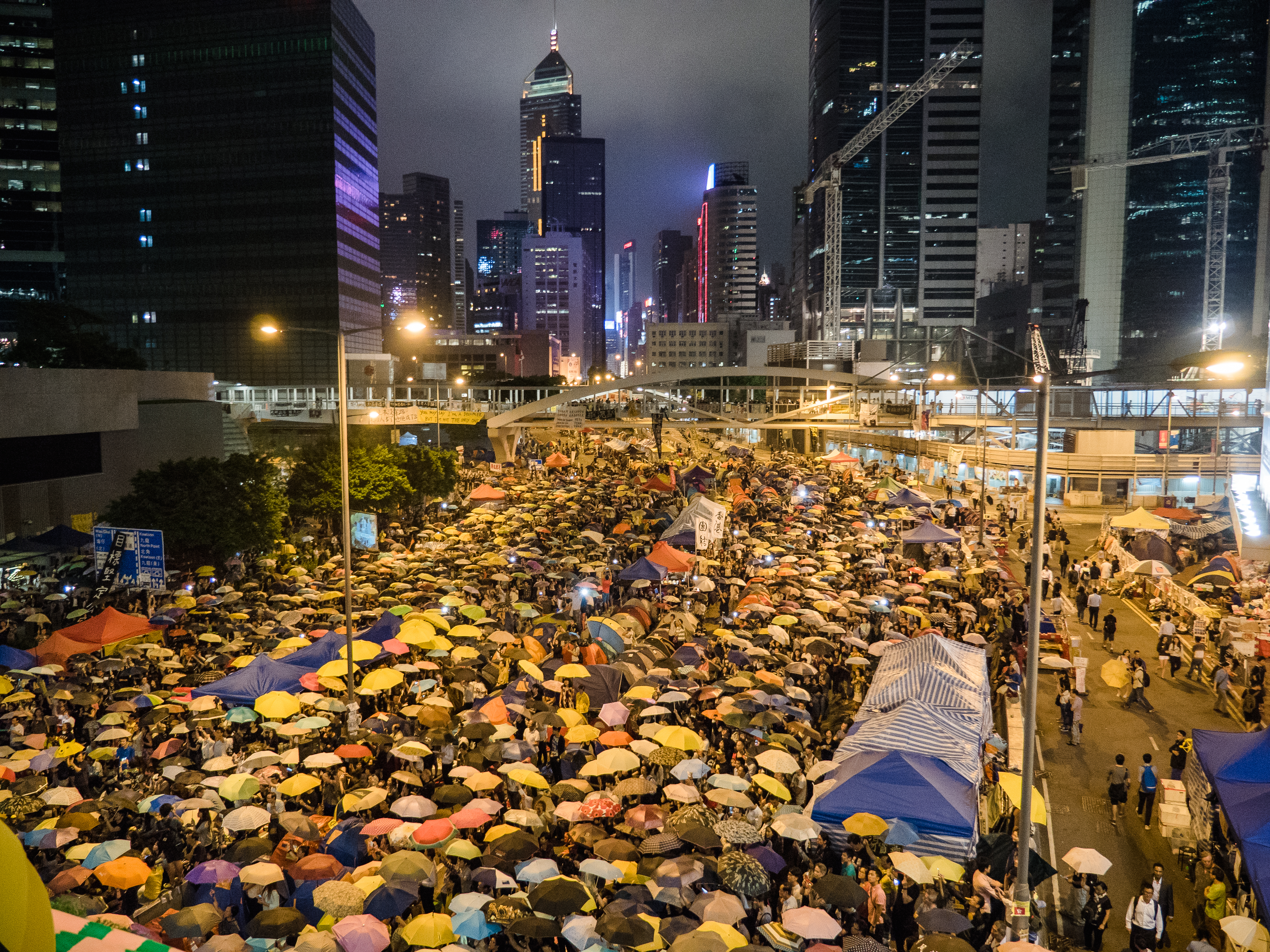
From 28 September 2014 to 11 December 2014, the Umbrella Revolution took place. The section of Harcourt Road near the Admiralty MTR station, and the Government and Legislative Council Complex, transformed into Umbrella Square; it was occupied by pro-democracy protesters for 79 days.

On 12 June 2019, protests took place on Harcourt Road to oppose the extradition bill to China.
References
References
- (2009). "Signs of a Colonial Era". [[Hong Kong University Press]].
- Phila Siu. (18 February 2019). "Hong Kong’s Central-Wan Chai Bypass to fully open on February 24 after month-long first-stage operations". South China Morning Post.
- (16 April 1966). "Harcourt Road Flyover opens on Tuesday". South China Morning Post.
- (3 August 1967). "Flyover To Garden Road Open To Traffic Tomorrow". South China Morning Post.
- (4 May 1968). "Slip road opens tomorrow". South China Morning Post.
- (30 March 2015). "A Revolution in Place". Urbanphoto.
- Claire Huang. (12 June 2019). "Hong Kong protests: At least 72 people taken to hospital during clashes with police". [[The Straits Times]].
This article was imported from Wikipedia and is available under the Creative Commons Attribution-ShareAlike 4.0 License. Content has been adapted to SurfDoc format. Original contributors can be found on the article history page.
Ask Mako anything about Harcourt Road — get instant answers, deeper analysis, and related topics.
Research with MakoFree with your Surf account
Create a free account to save articles, ask Mako questions, and organize your research.
Sign up freeThis content may have been generated or modified by AI. CloudSurf Software LLC is not responsible for the accuracy, completeness, or reliability of AI-generated content. Always verify important information from primary sources.
Report