From Surf Wiki (app.surf) — the open knowledge base
Haplogroup R (Y-DNA)
Human Y-chromosome DNA haplogroup
_with_tomb_artifacts,_Hermitage_Museum,_Saint-Petersburg.jpg)
Human Y-chromosome DNA haplogroup
| Field | Value | |
|---|---|---|
| name | R | |
| map | Haplogroup R (Y-DNA).png | |
| origin-date | about 27,000 years BP | |
| origin-place | North Asia, Indian subcontinent, Central Asia, or Middle East | |
| ancestor | P-M45 (P1c, formerly P1), one of the three primary clades of P* (P-F5850) | |
| descendants | R1 (R-M173), R2 (R-M479) (R2) | |
| mutations | M207/Page37/UTY2, CTS207/M600/PF5992, CTS2426/M661/PF6033, CTS2913/M667, CTS3229/M672/PF6036/YSC0001265, CTS3622/PF6037, CTS5815/M696, CTS6417/Y480, CTS7876/PF6052, CTS7880/M725/PF6053, CTS8311/M732, CTS9005/M741, CTS10663/M788, CTS11075/M795/P6078, CTS11647/Y369, F33/M603/PF6013, F63/M614/PF6016, F82/M620, F154/M636, F295/M685, F356/M703/PF5919, F370/M708/Y479, F459/Y482, F652/M805, F765, FGC1168, L248.3/M705.3, L747/M702/PF5918/YSC0000287, L760/M642/PF5877/YSC0000286, L1225/M789/YSC0000232, L1347/M792/PF6077/YSC0000233, M613, M628/PF5868, M651/Y296, M718, M734/PF6057/S4/YSC0000201, M760/Y506, M764/PF5953, M799, P224/PF6050, P227, P229/PF6019, P232, P280, P285, PF5938, PF6014/S9 | members = |
|origin-date = about 27,000 years BP |origin-place = North Asia, Indian subcontinent, Central Asia, or Middle East
Haplogroup R, or R-M207, is a Y-chromosome DNA haplogroup. It is both numerous and widespread among modern populations.
Some descendant subclades have been found since pre-history in Europe, Central Asia and South Asia. Others have long been present, at lower levels, in parts of West Asia and Africa. Some authorities have also suggested, more controversially, that R-M207 has long been present among Native Americans in North America – a theory that has not yet been widely accepted.
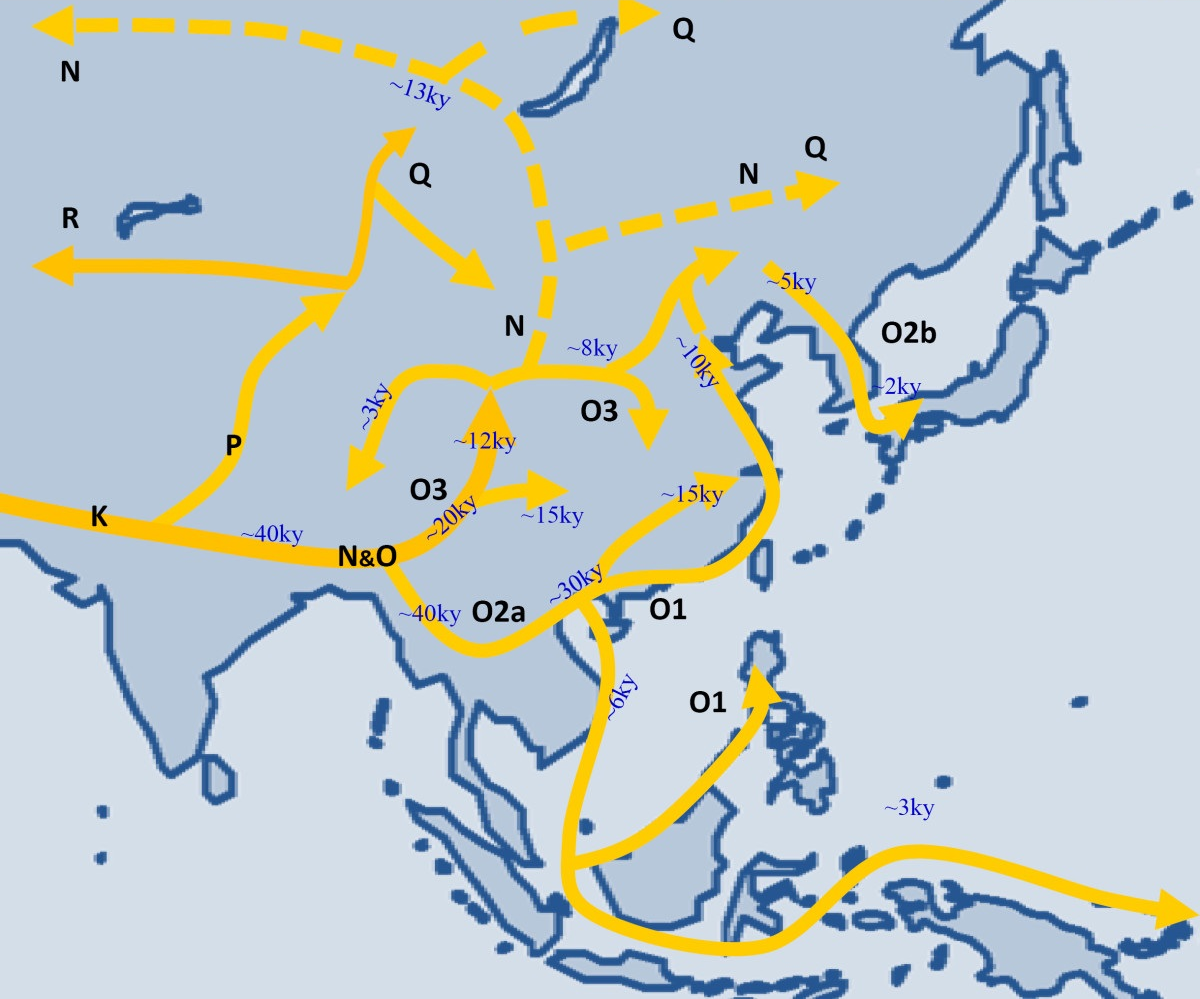
According to geneticist Spencer Wells, haplogroup K originated in the Middle East or Central Asia. However, Karafet et al. (2014) proposed that "rapid diversification ... of K-M526", also known as K2, likely occurred in Southeast Asia (near Indonesia) and later expanded to mainland Asia, although they could not rule out that it might have arisen in Eurasia and later went extinct there, and that either of these scenarios are "equally parsimonious". According to Bergstorm et al, haplogroup K2b1 (Y-haplogroup S/M) found in Indigenous Australians and ancestors of haplogroup R and Q (Y-haplogroup K2b2/root P) split in Southeast Asia near Sahul.
Structure
Subclades
| {{Clade | M207 (R)]] | 1={{Clade | M173 (R1)]] | 1={{Clade | M420 (R1a)]] | 1= {{Clade | label1=M459 | (R1a1)]] | 2= (R1a*) | label2= | M343 (R1b)]] | 2= {{Clade | label1=L278 | (R1b1)]] | 2= (R1b*) | label2= | M479 (R2)]] | 2={{Clade | M124 (R2a)]] | 1= {{Clade | label1=L263 | (R2a1)]] | label2= F1092 | (R2a2)]] | label3= Y12100 | (R2a3)]] | label2= | 2=(R2*) |
|---|
Origins
Geneticist Spencer Wells suggests that haplogroup K likely originated in the Middle East or Central Asia, perhaps in the region of Iran or Pakistan. According to Bergstorm et al, deep-rooted haplogroup K2b1 (Y-haplogroup S/M) found in Indigenous Australians and ancestors of haplogroup R and Q (Y-haplogroup K2b2/root P) split in Southeast Asia near Sahul. Haplogroup P1 may have emerged in Southeast Asia, however according to Karafet, et al. this hypothesis is "parsimonious" and it is just as likely that it originated elsewhere in Eurasia. The SNP M207, which defines Haplogroup R, is believed to have arisen during the Upper Paleolithic era, about 27,000 years ago.
Only one confirmed example of basal R* has been found, in 24,000-year-old remains, known as MA1, found at Mal'ta–Buret' culture near Lake Baikal in Siberia. (While a living example of R-M207(xM17,M124) was reported in 2012, it was not tested for the SNP M478; the male concerned – among a sample of 158 ethnic Tajik males from Badakshan, Afghanistan – may therefore belong to R2.)
It is possible that neither of the primary branches of R-M207, namely R1 (R-M173) and R2 (R-M479) still exist in their basal, original forms, i.e. R1* and R2*. No confirmed case, either living or dead, has been reported in scientific literature. (Although in the case of R2*, relatively little research has been completed.)
Despite the rarity of R* and R1*, the relatively rapid expansion – geographically and numerically – of subclades from R1 in particular, has often been noted: "both R1a and R1b comprise young, star-like expansions" .
The wide geographical distribution of R1b, in particular, has also been noted. Hallast et al. (2014) mentioned that living examples found in Central Asia included:
- the "deepest subclade" of R-M269 (R1b1a1a2) – the most numerous branch of R1b in Western Europe, and;
- the rare subclade R-PH155 (R1b1b) found only in one Bhutanese individual and one Tajik. (While Hallast et al. suggested that R-PH155 was "almost as old as the R1a/R1b split", R-PH155 was later discovered to be a subclade of R-L278 (R1b1) and has been given the phylogenetic name R1b1b.)
Distribution
Y-haplogroup R-M207 is common throughout Europe, South Asia and Central Asia . It also occurs in the Caucasus and Siberia. Some minorities in Africa also carry subclades of R-M207 at high frequencies.
While some indigenous peoples of The Americas and Australasia also feature high levels of R-M207, it is unclear whether these are deep-rooted, or an effect of European colonisation during the early modern era.
R (R-M207)
Haplogroup R* Y-DNA (xR1,R2) was found in 24,000-year-old remains from Mal'ta in Siberia near Lake Baikal. In 2013, R-M207 was found in one out of 132 males from the Kyrgyz people of East Kyrgyzstan.
R1 (R-M173)
Main article: Haplogroup R1
There are many downstream mutations of haplogroup R ( and ).
Initially, there was debate about the origin of haplogroup R1b in Native Americans. Two early studies suggested that this haplogroup could have been one of the founding Siberian lineages of Native Americans; however, this is now considered unlikely, because the R1b lineages commonly found in Native Americans are in most cases identical to those in western Europeans, and its highest concentration is found among a variety of culturally unaffiliated tribes, in eastern North America.
Thus, according to several authors, R1b was most likely introduced through admixture during the post-1492 European settlement of North America.
R2 (R-M479)
Main article: Haplogroup R2
Haplogroup R-M479 is defined by the presence of the marker M479. The paragroup for the R-M479 lineage is found predominantly in South Asia, although deep-rooted examples have also been found among Portuguese, Spanish, Tatar (Bashkortostan, Russia), and Ossetian (Caucasus) populations .
One rare subclade may occur only among Ashkenazi Jews, possibly as a result of a founder effect.
References
References
- [[ISOGG]], ''[http://www.isogg.org/tree/ISOGG_HapgrpR.html Y-DNA Haplogroup R and its Subclades – 2016]'' (12 December 2016).
- [http://www.nature.com/nature/journal/vaop/ncurrent/extref/nature12736-s1.pdf Raghavan, M. et al. 2014. Upper Palaeolithic Siberian genome reveals dual ancestry of Native Americans, ''Nature'', 505, 87–91.]
- (2018). "The Geographic Origins of Ethnic Groups in the Indian Subcontinent: Exploring Ancient Footprints with Y-DNA Haplogroups". Frontiers in Genetics.
- (25 May 2021). "Ethnolinguistic Prehistory: The Peopling of the World from the Perspective of Language, Genes and Material Culture". BRILL.
- (2009). "Presence of three different paternal lineages among North Indians: A study of 560 Y chromosomes". Annals of Human Biology.
- (20 November 2007). "Deep Ancestry: The Landmark DNA Quest to Decipher Our Distant Past". National Geographic Books.
- (March 2015). "Improved phylogenetic resolution and rapid diversification of Y-chromosome haplogroup K-M526 in Southeast Asia". European Journal of Human Genetics.
- (March 2016). "Deep Roots for Aboriginal Australian Y Chromosomes". Current Biology.
- (2021). "The Siberian Paleolithic site of Mal'ta: a unique source for the study of childhood archaeology". Evolutionary Human Sciences.
- (June 2013). "Inferring human history in East Asia from Y chromosomes". Investigative Genetics.
- (January 2014). "Upper Palaeolithic Siberian genome reveals dual ancestry of Native Americans". Nature.
- (18 October 2013). "Afghan Hindu Kush: where Eurasian sub-continent gene flows converge". PLOS ONE.
- (2006). "Asymmetric Male and Female Genetic Histories among Native Americans from Eastern North America". Molecular Biology and Evolution.
- (2005). "The Genetic Prehistory of Eastern North America: Evidence from Ancient and Modern DNA". University of California, Davis.
- (8 February 2022). "Origin: A Genetic History of the Americas". Grand Central Publishing.
- (December 2008). "Distribution of Y chromosomes among Native North Americans: A study of Athapaskan population history". American Journal of Physical Anthropology.
This article was imported from Wikipedia and is available under the Creative Commons Attribution-ShareAlike 4.0 License. Content has been adapted to SurfDoc format. Original contributors can be found on the article history page.
Ask Mako anything about Haplogroup R (Y-DNA) — get instant answers, deeper analysis, and related topics.
Research with MakoFree with your Surf account
Create a free account to save articles, ask Mako questions, and organize your research.
Sign up freeThis content may have been generated or modified by AI. CloudSurf Software LLC is not responsible for the accuracy, completeness, or reliability of AI-generated content. Always verify important information from primary sources.
Report