From Surf Wiki (app.surf) — the open knowledge base
Haplogroup L1
Human mitochondrial DNA grouping indicating common ancestry

Human mitochondrial DNA grouping indicating common ancestry
| Field | Value |
|---|---|
| name | L1 |
| origin-date | 107,600–174,300 YBP |
| origin-place | Central Africa |
| ancestor | L1-6 |
| descendants | L1b, L1c |
| mutations | 3666, 7055, 7389, 13789, 14178, 14560 |
|origin-date=107,600–174,300 YBP |origin-place=Central Africa
Haplogroup L1 is a human mitochondrial DNA (mtDNA) haplogroup. It is most common in Central Africa and West Africa. It diverged from L1-6 at about 140,000 years ago ( 95% CI). Its emergence is associated with the early peopling of Africa by anatomically modern humans during the Eemian, and it is now mostly found in Central African foragers.
Ancient DNA
Among the less than 1% of subgroups of macro-haplogroup L found among the population in Europe, haplogroup L1b is present; haplogroup L1b in Europe, which is often found in West Africa, has been dated to 10,000 BP.
Distribution
Haplogroup L1 is found most commonly in Central Africa and West Africa. It reaches its highest frequency among the Mbenga people. It is likely that it was formerly more widespread, and was constrained to its current area as a result of the Bantu migration (which is largely associated with haplogroup L2). Haplogroup L1 has been observed in specimens from the island cemetery in Kulubnarti, Sudan, which date from the Early Christian period (AD 550–800). An ancient Beaker culture individual at the Camino de las Yeseras in Spain (San Fernando de Henares, Madrid; [I4245 / RISE695] F) has also been found to carry the L1b1a mitochondrial haplogroup.
Subclades
L1c
L1c emerged at about 85 kya. It reaches its highest frequencies in Central Africa, notably among the Mbenga people. (See map.) Among the Mbenga, it is carried by 100% of Ba-Kola, 97% of Ba-Benzélé, and 77% of Biaka. Other populations in which L1c is particularly prevalent include the Bedzan (Tikar) people (100%), Baka people from Gabon (97%) and Cameroon (90%), the Bakoya (97%), and the Ba-Bongo (82%). Common also in São Tomé (20%) and Angola (16–24%).
L1b
L1b is much more recent, dated at about 10 kya. It is frequent in West Africa. It has also been found in Mozambique (1%), Ethiopia (2%), Egypt (1%), the Nile Valley (4%), Kung (1%), Cape Verde (8%), Senegal (17–20%), Niger/Nigeria (15%), Guinea Bissau (11%), Morocco (4–5%), and Algeria (1–2%).
Phylogenetics
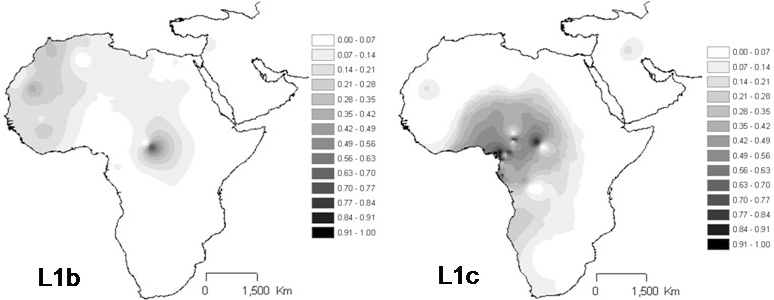
L1 has two branches, L1c and L1b (the formerly named haplogroups L1d, L1k, L1a, L1f have been re-classified into haplogroup L0, as L0d, L0k, L0a, L0f; L1e as L5).
Phylogeny of L1c:
- L1c
- L1c1'2'4'6
- L1c1
- L1c1a
- L1c1a1
- L1c1a1a
- L1c1a1a1
- L1c1a1a1a
- L1c1a1a1b
- L1c1a1a1b1
- L1c1a1a2
- L1c1a1a1
- L1c1a1b
- L1c1a1a
- L1c1a2
- L1c1a2a
- L1c1a2a1
- L1c1a2a2
- L1c1a2b
- L1c1a2c
- L1c1a2a
- L1c1a1
- L1c1b'c'd
- L1c1b
- L1c1c'd
- L1c1c
- L1c1d
- L1c1a
- L1c2'4
- L1c2
- L1c2a
- L1c2a1
- L1c2a1a
- L1c2a1b
- L1c2a2
- L1c2a1
- L1c2b
- L1c2b1
- L1c2b2
- L1c2a
- L1c4
- L1c4a
- L1c4b
- L1c2
- L1c6
- L1c1
- L1c3
- L1c3a
- L1c3a1
- L1c3a1a
- L1c3b'c
- L1c3b
- L1c3b1
- L1c3b1a
- L1c3b1b
- L1c3b2
- L1c3b1
- L1c3c
- L1c3b
- L1c3a
- L1c1'2'4'6
Phylogeny of L1b:
- L1b
- L1b1
- L1b1a
- L1b1a1'4
- L1b1a1
- L1b1a4
- L1b1a2
- L1b1a2a
- 189
- L1b1a3
- L1b1a3a
- L1b1a3a1
- L1b1a3a
- L1b1a3
- L1b1a5
- L1b1a6
- L1b1a7
- L1b1a1'4
- L1b1a
- L1b1
References
References
- Soares, Pedro. (4 Jun 2009). "Supplemental Data Correcting for Purifying Selection: An Improved Human Mitochondrial Molecular Clock". The American Journal of Human Genetics.
- van Oven, Mannis. (13 Oct 2008). "Updated comprehensive phylogenetic tree of global human mitochondrial DNA variation". Human Mutation.
- (2009). "Correcting for Purifying Selection: An Improved Human Mitochondrial Molecular Clock Supplementary material". American Journal of Human Genetics.
- (2024). "Phylogenetic insights into the genetic legacies of Hungarian‑speaking communities in the Carpathian Basin". Scientific Reports.
- (2015). "60,000 years of interactions between Central and Eastern Africa documented by major African mitochondrial haplogroup L2". Sci. Rep..
- Sirak, Kendra. (2016). "Abstract Book of the IUAES Inter-Congress 2016 - A community divided? Revealing the community genome(s) of Medieval Kulubnarti using next- generation sequencing". IUAES.
- ''Iñigo Olalde'' et al. [http://biorxiv.org/content/early/2017/05/09/135962 The Beaker Phenomenon And The Genomic Transformation Of Northwest Europe], 2017
- (2008). "Maternal traces of deep common ancestry and asymmetric gene flow between Pygmy hunter–gatherers and Bantu-speaking farmers". Proceedings of the National Academy of Sciences of the United States of America.
- Sarah A. Tishkoff et al. 2007, [https://web.archive.org/web/20080517050807/http://mbe.oxfordjournals.org/cgi/content/full/24/10/2180 History of Click-Speaking Populations of Africa Inferred from mtDNA and Y Chromosome Genetic Variation.] Molecular Biology and Evolution 2007 24(10):2180-2195
- Lluis Quintana-Murci et al. MtDNA diversity in Central Africa: from hunter-gathering to agriculturalism. CNRS-Institut Pasteur, Paris
- Batini, Chiara et al 2006, [http://bhusers.upf.edu/dcomas/wp-content/uploads/2011/02/Batini2007.pdf Phylogeography of the human mitochondrial L1c haplogroup: Genetic signatures of the prehistory of Central Africa] {{Webarchive. link. (2012-03-24)
- Rosa, Alexandra. (2004). "MtDNA profile of West Africa Guineans: towards a better understanding of the Senegambia region". Annals of Human Genetics.
This article was imported from Wikipedia and is available under the Creative Commons Attribution-ShareAlike 4.0 License. Content has been adapted to SurfDoc format. Original contributors can be found on the article history page.
Ask Mako anything about Haplogroup L1 — get instant answers, deeper analysis, and related topics.
Research with MakoFree with your Surf account
Create a free account to save articles, ask Mako questions, and organize your research.
Sign up freeThis content may have been generated or modified by AI. CloudSurf Software LLC is not responsible for the accuracy, completeness, or reliability of AI-generated content. Always verify important information from primary sources.
Report