From Surf Wiki (app.surf) — the open knowledge base
Haplogroup L0
Human mitochondrial DNA grouping indicating common ancestry
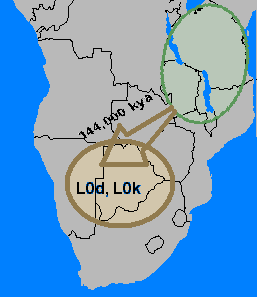
Human mitochondrial DNA grouping indicating common ancestry
| Field | Value | |||||||||||||||||||||||||||
|---|---|---|---|---|---|---|---|---|---|---|---|---|---|---|---|---|---|---|---|---|---|---|---|---|---|---|---|---|
| name | L0 | |||||||||||||||||||||||||||
| origin-date | 130 to 200 ka | |||||||||||||||||||||||||||
| point estimate 168.5 ka (136.3–201.1 ka 95% CI) according to {{cite journal | last1 | Heinz, Tanja | display-authors=etal | title=Updating the African human mitochondrial DNA tree: Relevance to forensic and population genetics | journal=Forensic Science International: Genetics | date=2017 | volume=27 | pages=156–159 | doi=10.1016/j.fsigen.2016.12.016 | pmid=28086175}} (table 2). | ||||||||||||||||||
| 150 ka suggested in:{{cite journal | doi | 10.1016/j.ajhg.2009.05.001 | title=Correcting for Purifying Selection: An Improved Human Mitochondrial Molecular Clock | year=2009 | last1=Soares | first1=Pedro | last2=Ermini | first2=Luca | last3=Thomson | first3=Noel | last4=Mormina | first4=Maru | last5=Rito | first5=Teresa | last6=Röhl | first6=Arne | last7=Salas | first7=Antonio | last8=Oppenheimer | first8=Stephen | last9=MacAulay | first9=Vincent | journal=The American Journal of Human Genetics | volume=84 | issue=6 | pages=740–59 | pmid=19500773 | pmc=2694979 }}. |
| Rito T, Richards MB, Fernandes V, Alshamali F, Cerny V, Pereira L, Soares P., "The first modern human dispersals across Africa", PLoS One 2013 Nov 13; 8(11):e80031. [http://journals.plos.org/plosone/article?id | 10.1371/journal.pone.0080031 doi: 10.1371/journal.pone.0080031]. | |||||||||||||||||||||||||||
| origin-place | Southern Africa or Southern East Africa | |||||||||||||||||||||||||||
| ancestor | L (Mitochondrial Eve) | |||||||||||||||||||||||||||
| descendants | L0a'b'f'k, L0d | |||||||||||||||||||||||||||
| mutations | 263!, 1048, 3516A, 5442, 6185, 9042, 9347, 10589, 12007, 12720 |
|origin-date= 130 to 200 ka point estimate 168.5 ka (136.3–201.1 ka 95% CI) according to (table 2). 150 ka suggested in:. Age estimates (ka, 95% CI in angular brackets): ML whole-mtDNA age estimate: 128.2 [95% CI: 107.9-148.9], ρ whole-mtDNA age estimate: 121.3 [99.2;143.7], ρ synonymous age estimate (ka): 131.0 [97.8;164.2]: Rito T, Richards MB, Fernandes V, Alshamali F, Cerny V, Pereira L, Soares P., "The first modern human dispersals across Africa", PLoS One 2013 Nov 13; 8(11):e80031. doi: 10.1371/journal.pone.0080031. |origin-place=Southern Africa or Southern East Africa Haplogroup L0 is a human mitochondrial DNA (mtDNA) haplogroup.
Origin
L0 is one of two branches from the most recent common ancestor (MRCA) for the shared human maternal lineage. The haplogroup consists of five main branches (L0a, L0b, L0d, L0f, L0k). Four of them were originally classified into L1 subclades, L1a, L1d, L1f and L1k.
In 2014, ancient DNA analysis of a 2,330 year old male forager's skeleton in Southern Africa found that the specimen belonged to the L0d2c1c mtDNA subclade. This maternal haplogroup is today most closely associated with the Ju, a subgroup of the indigenous San people, which points to population continuity in the region. In 2016, a Late Iron Age desiccated mummy from the Tuli region in northern Botswana was also found to belong to haplogroup L0.
Distribution


L0 is found most commonly in Sub-Saharan Africa. It reaches its highest frequency in the Khoisan people at 73% on average. Some of the highest frequencies are: Namibia (!Xun) 79%, South Africa (Khwe/!Xun) 83%, and Botswana (!Kung) 100%.
Haplogroup L0d is found among Khoisan groups of Southern Africa closer to the Khoid side with (following L0k) being more Sanid but is largely restricted to the Khoisan as a whole. L0d is also commonly found in sections of the Coloured population of South Africa and frequencies range from 60% to 71%. This illustrates the massive maternal contribution of Khoisan people to sections of the Coloured population of South Africa.
Haplogroups L0k is the second most common haplogroup in the Khoisan groups closer to the Sanid side with (following L0d) being more Khoid but is largely restricted to the Khoisan as a whole. Although the Khoisan associated L0d haplogroup were found in high frequencies in sections of the Coloured population of South Africa, L0k were not observed in two studies involving large groups of Coloured individuals.
Haplogroup L0f is present in relatively small frequencies in Tanzania, East Africa among the Sandawe people of Tanzania.
Haplogroup L0a is most prevalent in South-East African populations (25% in Mozambique). Among Guineans, it has a frequency between 1% and 5%, with the Balanta group showing increased frequency of about 11%. Haplogroup L0a has a Paleolithic time depth of about 33,000 years and likely reached Guinea between 10,000 and 4,000 years ago. It also is often seen in the Mbuti and Biaka Pygmies. L0a is found at a frequency of almost 25% in Hadramawt (Yemen).
Haplogroup L0b is found in Ethiopia.
Drug and disease interactions
In patients who are given the drug stavudine to treat HIV, Haplogroup L0a2 is associated with a higher likelihood of peripheral neuropathy as a side effect.
Subclades
Tree

This phylogenetic tree of haplogroup L0 subclades is based on the paper by Mannis van Oven and Manfred Kayser Updated comprehensive phylogenetic tree of global human mitochondrial DNA variation and subsequent published research.
- Most Recent Common Ancestor (MRCA)
- L0
- L0d
- L0d3
- L0d1'2
- L0d1
- L0d1a
- L0d1b
- L0d1c
- L0d1c1
- L0d2
- L0d2a'b
- L0d2a
- L0d2a1
- L0d2b
- L0d2a
- L0d2c
- L0d2c1c
- L0d2a'b
- L0d1
- L0a'b'f'k
- L0k
- L0k1
- L0k2
- L0a'b'f
- L0f
- L0f1
- L0f2
- L0f2a
- L0f2b
- L0a'b
- L0a
- L0a1
- L0a1a
- L0a1a2
- L0a1b
- L0a1b1
- L0a1b1a
- L0a1b2
- L0a1b1
- L0a1c
- L0a1d
- L0a1a
- L0a2
- L0a2a
- L0a2a1
- L0a2a1a
- L0a2a1a1
- L0a2a1a2
- L0a2a1a
- L0a2a2
- L0a2a2a
- L0a2a1
- L0a2b
- L0a2ba
- L0a2c
- L0a2d
- L0a2a
- L0a3
- L0a4
- L0a1
- L0b
- L0a
- L0f
- L0k
- L0d
- L0
References
References
- (2014). "First Ancient Mitochondrial Human Genome from a Pre-Pastoralist Southern African". Genome Biology and Evolution.
- (January–February 2016). "Radiological and genetic analysis of a Late Iron Age mummy from the Tuli Block, Botswana". South African Journal of Science.
- (2004). "MtDNA Profile of West Africa Guineans: Towards a Better Understanding of the Senegambia Region". Annals of Human Genetics.
- (2007). "History of Click-Speaking Populations of Africa Inferred from mtDNA and Y Chromosome Genetic Variation". Molecular Biology and Evolution.
- (2000). "MtDNA Variation in the South African Kung and Khwe—and Their Genetic Relationships to Other African Populations". The American Journal of Human Genetics.
- (2003). "African Y Chromosome and mtDNA Divergence Provides Insight into the History of Click Languages". Current Biology.
- (2009). "SNaPshot minisequencing to resolve mitochondrial macro-haplogroups found in Africa". Electrophoresis.
- (2010). "Strong Maternal Khoisan Contribution to the South African Coloured Population: A Case of Gender-Biased Admixture". The American Journal of Human Genetics.
- (2009). "The Evolution of Human Populations in Arabia".
- Kampira E, Kumwenda J, van Oosterhout JJ, Dandara C. [https://www.ncbi.nlm.nih.gov/pubmed/23614993 Mitochondrial DNA subhaplogroups L0a2 and L2a modify susceptibility to peripheral neuropathy in malawian adults on stavudine containing highly active antiretroviral therapy.], J Acquir Immune Defic Syndr. 2013 Aug 15; 63(5):647-52. doi: 10.1097/QAI.0b013e3182968ea5
- (2009). "Updated comprehensive phylogenetic tree of global human mitochondrial DNA variation". Human Mutation.
- [https://web.archive.org/web/20141008184407/http://gbe.oxfordjournals.org/content/early/2014/09/10/gbe.evu202.abstract First Ancient Mitochondrial Human Genome from a Pre-Pastoralist Southern African]
This article was imported from Wikipedia and is available under the Creative Commons Attribution-ShareAlike 4.0 License. Content has been adapted to SurfDoc format. Original contributors can be found on the article history page.
Ask Mako anything about Haplogroup L0 — get instant answers, deeper analysis, and related topics.
Research with MakoFree with your Surf account
Create a free account to save articles, ask Mako questions, and organize your research.
Sign up freeThis content may have been generated or modified by AI. CloudSurf Software LLC is not responsible for the accuracy, completeness, or reliability of AI-generated content. Always verify important information from primary sources.
Report