From Surf Wiki (app.surf) — the open knowledge base
Haplogroup E-P2
Human Y-chromosome DNA haplogroup
Human Y-chromosome DNA haplogroup
| Field | Value |
|---|---|
| name | E-P2 |
| origin-date | 41,400–49,800 years BP |
| TMRCA | 39,200–41,400 years BP |
| origin-place | East Africa |
| ancestor | E-P177 |
| descendants | E-V38, E-M215 |
| mutations | DYS391p, L337, L339, L342, L487, L492, L613, P2/PN2, P179, P180, P181 |
| origin-date = 41,400–49,800 years BP | origin-place = East Africa
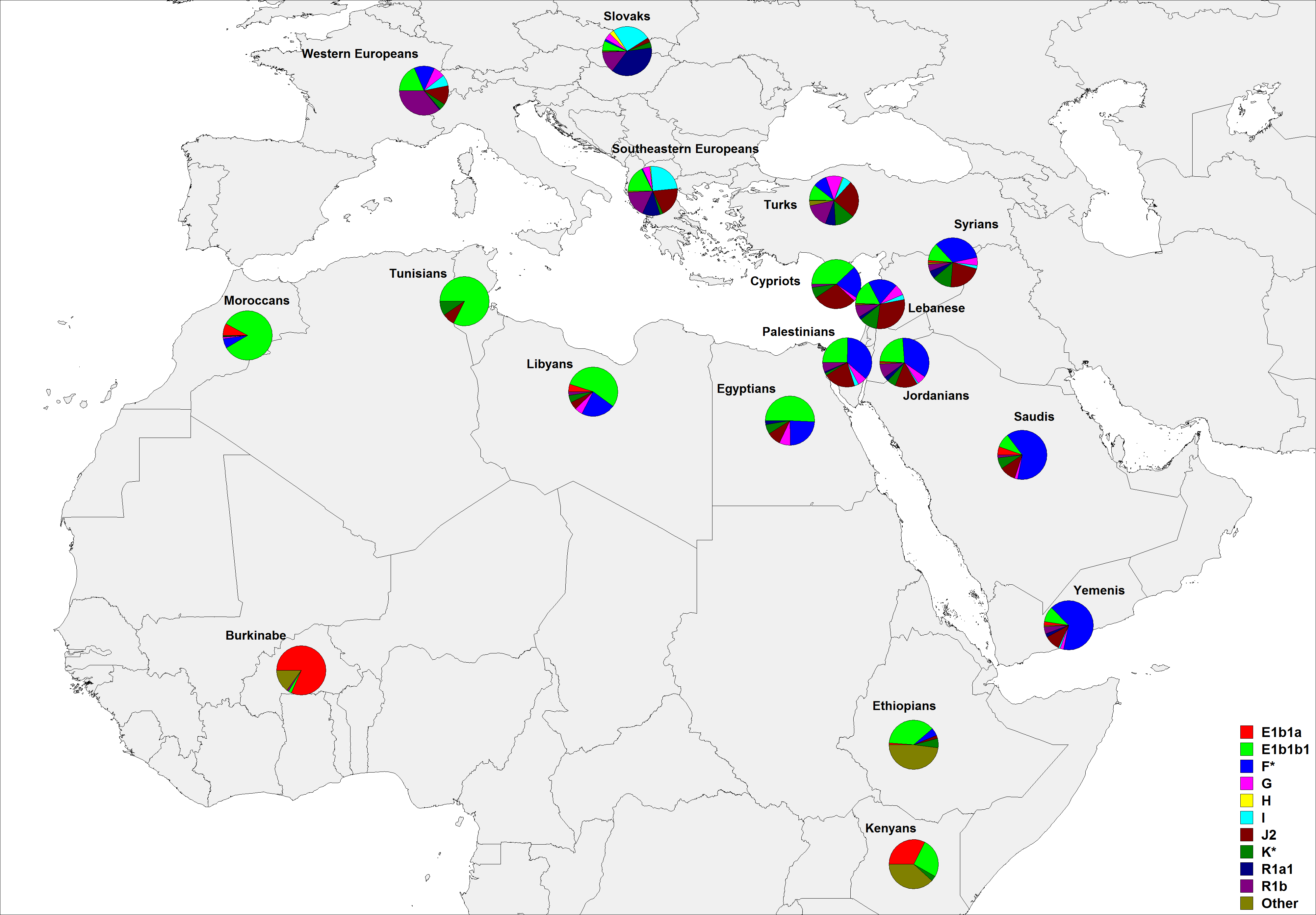
Haplogroup E-P2, also known as E1b1, is a human Y-chromosome DNA haplogroup. E-P2 has two basal branches, E-V38 and E-M215. E-P2 had an ancient presence in the Levant; presently, it is primarily distributed in Africa where it may have originated, and occurs at lower frequencies in the Middle East and Europe.
Origins
Semino et al. (2004) suggested an origin in East Africa stating: "Both phylogeography and microsatellite variance suggest that E-P2 and its derivative, E-M35, probably originated in eastern Africa."
Trombetta et al. (2011) would also suggested an origin in East Africa:
The new topology here reported has important implications as to the origins of the haplogroup E-P2. Using the principle of the phylogeographic parsimony, the resolution of the E-M215 trifurcation in favor of a common ancestor of E-M2 and E-M329 strongly supports the hypothesis that haplogroup E-P2 originated in eastern Africa, as previously suggested, and that chromosomes E-M2, so frequently observed in sub-Saharan Africa, trace their descent to a common ancestor present in eastern Africa.
Ancient DNA
A sample from the Natufian remains were found to have carried haplogroup E1b1 (1/5; 20%).
At Mota Cave, in Ethiopia, the remains of an ancient Ethiopian male, which was dated to 4500 BP, carried paternal haplogroup E1b1 and maternal haplogroup L3x2a.
Distribution
E-P2 is now found mostly in Africa, mainly in the form of its predominant subclades E-M215 and E-V38. E-M215 is more common in Northern Africa and the Horn of Africa, and is also found at lower frequencies in the Middle East, Europe and Southern Africa. E-V38 is more common in West Africa, Central Africa, Southern Africa and the African Great Lakes, and occurs at lower frequencies in North Africa and Middle East.
The paraclade, referred to as E-P2*, and including cases which are neither in E-V38 or E-M215 are either rare or nonexistent, and so far none have been found.
found E-P2 (xM35,xM2) in 10.4% of 48 Ethiopian Amhara, 12.8% of 78 Ethiopian Oromo, 1.9% of 53 South African Bantu, and 2.9% of 139 Senegalese.
have reported finding E-P2(xP1, xM35) in 11% (1/9) of a sample of Oromo from Ethiopia, 11% (1/9) of a sample of Iraqw from Tanzania, 10% (2/20) of a mixed sample of speakers of various South Semitic languages from Ethiopia, 6% (1/18) of a sample of Amhara from Ethiopia, 3% (1/30) of a sample of Ewe from Ghana, 3% (1/32) of a sample of Fante from Ghana, and 3% (1/34) of a sample of Wolof from Gambia/Senegal.
reported one individual out of a sample of 199 African American men from Philadelphia with E-P2 (xM35, xM2).
found E-P2 (xM35, xM2) in: 18% of 22 Ethiopian Jews, 2% of 49 Mossi from Burkina Faso, 3% of 37 Rimaibe also from Burkina Faso, and 6% of 17 Fulbe from Cameroon.
found E-P2 (xM35, xM2) in 18.2% of 88 Ethiopians.
found E-P2 (xM35, xM2) in Ethiopian athletes and control groups and reported the following results; General control: 4%(4/95), Arsi control: 8%(7/85), 5-10K: 22%(5/23) and Track and Field: 11%(2/11).
Subclades
E-M215
Main article: Haplogroup E-M215
Haplogroup E-M215 is a subclade of haplogroup E-P2.
E-V38
Main article: Haplogroup E-V38
Haplogroup E-V38 is a subclade of haplogroup E-P2.
E-M329
Main article: Haplogroup E-M329
Haplogroup E-M329 is a subclade of haplogroup E-P2.
Phylogenetics
Phylogenetic history
Main article: Conversion table for Y chromosome haplogroups
Prior to 2002, there were in academic literature at least seven naming systems for the Y-Chromosome Phylogenetic tree. This led to considerable confusion. In 2002, the major research groups came together and formed the Y-Chromosome Consortium (YCC). They published a joint paper that created a single new tree that all agreed to use. Later, a group of citizen scientists with an interest in population genetics and genetic genealogy formed a working group to create an amateur tree aiming at being above all timely. The table below brings together all of these works at the point of the landmark 2002 YCC Tree. This allows a researcher reviewing older published literature to quickly move between nomenclatures.
| YCC 2002/2008 (Shorthand) | (α) | (β) | (γ) |
|---|---|---|---|
| (δ) | (ε) | (ζ) | (η) |
| E-P29 | 21 | III | 3A |
| E-M33 | 21 | III | 3A |
| E-M44 | 21 | III | 3A |
| E-M75 | 21 | III | 3A |
| E-M54 | 21 | III | 3A |
| E-P2 | 25 | III | 4 |
| E-M2 | 8 | III | 5 |
| E-M58 | 8 | III | 5 |
| E-M116.2 | 8 | III | 5 |
| E-M149 | 8 | III | 5 |
| E-M154 | 8 | III | 5 |
| E-M155 | 8 | III | 5 |
| E-M10 | 8 | III | 5 |
| E-M35 | 25 | III | 4 |
| E-M78 | 25 | III | 4 |
| E-M148 | 25 | III | 4 |
| E-M81 | 25 | III | 4 |
| E-M107 | 25 | III | 4 |
| E-M165 | 25 | III | 4 |
| E-M123 | 25 | III | 4 |
| E-M34 | 25 | III | 4 |
| E-M136 | 25 | III | 4 |
Research publications
The following research teams per their publications were represented in the creation of the YCC tree.
- α and
- β
- γ
- δ
- ε
- ζ
- η
Phylogenetic trees
This phylogenetic tree of haplogroup subclades is based on the YCC 2008 tree of Karafet (2008) and subsequent published research.
References
Bibliography
Sources for conversion tables
References
- "E-P177 YTree".
- (May 2004). "Origin, Diffusion, and Differentiation of Y-Chromosome Haplogroups E and J: Inferences on the Neolithization of Europe and Later Migratory Events in the Mediterranean Area". American Journal of Human Genetics.
- {{harvtxt. Trombetta. Cruciani. Sellitto. Scozzari. 2011
- (20 December 2020). "Supplementary Material: Placing ancient DNA sequences into reference phylogenies". Molecular Biology and Evolution.
- (13 November 2015). "Ancient Ethiopian genome reveals extensive Eurasian admixture in Eastern Africa". Science.
- (13 November 2015). "Supplementary Materials: Ancient Ethiopian genome reveals extensive Eurasian admixture in Eastern Africa". Science.
- (2013-01-30). "Y-Chromosome and mtDNA Genetics Reveal Significant Contrasts in Affinities of Modern Middle Eastern Populations with European and African Populations". PLOS ONE.
- {{harvtxt. Semino. Magri. Benuzzi. Lin. 2004
- {{harvtxt. Wood. Stover. Ehret. Destro-Bisol. 2005
- {{harvtxt. Stefflova. Dulik. Pai. Walker. 2009
- {{harvtxt. Cruciani. Santolamazza. Shen. MacAulay. 2002
- {{harvtxt. Semino. Santachiara-Benerecetti. Falaschi. Cavalli-Sforza. 2002
- {{harvtxt. Underhill. Shen. Lin. Jin. 2000
- {{harvtxt. Moran. Scott. Adams. Warrington. 2004
- {{harvtxt. Karafet. Mendez. Meilerman. Underhill. 2008
This article was imported from Wikipedia and is available under the Creative Commons Attribution-ShareAlike 4.0 License. Content has been adapted to SurfDoc format. Original contributors can be found on the article history page.
Ask Mako anything about Haplogroup E-P2 — get instant answers, deeper analysis, and related topics.
Research with MakoFree with your Surf account
Create a free account to save articles, ask Mako questions, and organize your research.
Sign up freeThis content may have been generated or modified by AI. CloudSurf Software LLC is not responsible for the accuracy, completeness, or reliability of AI-generated content. Always verify important information from primary sources.
Report