From Surf Wiki (app.surf) — the open knowledge base
Hanunoo script
Abugida indigenous to Mindoro, Philippines
Abugida indigenous to Mindoro, Philippines
| Field | Value |
|---|---|
| name | Hanunó'o |
| (Mangyan Baybayin/Surat Mangyan) | |
| altname | |
| type | Abugida |
| languages | Hanunó'o, Tagalog |
| fam1 | Proto-Sinaitic script |
| fam2 | Phoenician alphabet |
| fam3 | Aramaic alphabet |
| fam4 | Brāhmī |
| fam5 | Pallava |
| fam6 | Kawi |
| fam7 | Baybayin |
| sisters | In the Philippines: |
| time | –present |
| unicode | U+1720–U+173F |
| iso15924 | Hano |
| sample | Hanunoo script sample.svg |
| imagesize | 220px |
| note | none |
(Mangyan Baybayin/Surat Mangyan)
Buhid (Mangyan Baybayin, Surat Mangyan)
Kulitan (Súlat Kapampángan)
Tagbanwa script
Ibalnan script
In the Indonesian Archipelago:
Balinese
Batak
Javanese
Lontara
Sundanese
Rencong
Rejang
Hanunoo (), also rendered Hanunó'o, is one of the scripts indigenous to the Philippines and is used by the Mangyan peoples of southern Mindoro to write the Hanunó'o language.{{cite journal
It is an abugida descended from the Brahmic scripts, closely related to Sulat Tagalog, and is famous for being written vertical but written upward, rather than downward as nearly all other scripts (however, it is read horizontally left to right). It is usually written on bamboo by incising characters with a knife.{{cite web | access-date=2016-10-08}} Most known Hanunó'o inscriptions are relatively recent because of the perishable nature of bamboo. It is therefore difficult to trace the history of the script.
Structure
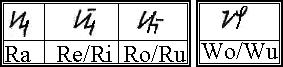
Fifteen basic characters of the Hanunó'o script each represent one of the fifteen consonants followed by the inherent vowel .{{cite book Final consonants are not written, and so must be determined from context. Dutch anthropologist Antoon Postma, who went to the Philippines from the Netherlands in the 1950s, introduced the pamudpod virama () to indicate a syllable final consonant. The pamudpod is also used in modern Baybayin.
The script makes use of single ( ) and double ( ) danda punctuation characters.
Direction of writing
The Hanunó'o script is conventionally written away from the body (from bottom to top) in columns which go from left to right. Within the columns, characters may have any orientation but the orientation must be consistent for all characters in a text. The characters are typically vertical with the /i/ diacritic on the left and the /u/ on the right, or horizontal with the /i/ on the top and the /u/ on the bottom. Left-handed people often write in mirror image, which reverses both the direction of writing (right to left instead of left to right) and the characters themselves.
Learning the script
Young Hanunó'o men and women (called layqaw) learn the script primarily in order to memorize love songs. The goal is to learn as many songs as possible, and using the script to write the songs facilitates this process. The script is also used to write letters, notifications, and other documents. The characters are not memorized in any particular order; learners typically begin by learning how to write their name. Literacy among the Hanunó'o people is high despite a lack of formal education in the script.
Examples
The Hanunó'o people's poetry, Ambahan, consists of seven syllable lines inscribed onto bamboo segments, nodes, musical instruments or other materials using the tip of a knife. Charcoal and other black pigments are then used to make the characters stand out. The poems represent a Mangyan's personal thoughts, feelings or desires. It is recited during social occasions (without accompaniment), in courting ceremonies or when requested. ;Hanunoo text ᜨᜳ ᜣ ᜦᜲ ᜨ ᜤᜲ ᜧ ᜫ ᜫ ᜢ ᜮ ᜫ ᜧᜲ ᜣ ᜨ ᜫ ᜦ ᜣᜲ ᜫ ᜧᜲ ᜣ ᜯ ᜨᜳ ᜣ ᜦᜲ ᜨ ᜤᜲ ᜧᜳ ᜫ ᜤ ᜰᜲ ᜬᜳ ᜧᜲ ᜰ ᜠ ᜥ ᜤ ᜩ ᜦ ᜧ ᜬᜳ ᜧ ᜫ ᜶}}}} ;Hanunoo text with pamudpod ᜨᜳ ᜣᜥ᜴ ᜦᜲ ᜨ ᜤᜲᜨ᜴ᜧᜳ ᜫᜨ᜴ ᜫᜬ᜴ ᜦ ᜣᜲᜩ᜴ ᜫ ᜧᜲ ᜣᜬ᜴ ᜯᜨ᜴ ᜫᜳ ᜣᜥ᜴ ᜦᜲ ᜨ ᜤᜲᜨ᜴ ᜧᜳ ᜫᜨ᜴ ᜤ ᜰᜲ ᜬᜳᜨ᜴ ᜧᜲ ᜰ ᜠᜧ᜴ ᜥᜨ᜴ ᜤ ᜩᜤ᜴ ᜦᜥ᜴ᜧ ᜬᜳᜨ᜴ ᜧᜲ ᜫᜨ᜴᜶}}}} ;Transliteration No kang ti- na gin-du- man May u- lang ma- di kag-nan May ta- kip ma di kay-wan Mo kang ti- na gin-du- man Ga si- yon di sa ad- ngan Ga pag- tang-da- yon di-man.}} ;English You my friend, dearest of all, thinking of you makes me sad; rivers deep are in between forests vast keep us apart But thinking of you with love; as if you are here nearby standing, sitting at my side.
Unicode
Main article: Hanunoo (Unicode block)
The Unicode range for Hanunó'o is U+1720–U+173F:
References
References
- (April 27, 2018). "Protect all PH writing systems, heritage advocates urge Congress".
- (March 2020). "Chapter 17: Indonesia and Oceania". Unicode Consortium.
- Harold C. Conklin. (1953). "Hanunóo-English Vocabulary". University of California Press.
- (1966). "T.L.S. (Times literary supplement)". Oxford University Press.
This article was imported from Wikipedia and is available under the Creative Commons Attribution-ShareAlike 4.0 License. Content has been adapted to SurfDoc format. Original contributors can be found on the article history page.
Ask Mako anything about Hanunoo script — get instant answers, deeper analysis, and related topics.
Research with MakoFree with your Surf account
Create a free account to save articles, ask Mako questions, and organize your research.
Sign up freeThis content may have been generated or modified by AI. CloudSurf Software LLC is not responsible for the accuracy, completeness, or reliability of AI-generated content. Always verify important information from primary sources.
Report