From Surf Wiki (app.surf) — the open knowledge base
Hanuman Chalisa
Hindu devotional hymn
Hindu devotional hymn
| Field | Value | |
|---|---|---|
| <!-- | italic title | (see above) -- |
| name | Hanuman Chalisa | |
| image | File:Hanuman_Chalisa_img.jpg | |
| caption | Hanuman Chalisa Full Text (Book) | |
| author | Tulsidas | |
| title_orig | Shubham Krishnatray | |
| religion | Hinduism | |
| language | Awadhi | |
| genre | Bhakti literature | |
| devotional poetry | ||
| verses | 40 |
devotional poetry
The Hanuman Chalisa (Hindi: हनुमान चालीसा; ; Forty chaupais on Hanuman) is a Hindu devotional hymn (stotra) in praise of Hanuman, and regularly recited by Hindus. It was written by Tulsidas in the Awadhi language and is the best known text from the Ramcharitmanas.
Hanuman is a Hindu deity and a devotee of the Hindu god, Rama. He is one of the central characters of the Ramayana. According to the Shaiva tradition, he is also an incarnation of Shiva. The Hanuman Chalisa praises the power and other qualities of Hanuman including his strength, courage, wisdom, celibacy (brahmacharya), and devotion to Rama.
Etymology
The word 'chālīsā' is derived from 'chālīs' meaning the number 'forty' in Hindi, denoting the number of chaupais (quatrains) in the Hanuman Chalisa (excluding the couplets at the beginning and the end).
Authorship

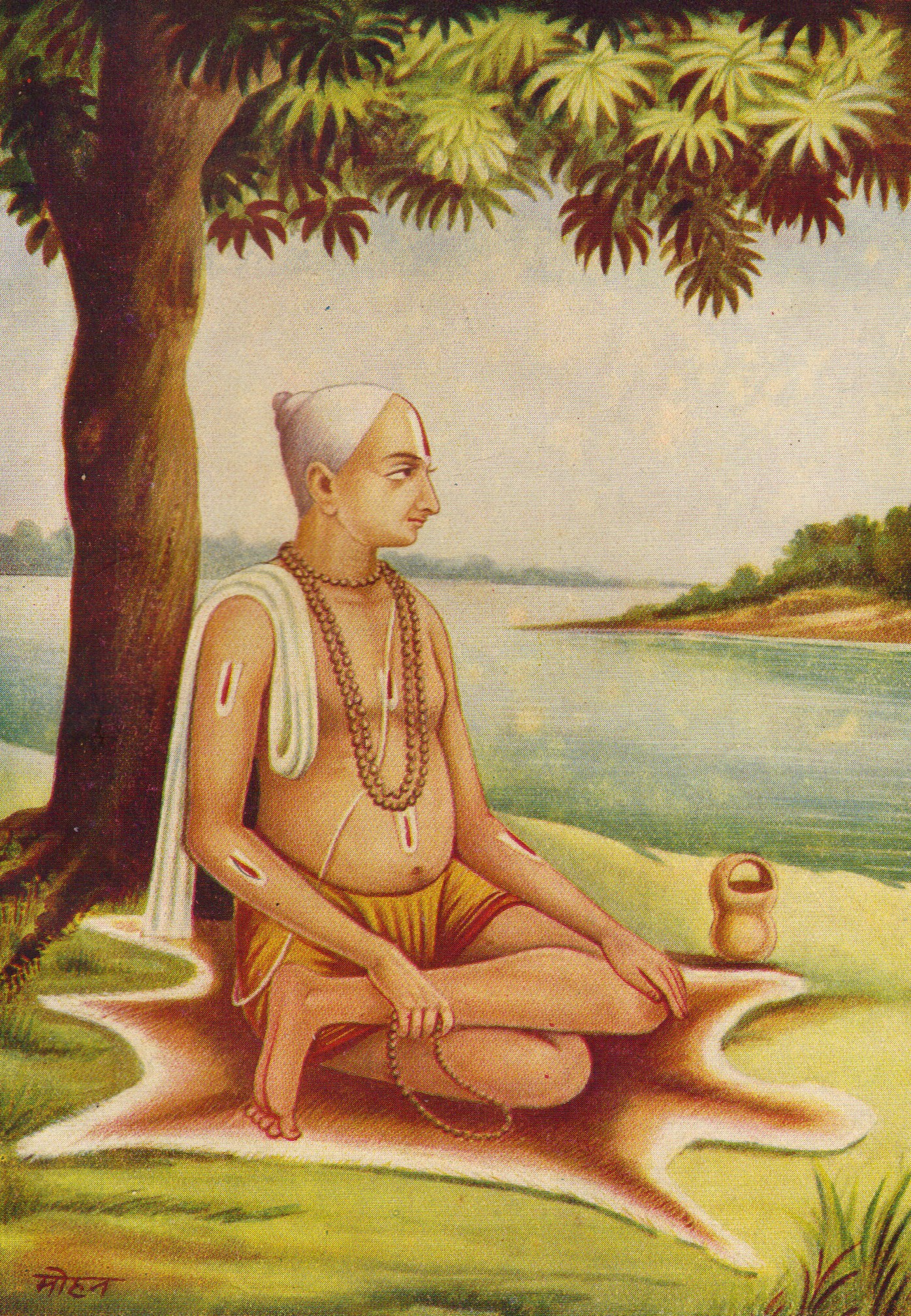
The Hanuman Chalisa was authored by Tulsidas, a poet-saint who lived in the 16th century CE. Tulsidas, a Hindu saint-poet, reformer, and philosopher, was known for his devotion to Rama. A composer of several popular works, he is best known for being the author of the epic Ramcharitmanas, a retelling of the Ramayana in the vernacular Awadhi language. Tulsidas was acclaimed in his lifetime to be a reincarnation of Valmiki, the composer of the original Ramayana in Sanskrit. Tulsidas lived in the city of Varanasi until his death. The Tulsi Ghat in Varnasi is named after him. He founded the Sankat Mochan Hanuman Temple dedicated to Hanuman in Varanasi, believed to stand at the place where he had the sight of Hanuman. Tulsidas started the Ramlila plays, a folk-theatre adaption of the Ramayana. He has been acclaimed as one of the greatest poets in Hindi, Indian, and World literature. The impact of Tulsidas and his works on the art, culture and society in India is widespread and is seen to date in vernacular language, Ramlila plays, Hindustani classical music, popular music, and television series.
Deity
Hanuman, the Hindu deity to whom the prayer is addressed to, was an ardent devotee of Rama (the seventh avatar of Vishnu) and a central character in the Ramayana. A general among the vanaras, Hanuman was a warrior of Rama in the war against the rakshasa king Ravana. Hanuman's exploits are much celebrated in a variety of religious and cultural traditions, particularly in Hinduism, to the extent that he is often the object of worship according to some bhakti traditions, and is the prime deity in many temples known as Hanuman mandirs.
Structure
The work consists of forty-three verses – two introductory dohas, forty chaupais, and one doha in the end. The first introductory doha begins with the words 'shrī guru,' referring to Shiva, who is considered the guru of Hanuman. The auspicious form, knowledge, virtues, powers and bravery of Hanuman are described in the first ten Chaupais. Chaupais eleven to twenty describe the acts of Hanuman in his service to Rama, with the eleventh to fifteenth Chaupais describing the role of Hanuman in reviving Lakshmana. In the twenty-first Chaupai, Tulsidas describes the need of Hanuman's kripa (). At the end, Tulsidas greets Hanuman with subtle devotion and requests him to reside in his heart and in the heart of devotees. The concluding doha again requests Hanuman to reside in the heart, along with Rama, Lakshmana, and Sita.
Theological significance
The text expounds on Hanuman as not only a devotee of Rama but significant as a deity in his own right. Furthermore, the text describes Hanuman's strength, speed, knowledge, and devotion. Devotion (bhakti) is emphasized throughout. It is described in the text that one who recites the Chalisa will be granted protection, spiritual merit, and even liberation.
Ritual
The Hanuman Chalisa is recited by millions of Hindus every day, and many practising Hindus know its text by heart. Traditionally, Tuesday and Saturdays are devoted to Hanuman and the Chalisa is recited then.
Commentaries
.jpg)
Before the 1980s, no commentary had been composed on the Hanuman Chalisa, which Rambhadracharya attributes to the work not being included in printed editions of collected works of Tulsidas. Indubhushan Ramayani authored the first brief commentary on Hanuman Chalisa. Rambhadracharya's Mahaviri commentary in Hindi, authored in 1983, was called the best commentary on Hanuman Chalisa by Rama Chandra Prasad.
In popular culture
Classical and folk music
The Hanuman Chalisa is one of the best selling Hindu religious books and has been sung by many popular bhajan, classical and folk singers. The rendition of Hanuman Chalisa by Hari Om Sharan, originally released in 1974 by the Gramophone Company of India and re-released in 1995 by Super Cassettes Industries, is one of the most popular, and is regularly played at temples and homes across Northern India. This rendition is based on traditional melodies in the Mishra Khamaj, a raga belonging to the Khamaj That, with the base note taken at the second black key (kali do) of the harmonium. A recording based on the same traditional melodies was released in 1992 by Super Cassettes Industries, with Hariharan as the singer and Gulshan Kumar as the artiste.
Other notable renditions include those by bhajan singers Anup Jalota and Ravindra Jain, Hindustani vocalists Pandit Jasraj and Rajan and Sajan Mishra, and the Carnatic vocalist M.S. Subbulakshmi. The renditions by Unni Krishnan, Nithyasree Mahadevan, Pandit Bhimsen Joshi, Ganapathi Sachchidananda Swamiji and Morari Bapu are also popular.
Among western singers Krishna Das has performed the Hanuman Chalisa in both slow and fast formats.
Popular movies
In the Hindi movie 1920 (directed by Vikram Bhatt), Hanuman Chalisa is frequently used in different scenes. One of the scenes show the protagonist Arjun Singh Rathod (played by Rajneesh Duggal), reciting the Hanuman Chalisa in full. It is used in an important sequence in Bajrangi Bhaijaan, when the protagonist fights back against child traffickers and rescues a little girl from them.
An animation movie named Shri Hanuman Chalisa directed by Charuvi Agarwal and designed by Charuvi Design Labs is a film on Hanuman.
Popular music
Popular singers who have sung the Hanuman Chalisa include Carnatic singer M. S. Subbulakshmi, as well as Lata Mangeshkar, Gulshan Kumar, Mahendra Kapoor, S. P. Balasubrahmanyam, Shankar Mahadevan, Anuradha Paudwal, Kailash Kher, Sukhwinder Singh, Sonu Nigam, Hariharan, and Udit Narayan.
The Hanuman Chalisa was sung by Amitabh Bachchan in chorus with twenty other singers. This recording was released as a part of the Shri Hanuman Chalisa album in 2011 and received an unprecedented response by the releasing music label during November 2011.
A rendition of Hanuman Chalisa sung by Hariharan became the first devotional song and first on YouTube to cross 5 billion views in November 2025.
References
Bibliography
References
- Nityanand Misra 2015, p. xviii.
- Rambhadradas 1984, [http://jagadgururambhadracharya.org/works/hcm/amukha.php pp. 1–8.] {{Webarchive. link. (3 February 2014)
- (26 February 2003). "Hanuman Chalisa in digital version". The Hindu Business Line.
- (9 April 2020). "किसने लिखी थी हनुमान चालीसा, जिसके बारे में कही जाती हैं कई बातें".
- [[Karan Singh]], in Nityanand Misra 2015, p. xvi.
- Peebles 1986, p. 99
- (3 January 2006). "Book Review / Language Books : Epic of Tulasidas". The Hindu.
- (29 November 2002). "Lineage shows". [[The Hindu]].
- Peebles 1986, p. 100
- Lochtefeld, James G.. (2002). "The Illustrated Encyclopedia of Hinduism". Rosen Publishing Group.
- Lutgendorf 2007, p. 293.
- Prasad 2008, p. 857, quoting Mata Prasad Gupta: Although he paid occasional visits to several places of pilgrimage associated with Rama, his permanent residence was in Kashi.
- de Bruyn 2010, p. 471
- Callewaert 2000, p. 90
- Handoo 1964, p. 128: ... this book ... is also a drama, because Goswami Tulasidasa started his ''Ram Lila'' on the basis of this book, which even now is performed in the same manner everywhere.
- Prasad 2008, p. xii: He is not only the supreme poet, but the unofficial poet-laureate of India.
- Prasad 2008, p. xix: Of Tulsidas's place among the major Indian poets there can be no question: he is as sublime as Valmiki and as elegant as Kalidasa in his handling of the theme.
- Jones 2007, p. 456
- Sahni 2000, pp. 78–80
- Lutgendorf 1991, p. 11: ... – scores of lines from the ''Rāmcaritmānas'' have entered folk speech as proverbs – ...
- Mitra 2002, p. 216
- Subramanian 2008, p. inside cover
- Orlando O. Espín, James B. Nickoloff ''An introductory dictionary of theology and religious studies''. 2007, page 537
- Rosen, Steven. ''Essential Hinduism''. 2006, page 67-8
- Rambhadradas 1984, [http://jagadgururambhadracharya.org/works/hcm/doha01.php pp. 11–14] {{Webarchive. link. (3 February 2014)
- Rambhadradas 1984, [http://jagadgururambhadracharya.org/works/hcm/chaupai14.php pp. 46–47] {{Webarchive. link. (3 February 2014 , [http://jagadgururambhadracharya.org/works/hcm/chaupai15.php 48–49] {{Webarchive). link. (3 February 2014)
- Rao 2009, pp. 393–397
- Mehta 2007, p. xv
- Rambhadradas 1984, [http://jagadgururambhadracharya.org/works/hcm/chaupai20.php pp. 56–57] {{Webarchive. link. (3 February 2014)
- Rambhadradas 1984, [http://jagadgururambhadracharya.org/works/hcm/chaupai37.php pp. 78–79] {{webarchive. link. (3 February 2014)
- Rambhadradas 1984, [http://jagadgururambhadracharya.org/works/hcm/chaupai40.php pp. 81–82] {{Webarchive. link. (3 February 2014)
- Rambhadradas 1984, [http://jagadgururambhadracharya.org/works/hcm/doha03.php pp. 83–84] {{webarchive. link. (3 February 2014)
- Lutgendorf, Philip. (2007). "Hanuman's tale: the messages of a divine monkey". Oxford University Press.
- Nityanand Misra 2015, pp. xvii–xxi.
- Prasad, Ram Chandra. (1999). "Sri Ramacaritamanasa The Holy Lake of the Acts of Rama". Motilal Banarsidass.
- Manuel, Peter. (1993). "Cassette Culture: Popular Music and Technology in North India – Chicago Studies in Ethnomusicology". University of Chicago Press.
- Nityanand Misra 2015, pp. 199–212.
- Kats, Local. (11 May 2023). "Hanuman".
- (June 15, 2020). "Ep. 27 | Spiritual Experiences, Auschwitz and Bernie Glassman".
- (24 July 2015). "Bajrangi Bhaijaan Plot Summary – Times of India".
- "Charuvi Design Labs release The Second official teaser for "Shri Hanuman Chalisa"".
- "Charuvi Design Labs release The first official teaser for "Shri Hanuman Chalisa"".
- (6 November 2011). "All in praise of the Almighty". [[The Times of India]].
- (27 May 2020). "Hanuman Chalisa by Gulshan Kumar crosses 3 billion views on YouTube, another World record made by T-series". Infotonline.
This article was imported from Wikipedia and is available under the Creative Commons Attribution-ShareAlike 4.0 License. Content has been adapted to SurfDoc format. Original contributors can be found on the article history page.
Ask Mako anything about Hanuman Chalisa — get instant answers, deeper analysis, and related topics.
Research with MakoFree with your Surf account
Create a free account to save articles, ask Mako questions, and organize your research.
Sign up freeThis content may have been generated or modified by AI. CloudSurf Software LLC is not responsible for the accuracy, completeness, or reliability of AI-generated content. Always verify important information from primary sources.
Report