From Surf Wiki (app.surf) — the open knowledge base
Hanok
Traditional Korean house

Traditional Korean house
| Field | Value | |||||
|---|---|---|---|---|---|---|
| caption | Ojukheon in Gangneung | |||||
| hangul | 한옥 | |||||
| hanja | 韓屋 | |||||
| rr | hanok | |||||
| mr | hanok | |||||
| hangul1 | 조선집 | hanja1=朝鮮집 | rr1= Joseonjip | mr1= Chosŏnjip | othername1=In North Korean standard language | image=20151003최광모RX10DSC03016.JPG |
A ko (; name in South Korea) or chosŏnjip (; name in North Korea and for Koreans in Yanbian, China) is a traditional Korean house. ko were first designed and built in the 14th century during the Joseon dynasty.
Korean architecture considers the positioning of the house in relation to its surroundings, with thought given to the land and seasons. The interior of the house is also planned accordingly. This principle is called baesanimsu (), meaning that the ideal house is built with a mountain in the back and a river in the front. ko shapes differ by region. In the cold northern regions of Korea, ko are built in a square with a courtyard in the middle in order to retain heat better. In the south, ko are more open and L-shaped.
History
A ko is a Korean house which was developed in the Korean Peninsula and Manchuria.
Early history
Paleolithic people in the Korean peninsula may have occupied caves or made temporary houses. In the Neolithic era, the temporary house developed into a dugout hut. They dug into the ground with a small shovel and built a small house that used rafters and columns. Wood was used for the rafters and columns, and straw was used for roof. In the Bronze Age, there were several columns in the house, so the area of the house was extended relative to early houses. Iron Age ko had Ondol, and also used giwa (기와), a kind of roofing tile which was made with fired clay. By using giwa roof tiles, ko developed a specific shape.
South Korea

.jpg)
After the devastation of the Korean War there was a need for cheap, suitable housing for people displaced by the war. During the period immediately after the war, several ko of historical value were demolished. In the larger cities of South Korea, only small clusters of ko remain. However the value of ko has been discussed in the early twentieth century, with many comparing them favourably to the more common but less eco-friendly apartments found across South Korea. Today, some train stations are influenced by traditional ko design (Jeonju Station, for example).
North Korea
In Kaesong, the traditional ko originally there remain and play a role as a tourist attraction. Giwajip (tile-roofed houses) surround the ko.
China
ko can also be found in northeast China, and Koreans have been living for over 100 years in ko built for themselves. Since 2010, people have been working on a project focused on making a ko village in Heilongjiang, China.
In Lu Xun Park, Shanghai, Yun Bong-gil Memorial Hall is built in Hanok style to dedicate to Korean independence activist Yun Bong-gil.
Origin

The term 'ko' appeared for the first time in a paper about houses on April 23, 1907. In that paper, ko was used in reference to the specific area along Jeong-dong road from Donuimun to Baejae school. At that time, instead of using ko, terms like jooga (meaning living houses) and jaetaek (meaning a variety of houses) were more widely used. The word ko was only used in special circumstances when the latest house was built somewhere.
During the era of Korea under Japanese rule, the ruler used terms such as "jooga" or "Joseon house" when they were talking about house improvement. There is a record of ko; however, the specific term "ko" hasn't been used prevalently.
The specific word "ko" appeared in the Samsung Korean dictionary in 1975, where it was defined as an antonym of "western house" and as a term meaning Joseon house (Korean-style house). After the 1970s, with urban development, many apartments and terraced houses were built in South Korea, and many ko were demolished everywhere. From that time on, a ko was only called a "Korean traditional house".
In a broad sense, "ko" refers to a house with thatching or to a Neowa-jib (a shingle-roofed house) or a Giwa-jib (tile-roofed house), although the general meaning of ko refers to only a Giwa-jib in Korea.
Characteristics
.jpg)
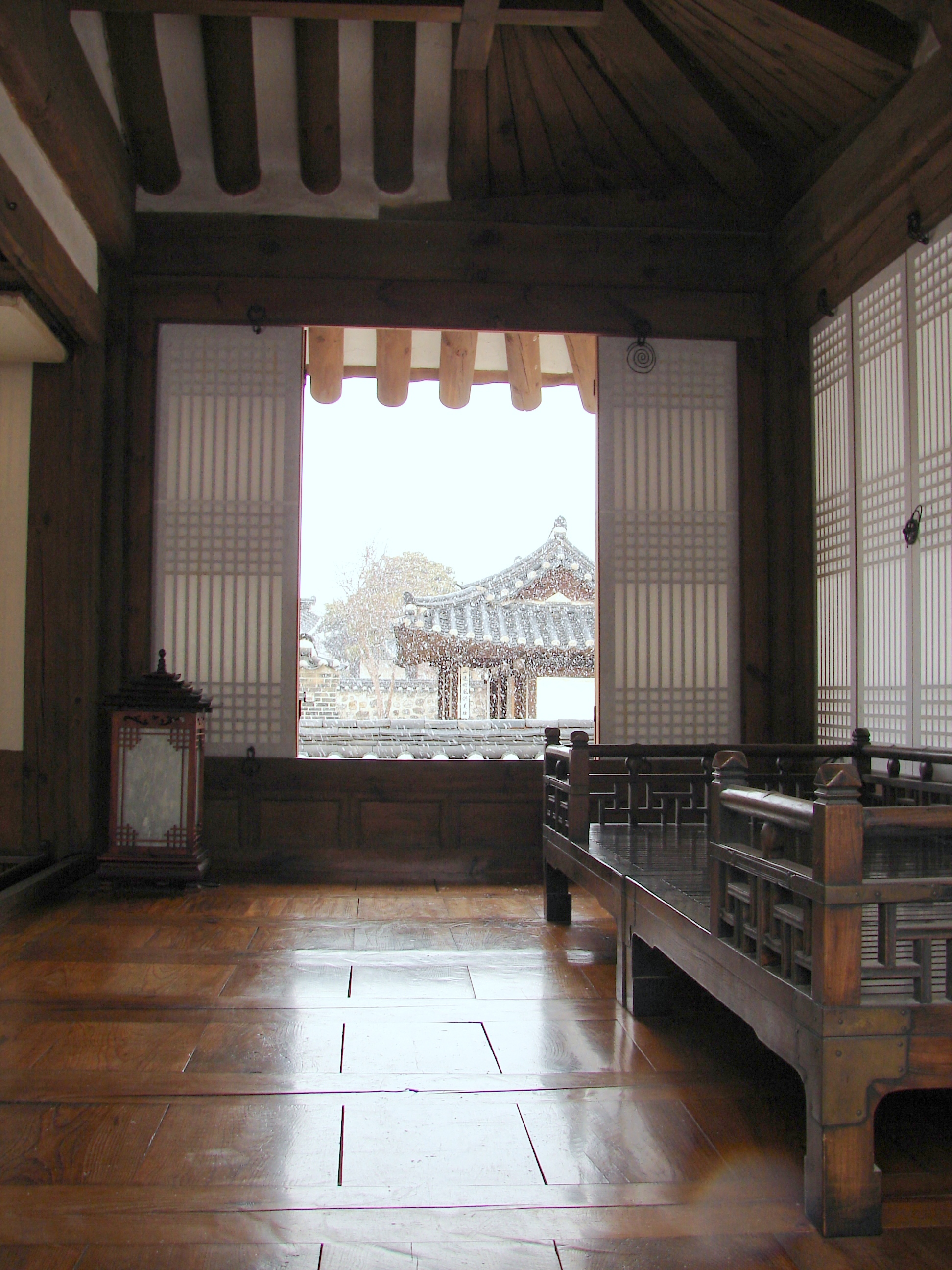
The environment-friendly aspects of traditional Korean houses range from the structure's inner layout to the building materials which were used. Another unique feature of traditional houses is their special design for cooling the interior in summer and heating the interior in winter.
Since Korea has hot summers and cold winters, the Ondol (Gudeul), a floor-based heating system, and the Daecheong, a cool wooden-floor style hall, were devised long ago to help Koreans survive the frigid winters and to block sunlight during summer. These early types of heating and air-conditioning were so effective that they are still in use in many homes today. The posts, or daedulbo, are not inserted into the ground, but are fitted into the cornerstones to keep ko safe from earthquakes.
Materials

The raw materials used in ko, such as soil, timber, and rock, are all natural and recyclable and do not cause pollution. ko have their own tiled roofs (기와, giwa), wooden beams and stone-block construction. Cheoma is the edge of curved roofs of the ko. The lengths of the Cheoma can be adjusted to control the amount of sunlight that enters the house. A form of traditional Korean paper (한지, hanji), lubricated with bean oil to make it waterproof and polished, is used to make beautiful and breathable windows and doors.
Variations
By region

The shapes of ko differ regionally. Due to the warmer weather in the southern region, Koreans built ko with the rooms aligned in a straight line. In order to allow good wind circulation, they have open, wooden floor living areas and many windows. The most common shape for ko in the central region is an L-shaped layout, an architectural mixture of the shapes in the northern and the southern regions. ko in the cold northern region have square layouts that block the wind flow. They do not have an open, wooden floor area, and the rooms are all joined together. They commonly have Jeongjugan, a space between the kitchen and other rooms, which is warmed by an Ondol.
By social class
The structure of ko is also classified according to social class. Typically the houses of yangban (upper class), jungin (middle class) and urban commoners, with giwa (tiled roof), emphasized not only the function of the house, but also its aesthetics. The houses of provincial commoners (as well as some impoverished yangban), with choga (a roof plaited by rice straw), were built in a more strictly functional manner.

Preservation
Many ko have been preserved, such as:
- Bukchon Hanok Village, a residential quarter in central Seoul
- Namsangol Hanok Village in Pil-dong, Jung District, Seoul
- Hahoe Folk Village, a traditional village from the Joseon period located in Andong, South Korea.
- Yangdong Folk Village, a traditional village from the Joseon period in Gyeongju, South Korea, along the Hyeongsan River.
- Korean Folk Village, a tourist attraction in the city of Yongin, Gyeonggi Province
- Jeonju Hanok Village, located in Jeonju, North Jeolla Province is one of the largest ko districts in Korea with over 800 ko houses.
- Gahoe-dong and Gye-dong in Jongno District, Seoul, are home to many ko, many of which have been remodeled into cafés, restaurants, or teahouses.
References
References
- (2015). "Hanok: The Korean House". [[Tuttle Publishing]].
- Tudor, Daniel. (2014). "Geek in Korea: Discovering Asia's New Kingdom of Cool". Tuttle Publishing.
- Mignon. Olivier. (2008)
- 이. 상현. (2007). 그물코
- "Ondol (Under-floor Heating System)". [[Korea Tourism Organization]].
- "The Layout of a Hanok". Korean Tourism Organization.
- Kim, Hyung-eun. (16 November 2012). "Historic Bukchon besieged by tourists, businesses". [[Korea JoongAng Daily]].
- "Jeonju Hanok Village [Slow City]". [[Korea Tourism Organization]].
- Yoo Sun-young. (2 March 2011). "Bukchon streets lure folks with rustic charm and retro cool". [[Korea JoongAng Daily]].
This article was imported from Wikipedia and is available under the Creative Commons Attribution-ShareAlike 4.0 License. Content has been adapted to SurfDoc format. Original contributors can be found on the article history page.
Ask Mako anything about Hanok — get instant answers, deeper analysis, and related topics.
Research with MakoFree with your Surf account
Create a free account to save articles, ask Mako questions, and organize your research.
Sign up freeThis content may have been generated or modified by AI. CloudSurf Software LLC is not responsible for the accuracy, completeness, or reliability of AI-generated content. Always verify important information from primary sources.
Report