From Surf Wiki (app.surf) — the open knowledge base
Hampton University
Historically black university in Hampton, Virginia, US
Historically black university in Hampton, Virginia, US
| Field | Value |
|---|---|
| name | Hampton University |
| image | Hampton University Seal.png |
| image_size | 150px |
| former_names | Hampton Normal and Agricultural Institute (1868–1930) |
| Hampton Institute (1930–1984) | |
| motto | "The Standard of Excellence, An Education for Life" |
| type | Private historically black research university |
| established | |
| affiliations | Big South Conference |
| MAISA | |
| academic_affiliations | Space-grant |
| endowment | $280.6 million (2020) |
| chancellor | JoAnn Haysbert |
| president | Darrell K. Williams |
| provost | JoAnn Haysbert |
| students | 4,243 (fall 2024) |
| undergrad | 3,727 (fall 2024) |
| postgrad | 498 (fall 2024) |
| doctoral | 18 (fall 2024) |
| city | Hampton, Virginia |
| country | U.S. |
| coor | |
| campus | Suburban, 314 acre |
| free_label | Newspaper |
| free | The Hampton Script |
| colors | Blue & white |
| athletics_affiliations | |
| sports_nickname | Pirates and Lady Pirates |
| logo | Hampton University logo.png |
| logo_size | 175px |
| website |
Hampton Institute (1930–1984) MAISA
Hampton University is a private, historically black, research university in Hampton, Virginia, United States. Founded in 1868 as Hampton Agricultural and Industrial School, it was established by Black and White leaders of the American Missionary Association after the American Civil War to provide education to freedmen. The campus houses the Hampton University Museum, which is the oldest museum of the African diaspora in the United States and the oldest museum in the commonwealth of Virginia. First led by former Union General Samuel Chapman Armstrong, Hampton University's main campus is located on 314 acres in Hampton, Virginia, on the banks of the Hampton River.
The university offers bachelor's, master's, and doctoral programs. The university has a satellite campus in Virginia Beach and also has online offerings. Hampton University is home to 16 research centers, including the Hampton University Proton Therapy Institute, the largest free-standing facility of its kind in the world. Hampton University is classified among "R2: Doctoral Universities – High research activity".
History
The campus was founded on the grounds of "Little Scotland", a former plantation in Elizabeth City County that is located on the Hampton River. It overlooked Hampton Roads and was not far from Fortress Monroe and the Grand Contraband Camp, that gathered formerly enslaved men and women who sought refuge with Union forces in the South during the first year of the war. Their facilities represented freedom.
In 1861 the American Missionary Association (AMA) responded to the former slaves' need for education and hired Mary Smith Peake as its first teacher at the camp. She had already secretly been teaching slaves and free Black people in the area despite the state's legal prohibition. She first taught for the AMA on September 17, 1861, and was said to gather her pupils under a large oak. In 1863 the Emancipation Proclamation was read here—the first place in the Confederate states. From then on the big tree was called the Emancipation Oak. The tree, now a symbol of both the university and of the city, survives as part of the designated National Historic Landmark District at Hampton University.
The Hampton Agricultural and Industrial School, later called the Hampton Institute, was founded in 1868 after the war by the biracial leadership of the American Missionary Association, who were chiefly Congregational and Presbyterian ministers. It was first led by former Union General Samuel Chapman Armstrong. Among the school's famous alumni is Booker T. Washington, an educator who was hired as the first principal at the Tuskegee Institute, which he developed for decades.
Civil War
During the American Civil War (1861–1865), Union-held Fortress Monroe in southeastern Virginia at the mouth of Hampton Roads became a gathering point and safe haven of sorts for fugitive slaves. The commander, General Benjamin F. Butler, determined they were "contraband of war", to protect them from being returned to slaveholders, who clamored to reclaim them. As numerous individuals sought freedom behind Union lines, the Army arranged for the construction of the Grand Contraband Camp nearby, from materials reclaimed from the ruins of Hampton, which had been burned by the retreating Confederate Army. This area was later called "Slabtown".
Hampton University traces its roots to Mary S. Peake, who began in 1861 with outdoor classes for freedmen, whom she taught under what is now the landmark Emancipation Oak in the nearby area of Elizabeth City County. In 1863 the newly issued Emancipation Proclamation was read to a gathering under the historic tree there.
After the War: teaching teachers

After the War, a normal school (teacher training school) was formalized in 1868, with former Union brevet Brigadier General Samuel C. Armstrong (1839–1893) as its first principal. The new school was established on the grounds of a former plantation named "Little Scotland", which had a view of Hampton Roads. The original school buildings fronted the Hampton River. Legally chartered in 1870 as a land grant school, it was first known as Hampton Normal and Agricultural Institute.
Typical of historically black colleges, Hampton received much of its financial support in the years following the Civil War from the American Missionary Association (whose black and white leaders represented the Congregational and Presbyterian churches), other church groups, and former officers and soldiers of the Union Army. One of the many Civil War veterans who gave substantial sums to the school was General William Jackson Palmer, a Union cavalry commander from Philadelphia. He later built the Denver and Rio Grande Western Railroad, and founded Colorado Springs, Colorado. As the Civil War began in 1861, although his Quaker upbringing made Palmer abhor violence, his passion to see the slaves freed compelled him to enter the war. He was awarded the Medal of Honor for bravery in 1894. (The current Palmer Hall on the campus is named in his honor.)
In 1872 Thomas P. Fenner was hired by Armstrong to create and lead the Hampton Singers (then known as the Hampton Jubilee Singers) in response to the tremendous financial success of the Fisk Jubilee Singers 1871 concert tour. Armstrong hoped that a similar choir at Hampton could also raise money for the financially struggling school. Fenner and the choir toured widely and were able to raise enough money through concerts to pay for the construction of Virginia Hall, the first dormitory for women at the Hampton Institute. Further funds raised by the choir in the 1870s were responsible for stabilizing the school's finances overall and prevented the school from closing.

At the close of its first decade, the school reported a total admission in those ten years of 927 students, with 277 graduates, all but 17 of whom had become teachers. Many of them had bought land and established themselves in homes; many were farming as well as teaching; some had gone into business. Only a very small proportion failed to do well. By another 10 years, there had been over 600 graduates. In 1888, of the 537 still alive, three-fourths were teaching, and about half as many undergraduates were also teaching. It was estimated that 15,000 children in community schools were being taught by Hampton's students and alumni that year.
After Armstrong's death, Hampton's leaders continued to develop a highly successful external relations program that forged a network of devoted supporters. By 1900, Hampton was the wealthiest school serving African Americans, largely due to its success in development and fundraising.
Hampton also had the only library school in the United States for educating black librarians. The Hampton Institute Library School opened in 1925 and through its Negro Teacher-Librarian Program (NTLTP) trained and issued professional degrees to 183 black librarians. The library school closed in 1939.
Booker T. Washington: spreading the educational work
Among Hampton's earliest students was Booker T. Washington, who arrived from West Virginia in 1872 at the age of 16. He worked his way through Hampton, and then went on to attend Wayland Seminary in Washington, D.C. After graduation, he returned to Hampton and became a teacher. Upon Armstrong's recommendation to the founder of a small school in Tuskegee, Alabama, established six years before, in 1881 the 25-year-old Washington went there to strengthen it and develop it to the status of a normal school, one recognized as being able to produce qualified teachers.
This new institution eventually became Tuskegee University. Embracing much of Armstrong's philosophy, Washington built Tuskegee into a substantial school and became nationally famous as an educator, orator, and fund-raiser as well. He collaborated with the philanthropist Julius Rosenwald in the early 20th century to create a model for rural black schools; Rosenwald established a fund that matched monies raised by communities to build more than 5,000 schools for rural black children, mostly in the South. In 1888 Washington recruited his Hampton classmate Charles W. Greene to Tuskegee to lead the Agriculture Department. Together they enticed George Washington Carver to the Tuskegee Agriculture faculty upon his graduation with a master's degree from Iowa State University in 1896.
Carver provided such technical strength in agriculture that, in 1900, Washington assigned Greene to establish a demonstration of black business capability and economic independence off-campus in Tuskegee. This project, entirely black-owned, comprised 4,000 lots of real estate and was formally established and designated Greenwood in 1901, as a demonstration for black-owned business and residential districts in every city in the nation with a significant black population. After Washington visited Tulsa, Oklahoma, in 1905 and addressed a large gathering there, the Oklahomans followed the Tuskegee model and named Tulsa's black-owned and operated district "Greenwood" in 1906.
Native Americans
In 1878, Hampton established a formal education program for Native Americans to accommodate men who had been held as prisoners of war. In 1875 at the end of the American Indian Wars, the United States Army sent seventy-two warriors from the Cheyenne, Kiowa, Comanche and Caddo Nations, to imprisonment and exile in St. Augustine, Florida. Essentially they were used as hostages to persuade their peoples in the West to keep peace. Lieutenant Richard Henry Pratt supervised them at Fort Marion and began to arrange for their education in the English language and American culture.
St. Augustine was attracting numerous visitors from the North as it became known as a winter resort. Many became interested in the Native Americans held at Fort Marion and volunteered as teachers. They also provided the men with art supplies. Some of the men created what is now known as ledger art in this period. Some of the resulting works (including by David Pendleton Oakerhater) are held by the Smithsonian Institution.
At the end of the warriors' incarceration, Pratt convinced seventeen of the younger men to enroll at Hampton Institute for additional education. He also recruited additional Native American students: a total of seventy Native Americans, young men and women from various tribes, mostly from the Plains rather than the acculturated tribes of Virginia, joined that first class. Because Virginia's First Families sometimes boasted of their Native American heritage through Pocahontas, some supporters hoped that the Native American students would help locals to accept the institute's black students. The black students were also supposed to help "civilize" the Native American students to current American society, and the Native Americans to "uplift the Negro[es]".
The Red Moon was a theatrical show featuring a fictionalized version of the school.
In 1923, in the face of growing controversy over racial mingling, after the former Confederate states had disenfranchised blacks and imposed Jim Crow, the Native American program ended. Native Americans stopped sending their boys to the school after some employers fired Native American men because they had been educated with blacks. The program's final director resigned because she could not prevent "amalgamation" between the Native American girls and black boys.
Name changes, expansion, and community

Hampton Normal and Agricultural Institute became simply Hampton Institute in 1930. In 1931 the George P. Phenix School for all age groups was opened there under principal Ian Ross. A new nurses' training school was attached to the Dixie Hospital, with Nina Gage as director. In 1945 the Austrian-American psychologist, art educator, and author of the influential text book Creative and Mental Growth Viktor Lowenfeld joined the Hampton faculty as an assistant professor of industrial arts and eventually became chair of the Art Department. By 1971 the university offered 42 evening classes in programs including "Educational Psychology", "Introduction to Oral Communication", "Modern Mathematics", and "Playwriting", among others. At the time, the tuition cost for these courses was $30 per semester hour.
In 1951, a 20-year-old student Benjamin Leroy Wigfall of Richmond, Virginia, became the youngest person ever to have a painting purchased by the Virginia Museum of the Fine Arts for $30 (~$ in ). The abstract painting was titled Chimneys.
With the addition of departments and graduate programs, it became Hampton University in 1984. Originally located in Elizabeth City County, it was long-located in the Town of Phoebus, incorporated in 1900. Phoebus and Elizabeth City County were consolidated with the neighboring City of Hampton to form a much larger independent city in 1952. The City of Hampton uses the Emancipation Oak on its official seal. From 1960 to 1970, noted diplomat and educator Jerome H. Holland was president of the Hampton Institute.
The university and its leadership has also been met with criticism. In 2018, Hampton University students launched a protest calling for the administration to address several concerns they believed to be longstanding and urgent, including food quality, living conditions and the handling of sexual assault complaints. The university released a statement indicating that it was "moving forward" to address student concerns and issues.
In July 2020, philanthropist MacKenzie Scott donated $30 million (~$ in ) to Hampton. The donation is the largest single gift in Hampton's history. Hampton's president has sole discretion on how funds will be used but has committed to consulting with other university leaders on the best way to allocate the generous donation. Also in 2020, Hampton's School of Pharmacy lost accreditation due to failure of compliance to standards. The university soon after sued the accreditation agency citing lack of due process but in 2022 the lawsuit was dismissed and loss of accreditation upheld.
In June 2022, William R. Harvey retired as the 12th president of Hampton University after 43 years of service. He is the longest serving president in Hampton's history and one of the longest serving college presidents in the nation. He is succeeded by Darrell K. Williams who is a 1983 graduate of Hampton University.
Presidents
- Samuel Chapman Armstrong (1868 to 1893)
- Hollis B. Frissell (1893 to 1917)
- James Edgar Gregg (1918 to 1929)
- George Perley Phenix (1930)
- Arthur Howe (1930 to 1940)
- Malcolm Shaw MacLean (1940 to 1943)
- Ralph P. Bridgeman (1944 to 1948)
- Alonzo G. Morón (1949 to 1959)
- Jerome H. Holland (1960 to 1970)
- Roy Davage Hudson (1970 to 1976)
- Carl McClellan Hill (1977 to 1978)
- William R. Harvey (1978 to 2022)
- Darrell K. Williams (2022 to present)
Campus

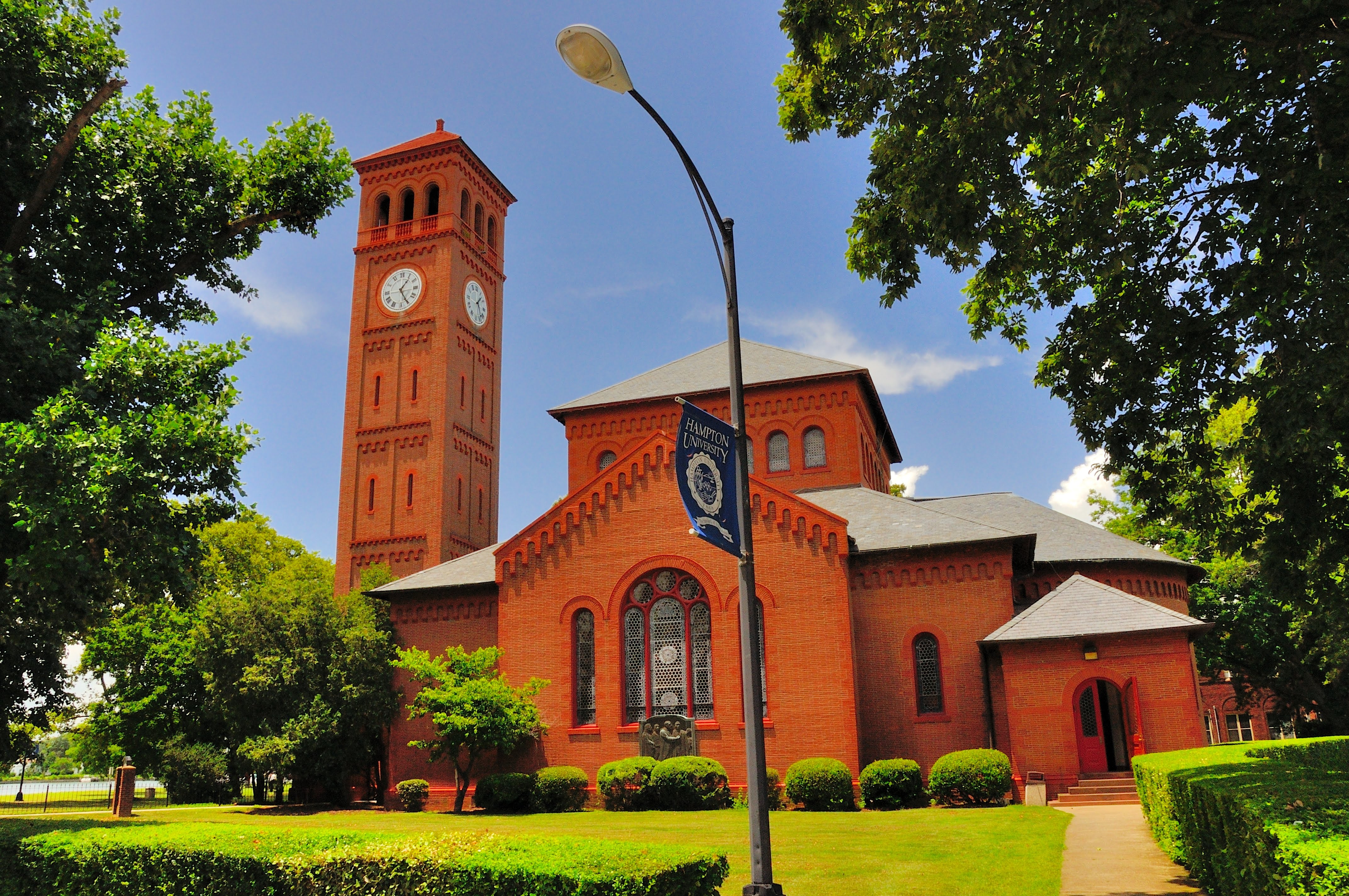
The campus contains several buildings that contribute to its National Historic Landmark district: Virginia-Cleveland Hall (freshman female dormitory, as well as former home to the school's two cafeterias), Wigwam building (home to administrative offices), Academy Building (administrative offices), Memorial Chapel (religious services) and the President's Mansion House.
The original High School on the campus became Phenix Hall when Hampton City Public Schools opened a new Phenix High School in 1962. Phenix Hall was damaged in a minor fire on June 12, 2008.
The Hampton University Museum was founded in 1868 and is the nation's oldest African-American museum. The museum contains over 9,000 pieces, some of which are highly acclaimed.
Hampton University is home to 16 research centers. The Hampton University Proton Therapy Institute is the largest free-standing facility of its kind in the world.
The four libraries on campus are the William R. and Norma B. Harvey Library (main library), William H. Moses Jr. Architecture Library, the Music Library, and the Nursing Library.
The Emancipation Oak was cited by the National Geographic Society as one of the 10 great trees in the world.
The waterfront campus is settled near the mouth of the Chesapeake Bay.
National Historic Landmark District
|access-date=May 30, 2008 |url-status=dead |archive-url=https://web.archive.org/web/20071226214931/http://tps.cr.nps.gov/nhl/detail.cfm?ResourceId=868&ResourceType=District |archive-date=December 26, 2007
- Mansion House, original plantation residence of Little Scotland
- Virginia Hall, built in 1873
- Academic Hall
- Wigwam
- Marquand Memorial Chapel, a Romanesque Revival red brick chapel with a 150 ft tower
In addition, Cleveland Hall, Ogden, and the Administration building are also included in the district.
The district was listed on the National Register of Historic Places in 1969 and declared a National Historic Landmark in 1974.
Student demographics
In 2023, nearly two-thirds of Hampton students were women and the other third men. Approximately 97% of them identified as Black and 20% were Virginia residents. 68% of students received need-based financial aid. The average need-based scholarship or grant awardeded to first-year students at Hampton was $10,025.
Academics
Hampton University has the following schools and colleges.
- School of Engineering and Technology
- School of Pharmacy
- James T. George School of Business
- Scripps Howard School of Journalism and Communication
- School of Nursing
- School of Liberal Arts and Education
- School of Religion
- School of Science
- University College
- College of Virginia Beach
- Graduate College , Hampton offers 50 baccalaureate programs, 26 master's programs, seven doctoral programs, two professional programs, and ten associate/certificate programs.
The Freddye T. Davy Honors College is a non-degree granting college that offers special learning opportunities and privileges to the most high-achieving undergraduates. To join the honors college, students must formally accept an invitation given by the college or directly apply for admissions into the college.
Hampton University consistently ranks among the top ten HBCUs in the nation and is ranked in Tier 1 (#217) among "National Universities" by U.S. News & World Report.
Hampton's student to faculty ratio is 10 to 1, which is better than the national university average of 18 to 1.
Hampton is the first and only HBCU to have 100% control of a NASA Mission.
The Alumni Factor named Hampton one of the seven best colleges in Virginia.
Hampton University is classified as a selective admissions institution.
Student activities
Athletics
Main article: Hampton Pirates and Lady Pirates

Hampton sports teams participate in NCAA Division I (FCS for football) in the Coastal Athletic Association (CAA). They joined in 2022 upon leaving the Mid-Eastern Athletic Conference and then later the Big South Conference. Hampton is one of three NCAA Division I HBCU institutions (along with Tennessee State University, in the Ohio Valley Conference and CAA rival North Carolina A&T) to not be a member of the Mid-Eastern Athletic Conference or Southwestern Athletic Conference.
In 2016, Hampton became the first and only HBCU to field a Division I men's lacrosse team. ESPN held a broadcast on campus preceding the inaugural game in Armstrong Stadium.
Hampton is the only HBCU with a competitive sailing team.
In 2001, the Hampton basketball team won its first NCAA tournament game, when they beat Iowa State 58–57, in one of the largest upsets of all time. They were only the fourth fifteen-seed to upset a two-seed in the tournament's history. They returned to the tournament a year later, as well as in 2006, 2011, 2015 and 2016, having won their conference basketball tournament. Their NCAA tournament record is 2–6, including the play-in game.
The "Lady Pirates" basketball team has made trips to the NCAA tournament in 2000, 2003, 2004, 2010–2014, and 2017. In 1988, as a Division II school, the Lady Pirates won the NCAA Women's Division II Basketball Championship, defeating West Texas State. In 2011, as a number-13 seed, the Lady Pirates nearly upset Kentucky, but fell in overtime, 66–62. In 2015, the Lady Pirates played in the Women's NIT, where they defeated Drexel 45–42 in the opening round. However, in the second round, the team lost to West Virginia 57–39.

The Pirates won their conference title in football in 1997, shared the title 1998 and 2004, and won it again outright in 2005 and 2006. From 2004 to 2006, the team won three MEAC Championships and three SBN-Black College National Championships, and was ranked in the Division I FCS top 25 poll each year. The Pirates also sent five players to the NFL Combine in 2007, the most out of any FCS subdivision school for that year. They have also been dominant in tennis, winning the MEAC from 1996 to 1999, 2001–2003 and 2007 for the men, and 1998 and 2002–2004 for the women.
Major rivals include Norfolk State University, located across Hampton Roads in downtown Norfolk, and Howard University in Washington, D.C.
In 2019, Hampton revived their rivalry with Virginia Union University from Richmond, Virginia.
Student organizations
There are over 55 student organizations on campus in arts, athletics, community service, leadership, religion, and student government.
"The Marching Force" marching band
Pirate athletics are supported by a plethora of groups, including "The Marching Force" Marching Band. The marching band has appeared at several notable events, including a Barack Obama Presidential Inauguration parade in Washington, D.C. "The Force" was chosen out of a large pool of applicants to participate in the parade as the representative for the state of Virginia. "The Force" is complemented by the "Ebony Fire" all-women danceline, as well as "Silky", the flag team, and as of 2018, "Shimmering Sapphire Elegance", the majorette team.
Greek life
Hampton University has over 15 Greek letter organizations, including the National Pan-Hellenic Council organizations.
Notable alumni
Business
Education
Entertainment, media, and the arts
Politics and government
Science, health care, technology, engineering and mathematics
Sociology and humanities
Sports
References
References
- (February 19, 2021). "U.S. and Canadian Institutions Listed by Fiscal Year 2020 Endowment Market Value and Change in Endowment Market Value from FY19 to FY20". National Association of College and University Business Officers and [[TIAA]].
- "Facts & Figures – Hampton University About".
- "The Hampton Script".
- "Arts & Museums {{!}} Hampton, VA - Official Website".
- Ellinghaus, Katherine. (2000). "Assimilation by Marriage: White Women and Native American Men at Hampton Institute, 1878–1923". Virginia Historical Society.
- (July 2024). "Carnegie Classifications Institution Lookup". Center for Postsecondary Education}}{{Dead link.
- Ellinghaus, Katherine. (2000). "Assimilation by Marriage: White Women and Native American Men at Hampton Institute, 1878–1923". Virginia Historical Society.
- "History". Hampton University.
- "Official Visitor Information Site for Hampton, VA - Civil War".
- (November 28, 2014). "Mary Peake - History of American Women".
- Shipley, Lori. (April 2011). "Music Education at Hampton Institute, 1868-1913". Journal of Historical Research in Music Education.
- (March 12, 1970). "Hampton Choir to Sing in Boston". [[Bay State Banner]].
- [http://www.rootsweb.com/%7Eusgenweb/va/history/lamb/lamb5.html ''Our Twin Cities of the Nineteenth Century: Norfolk and Portsmouth, Their Past, Present, and Future''] {{Webarchive. link. (November 27, 2007 , Robert W. Lamb, Editor. Norfolk, VA: Barcroft, Publisher. 1887–8. Norfolk Landmark Steam Presses.)
- (February 2021). "Not Just the Raising of Money: Hampton Institute and Relationship Fundraising, 1893-1917". History of Education Quarterly.
- (Spring 2005). "Bridging the Gap in Early Library Education History for African Americans: The Negro Teacher-Librarian Training Program (1936-1939)". Journal of Negro Education.
- "Wishing I Were There", Time Travel to Hampton Institute Graduation Exercises, 1875
- Landis, Barbara. (n.d.). "Carlisle Indian Industrial School History".
- (February 28, 2011). "The American Indian at Hampton Institute, Virginia".
- "Hampton".
- (June 6, 1931). "Hampton makes appointments of 2 whites". The Afro-American.
- (1987). "Creative and mental growth.". Collier Books.
- (January 7, 1971). "Hampton to Start Evening Credit Classes". Charlottesville-Albemarle Tribune.
- (1951-05-25). "Armstrong Grad Sells Painting". Afro-American (Baltimore).
- "History". Hampton University.
- "Hampton University Receives the Largest Single Gift in the School's History". Hampton University News.
- Lumpkin, Lauren. (July 28, 2020). "Mackenzie Scott gift: Howard University to receive $40 million, its largest gift from a single donor". The Washington Post.
- Ayo, Julius. (2022-11-03). "Hampton University’s lawsuit over pharmacy school’s withdrawal of accreditation dismissed". WAVY.com.
- (December 14, 2020). "Hampton University President Dr. William R. Harvey Seals 43 Stellar Years of Leadership by Announcing Plans to Retire in June 2022".
- Bowden, Henry Warner. (1993). "Dictionary of American Religious Biography". Greenwood Press.
- (1918). "The Missionary Review of the World". Missionary Review Publishing Company, Incorporated.
- (1946-02-24). "Dr. J.E. Gregg Dies; Hampton Ex-Head; Principal of Institute for 11 Years, Long a Congregational Minister, Succumbs at 70". [[The New York Times]].
- (2009-02-01). "Hampton Roads: Remembering Our Schools". Arcadia Publishing.
- Zaki, Hoda M.. (2007). "Civil Rights and Politics at Hampton Institute: The Legacy of Alonzo G. Moron". University of Illinois Press.
- (May 13, 1940). "Education: MacLean to Hampton".
- (March 23, 2018). "Interactive timeline: Hampton University 150th anniversary".
- Holt, Ann. (2012). "Lowenfeld at Hampton (1939-1946): Empowerment, Resistance, Activism, and Pedagogy". Studies in Art Education.
- "Jerome Holland, Educator, and Diplomat born".
- Waterhouse, Sheila. (2016-10-17). "Alumni Spotlight: Roy Hudson".
- (April 7, 1995). "Carl McClellan Hill, Former Hu President". Daily Press.
- (June 2, 2022). "Making A Mark: Hampton University President Dr. William Harvey to Retire After 44 Years".
- Reese, Brian. (2022-04-13). "Williams named Hampton University's 13th president". [[WAVY-TV]].
- "Hampton University – Admissions".
- "National Historic Landmarks Survey: Listing of National Historic Landmarks by State:Virginia".
- (August 2018). "Fire damages historic building on HU campus". Dailypress.com}}{{Dead link.
- "Our Museum : Hampton University Museum".
- "Research Centers". Hampton University.
- Salasky, Prue. (October 17, 2015). "Hampton proton therapy center treating a fraction of its predicted number of patients". Dailypress.com.
- "Libraries". Hampton University.
- "Virginia Landmarks Register". Virginia Department of Historic Resources.
- {{NRISref
- Poh, Carol Ann. (January 9, 1974). ["National Register of Historic Places Inventory-Nomination: Hampton Institute / Hampton Normal and Industrial Institute"]({{NHLS url). National Park Service}} and {{NHLS url.
- "Hampton Institute". National Park Service.
- "Student Profile – Hampton University About".
- "Hampton University {{!}} Hampton University - Cost and Financial Aid {{!}} US News Best Colleges".
- "Accreditation". Hampton University.
- "Hampton University School of Business Officially Named James T. George School of Business for Trustee James George". Hampton University News.
- Coast Live. (Feb 8, 2023). "Dean Julia A. Wilson discusses 20 years of Journalism at Scripps Howard on Coast Live". [[WKTR]].
- "Facts & Figures". Hampton University.
- "Freddye T. Davy Honors College : Requirements".
- (2021). "Hampton University". U.S. News & World Report.
- "6. What are National Universities?".
- "Student-to-Faculty Ratio: What Does it Mean?".
- (September 18, 2015). "Hampton University {{!}} State of HBCUs".
- "Top 227 Schools". The Alumni Factor.
- "The 10 Best Historically Black Colleges and Universities".
- "NCAA.com – The Official Website of NCAA Championships".
- (January 15, 2016). "ESPN TO BROADCAST BEFORE FIRST HOME LACROSSE GAME".
- "Student Organizations – Hampton University Activities".
- (4 February 2022). "Press Release: Ravens President Dick Cass to Retire, Sashi Brown Named Successor".
- "[http://www.tshaonline.org/handbook/online/articles/fcrab CREUZOT, PERCY PENNINGTON, JR. (FRENCHY)]." ''[[Handbook of Texas]]''. Retrieved on May 1, 2014.
- "Rashida Jones named next president of MSNBC". NBC.
- "Blue, Thomas F., Sr.". University of Kentucky Libraries.
- web. [link](Charles W Kelly & Charles W Greene Plaque (Greenwood dedication)". December 7, 1940. p. 2 – via newspapers.com.)
- "Hugh Page". University of Notre Dame.
- Schneider, Gregory S.. (September 9, 2019). "Northam names first diversity chief for Virginia state government". Washington Post.
- "Williams, Charles Holston". University of Kentucky Libraries.
- (April 18, 1947). ""Spider" Burks On KXLW Daily Mon. Thru Fri.". The St. Louis Argus.
- Tangcay, Jazz. (February 24, 2021). "Ruth E. Carter Makes History With a Star on the Hollywood Walk of Fame". Variety.
- (June 2021). "ESPN Signs Brian Custer as SportsCenter Anchor, Play by Play Commentator for College Basketball, Football". [[ESPN]].
- (April 5, 2021). "Taylor James, Justin Bieber's Longtime Tour DJ, Elevated to Pop Star's Personal A&R: Exclusive".
- Bomey, Nathan. "Rashida Jones named president of MSNBC, becoming first Black leader of news network".
- (February 9, 2010). "Orpheus M. and Mattie Allen McAdoo Papers". Yale University Beinecke Rare Books & Manuscript Library.
- (January 12, 2022). "Grammy-winning producer Che Pope launches new record label in Detroit backed by Dan Gilbert".
- (September 30, 1996). "A.S. 'Doc' Young, Noted Journalist-Author, Dies". Johnson Publishing Company, Inc..
- "Allyson Kay Duncan". Notable Name Data Base.
- "VANESSA D. GILMORE". Just The Beginning Foundation.
- "Honorable Theodore T. Jones". Court of Appeals State of New York.
- "Hampton University Alumna Tishaura Jones Elected as First Black Woman Mayor of St. Louis". Hampton University.
- McNamara, Brittney. (5 November 2018). "Meet Your Future President, Nupol Kiazolu".
- "Gloria G. Lawlah, Maryland Secretary of Aging". Msa.md.gov.
- (21 November 1995). "New Permanent Representative of Antigua and Barbuda Presents Credentials".
- "Spencer Overton". George Washington University Law School.
- "Biography of the Deputy Surgeon General". Notable Name Data Base.
- [http://www-history.mcs.st-andrews.ac.uk/Biographies/Claytor.html William Waldron Schieffelin Claytor], MacTutor History of Mathematics archive
- Warren, Wini. (1999). "Black Women Scientists in the United States". Indiana University Press.
- (June 2021). "Ayana Jordan". The Lancet Psychiatry.
- "Hampton University Marine and Environmental Science Alumni Serve Leadership Roles with New Non-profit Called Black in Marine Science". Hampton University Office of University Relations.
- (September 2003). "Sound reasoning".
- "African–American History Month at the Library of Virginia". Library of Virginia.
- Tarter, Brent. "Augustus M. Hodges".
- Brock, Elmore. (1969). "Augustus M. Hodges". Colored Co-operative Publishing Company.
- Williams, Michael Ann. (September 1995). "Great Smoky Mountains Folklife". University Press of Mississippi.
- "Chris Baker". nfl.com.
- "Jamal Brooks". nfl.com.
- Bell, Daryl. (December 19, 2018). "Mo'ne Davis chooses Hampton University to play softball because 'everything felt right'".
- Bengel, Chris. (February 10, 2020). "Mo'ne Davis, former Little League World Series star, makes college softball debut for Hampton".
- "Kenrick Ellis". Pro-Football-Reference.Com.
- "Devin Green". Basketball-Reference.Com.
- "Isaac Hilton". NFL Enterprises LLC.
- "Derrick Allen Mahorn". Basketball-Reference.Com.
- "Jerome Mathis". databaseFootball.com.
- "Nevin McCaskill". databaseFootball.com.
- "Athletes – McCorory Francena Biography". iaaf.org.
- (June 28, 2021). "Hampton University alum Chidi Okezie makes Nigeria's Olympic team in mixed 1,600 relay". pilotonline.com.
- "Ex-Norfolk State football coach Dick Price dies at 75". hamptonroads.com.
- "Zuriel Smith". databaseFootball.com.
- Tien-Dana, Jack. (September 11, 2024). "Pierre Sow Player Profile, Hartford".
- "Cordell Jerome Taylor". Pro-Football-Reference.Com.
- "NFL Players who attended Hampton University". databaseSports.com.
This article was imported from Wikipedia and is available under the Creative Commons Attribution-ShareAlike 4.0 License. Content has been adapted to SurfDoc format. Original contributors can be found on the article history page.
Ask Mako anything about Hampton University — get instant answers, deeper analysis, and related topics.
Research with MakoFree with your Surf account
Create a free account to save articles, ask Mako questions, and organize your research.
Sign up freeThis content may have been generated or modified by AI. CloudSurf Software LLC is not responsible for the accuracy, completeness, or reliability of AI-generated content. Always verify important information from primary sources.
Report