From Surf Wiki (app.surf) — the open knowledge base
Hampton Court Bridge
Bridge over the Thames linking London with Surrey, England
_engraving.jpg)
Bridge over the Thames linking London with Surrey, England
| Field | Value |
|---|---|
| bridge_name | Hampton Court Bridge |
| image | Hampton Court Bridge 1.jpg |
| caption | Hampton Court bridge in 2006 |
| carries | Thames Path |
| crosses | River Thames |
| locale | East Molesey |
| Hampton | |
| maint | Surrey County Council |
| designer | W. P. Robinson |
| Sir Edward Lutyens | |
| design | Arch |
| material | Concrete with a brick finish |
| spans | 3 |
| pierswater | 2 |
| length | 320 ft |
| width | 70 ft |
| height | 19 ft |
| open | 3 July 1933 |
| toll | Abolished 1876 |
| heritage | Grade II listed structure |
| coordinates |
Hampton Sir Edward Lutyens

Hampton Court Bridge is a Grade II listed bridge that crosses the River Thames in England approximately north–south between Hampton, London and East Molesey, Surrey, carrying the A309. It is the upper of two road bridges on the reach above Teddington Lock and downstream of Molesey Lock.
The bridge is the most upstream crossing of all of the Thames bridges of Greater London; uniquely one bank is within the county. The Thames Path crosses the river here.
Historic crossings
Ferry
The location of the bridge had been a ferry crossing point since at least the Tudor period.
First bridge
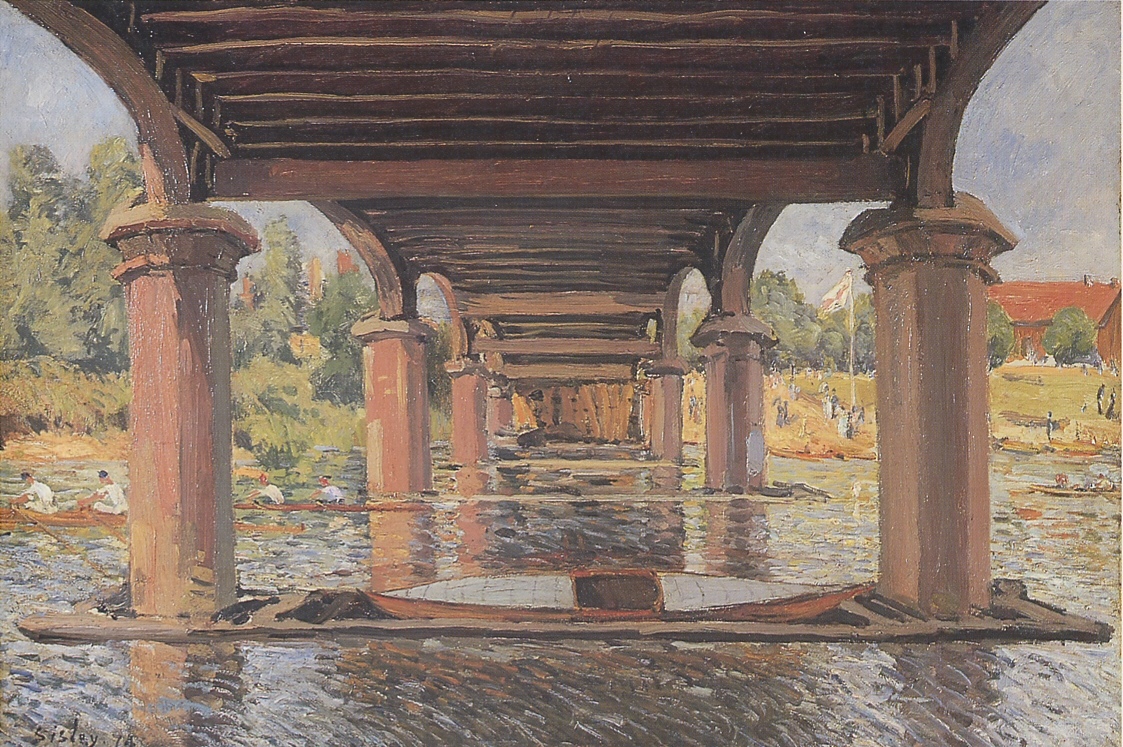
In 1750, James Clarke obtained an act of Parliament, the Hampton Court Bridge Act 1749 (23 Geo. 2. c. 37), to construct a privately owned bridge at Hampton Court. The first bridge was constructed by Samuel Stevens and Benjamin Ludgator from 1752 until 1753 and opened on 13 December that year. It had seven wooden arches and was built in the Chinoiserie design of the Willow pattern that was popular at the time, attested by two prints made in the year of its opening and the year after.
Second bridge
This bridge was replaced by a more sturdy eleven-arch wooden bridge in 1778.
Third bridge
From 1864 to 1865 construction took place on the third bridge on the site. It opened on 10 April 1865. Despite the criticism, it proved extremely lucrative for Allen, earning him over £3,000 annually in tolls until he was bought out in 1876 for £48,048 by a joint committee of the Hampton and Molesey local boards and the Corporation of London, using powers granted by the Kew and Other Bridges Act 1869 (32 & 33 Vict. c. xix).
The modern bridge
The modern bridge is the fourth on the site. The bridge has three wide arches, is designed to be able to carry quite heavy motorised road traffic and is constructed of reinforced concrete, faced with red bricks and white Portland stone on its pontoons, dressings, and balustrades.
The bridge was one of three authorised by Parliament in 1928 (the others being Twickenham Bridge and Chiswick Bridge). It was designed by the Surrey county engineer W. P. Robinson and the architect Sir Edwin Lutyens to reflect the style of the portions of Hampton Court Palace designed by Sir Christopher Wren – whose architectural style has another legacy by the bridge, as his well-conserved blue-plaqued house in which he lived his final years faces the roundabout by the two north bank roads which meet just north of the bridge and palace front gate. To ensure that traffic could still cross, the new bridge was built a short distance downstream from the old, which was subsequently demolished.

Construction began in September 1930. The work required the demolition of a small hotel (The Old Castle) and, to the south, diversion of the flow of the River Mole into the River Ember, formerly the secondary distributary of the Mole. The bridge was opened by the Prince of Wales (who became King Edward VIII) on 3 July 1933, on the same day as the opening of Chiswick and Twickenham bridges, which carry the A316 (and between those sections is still occasionally nicknamed the 'Richmond bypass'). The bridge was Grade II listed in 1952 for its architecture.
Surroundings
;Immediate environs Aside from two parallel lines of architecturally rich buildings and riverside homes – approximately half of which are listed on the north bank are Hampton Court Palace and Gardens, Hampton Court Park and Bushy Park, Royal Parks.
On the south bank is a one-way street of restaurants, boutiques, and bars surrounded by apartments immediately then homes with gardens west of Hampton Court railway station. On the Thames itself, a few hundred metres to either side are Molesey Lock on the Thames and the mouth of the River Mole, on the south side.
Roads
;Hampton Court Way (A309) The bridge construction was taken as the opportunity for Surrey County Council to construct a new road, which starts at the same road as before with its roundabout with the A308 (Staines–Kingston road) (then running south between the palace's entrance driveway and a short row of a hotel/restaurant, a restaurant and shop), before becoming being considerably straighter than the existing old roads as a route south. Numbered A309, this connects directly with the A307 (Old London–Portsmouth road) and more recently with the A3(M) motorway deeper into Surrey than the old route.
;A3050 The A3050 commences immediately southwest of the bridge and passes through three riverside settlements: the rest of Molesey and the towns of Walton-on-Thames and Weybridge also in Elmbridge, Surrey.
;Neighbouring bridges The next bridge downstream is 1.5 mi and upstream is exactly 4 mi.
The next downstream bridge has considerably older predecessors going back to the early medieval period and is the only other of the reach, Kingston Bridge, London – it is pale brick and stone only and of taller design with two extra arches.
The next bridge upstream was replaced in 2013 with a single-span bridge heading up the Thames, a tied arch bridge, Walton Bridge.
Notes
References
Bibliography
-
Elmbridge Borough Council – Information plaque at the Bridge
References
- [http://www.moleseyhistory.co.uk/books/molesey/tm/tm_5.htm Thameside Molesey]
- River Thames Alliance. [https://web.archive.org/web/20080124114502/http://www.visitthames.co.uk/text.asp?PageId=320 Bridge heights on the River Thames.]
- {{NHLE. (2 September 1952)
- Baker, Rowland. (1989). "Thameside Molesey". Molesey History.
- (1911). "Spelthorne Hundred: Hampton: introduction". Institute of Historical Research.
- By 1840 this bridge had become dilapidated and the owner appealed to the [[Corporation of London]] to support reconstruction. Among their arguments were that since the bridge was built, the city had created [[Molesey Lock. Molesey Lock and Weir]] and as a consequence navigation through the bridge was dangerous. The bridge was described at about this time as "crazy, hog-backed, inconvenient and obstructive of the navigation".Fred. S. Thacker ''The Thames Highway: Volume II Locks and Weirs'' 1920 – republished 1968 [[David & Charles]]
- Croad, Stephen. (2003). "Liquid History: The Thames Through Time". Batsford.
- Wren's latter-life home, the Old Court House, Grade II* listing {{NHLE
- [http://gridreferencefinder.com/ Grid Reference Finder] distance tools
This article was imported from Wikipedia and is available under the Creative Commons Attribution-ShareAlike 4.0 License. Content has been adapted to SurfDoc format. Original contributors can be found on the article history page.
Ask Mako anything about Hampton Court Bridge — get instant answers, deeper analysis, and related topics.
Research with MakoFree with your Surf account
Create a free account to save articles, ask Mako questions, and organize your research.
Sign up freeThis content may have been generated or modified by AI. CloudSurf Software LLC is not responsible for the accuracy, completeness, or reliability of AI-generated content. Always verify important information from primary sources.
Report