From Surf Wiki (app.surf) — the open knowledge base
Hammerhead shark
Family of sharks
Family of sharks
- Sphyrna
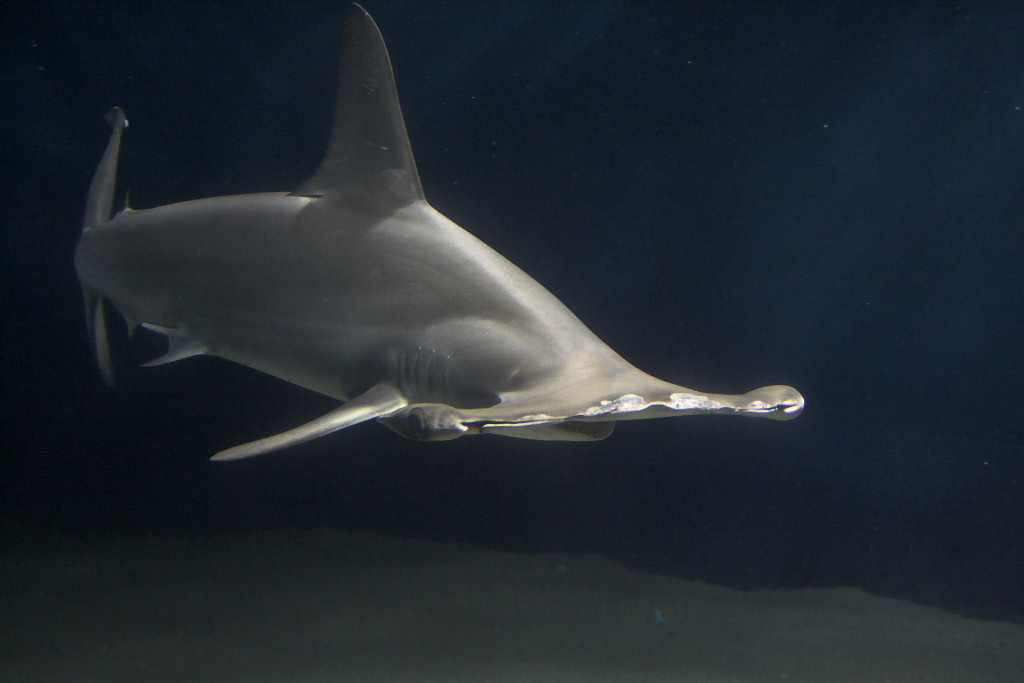
The hammerhead sharks are a group of sharks that form the family Sphyrnidae, named for the unusual and distinctive form of their heads, which are flattened and laterally extended into a cephalofoil (a T-shape or "hammer"). The shark's eyes are placed one on each end of this T-shaped structure, with their small mouths directly centered and underneath. Most hammerhead species are placed in the genus Sphyrna, while the winghead shark is placed in its own genus, Eusphyra. Many different—but not necessarily mutually exclusive—functions have been postulated for the cephalofoil, including sensory reception, manoeuvering, and prey manipulation. The cephalofoil gives the shark superior binocular vision and depth perception, as well as increased surface area for electrocreceptors.
Hammerheads are found worldwide, preferring life in warmer waters along coastlines and continental shelves. Unlike most sharks, some hammerhead species will congregate and swim in large schools during the day, becoming solitary hunters at night.
Description

Hammerhead shark species vary in length and weight. The largest species, the Great Hammerhead, has an average length of 13.1 ft and weight of 500 lb. The smallest species, the bonnethead shark, can reach 5 feet in length and 24 pounds in weight. One specimen caught off the Florida coast in 1906 weighed over 680 kg. They are usually light gray and have a greenish tint. Their bellies are white, which allows them to blend into the background when viewed from below and sneak up to their prey. Their heads have lateral projections that give them a hammer-like shape. While overall similar, this shape differs somewhat between species; examples are: a distinct T-shape in the great hammerhead, a rounded head with a central notch in the scalloped hammerhead, and an unnotched rounded head in the smooth hammerhead.
Hammerheads have disproportionately small mouths compared to other shark species. Some species are also known to form schools. In the evening, like most other sharks, they become solitary hunters. National Geographic explained that hammerheads can be found in warm, tropical waters, but during the summer, they begin a mass migration period in search of colder waters.
Taxonomy and evolution

Because sharks do not have mineralized bones and rarely fossilize, only their teeth are commonly found as fossils. Their closest relatives are the requiem sharks (Carcharinidae). Based on a recent combined molecular and paleontological study, the ancestor of the hammerheads probably lived in the Cretaceous or Paleocene. Definitive fossils of the family date back to the Eocene. Prior DNA studies had estimated the family to have arisen in the Miocene, about 20 million years ago.
Using mitochondrial DNA, a phylogenetic tree of the hammerhead sharks showed the winghead shark as sister to the rest of the hammerhead sharks. As the winghead shark has proportionately the largest "hammer" of the hammerhead sharks, this suggests that the first ancestral hammerhead sharks also had large hammers.
Cephalofoil
The hammer-like shape of the head may have evolved at least in part to enhance the animal's vision. The positioning of the eyes, mounted on the sides of the shark's distinctive hammer head, allows 360° of vision in the vertical plane, meaning the animals can see above and below them at all times. They also have an increased binocular vision and depth of visual field as a result of the cephalofoil. The shape of the head was previously thought to help the shark find food, aiding in close-quarters maneuverability, and allowing sharp turning movement without losing stability. The unusual structure of its vertebrae, though, has been found to be instrumental in making the turns correctly, more often than the shape of its head, though it would also shift and provide lift. From what is known about the winghead shark, the shape of the hammerhead apparently has to do with an evolved sensory function. Like all sharks, hammerheads have electroreceptory sensory pores called ampullae of Lorenzini. The pores on the shark's head lead to sensory tubes, which detect electric fields generated by other living creatures. By distributing the receptors over a wider area, like a larger radio antenna, hammerheads can sweep for prey more effectively.
Reproduction
Reproduction occurs only once a year for hammerhead sharks, and usually occurs with the male shark biting the female shark violently until she agrees to mate with him. The hammerhead sharks exhibit a viviparous mode of reproduction with females giving birth to live young. Like other sharks, fertilization is internal, with the male transferring sperm to the female through one of two intromittent organs called claspers. The developing embryos are at first sustained by a yolk sac. When the supply of yolk is exhausted, the depleted yolk sac transforms into a structure analogous to a mammalian placenta (called a "yolk sac placenta" or "pseudoplacenta"), through which the mother delivers sustenance until birth. Once the baby sharks are born, they are not taken care of by the parents in any way. Usually, a litter consists of 12 to 15 pups, except for the great hammerhead, which gives birth to litters of 20 to 40 pups. These baby sharks huddle together and swim toward warmer water until they are old and large enough to survive on their own.
In 2007, the bonnethead shark was found to be capable of asexual reproduction via automictic parthenogenesis, in which a female's ovum fuses with a polar body to form a zygote without the need for a male. This was the first shark known to do this.
Diet
Hammerhead sharks eat a large range of prey such as fish (including other sharks), squid, octopus, and crustaceans. Stingrays are a particular favorite, with the positioning of their (comparatively) smaller, crescent-shaped mouths underneath their T-shaped heads allowing for skilled skate, ray, and flounder hunting, among other seafloor-dwellers. These sharks will often be found swimming above the sand along the bottom of the ocean, stalking their prey. Their unique heads are further utilized as a tool (or weapon) if hunting rays and flatfishes; the shark uses its head to pin down and briefly stun the prey, and only eats once their quarry is clearly weakened and in shock. The great hammerhead, tending to be larger and more aggressive to its own kind than other hammerheads, occasionally engages in cannibalism, eating other hammerhead sharks, including mothers consuming their own young. In addition to the typical animal prey, bonnetheads have been found to feed on seagrass, which sometimes makes up as much as half their stomach contents. They may swallow it unintentionally, but they are able to partially digest it. At the time of discovery, this was the only known case of a potentially omnivorous species of shark (since then, whale sharks were also found to be omnivorous).
Species
There are ten distinct species of Hammerhead sharks in the wild:
| Species | Common names | IUCN Red List status | Population trend | References | |
|---|---|---|---|---|---|
| [[File:Eusphyra blochii csiro-nfc.jpg | frameless]] | Eusphyra blochii | Winghead shark | [[File:CR IUCN 3 1.svg]] Critically endangered | Decreasing |
| Sphyrna alleni | Shovelbill shark | [[File:NE IUCN 3 1.svg]] Not Evaluated | Unknown | ||
| [[File:Sphyrna corona SI3.jpg | frameless]] | Sphyrna corona | Scalloped bonnethead | [[File:CR IUCN 3 1.svg]] Critically Endangered | Decreasing |
| [[File:Carolinahmmrhd.jpg | frameless]] | Sphyrna gilberti | Carolina hammerhead | [[File:DD IUCN 3 1.svg]] Data Deficient | Unknown |
| [[File:Scalloped hammerhead (Duane Raver).png | frameless]] | Sphyrna lewini | Scalloped hammerhead | [[File:CR IUCN 3 1.svg]] Critically Endangered | Decreasing |
| [[File:Sphyrna media SI.jpg | frameless]] | Sphyrna media | Scoophead | [[File:CR IUCN 3 1.svg]] Critically Endangered | Decreasing |
| [[File:Great hammerhead (Duane Raver).png | frameless]] | Sphyrna mokarran | Great hammerhead | [[File:CR IUCN 3 1.svg]] Critically Endangered | Decreasing |
| [[File:Bonnethead shark (Duane Raver).png | frameless]] | Sphyrna tiburo | Bonnethead | [[File:EN IUCN 3 1.svg]] Endangered | Decreasing |
| [[File:Sphyrna tudes2.jpg | frameless]] | Sphyrna tudes | Smalleye hammerhead | [[File:CR IUCN 3 1.svg]] Critically Endangered | Decreasing |
| [[File:Smooth hammerhead (Duane Raver).png | frameless]] | Sphyrna zygaena | Smooth hammerhead | [[File:VU IUCN 3 1.svg]] Vulnerable | Decreasing |
Relationship with humans

.jpg)
According to the International Shark Attack File, humans have been subjects of 17 documented, unprovoked attacks by hammerhead sharks within the genus Sphyrna since AD 1580. No human fatalities have been recorded. Most hammerhead shark species are too small to inflict serious damage to humans.
The great and the scalloped hammerheads are listed on the World Conservation Union's (IUCN) 2008 Red List as endangered, whereas the smalleye hammerhead is listed as vulnerable. The status given to these sharks is as a result of overfishing and demand for their fins, an expensive delicacy. Among others, scientists expressed their concern about the plight of the scalloped hammerhead at the American Association for the Advancement of Science annual meeting in Boston. The young swim mostly in shallow waters along shores all over the world to avoid predators.
Shark fins are prized as a delicacy in certain countries in Asia (such as China and Japan), and overfishing is putting many hammerhead sharks at risk of extinction. Fishermen who harvest the animals typically cut off the fins and toss the remainder of the fish, which is often still alive, back into the sea. This practice, known as finning, is lethal to the shark.
In captivity
The relatively small bonnethead is regular at public aquariums, as it has proven easier to keep in captivity than the larger hammerhead species, and it has been bred at a handful of facilities. Nevertheless, at up to 1.5 m in length and with highly specialized requirements, very few private aquarists have the experience and resources necessary to maintain a bonnethead in captivity. The larger hammerhead species can reach more than twice that size and are considered difficult, even compared to most other similar-sized sharks (such as Carcharhinus species, lemon shark, and sand tiger shark) regularly kept by public aquariums. As a consequence, relatively few public aquaria have kept them for long periods. In 2014, fewer than 15 public aquaria in the world kept scalloped hammerheads. Smooth hammerheads have also been kept in the past.
Protection

Humans are the main threat to hammerhead sharks. Although they are not usually the primary target, hammerhead sharks are caught in fisheries all over the world. Tropical fisheries are the most common place for hammerheads to be caught because of their preference to reside in warm waters. The total number of hammerheads caught in fisheries is recorded in the Food and Agriculture Organization of the United Nations Global Capture Production dataset. The number steadily increased from 75 metric tons in 1990, to 6,313 metric tons by 2010.
Shark fin traders say that hammerheads have some of the best quality fin needles which makes them good to eat when prepared properly. Hong Kong is the world's largest fin trade market and accounts for about 1.5% of the total annual amount of fins traded. It is estimated that around 375,000 great hammerhead sharks alone are traded per year which is equivalent to 21,000 metric tons of biomass. However, most sharks that are caught are only used for their fins and then discarded. The meat of hammerheads is generally unwanted. Consumption of hammerhead meat has been recorded in Trinidad and Tobago, Venezuela, Kenya and Japan. Hammerhead sharks are particularly vulnerable to overfishing due to their tendency to form large aggregations, making them easy targets for commercial fishing operations. Recent genetic studies indicate that population fragmentation may further threaten their long-term survival, as isolated populations show reduced genetic diversity.
In March 2013, three endangered, commercially valuable sharks, the hammerheads, the oceanic whitetip, and porbeagle, were added to Appendix II of CITES, bringing shark fishing and commerce of these species under licensing and regulation.
Cultural significance
Among Torres Strait Islanders, the hammerhead shark, known as the beizam, is a common family totem and often represented in cultural artefacts such as the elaborate headdresses worn for ceremonial dances, known as dhari (dari). They are associated with law and order. Renowned artist Ken Thaiday Snr is known for his representations of* beizam* in his sculptural dari and other works.
In native Hawaiian culture, sharks are considered to be gods of the sea, protectors of humans, and cleaners of excessive ocean life. Some of these sharks are believed to be family members who died and have been reincarnated into shark form, but others are considered man-eaters, also known as niuhi. These sharks include great white sharks, tiger sharks, and bull sharks. The hammerhead shark, also known as mano kihikihi, is not considered a man-eater or niuhi; it is considered to be one of the most respected sharks of the ocean, an aumakua. Many Hawaiian families believe that they have an aumakua watching over them and protecting them from the niuhi. The hammerhead shark is thought to be the birth animal of some children. Hawaiian children who are born with the hammerhead shark as an animal sign are believed to be warriors and are meant to sail the oceans. Hammerhead sharks rarely pass through the waters of Maui, but many Maui natives believe that their swimming by is a sign that the gods are watching over the families, and the oceans are clean and balanced.
References
References
- "Great Hammerhead Shark".
- Fisheries, NOAA. (2025-04-14). "Bonnethead Shark {{!}} NOAA Fisheries".
- New-York Tribune. (15 April 1906). "Hammerhead Shark Captured in Florida Waters". New-York Tribune.
- "Hammerhead Shark".
- "Marine Species ID: Great Hammerhead vs. Scalloped and Smooth Hammerhead".
- "Hammerhead shark {{!}} Diet, Size, & Facts {{!}} Britannica".
- Ward-Sing, Elizabeth. (2017-05-12). "Great Hammerhead Shark".
- (10 September 2010). "Hammerhead Shark".
- (19 December 2022). "Combining palaeontological and neontological data shows a delayed diversification burst of carcharhiniform sharks likely mediated by environmental change". Scientific Reports.
- (27 February 2019). "A middle - late Eocene neoselachian assemblage from nearshore marine deposits, Mahajanga Basin, northwestern Madagascar". PLOS ONE.
- (2020). "Diversity and renewal of tropical elasmobranchs around the Middle Eocene Climatic Optimum (MECO) in North Africa: New data from the lagoonal deposits of Djebel el Kébar, Central Tunisia". Palaeontologia Electronica.
- (19 May 2010). "Hammerhead shark study shows cascade of evolution affected size, head shape". [[University of Colorado at Boulder]].
- (September 2013). "Contributions to the tooth morphology in early embryos of three species of hammerhead sharks (Elasmobranchii: Sphyrnidae) and their evolutionary implications". Comptes Rendus. Biologies.
- Martin, R. Aidan. "Origin and Evolution of the 'Hammer'".
- (2009). "Enhanced visual fields in hammerhead sharks". Journal of Experimental Biology.
- McComb, D. Michelle. (27 November 2009). "Hammerhead shark mystery solved". BBC News.
- "World's Deadliest: Hammerhead Sharks".
- Barley, Shanta. (26 February 2019). "Why the hammerhead shark got its hammer".
- Explained, Wildlife. (5 January 2022). "Great Hammerhead Shark - Lifestyle, Diet, and More - Wildlife Explained". Wildlife Explained.
- (2000). "Hammerheads and Other Sharks". World Book, Inc..
- Martin, R. Aidan. (August 1993). "If I Had a Hammer". ReefQuest Centre for Shark Research.
- "Hammerhead Shark".
- (22 August 2007). "Virgin birth in a hammerhead shark". [[Biology Letters]].
- "Great hammerhead shark". Enchanted Learning.
- Hannah Lang. (29 June 2017). "This Shark Eats Grass, and No One Knows Why".
- (2022). "The world's largest omnivore is a fish". Ecology.
- (21 April 2017). "Crossing lines: a multidisciplinary framework for assessing connectivity of hammerhead sharks across jurisdictional boundaries". Scientific Reports.
- Smart, J.J.. (2016). "''Eusphyra blochii''".
- (23 September 2024). "Sphyrna alleni sp. nov., a new hammerhead shark (Carcharhiniformes, Sphyrnidae) from the Caribbean and the Southwest Atlantic.". Zootaxa.
- (2020). "''Sphyrna corona''".
- (2020). "''Sphyrna gilberti''".
- (2019). "''Sphyrna lewini''".
- (2020). "''Sphyrna media''".
- (2019). "''Sphyrna mokarran''".
- (2021). "''Sphyrna tiburo''".
- (2020). "''Sphyrna tudes''".
- (2019). "''Sphyrna zygaena''".
- "Statistics on Attacking Species of Shark".
- (12 May 2023). "'Breath holding' as a thermoregulation strategy in the deep-diving scalloped hammerhead shark". Science.
- (25 February 2011). "Panamanian officials find half ton of shark fins".
- link. Giam Choo Hoo. "Shark's fin soup – eat without guilt". (1 December 2006)
- Compagno, L.. (2004). "Sharks of the World". HarperCollins.
- (March 2025). "Elasmobranch Husbandry Manual: Captive Care of Sharks, Rays, and their Relatives". Ohio Biological Survey.
- (November 2013). "Babies Of The S.E.A. – Bonnethead Shark". SEA Aquarium.
- (September 2007). "The Bonnethead Shark Sphyrna tiburo: Is it Suitable for Home Aquariums?". TFH Magazine.
- (2014). "Husbandry of scalloped hammerhead sharks Sphyrna lewini (Griffith & Smith, 1834) at Reef HQ Aquarium, Townsville, Australia". Der Zoologische Garten.
- "Scalloped hammerhead shark".
- "Great Hammerheads, ''Sphyrna mokarran'' (Rueppell, 1837) in Captivity".
- (2014). "Status review report: great hammerhead shark (''Sphyrna mokarran'')". National Marine Fisheries Service, Office of Protected Resources.
- Ovenden, J. R., Kashiwagi, T., Broderick, D., Giles, J., & Salini, J. (2005). The extent of population genetic subdivision differs among four codistributed shark species in the Indo‐Australian archipelago. ''Conservation Genetics, 6''(2), 213–225. doi:10.1007/s10592-005-9036-2
- McGrath, Matt. (11 March 2013). "'Historic' day for shark protection".
- Gerhardt, Katrin. (30 November 2018). "Indigenous knowledge and cultural values of hammerhead sharks in Northern Australia".
- (15 May 2019). "Dr Ken Thaiday Senior".
- "Ken Thaiday".
- Hurley, Timothy. (28 September 2004). "Shark highly respected in Hawaiian culture". [[The Honolulu Advertiser]].
This article was imported from Wikipedia and is available under the Creative Commons Attribution-ShareAlike 4.0 License. Content has been adapted to SurfDoc format. Original contributors can be found on the article history page.
Ask Mako anything about Hammerhead shark — get instant answers, deeper analysis, and related topics.
Research with MakoFree with your Surf account
Create a free account to save articles, ask Mako questions, and organize your research.
Sign up freeThis content may have been generated or modified by AI. CloudSurf Software LLC is not responsible for the accuracy, completeness, or reliability of AI-generated content. Always verify important information from primary sources.
Report