From Surf Wiki (app.surf) — the open knowledge base
Hammer and sickle
Symbol of communism

Symbol of communism
The hammer and sickle (Unicode: ) is a socialist and communist symbol representing proletarian solidarity between industrial and agricultural workers. It was first adopted during the Russian Revolution at the end of World War I, the hammer representing workers and the sickle representing the peasants.
After World War I (from which Russia withdrew in 1917) and the Russian Civil War, the hammer and sickle became more widely used as a symbol for labor within the Soviet Union (USSR) and for international proletarian unity. It was taken up by many communist movements around the world, some with local variations. The hammer and sickle remains commonplace in Communist states, such as China, Cuba, Laos, North Korea, and Vietnam, but also some former Soviet republics following the dissolution of the Soviet Union, such as Belarus and Russia. Some countries have imposed bans on communist symbols, where the display of the hammer and sickle is prohibited.
History
Worker symbolism
One example of use prior to its political instrumentalization by the Soviet Union is found in Chilean currency circulating since 1894.
Inception
In 1918, Yevgeny Ivanovich Kamzolkin proposed a 'hammer and sickle' symbol as a decoration for the May Day celebrations in the Zamoskvorechye District of Moscow. It originally featured a sword, but Lenin strongly objected, disliking the militaristic connotations. On 6 July 1923, the 2nd session of the Central Executive Committee (CIK) adopted the emblem.
In 1919, the new Republic of Austria introduced a sickle and a hammer to its coat of arms, one in each talon of its supporting eagle, to represent the farming and industrial classes. They were removed in 1934 with the establishment of the Fascist Federal State of Austria and returned in 1945 after the defeat of Nazi Germany (which had absorbed Austria in 1938) in the Second World War.
In his work, Daily Life in a Crumbling Empire: The Absorption of Russia into the World Economy, sociologist David Lempert hypothesizes that the hammer and sickle was a secular replacement for the patriarchal cross.
Use in Soviet Union

.svg)
- The State Emblem of the Soviet Union and the Coats of Arms of the Soviet Republics showed the hammer and sickle, which also appeared on the red star badge on the uniform cap of the Red Army uniform and in many other places.
- Serp i Molot (transliteration of , "sickle and hammer") is the name of the Moscow Metallurgical Plant.
- Serp i Molot is also the name of a stop on the electric railway line from Kurski railway station in Moscow to Gorky, featured in Venedikt Yerofeyev's novel, Moscow-Petushki.
Meaning
At the time of creation, the hammer and sickle stood for worker-peasant alliance, with the hammer a traditional symbol of the industrial proletariat (who dominated the proletariat of Russia) and the sickle a traditional symbol for the peasantry, but the meaning has since broadened to a globally recognizable symbol for Marxism, communist parties, or socialist states.
Current usage
Post-Soviet states
Two federal subjects of the post-Soviet Russian Federation use the hammer and sickle in their symbols: the Vladimir Oblast has them on its flag and the Bryansk Oblast has them on its flag and coat of arms, which is also the central element of its flag. In addition, the Russian city of Oryol also uses the hammer and sickle on its flag.
The former Soviet (now Russian) national airline, Aeroflot, continues to use the hammer and sickle in its symbol.

The de facto government of Transnistria uses (with minor modifications) the flag and the emblem of the former Moldavian SSR, which includes the hammer and sickle. The flag can also appear without the hammer and sickle in some circumstances, for example on Transnistrian-issued license plates, military uniforms, and money.
Communist parties
Three out of the five currently ruling Communist parties use a hammer and sickle as the party symbol: the Chinese Communist Party, the Communist Party of Vietnam and the Lao People's Revolutionary Party. In Laos and Vietnam, the hammer and sickle party flags can often be seen flying side by side with their respective national flags.
Many communist parties around the world also use it, including the Communist Party of Greece, the Communist Party of Argentina, the Communist Party of Chile, both the Communist Party of Brazil and the Brazilian Communist Party, the Purba Banglar Sarbahara Party from Bangladesh, the Communist Party of Sri Lanka, the Communist Party of India (Marxist), the Communist Party of India (Marxist–Leninist) Liberation, the Communist Party of India, the Communist Party of India (Maoist), the Indian Communist Marxist Party, the Socialist Unity Centre of India (Communist), the Egyptian Communist Party, the Communist Party of Pakistan, the Communist Refoundation Party in Italy, the Communist Party of Spain, the Communist Party of Denmark, the Communist Party of Norway, the Romanian Communist Party, the Lebanese Communist Party, the Communist Party of the Philippines and the Shining Path. The Communist Party of Sweden, the Portuguese Communist Party and the Mexican Communist Party use the hammer and sickle imposed on the red star.
Variations
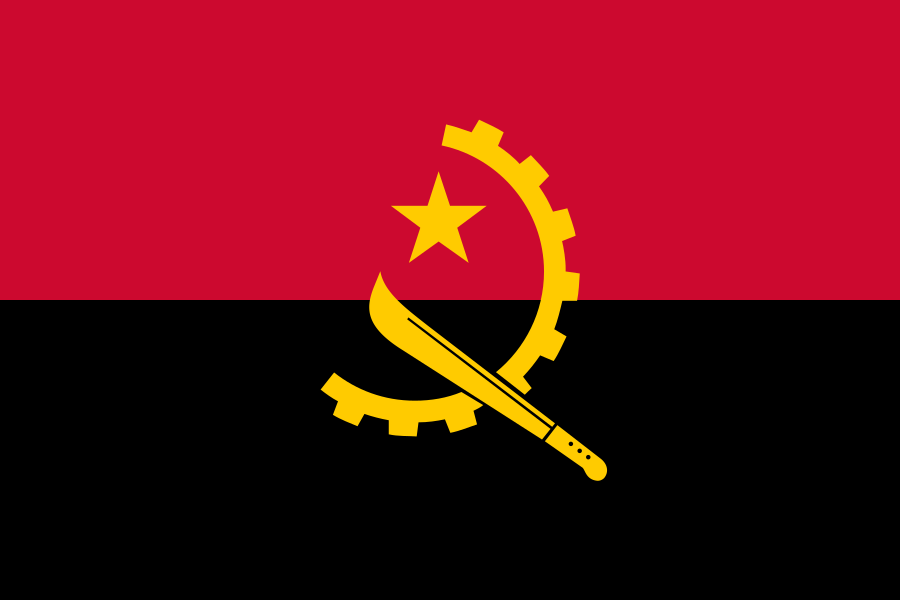
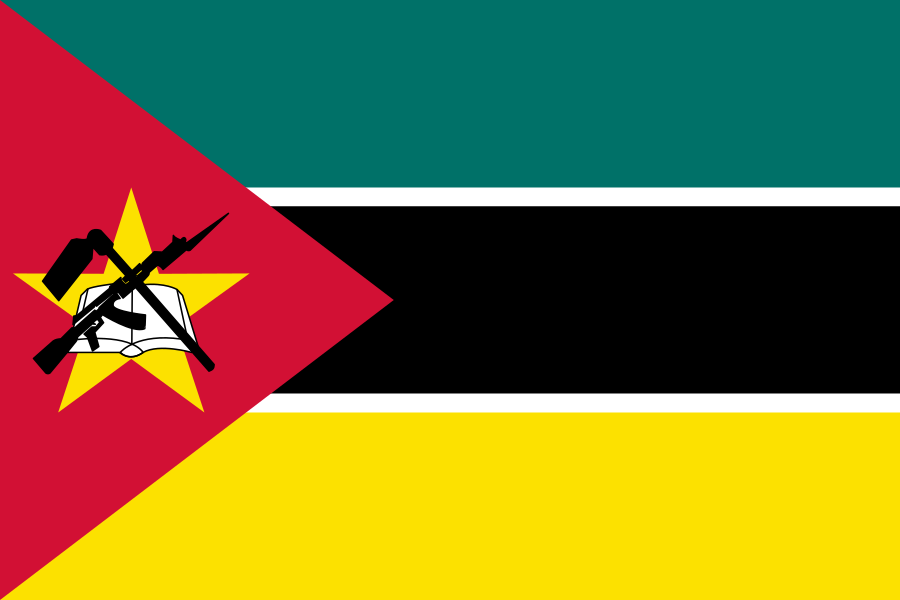
Many symbols having similar structures and messages to the original have been designed. For example, the Angolan flag shows a segment of a cog, crossed by a machete and crowned with a socialist star, while the flag of Mozambique features an AKM crossed by a hoe. In the logo of the Communist Party USA, a circle is formed by a half cog and a semicircular sickle-blade. A hammer is laid directly over the sickle's handle, with the hammer's head at the logo's center. The logo of the Communist Party of Turkey consists of half a cog wheel crossed by a hammer, with a star on the top.
Tools represented in other designs include: the brush, sickle and hammer of the Workers' Party of Korea; the spade, flaming torch and quill used prior to 1984 by the British Labour Party; the pickaxe and rifle used in communist Albania; and the hammer and compasses of the East German emblem and flag. The Far Eastern Republic of Russia used an anchor crossed over a spade or pickaxe, symbolising the union of the fishermen and miners. The Fourth International, founded by Leon Trotsky, uses a hammer and sickle symbol on which the number 4 is superimposed. The hammer and sickle in the Fourth International symbol are the opposite of other hammer and sickle symbols in that the head of the hammer is on the right side and the sickle end tip on the left. The Trotskyist League for the Fifth International merges a hammer with the number 5, using the number's lower arch to form the sickle. A sickle with a rifle is also used by the People's Mojahedin of Iran.
The Communist Party of Britain uses the hammer and dove symbol. Designed in 1988 by Michal Boncza, it is intended to highlight the party's connection to the peace movement. It is usually used in conjunction with the hammer and sickle, and it appears on all of the CPB's publications. Some members of the CPB prefer one symbol over the other, although the party's 1994 congress reaffirmed the hammer and dove's position as the official emblem of the party. Similarly, the Communist Party of Israel uses a dove over the hammer and sickle as its symbol. The flag of the Guadeloupe Communist Party uses a sickle, turned to look like a majuscule G, to represent Guadeloupe.
In 1938, the Dobama Asiayone, an anti-British nationalist group in the then British Burma, adopted a tricolour flag charged with a red sickle and hammer. From 1974–2010, the flag of Burma (Myanmar) featured a bushel of rice superimposed on a cogwheel surrounded by fourteen white stars; the rice representing the peasants and the cogwheel representing the workers, the combination symbolizing that the peasants and workers be the two basic social classes for State building, while the fourteen equal-sized white stars indicate the unity and equality of fourteen member states of the Union.
The flag of Chama Cha Mapinduzi (CCM, Party of the Revolution in Swahili), currently the ruling political party of Tanzania, has a slightly different symbol with a hammer and a hoe (jembe) instead of a sickle to represent the most common farm tool in Africa.
The symbols of the liberal socialist parties of Radical Civic Union in Argentina and the Czech National Social Party in the Czech Republic feature a hammer and a quill, with the former representing workers and the latter representing clerks.
The election symbol of the Communist Party of India consists of a horizontal sickle, vertically crossed by Ears of Corn in the center.
Art
The hammer and sickle has long been a common theme in socialist realism, but it has also seen some depiction in non-Marxist popular culture. Andy Warhol who created many drawings and photographs of the hammer and sickle is the most famous example of this. File:Lenpl_06.jpg|The metro station, Plošča Lienina, Minsk File:BWHammerSickle.jpg|Sándor Pinczehelyi, Hammer and Sickle File:Hammer and Sickle - Kerala.jpg|A tableau in a communist rally in Kerala, India File:Juche-Tower-2014.jpg | "Worker, peasant and the intellectual" in front of the Juche Tower, Pyongyang File:Animalism flag.svg|The Hoof and Horn flag described in the book Animal Farm is a parody of the hammer and sickle.
Legal status
In several countries in the former Eastern Bloc, there are laws that define the hammer and sickle as the symbol of a "totalitarian and criminal ideology" and the public display of the hammer and sickle and other Communist symbols such as the red star is considered a criminal offence. Georgia, Hungary, Latvia, Lithuania, Moldova (1 October 2012 – 4 June 2013) and Ukraine have banned communist symbols including this one. A similar law was considered in Estonia, but it eventually failed in a parliamentary committee. In Ukraine, the legislature equates communist symbols including hammer with sickle to Nazi swastika symbols.
In 2010, the Lithuanian, Latvian, Bulgarian, Hungarian, Romanian, and Czech governments called for the European Union to criminalize "the approval, denial or belittling of communist crimes" similar to how a number of EU member states have banned Holocaust denial. The European Commission turned down this request, finding after a study that the criteria for EU-wide criminal legislation were not met, leaving individual member states to determine the extent to which they wished to handle past totalitarian crimes.
In February 2013, the Constitutional Court of Hungary annulled the ban on the use of symbols of fascist and communist dictatorships, including the hammer and sickle, the red star and the swastika, saying the ban was too broad and imprecise. The court also pointed to a judgement of the European Court of Human Rights in which Hungary was found guilty of violation of article 10, the right to freedom of expression. In June 2013, the Constitutional Court of Moldova ruled that the Moldovan Communist Party's symbols—the hammer and sickle—are legal and can be used.
In Indonesia, the display of communist symbols is banned and the country's Communist party was also banned by decree of president Suharto, following the 1965–1966 killings of communists in which over 500,000 people were killed. In January 2018, an activist protesting against Bumi Resources displayed the hammer and sickle, was accused of spreading communism, and later jailed.
In Poland, dissemination of items which are "media of fascist, communist or other totalitarian symbolism" was criminalized in 1997. However, the Constitutional Tribunal found this sanction to be unconstitutional in 2011.
Usage gallery
Flags
Europe and Russia/Soviet Union
Current
File:KPRF Flag.svg|Flag of the Communist Party of the Russian Federation File:Flag of Communists of Russia.svg|Flag of the Communists of Russia File:Flag of the United Communist Party.svg|Flag of the United Communist Party (Russia) File:Flag of the Russian Communist Workers' Party of the Communist Party of the Soviet Union.svg|Flag of the Russian Communist Workers' Party of the Communist Party of the Soviet Union File:Flag of SERB.svg|Flag of the SERB (Russia) File:Flag of Bryansk Oblast.svg|Flag of Bryansk Oblast (Russia) File:Flag of Vladimirskaya Oblast.svg|Flag of Vladimir Oblast (Russia) File:Flag of Oryol.svg|Flag of Oryol (Russia) File:Flag of Dzerzhinsk (Nizhny Novgorod region).jpg|Flag of Dzerzhinsk (Russia) File:Flag of Transnistria (state).svg|Flag of Transnistria File:KKE Flag.png|Flag of the Communist Party of Greece File:Flag of the Communist Refoundation Party.svg|Flag of the Communist Refoundation Party (Italy) File:Flag of the Communist Party of Ireland.svg|Flag of the Communist Party of Ireland File:Flag of the Portuguese Communist Party.svg|Flag of the Portuguese Communist Party File:MKP-FLAG.svg|Flag of the Maoist Communist Party (Turkey) File:Dhkp.svg|Flag of the Revolutionary People's Liberation Party–Front (Turkey) File:Flag of Communist Party of Britain.svg|Flag of the Communist Party of Britain File:Flag of the Communist Party of Great Britain (Marxist–Leninist).svg|Flag of the Communist Party of Great Britain (Marxist–Leninist)
Former
File:Flag of the Soviet Union (1922–1923).svg|Flag of the Soviet Union from 1922 to November 1923 File:Flag of the Soviet Union (1924).svg|Flag of the Soviet Union from November 1923 to April 1924 File:Flag of the Soviet Union (1924–1936).svg|Flag of the Soviet Union from April 1924 to December 1936 File:Flag of the Soviet Union (1936–1955).svg|alt=|Flag of the Soviet Union from December 1936 to 1955 File:Flag of the Soviet Union.svg|Flag of the Soviet Union from 19 August 1955 to 26 December 1991 File:USSR, Jack and fortress flag of naval fortresses 1964.svg|Naval Jack of the Soviet Union and Russia from 16 November 1950 to 26 July 1992 File:Naval Ensign of the Soviet Union (1950–1991).svg|Naval ensign of the Soviet Union and Russia from 16 November 1950 to 26 July 1992 File:Flag of the Aeroflot.svg|Flag of Aeroflot from 1961 to 1991 File:Flag of the Russian Soviet Federative Socialist Republic (1954–1991).svg|Flag of the Russian SFSR from 1954 to 1991 File:Flag of the Ukrainian Soviet Socialist Republic.svg|Flag of the Ukrainian SSR from 1950 to 1992 File:Flag of the Byelorussian Soviet Socialist Republic (1951–1991).svg|Flag of the Byelorussian SSR from 1951 to 1991 File:Flag of the Uzbek Soviet Socialist Republic (1952–1991).svg|Flag of the Uzbek SSR from 1952 to 1991 File:Flag of the Kazakh Soviet Socialist Republic (1953–1991); Flag of Kazakhstan (1991–1992).svg|Flag of the Kazakh SSR from 1953 to 1992 File:Flag of the Georgian Soviet Socialist Republic (1951–1990).svg|Flag of the Georgian SSR from 1951 to 1990 File:Flag of the Azerbaijan Soviet Socialist Republic (1956–1991).svg|Flag of the Azerbaijani SSR from 1956 to 1991 File:Flag of the Lithuanian Soviet Socialist Republic (1953–1988).svg|Flag of the Lithuanian SSR from 1953 to 1988 File:Flag of the Moldavian Soviet Socialist Republic (1952–1990).svg|Flag of the Moldavian SSR from 1952 to 1990 File:Flag of the Latvian Soviet Socialist Republic (1953–1990).svg|Flag of the Latvian SSR from 1953 to 1990 File:Flag of the Kirghiz Soviet Socialist Republic.svg|Flag of the Kirghiz SSR from 1952 to 1992 File:Flag of the Tajik Soviet Socialist Republic.svg|Flag of the Tajik SSR from 1953 to 1991 File:Flag of the Armenian Soviet Socialist Republic (1952–1990).svg|Flag of the Armenian SSR from 1952 to 1990 File:Flag of the Turkmen Soviet Socialist Republic.svg|Flag of the Turkmen SSR from 1953 to 1992 File:Flag of the Estonian Soviet Socialist Republic (1953–1990).svg|Flag of the Estonian SSR from 1953 to 1990 File:Flag of the Karelo-Finnish SSR.svg|Flag of the Karelo-Finnish SSR from 1953 to 1956 File:Flag of the Communist Party of the Donetsk People's Republic.svg|Flag of the Communist Party of the Donetsk People's Republic File:Flag_of_the_Russian_Decommunization.svg|Flag of the Decommunization (Russia) File:Flag of PCR.svg|Flag of the Romanian Communist Party File:National Bolshevik Party flag.svg|Flag of the National Bolshevik Party File:Flag of the KSC.svg|Flag of Communist Party of Czechoslovakia File:Flag of the Communist Party of Germany.svg|Flag of the Communist Party of Germany File:Flag of the Communist Party of Germany (reverse).svg|Reverse side of the Communist Party of Germany flag File:Flag of East Germany.svg|Flag of East Germany from 1959 to 1990 File:Flag of the Italian Communist Party.svg|Flag of the Italian Communist Party File:Sammarinese Communist Party flag, 1950s.svg|Flag of the Sammarinese Communist Party File:League of Communists of Yugoslavia Flag.svg|Flag of the League of Communists of Yugoslavia
Asia and Oceania except Russia/Soviet Union
Current
File:Flag of the Communist Party of Vietnam.svg|Flag of the Vietnamese Communist Party File:Flag of the Chinese Communist Party.svg|Flag of the Chinese Communist Party File:Taiwan People's Communist Party Flag Updated.png|Flag of the Taiwan People's Communist Party File:Flag of the Workers' Party of Korea.svg|Flag of the Workers' Party of Korea File:CPI-banner.svg|Flag of the Communist Party of India File:CPI-M-flag.svg|Flag of the Communist Party of India (Marxist) File:South Asian Communist Banner.svg|Flag of various South Asian communist parties, including the Communist Party of India (Maoist) File:SUCI flag.svg|Flag of the Socialist Unity Centre of India File:বাংলাদেশ কমিউনিস্ট পার্টির পতাকা.svg|Flag of the Communist Party of Bangladesh File:Communist Party of Bhutan Flag.svg|Flag of the Communist Party of Bhutan (Marxist–Leninist–Maoist) File:Bandeira do Partido Socialista de Timor.png|Flag of the Socialist Party of Timor File:Flag of the Communist Party of the Philippines (alternative II).svg|Flag of the Communist Party of the Philippines File:Flag of LPRP.svg|Flag of the Lao People's Revolutionary Party File:Flag of the Lebanese Communist Party.svg|Flag of the Lebanese Communist Party File:Flag of the Syrian Communist Party (Bakdash).svg|Flag of the Syrian Communist Party (Bakdash) File:Flag of the Jordanian Communist Party.svg|Flag of the Jordanian Communist Party File:Palestinian Communist Party Flag.svg|Flag of the Palestinian Communist Party
Former
File:Flag of the Chinese Communist Party (Pre-1996).svg|Flag of the Chinese Communist Party (before 1996) File:中國工農紅軍軍旗.svg|Flag of Chinese Workers' and Peasants' Red Army File:Flag of the Taiwan Democratic Communist Party.svg|Flag of the Taiwan Democratic Communist Party File:National Flag of Chinese Soviet Republic.svg|Flag of the Chinese Soviet Republic (1931–1937) File:South Asian Communist Banner.svg|Flag of various South Asian communist parties, including the Communist Party of India (Maoist) File:Flag of CMKP.svg|Flag of the Communist Mazdoor Kissan Party File:Flag of the CPN (Unified Socialist).svg|Flag of the Nepal Communist Party File:Flag of the Communist Party of Indonesia.svg|Flag of Communist Party of Indonesia File:Banner of the Communist Party of Kampuchea.svg|Flag of the Communist Party of Kampuchea File:Flag of the Communist Party of Malaya.svg|Flag of the Malayan Communist Party (1930–1989) File:Flag of Kurdistan Workers' Party 1978.svg|Flag of the Kurdistan Workers' Party (1978–1995)
Africa
Current
File:Flag of Angola.svg|Flag of Angola File:Communist Party of Kenya Flag.png|Flag of the Communist Party of Kenya File:Flag of the South African Communist Party.svg|Flag of the South African Communist Party File:CPMK Party Flag.jpg|Flag of the Communist Party Marxist – Kenya File:Communist Party of Swaziland flag.svg|Flag of the Communist Party of Swaziland File:Flag of the People's Republic of the Congo.svg|Flag of the People's Republic of the Congo and the Congolese Party of Labour
Former
File:Flag of Algerian Communist Party.svg|Flag of the Algerian Communist Party File:Flag of FRELIMO (until 2004).svg|Flag of FRELIMO (1987–2004) File:Workers' Party of Ethiopia flag (variant).png|Flag of the Workers' Party of Ethiopia
Americas
Current
File:BANDERA PCCE.png|Flag of the PCCE File:PCB_logo.svg|Flag of the PCB File:PCdoB flag.svg|Flag of the PCdoB File:Bandeira do Partido da Causa Operária, do Brasil.svg|Flag of the Workers' Cause Party (Brazil) File:Flag of the Communist Party of Chile.svg|Flag of the Communist Party of Chile File:Partido comunista-ec.png|Flag of the Communist Party of Ecuador File:Flag of Sendero Luminoso.svg|Flag of the Shining Path (Peru) File:Communist Party USA Flag.svg|Flag of the Communist Party USA File:Pcrcolor 0.svg|Flag of the Revolutionary Communist Party (Argentina)
State emblems
Soviet Union (in the constitutional order) ====
File:State Emblem of the Soviet Union.svg|State emblem of the Union of Soviet Socialist Republics File:Emblem of the Russian SFSR.svg|Emblem of the Russian Soviet Federative Socialist Republic File:Coat of arms of the Russian Federation (1992-1993).svg|Emblem of the Russian Federation (1992‒1993) File:Emblem of the Ukrainian SSR.svg|Emblem of the Ukrainian Soviet Socialist Republic File:Emblem of the Byelorussian SSR (1981-1991).svg|Emblem of the Byelorussian Soviet Socialist Republic File:Emblem of the Uzbek SSR.svg|Emblem of the Uzbek Soviet Socialist Republic File:Emblem of Kazakh SSR.svg|Emblem of the Kazakh Soviet Socialist Republic File:Emblem of the Georgian SSR.svg|Emblem of the Georgian Soviet Socialist Republic File:Emblem of the Azerbaijan Soviet Socialist Republic (1978–1991), Emblem of Azerbaijan (1991–1993).svg|Emblem of the Azerbaijan Soviet Socialist Republic File:Emblem of the Lithuanian SSR.svg|Emblem of the Lithuanian Soviet Socialist Republic File:Emblem of the Moldavian SSR (1981-1990).svg|Emblem of the Moldavian Soviet Socialist Republic File:Emblem of the Latvian SSR.svg|Emblem of the Latvian Soviet Socialist Republic File:Emblem of the Kirghiz SSR.svg|Emblem of the Kirghiz Soviet Socialist Republic File:Emblem of the Tajik SSR.svg|Emblem of the Tajik Soviet Socialist Republic File:Emblem of the Turkmen SSR.svg|Emblem of the Turkmen Soviet Socialist Republic File:Emblem of the Estonian SSR.svg|Emblem of the Estonian Soviet Socialist Republic File:Emblem of the Transcaucasian SFSR (1930-1936).svg|Emblem of the Transcaucasian Socialist Federative Soviet Republic (1923‒1936) File:Emblem of the Karelo-Finnish SSR.svg|Emblem of the Karelo-Finnish Soviet Socialist Republic (1941‒1956) File:Emblem of the Armenian SSR.png|Emblem of the Armenian Soviet Socialist Republic
Other
Current
File:Coat of arms of Transnistria.svg|Emblem of the self-proclaimed Pridnestrovian Moldavian Republic File:Emblem of Angola.svg|Emblem of Angola File:Coat of Arms of Bryansk Oblast.svg|Coat of arms of Bryansk Oblast, Russia
Former
File:Coat of arms of East Germany (1955–1990).svg|National emblem of the German Democratic Republic (1955–1990) File:Emblem of the Tuvan People's Republic (1943-1944).svg|State emblem of the Tuvan People's Republic (1943‒1944) File:Emblem of Laos 1975-1991.svg|State emblem of the Lao People's Democratic Republic (1975‒1991) File:Coat of arms of the People's Republic of the Congo.svg|Emblem of the People's Republic of the Congo (1970–1991) File:National Emblem of the Chinese Soviet Republic.svg|State emblem of the Chinese Soviet Republic (1934–1937) File:Coa Hungary Country History (1949-1956).svg|Emblem of Hungarian People's Republic (1949–1956) File:Coat of Arms of Moscow (Soviet).svg|Emblem of Moscow (1924–1937)
Logos
Europe
Current File:KPRF Logo.svg|Logo of the Communist Party of the Russian Federation File:Logo of the Communist Party of Greece.svg|Logo of the Communist Party of Greece File:Logo of the Communist Party (Italy).svg|Logo of the Communist Party (Italy) File:Pce 2014.svg|Logo of the Communist Party of Spain File:Portuguese Communist Party logo.svg|Logo of the Portuguese Communist Party File:Communist Party of Ireland.svg|Logo of the Communist Party of Ireland File:Logo of the Communist Party of Britain.svg|Logo of the Communist Party of Britain File:CPGB hi res.png|Logo of the Communist Party of Great Britain (Provisional Central Committee) File:SKP 2024 Logo.png|Logo of the Communist Party of Sweden (1995) File:Norwegian Communist Party.svg|The Logo of the Communist Party of Norway File:DKP logo.svg|Logo of the Communist Party of Denmark File:Logo of Communist Party (Denmark).svg|Logo of the Communist Party (Denmark) File:Partito Comunista (Svizzera).tif|Logo of the Communist Party (Switzerland) File:Logo - Nieuwe Communistische Partij van Nederland (2022).svg|Logo of the New Communist Party of the Netherlands File:PCB-CPB logo.jpg|Logo of the Communist Party of Belgium (1989) File:MLKP Badge.svg|Badge of the Marxist–Leninist Communist Party of Turkey File:TDKP Logo.svg|Logo of the Revolutionary Communist Party of Turkey File:Aeroflot.svg|Logo of Aeroflot
Former
File:Hammer and Sickle and Star.svg|The hammer and sickle symbol used with the red star used as a symbol of Soviet Union. File:КПСС.svg|Badge of the Communist Party of the Soviet Union File:Emblem of the Communist Party of Czechoslovakia.svg|Emblem of the Communist Party of Czechoslovakia File:Coat of arms of PCR.svg|Emblem of the Romanian Communist Party File:LogoBKP.svg|Logo of the Bulgarian Communist Party File:Compass and Hammer.svg|Compass and hammer of East Germany. File:Hammer und Ähre.svg|Hammer and grain of the Hungarian People's Republic File:Emblem of the SKJ.svg|Emblem of the League of Communists of Yugoslavia File:Logo Partito Comunista Italiano.svg|Logo of the Italian Communist Party File:Partito di Unità Proletaria logo.svg|Logo of the Proletarian Unity Party (Italy) File:PCPE.svg|Logo of the Communist Party of the Peoples of Spain File:Logo du Parti communiste français.png|Logo of the French Communist Party (1980‒1996) File:KPD-logo.svg|Logo of the Communist Party of Germany File:Communist Party of Ireland (Marxist-Leninist) Emblem.png|Logo of the Communist Party of Ireland (Marxist–Leninist) File:Group of Social Revolutionary Nationalists.svg|Symbol of the Group of Social Revolutionary Nationalists
Asia
Current
File:WPK symbol.svg|Emblem of the Workers' Party of Korea File:LogoKPT.svg|Logo of the Communist Party of Tajikistan File:Socialist Party of Bangladesh Official Logo.png|Logo of the Socialist Party of Bangladesh File:Communist Party of Vietnam flag logo.svg|Emblem of the Communist Party of Vietnam File:Emblem of Vietnam Communist Party.svg|Alternative emblem of the Communist Party of Vietnam File:MSS globe logo.png|Logo of the Ministry of State Security File:Danghui.svg|Emblem of the Chinese Communist Party (1996–present) File:LankaSamaSamajaLogo.png|Logo of the Lanka Sama Samaja Party, which features the symbol of the Fourth International File:CPI symbol.svg|Logo of the Communist Party of India File:Cpm election symbol.svg|Logo of the Communist Party of India (Marxist)
Former
File:Logo of the Communist Party of Indonesia.svg|Emblem of the Communist Party of Indonesia (1914‒1966) File:Logo of the Acoma Party.svg|Logo of the Acoma Party (Indonesia) File:CPN-UML.svg|Logo of the Communist Party of Nepal (Unified Marxist–Leninist) (1991–2018) File:Danghui (pre-1996).svg|Emblem of the Chinese Communist Party (1942–1996) File:Emblem of the Yemeni Socialist Party (1978‐1990).svg|Emblem of the Yemeni Socialist Party (1978-1990)
Africa
Current
File:Cog and Machete.svg|Logo of the People's Movement for the Liberation of Angola File:PCBeninlogo.svg|Logo of the Communist Party of Benin File:Roundel of Congo 1970.svg|Logo of the Congolese Party of Labour File:Egyptian Communist Party logo.svg|Logo of the Egyptian Communist Party File:Meison.jpg|Emblem of the All-Ethiopia Socialist Movement File:PCCote-d-Ivoire.svg|Hammer and machete logo of the Revolutionary Communist Party of Ivory Coast File:Communist Party of Kenya logo.png|Logo of the Communist Party of Kenya File:Emblem of the South African Communist Party.svg|Logo of the South African Communist Party File:Parti des travailleurs (Tunisie).svg|Logo of the Workers' Party of Tunisia
Former
File:Workers' Party of Ethiopia Logo.png|Flag of the Workers' Party of Ethiopia File:Logo of the Ethiopian Peoples Revolutionary Party.svg|Emblem of the Ethiopian People's Revolutionary Party (ca. 1975) File:FRELIMO Emblem.svg|Logo of FRELIMO (Mozambique) (1987–2004) File:Emblem of Somali Revolutionary Socialist Party.svg|Emblem of the Somali Revolutionary Socialist Party File:Parti des travailleurs (Tunisie).svg|Logo of the Workers' Party of Tunisia
Americas
Current
File:Escudo del Partido Comunista Argentino.svg|Logo of the Communist Party of Argentina File:Logo of the Communist Party of Argentina (Extraordinary Congress).svg|Logo of the Communist Party of Argentina (Extraordinary Congress) File:PCB logo.svg|Logo of the Brazilian Communist Party File:PCdoB logo.svg|Logo of the Communist Party of Brazil File:Logo PCO Institucional.svg|Logo of the Workers' Cause Party File:Partido Comunista de Chile.svg|Logo of the Communist Party of Chile File:Logo del Partido Comunista del Ecuador.svg|Logo of the Communist Party of Ecuador File:PCP paraguay.jpg|Logo of the Paraguayan Communist Party File:Shining Path Hammer and Sickle.svg|Logo of the Shining Path File:Logo_of_the_Militarized_Communist_Party_of_Peru.svg|Logo of the Militarized Communist Party of Peru File:CPUSA.svg|Logo of the Communist Party USA File:CPUSA logo.svg|Logo of the American Communist Party
Former
File:Emblema PCM Mexico.svg|Logo of the Mexican Communist Party
Unicode
In Unicode, the "hammer and sickle" symbol is U+262D (☭). It is part of the Miscellaneous Symbols (2600–26FF) code block. It was added to Unicode 1.1 in 1993.
References
References
- "Flag of Union of Soviet Socialist Republics".
- "20 Centavos 1895".
- "Chilean peso example, 1927".
- (1957-03-18). "АртРу.инфо - Художники - Камзолкин Евгений Иванович".
- "International Gallery of Contemporary Artists".
- "The Hammer and Sickle: The Role of Symbolism and Rituals in the Russian Revolution".
- (1997). "Critical companion to the Russian Revolution, 1914-1921". Indiana University Press.
- Lempert, David. (1996). "Daily Life in a Crumbling Empire: The Absorption of Russia into the World Economy". Columbia University Press/ Eastern European Monographs.
- (2018-09-01). "De unde vine simbolul "secera şi ciocanul". Ce ţară l-a folosit prima şi în ce state este interzis". Adevarul Holding.
- (May 13, 2020). "Hammer and Sickle on Flags and State Emblems".
- (April 18, 2003). "Aeroflot Logo To Keep Hammer And Sickle".
- Potter, Benjamin. (2022). "Unrecognized Republic, Recognizable Consequences". [[Marine Corps University Press]].
- "KKE - Αρχική". kke.gr.
- (17 March 2010). "Estatutos do PCP, art. 72". pcp.pt/estatutos-do-pcp.
- TM. (2019-06-17). "Turkey's communist party to boycott İstanbul election".
- "Parti Communiste Guadeloupéen". flagspot.net.
- Khin Yi. (1988). "The Dobama Movement in Burma (1930-1938)". Cornell University Press.
- . (2006). ["မြန်မာဖတ်စာ ဒုတိယတန်း (Grade-3)"](http://www.myanmarbookshop.com/MyanmarBooks/BookDetails/7116). *Ministry of Education, Government of the Union of Myanmar*.
- (4 May 2014). "Communist symbols to be banned in Georgia". [[BBC News]].
- "Act C of 2012 on the Criminal Code, Section 335: Use of Symbols of Totalitarianism".
- (21 June 2013). "Latvia Bans Soviet, Nazi Symbols". RIA Novosti.
- (17 June 2008). "Lithuanian ban on Soviet symbols". [[BBC News]].
- (12 July 2012). "Moldovan Parliament Bans Communist Symbols". [[Radio Free Europe]].
- "Ukraine Bans Soviet-Era Symbols". [[The Wall Street Journal]].
- "LAW OF UKRAINE. On the condemnation of the communist and national socialist (Nazi) regimes, and prohibition of propaganda of their symbols".
- "Про засудження комуністичного та націонал-соціалістичного ... - від 09.04.2015 № 317-VIII". rada.gov.ua.
- "Free speech questioned as Estonia prepares to ban Soviet, Nazi symbols".
- "Ants Erm: Erinevalt venelaste ajaloost on Venemaa ajalugu Eestis vaid vägivald, küüditamine ja kommunistlik diktatuur".
- "У поліції нагадали, що за серп і молот можна сісти на 5 років".
- Bobkov, Denys. (7 May 2021). "Заборона символіки тоталітарних режимів: що мають знати миколаївці".
- [https://www.bbc.com/news/world-europe-12059475 EU won't legislate on communist crimes], BBC News (22 December 2010).
- (27 February 2013). "Hungary, hammer and sickle ban declared illegal". [[Agenzia Nazionale Stampa Associata.
- (5 June 2013). "Constitutional Court rules that 'hammer and sickle' can be used". allmoldova.com.
- (2017-10-29). "Declassified files outline US support for 1965 Indonesia massacre".
- Dickie Christanto. (20 October 2008). "Artists summoned over communist symbol exhibition". [[The Jakarta Post]].
- "Indonesian activist jailed for advocating communism".
- (2018-01-12). "Indonesia's 'Anti-Communism' Law Used Against Environmental Activist".
- (19 July 2011). "Nowelizacja kodeksu karnego.".
- "☭ Hammer and Sickle Emoji".
This article was imported from Wikipedia and is available under the Creative Commons Attribution-ShareAlike 4.0 License. Content has been adapted to SurfDoc format. Original contributors can be found on the article history page.
Ask Mako anything about Hammer and sickle — get instant answers, deeper analysis, and related topics.
Research with MakoFree with your Surf account
Create a free account to save articles, ask Mako questions, and organize your research.
Sign up freeThis content may have been generated or modified by AI. CloudSurf Software LLC is not responsible for the accuracy, completeness, or reliability of AI-generated content. Always verify important information from primary sources.
Report