From Surf Wiki (app.surf) — the open knowledge base
Hamat Gader
Site of hot springs near the Yarmuk River

Site of hot springs near the Yarmuk River
| Field | Value |
|---|---|
| name | Hammat Gader |
| native_name | חמת גדר |
| image | File:Hot springs in Hamat Gader.jpg |
| caption | Modern hot springs-fed pools |
| map_size | 100 |
| map_type | Israel |
| coordinates | |
| location | Israel |
| region | Northern District |
Hamat Gader (; , arc; , grc or ῎Αμαθα, grc; ar) is a hot springs site in the Yarmuk River valley, located in an area under Israeli control, near the Golan Heights and the border with Jordan. It contains a spa, modern and ancient baths, a crocodilians farm and a zoo.
Hamat Gader, known for its health benefits and recreation since classical antiquity, was mentioned in several historical texts. Built by the Romans in the 2nd century, the site featured a bath complex and a theater. An ancient synagogue, complete with mosaics and inscriptions, also stood within its walls. Despite earthquakes damaging the site in the 7th and 8th centuries, it continued to attract visitors until abandonment in the 9th century, eventually becoming buried beneath silt.
It is set on several mineral springs with temperatures up to 50 °C.
Geography
The site is located in what was a demilitarized zone between Israel and Syria from 1949 to 1967. The site is next to the Jordanian border, and about 10 km from the tripoint of Israel, Jordan and Syria.
Etymology
The ancient Hebrew name, Hammat Gader or Hammath Gader, means hot springs of Gader, also translated as Hammath-by-Gadara. The ruins of the ancient city of Gadara stand south of Hammat Gader, on the plateau edge above the springs, in modern Umm Qais.
The Arabic name Al-Hammeh or El-Hamma dates back to the medieval period and also relates to "hot springs". The name of the tell located near the site, Tell Bani, is a corruption of the Latin word meaning "baths".
History
Roman, Byzantine and Umayyad periods

Hamat Gader was already a widely known health and recreation site in Roman times. It is mentioned in Strabo, Origen and Eunapius, as well as the Rabbinic literature of the first centuries CE.
Construction of the bath complex began in the 2nd century by the 10th Roman Legion, which was garrisoned in the city of Gadara. Two distinct construction periods are evident at the site: The Roman-Byzantine Period, during which most of the bath complex was built, and the Muslim period, during which major changes were made to the existing structures.
The site includes a Roman theatre, which was built in the 3rd century CE and contained 2,000 seats.[[File:Hammat Gader.JPG|thumb|right|250px|A section of the mosaic pavement recovered from the ancient Hamat Gader synagogue, now installed in the entrance hall of the [[Supreme Court of Israel]].]]A large synagogue was built in the 5th century CE. The synagogue complex is enclosed by a 32.5-meter-long wall and oriented southwards towards Jerusalem. The main prayer hall, nearly square at 13 meters per side, boasted two rows of columns, an apse, and a bema set into the southern wall. Adorned with a mosaic floor, the hall retained four well-preserved Aramaic inscriptions, while damaged sections bore inscriptions detailing donations from various locales. Sukenik's 1932 excavation uncovered the main structure along with the Aramaic mosaic inscriptions and a Greek inscription from the chancel screen. Subsequent analysis by G. Foerster in 1982 shed light on earlier phases of construction.
The empress Aelia Eudocia composed a poem praising the qualities of the multiple springs which was inscribed so that visitors could see it as they went into the pool.
Some of the buildings including the famous thermae were damaged by an earthquake and restored in 663 by the first Umayyad caliph Mu'awiyah who ruled from Damascus. A century later the 749 Galilee earthquake hit. Eventually, in the 9th century, the baths were abandoned and a thick layer of silt covered the ruins.
Mandate period
The border between the Mandatory Palestine and the French Mandate for Syria and the Lebanon was drawn in 1923, and Al-Hamma was included in Palestine.
Before 1949, the Palestinian Arab village Al-Hamma was located at this site. At the time of the 1931 census, it had 46 occupied houses and a population of 170 Muslims, 1 Jew and 1 Christian.
Syrian control
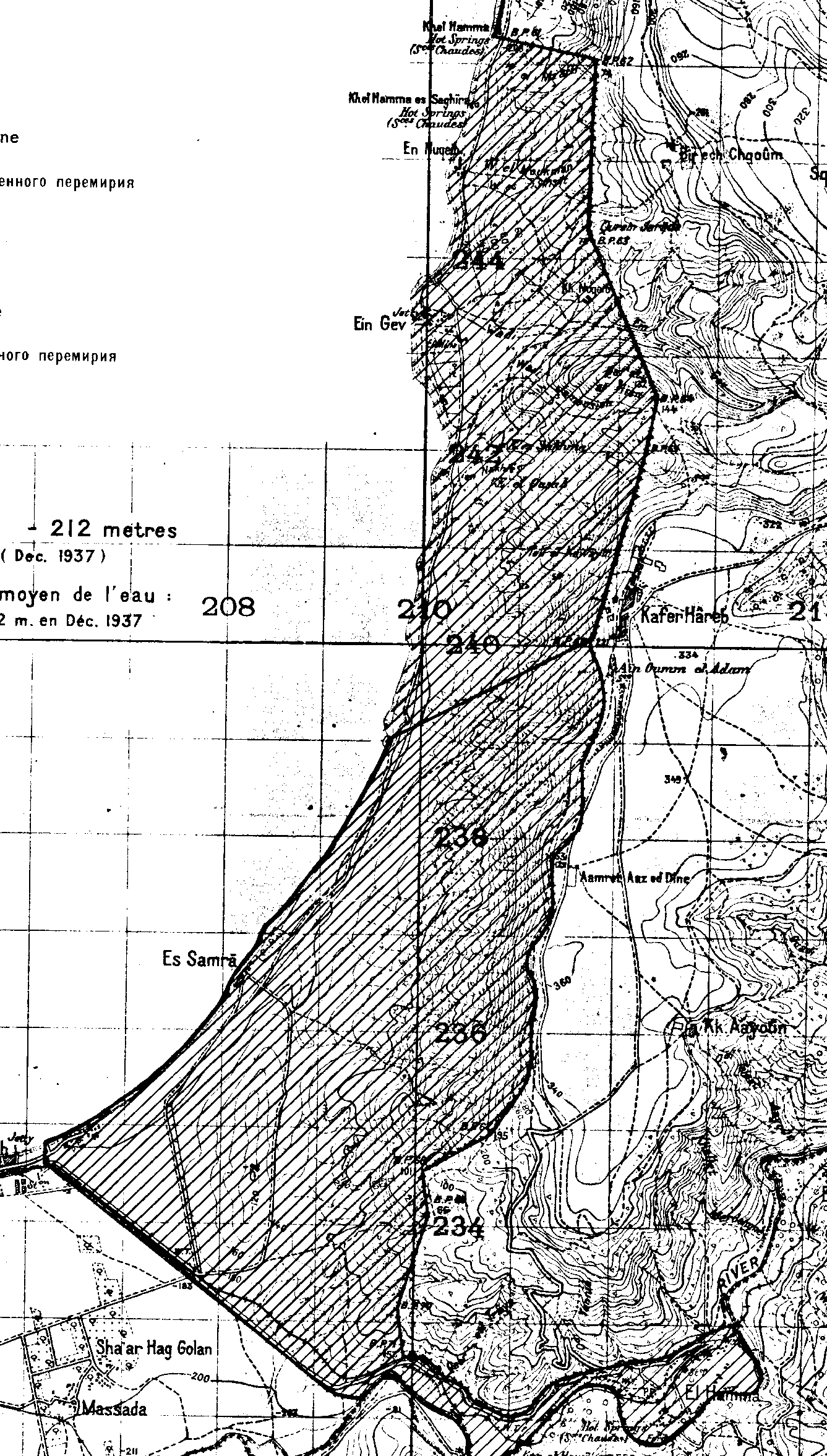
After the 1948 Arab–Israeli War, according to the armistice agreements of 1949 Between Israel and Syria, it was determined that the area would be included in the demilitarized zone (DMZ) between Israel and Syria. The villagers and their property were formally protected by Article V of the Israeli-Syrian agreement of 20 July that year. However, Israel thought the Arab villagers could pose a security threat, and Israeli settlers and settlement agencies coveted the land. Israel therefore wanted the Palestinian inhabitants, a total of 2,200 people, moved to Syria.
On April 4, 1951, a two-vehicle military patrol set out for Hamat Gader in order to assert Israeli sovereignty over the site, over the objections from the Northern Command that Syria was likely to attack it. Since military forces were not permitted in the DMZ, members of the patrol were disguised as policemen. As predicted, the Syrians attacked the patrol and seven Israeli soldiers were killed. In retaliation, Israel bombed the Syrian police station at al Hamma and another Syrian position, killing two women, and demolished the empty houses in Kirad al-Ghannama, Kirad al-Baqqara, Al-Samra and Nuqeib in order to render the DMZ "clear of Arabs".
Israeli control
Israeli control over Hamat Gader was secured during the Six-Day War in 1967, when the Israeli army occupied the surrounding Golan Heights, allowing free access to Hamat Gader for Israelis. Since then, it has been under Israeli control and has been developed as a tourist attraction, health resort and an alligator and exotic bird reserve. The health resort opened in 1977.
Today, Hamat Gader also includes a crocodilian farm with crocodiles, alligators and even caimans and gavials. It has about 200 crocodilians and it is the largest crocodile farm in the Middle East.
Tourist site

The Hamat Gader tourist site is centered around thermal baths and a crocodile farm. The water of the thermal baths contains sulfur at a concentration of 4.7%, which may have a therapeutic effect on skin diseases, asthma, rheumatism and wrist pain, as well as renew skin cells.
References
References
- Brown, J., E. Meyers, R. Talbert, T. Elliott, S. Gillies. (30 January 2019). "Places: 678131 (Emmatha)". Pleiades.
- [https://www.nytimes.com/1997/08/26/world/israel-to-build-dam-on-disputed-land-claimed-by-syria.html Israel to build dam on disputed land claimed by Syria] New York Times, 26 August 1997
- (2001). "Hamath Gader". Continuum.
- May, Herbert Gordon. (February 1944). "Synagogues in Palestine". The [[University of Chicago Press]] for the [[American Schools of Oriental Research]] (BASOR).
- Levin, Gabriel. (2013). "The Dune's Twisted Edge: Journeys in the Levant". [[University of Chicago Press]].
- (1987). "The History and Town-Plan of Ancient Ḥammat Gādẹ̄r". Zeitschrift des Deutschen Palästina-Vereins.
- ''Geog''. XVI, 45.
- Commentary on St. John, VI, 41, 210
- ''Vit. Soph.'' 368-370. {{cite encyclopedia. Zvi Uri. Ma'oz. (1997)
- link. (2006-02-12)
- (2023-03-20). "CXXXIV. Hammatha (Emmatha, Ḥammat Gader, el-Ḥamme) nos. 7371-7497". De Gruyter.
- [[Eleazar Sukenik]], "The ancient synagogue at Hamat Gader" (in Qobes, [[Jewish Palestine Exploration Society]], 1934), pp. 41-61
- (1981). "The Roman Thermae at Ḥammat Gader: Preliminary Report of Three Seasons of Excavations". Israel Exploration Journal.
- [http://www.jewishvirtuallibrary.org/jsource/Peace/67line.html "''The Line of June 4, 1967''", Frederic C. Hof, Jewish Virtual Library]
- (1932). "Census of Palestine 1931. Population of Villages, Towns and Administrative Areas". Government of Palestine.
- [https://unispal.un.org/UNISPAL.NSF/0/E845CA0B92BE4E3485256442007901CC UN Doc S/1353] {{webarchive. link. (2011-07-26 Syria Israel Armistice Agreement of 20 July 1949)
- Morris, Benny. (2004). "The Birth of the Palestinian Refugee Problem Revisited". Cambridge University Press.
- Benny Morris. (1993). "Israel's Border Wars, 1949–1956". Oxford University Press.
- [https://web.archive.org/web/20060212230801/http://www.hamat-gader.com/hamatInfo.php?subjId=todayProfile&linkOrder=9&subLink=20 Hamat Gader in the 20th Century]
This article was imported from Wikipedia and is available under the Creative Commons Attribution-ShareAlike 4.0 License. Content has been adapted to SurfDoc format. Original contributors can be found on the article history page.
Ask Mako anything about Hamat Gader — get instant answers, deeper analysis, and related topics.
Research with MakoFree with your Surf account
Create a free account to save articles, ask Mako questions, and organize your research.
Sign up freeThis content may have been generated or modified by AI. CloudSurf Software LLC is not responsible for the accuracy, completeness, or reliability of AI-generated content. Always verify important information from primary sources.
Report