From Surf Wiki (app.surf) — the open knowledge base
Halasana
Inverted posture in hatha yoga
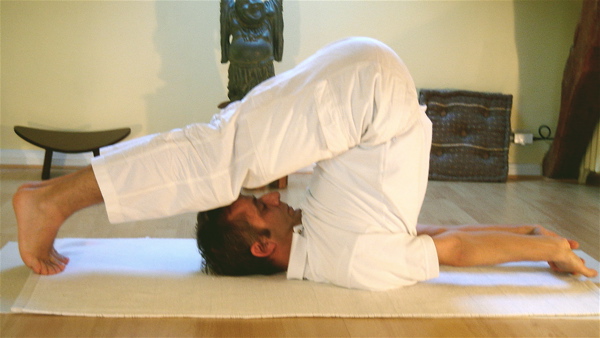
Inverted posture in hatha yoga
Halasana (; ) or Plough pose is an inverted asana in hatha yoga and modern yoga as exercise. Its variations include Karnapidasana with the knees by the ears, and Supta Konasana with the feet wide apart.
Etymology and origins
The name Halasana comes from Sanskrit हला hala, "plough" and आसन āsana, "posture" or "seat". The pose is described and illustrated in the 19th century Sritattvanidhi as Lāṇgalāsana, which also means plough pose in Sanskrit.
Karnapidasana is not found in the medieval hatha yoga texts. It is described independently in Swami Vishnudevananda's 1960 Complete Illustrated Book of Yoga in the Sivananda Yoga tradition, and by B. K. S. Iyengar in his 1966 Light on Yoga, implying that it may have older origins. The name comes from the Sanskrit words karṇa (कर्ण) meaning "ears", pīḍ (पीड्) meaning "to squeeze", and āsana (आसन) meaning "posture" or "seat".
File:Arair champige a reil.png|The completed pose resembles a traditional plough. File:Sritattvanidhi Lalangasana.jpg|Lāṇgalāsana in the Sritattvanidhi from the Mysore Palace, before 1868 File:Marguerite Agniel posing with her back arched and legs stret Wellcome V0048584.jpg|The health and beauty guru Marguerite Agniel in plough pose, c. 1928. Photograph by John de Mirjian
Description
The pose is entered from Sarvangasana (shoulderstand), lowering the back slightly for balance, and moving the arms and legs over the head until the outstretched toes touch the ground and the fingertips, in a preparatory variant of the pose. The arms may then be moved to support the back into a more vertical position, giving a second variant pose. Finally, the arms may be stretched out on the ground away from the feet, giving the final pose in the shape of a traditional plough.
Variations
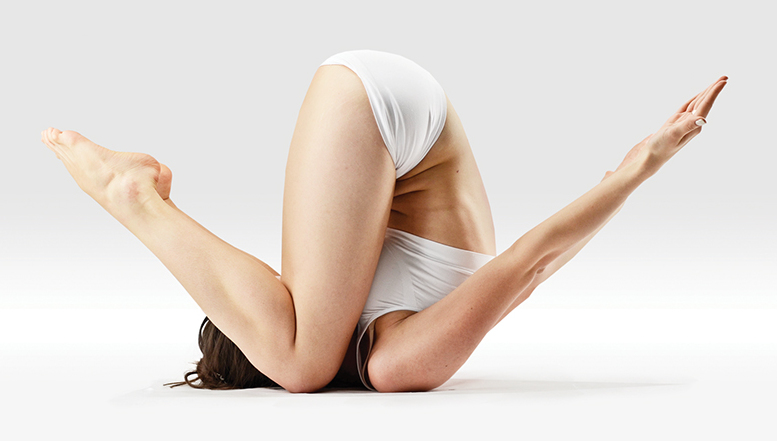
Karnapidasana (ear-pressing pose) or Raja Halasana (royal plough pose) has the knees bent close to the head and grasped by the arms.
Parsva Halasana (sideways plough) has the body vertical, the trunk twisted to one side, and legs out straight with the feet touching the ground (to that side).
Supta Konasana (supine angle pose) has the legs as wide apart as possible, the toes on the ground, like an inverted Upavistha Konasana; the fingertips may grasp the big toes.
All these variations may be performed as part of a cycle starting from Sarvangasana (Shoulderstand).
References
Sources
References
- Anon. (28 August 2007). "Plough Pose". [[Yoga Journal]].
- Sivananda Saraswati. (June 1985). "Health and hatha yoga". Divine Life Society.
- Sinha, S. C.. (1996). "Dictionary of Philosophy". Anmol Publications.
- (February 1983). "Halasana". [[Yoga Journal]].
- Robin, Mel. (May 2002). "A Physiological Handbook for Teachers of Yogasana". Wheatmark.
- Robin, Mel. (2009). "A Handbook for Yogasana Teachers: The Incorporation of Neuroscience, Physiology, and Anatomy Into the Practice". Wheatmark.
- "Supta Konasana". Yogapedia.
This article was imported from Wikipedia and is available under the Creative Commons Attribution-ShareAlike 4.0 License. Content has been adapted to SurfDoc format. Original contributors can be found on the article history page.
Ask Mako anything about Halasana — get instant answers, deeper analysis, and related topics.
Research with MakoFree with your Surf account
Create a free account to save articles, ask Mako questions, and organize your research.
Sign up freeThis content may have been generated or modified by AI. CloudSurf Software LLC is not responsible for the accuracy, completeness, or reliability of AI-generated content. Always verify important information from primary sources.
Report