From Surf Wiki (app.surf) — the open knowledge base
Hakata-ku, Fukuoka
| Field | Value |
|---|---|
| name | Hakata |
| official_name | Hakata Ward |
| native_name | 博多区 |
| native_name_lang | ja |
| settlement_type | Ward |
| image_skyline | Hakata Port 01.jpg |
| image_caption | Hakata Port |
| image_flag | Flag of Hakata, Fukuoka.svg |
| image_seal | Emblem of Hakata, Fukuoka.svg |
| image_map | Fukuoka City hakata-ward.png |
| map_caption | Location of Hakata-ku in Fukuoka |
| pushpin_map | Japan |
| pushpin_label_position | |
| pushpin_map_caption | |
| coordinates | |
| coor_pinpoint | |
| coordinates_footnotes | tags -- |
| subdivision_type | Country |
| subdivision_name | Japan |
| subdivision_type1 | Region |
| subdivision_name1 | Kyushu |
| subdivision_type2 | Prefecture |
| subdivision_name2 | Fukuoka Prefecture |
| subdivision_type3 | City |
| subdivision_name3 | Fukuoka |
| established_title | |
| seat_type | |
| government_footnotes | tags -- |
| leader_name1 | |
| total_type | |
| unit_pref | |
| area_magnitude | |
| area_footnotes | tags -- |
| area_total_km2 | 31.47 |
| elevation_footnotes | tags -- |
| population_footnotes | tags -- |
| population_total | 228,000 |
| population_as_of | March 1, 2016 |
| population_density_km2 | 7200 |
| population_demonym | |
| timezone1 | Japan Standard Time |
| utc_offset1 | +9 |
| area_code_type | |
| blank_name_sec1 | City Symbols |
| blank1_name_sec1 | - Tree |
| blank2_name_sec1 | - Flower |
| blank3_name_sec1 | - Bird |
| blank_name_sec2 | Phone number |
| blank_info_sec2 | 092-441-2131 |
| blank1_name_sec2 | Address |
| blank1_info_sec2 | 2-9-3 Hakata Ekimae, Hakata-ku Fukuoka-shi, Fukuoka-ken 812-8512 |
Hakata-ku is a ward of the city of Fukuoka in Fukuoka Prefecture, Japan.
Many of Fukuoka Prefecture and Fukuoka City's principal government, commercial, retail and entertainment establishments are located in the district. Hakata-ku is also the location of Fukuoka's main train station, Hakata Station, Fukuoka Airport and the Hakata Port international passenger ship terminal.
Geography
Hakata-ku is a ward of Fukuoka City located on its eastern edge. It covers an area of 31.47 km2 with a population of 206,629 (as of January 1, 2009). Much of the ward consists of low-lying plains beside the Mikasa River. The northwestern end of the ward faces Hakata Bay, which includes both ferry and international cruise ship terminals Hakata Harbor. The northeast end of the ward is slightly elevated, and is named Higashihirao, with nearby Fukuoka Airport. Around Hakata Station is downtown; Nakasu is the main dining and entertainment district of the ward along the Naka River. Hakata-ku also houses the Fukuoka Prefectural office.
Economy
Many Japanese companies have established branch offices in Hakata-ku due to its ease of access to local government offices as well transportation hubs such as Hakata Station and Fukuoka Airport. The headquarters of JR Kyūshū, Best Denki, and many other companies are in the ward.
Air Next, a subsidiary of All Nippon Airways, is headquartered on the grounds of Fukuoka Airport in Hakata-ku. Link Airs has its headquarters in the Fukuoka Gion Daiichi Seimei Building (福岡祇園第一生命ビル Fukuoka Gion Daiichi Seimei Biru) in Hakata-ku. Cisco has an Asia-Pacific sales office on the 12th floor of the Fukuoka Gion Daiichi Seimei Building.
Prior to its dissolution, Harlequin Air was headquartered on the grounds of the airport in Hakata-ku.
Hakata's economy was significantly transformed in 1996 with the opening of Canal City Hakata, an award-winning destination shopping and entertainment center.
Cruise ship tourism
From the early 2010s Hakata became the beneficiary of significant growth in cruise ship tourism; particularly with visitors from China.
In 2014, 91 cruise ships travelled from China called at Hakata. In 2015, 245 cruise ship calls were made at Hakata Port. After expansion and redevelopment of the port facilities, the number of cruise ship port calls in 2016 is expected to exceed 400. As of 2015, the largest passenger vessel making regular port calls at Hakata is Royal Caribbean International's MS Quantum of the Seas.
Partly as a result of growing international tourism, in 2015 Fukuoka reported the fastest rising tax revenues and population in Japan.
History
Hakata is one of the oldest cities in Japan. In the Middle Ages, Hakata which faces onto the Genkai-Nada Channel (玄界灘) dividing Japan from Korea, was a base for merchants who traded with China and Korea, and the city housed Japan's first Chinatown. Taira no Kiyomori is said to have built the artificial harbor Sode-no-minato (袖の湊) to increase commerce. Hakata was burned down by many wars, including the Mongol invasions.
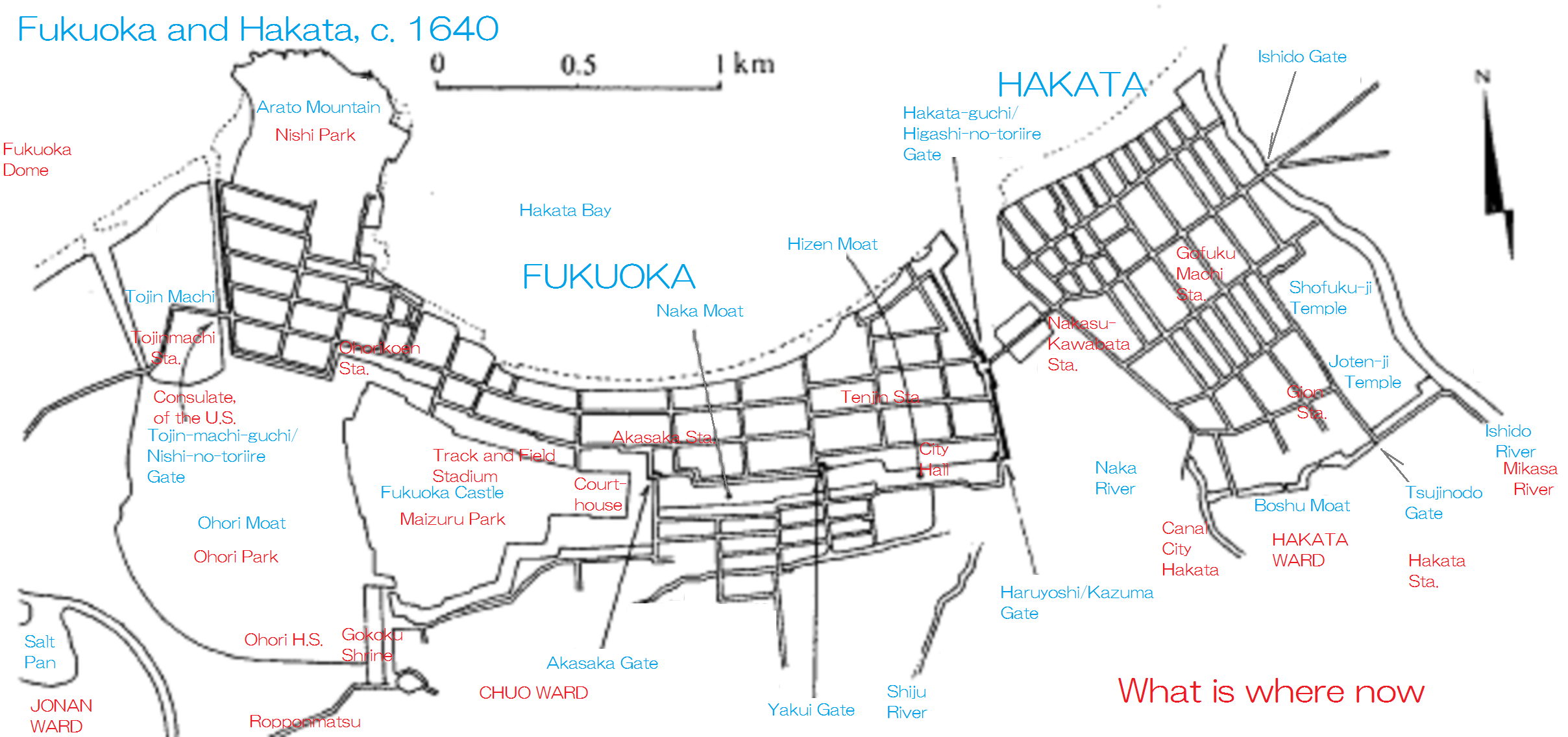
In the early Edo period, Kuroda Nagamasa, appointed the lord of Chikuzen Province, and most of his samurai vassals lived in Fukusaki, on the opposite shore of the Naka River from Hakata. Kuroda Nagamasa changed the name of the area to Fukuoka after his home town; Fukuoka in Okayama Prefecture. He ordered Tachibana Castle and Najima Castle dismantled, and had Fukuoka Castle built using the stones from those older castles. At that time Hakata was no larger than one square kilometer, demarcated by defensive lines along the Naka River, the Boshu-bori (or Boshu Canal), and the Ishido or Mikasa River.
In 1876, Hakata, then also known as Dai-Ni-Dai-ku, and Fukuoka, or Dai-Ichi-Dai-ku, were merged. In 1878 the settlement was renamed Fukuoka-ku (福岡区) by the Fukuoka prefectural government, though the population of Hakata was 25,677 and that of Fukuoka was 20,410. At that time, the name Hakata vanished from the administration. In 1889, after a local referendum in which half the voters chose the name Fukuoka and half chose Hakata, the city was officially renamed Fukuoka-shi, but at the same time a new train station then being built was named Hakata Station.
An imperial decree issued in July 1899 established Hakata as an open port for trade with the United States and the United Kingdom.
In 1972, when Fukuoka City was granted designated status by government ordinance, a ward including the old Hakata area was given the name Hakata-ku.
In 2016 a large sinkhole appeared in the city center just west of Hakata station. The sinkhole was filled and the affected roads were completely repaired within a few days. However, the hasty repair seems to have been problematic as less than a month later the road began showing signs of imminent implosion.
Culture
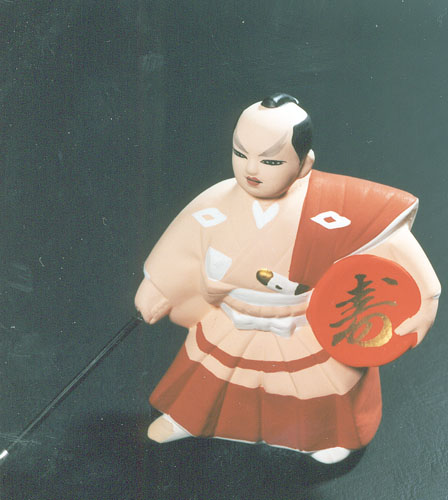

Hakata was the traditional center for the manufacture of Hakata ningyō, which are traditional Japanese dolls that are famous throughout Japan. Today, almost all Hakata ningyō makers (Hakata ningyō shi) have their factories in the Old Hakata Area, a part of modern Hakata-ku.
Hakata-ori is a textile used for obi of kimono.
It is also the home of Mentai Rock, named after the popular mentaiko dish served in the region, that spawned numerous J-pop idols during the early 1980s. Neo Mentai Rock is the name given to a recent renewal in activity from local musicians.
Hakata-ben is the local Japanese dialect spoken in the Old Hakata Area.
Hakata is also the location of the pop group HKT48. Other popular groups from Hakata are Kanikapila and NUMBER GIRL.
Parts of the famous crime novel 'Points and lines' ('Ten to Sen' in Japanese) by the award-winning Japanese writer Seichō Matsumoto occur in Hakata and its train station.
The South Korean government maintains the Korea Education Institution (; ) in Hakata-ku.
Famous foods
- Mentaiko
- Tonkotsu (pork bone) ramen, also called simply Hakata ramen
- Motsunabe
- Japanese cheesecake
- Mizutaki - Nabemono of chicken
- Hakata Torimon (:ja:博多通りもん) - a type of cake
- Hakata no Hito - a type of cake

- Tsukemen (dipping noodles)
Festivals
- Hakata Dontaku Minato Matsuri - May 3 and 4
- Hakata Gion Yamakasa - from July 1 to 15
- Hakata O-kunchi - October 23 and 24 (prior to 1953, November 23)
Transportation
Rail
- JR West
- Sanyō Shinkansen
- Hakata Station
- Sanyō Shinkansen
- JR Kyūshū
- Kyūshū Shinkansen
- Hakata Station
- Kagoshima Main Line
- Yoshizuka Station - Hakata Station - Takeshita Station - Minami-Fukuoka Station
- Sasaguri Line
- Yoshizuka Station
- Kyūshū Shinkansen
- Nishi-Nippon Railroad
- Tenjin Ōmuta Line
- Zasshonokuma Station
- Tenjin Ōmuta Line
- Fukuoka City Subway
- Kūkō Line
- Nakasu-Kawabata Station - Gion Station - Hakata Station - Higashi-Hie Station - Fukuokakūkō Station (Fukuoka Airport)
- Hakozaki Line
- Nakasu-Kawabata Station - Gofukumachi Station - Chiyo-Kenchōguchi Station
- Kūkō Line
Bus
- Hakata bus terminus (see Nishitetsu)
Airport
- Fukuoka Airport
Harbor
- Bayside place Hakata Futoh (Hakata Pier)
- Chūō Wharf (Central Wharf) - international ferry Beetle and Kobee and New Camellia
Facilities
Commerce
- Canal City Hakata
- Grand Hyatt Fukuoka
- Hakata Riverain
- Hakata-za
- Hotel Ōkura Fukuoka
Culture
- Level-5 stadium (Hakata no mori Stadium)
- Fukuoka Convention Center - Marine Messe Fukuoka, Fukuoka International Congress Center, Fukuoka Kokusai Center
- Hakata Civic Center, Hakata Library
- Hakata South Library
- Nakasu
- Rakusui-en
Religion
- Shinto
- Kushida Shrine
- Sumiyoshi Shrine
- Tōka Ebisu Shrine
- Buddhism
- Shōfuku Temple
- Tōchō Temple
- Jōten Temple
- Sōfuku Temple
- Christianity
- Fukuoka Korean Christian Church, Chiyo
- Hakata New Life Church
- Hikarigaoka (Hill of light) Catholic Church https://web.archive.org/web/20010824102948/http://www.omijapankorea.net/en/history/history2.html
- Minoshima Catholic Pastoral Center
- Japan Evangelical Lutheran church, Sasaki machi
- Japan Baptist Church, Aoki
- North Kyushu Japanese Orthodox Church, Higashi-hirao
References
References
- "[http://www.jrkyushu.co.jp/english/summary.html Corporate Summary] {{Webarchive. link. (2009-12-09 ." Kyushu Railway Company. Retrieved on March 27, 2010.)
- "企業検索-福岡商工会議所".
- [https://web.archive.org/web/20041207152108/http://www.airnext.ana-g.com/company/index.html 会社概要] . ''[[Air Next]]''. Retrieved on May 20, 2009.
- "[http://linkairs.jp/corporate.html 会社概要] {{webarchive. link. (2013-10-10 ." Link Airs. Retrieved on 5 November 2013. "福岡県福岡市博多区冷泉町5番35 福岡祇園第一生命ビル5F" ("Fukuoka Gion Daiichi Seimei Building 5F, 5-35 Reisenmachi, Hakata-ku, Fukuoka City, Fukuoka 812-0039 Japan"))
- "[http://www.cisco.com/web/siteassets/contacts/offices/asiapac.html Asia/Pacific Sales Offices]." [[Cisco]]. Retrieved on November 6, 2013. "Cisco Systems G.K Fukuoka Fukuoka Gion Daiichi Seimei Building 12th floor, 5-35 Reisencho Hakata-ku, Fukuoka-shi Fukuoka 812-0039 Japan"
- [https://web.archive.org/web/20041027012833/http://harlequin-air.co.jp/menu/corporate/corporate_1.html 会社概要]. ''[[Harlequin Air]]''. Retrieved on May 20, 2009.
- "[https://web.archive.org/web/19981207015833/http://www.harlequin-air.co.jp/j.html ハーレクィンエア会社概要]." Harlequin Air. December 7, 1998. Retrieved on February 22, 2010.
- (14 July 2015). "Chinese influx buoys Japan port city of Fukuoka". Financial Times.
- (12 March 2016). "Cruise ships with Chinese tourists pour into Japan". Japan Today.
- (14 July 2015). "Chinese influx buoys Japan port city of Fukuoka". Financial Times.
- US Department of State. (1906). [https://books.google.com/books?id=dKCOAAAAMAAJ&pg=PA759&dq= ''A digest of international law as embodied in diplomatic discussions, treaties and other international agreements'' (John Bassett Moore, ed.), Vol. 5, p. 759].
- [http://the-japan-news.com/news/article/0003335321 Large sinkhole opens up near Hakata Station]
- "Japan's giant sinkhole is sinking again". [[CNN]].
- "Hakata Ori website (English)".
- Martin, Ian F.. (2016). "Quit Your Band: Musical Notes From the Japanese Underground". Awai Books.
- "Home". Korea Education Institution.
This article was imported from Wikipedia and is available under the Creative Commons Attribution-ShareAlike 4.0 License. Content has been adapted to SurfDoc format. Original contributors can be found on the article history page.
Ask Mako anything about Hakata-ku, Fukuoka — get instant answers, deeper analysis, and related topics.
Research with MakoFree with your Surf account
Create a free account to save articles, ask Mako questions, and organize your research.
Sign up freeThis content may have been generated or modified by AI. CloudSurf Software LLC is not responsible for the accuracy, completeness, or reliability of AI-generated content. Always verify important information from primary sources.
Report