From Surf Wiki (app.surf) — the open knowledge base
Haka
Traditional Māori dance or performance art

Traditional Māori dance or performance art
Māori dances
Haka (; singular and plural haka, in both Māori and New Zealand English) are a variety of ceremonial dances in Māori culture. A performance art, haka are often performed by a group, with vigorous movements and stamping of the feet with rhythmically shouted accompaniment. Haka have been traditionally performed by both men and women for a variety of social functions within Māori culture. They are performed to welcome distinguished guests, or to acknowledge great achievements, occasions, or funerals.
Kapa haka groups are common in schools. The main Māori performing arts competition, Te Matatini, takes place every two years.
New Zealand sports teams' practice of performing a haka to challenge opponents before international matches has made the dance form more widely known around the world. This tradition began with the 1888–89 New Zealand Native football team tour and has been carried on by the New Zealand rugby union team (known as the All Blacks) since 1905. Although popularly associated with the traditional battle preparations of male warriors, conceptions that haka are typically war dances are considered erroneous by Māori scholars, alongside the inaccurate performance of haka by non-Māori.
Etymology
The group of people performing a haka is referred to as a kapa haka (kapa meaning group or team, and also rank or row). The Māori word haka has cognates in other Polynesian languages, for example: Samoan saʻa (saʻasaʻa), Tokelauan haka, Rarotongan ʻaka, Hawaiian haʻa, Marquesan haka, meaning 'to be short-legged' or 'dance'; all from Proto-Polynesian saka, from Proto-Malayo-Polynesian sakaŋ, meaning 'bowlegged'.
History and practice
.jpg)
Overview
Haka is a form of indigenous dance that encompasses multiple ceremonial purposes in Māori culture. As Nathan Matthew explains, "it is a posture dance accompanied by chanted or shouted song... One of the main characteristics of haka are that actions involving all parts of the body are used to emphasise the words."
Origins in Māori tradition
According to Māori tradition, haka originated from a creation story. The sun god, Tama-nui-te-rā, had two wives, the Summer Maid, Hine-raumati, and the Winter Maid, Hine-takurua. Haka originated in the coming of Hine-raumati, whose presence on still, hot days was revealed in a quivering appearance in the air. This was haka of Tāne-rore, the son of Hine-raumati and Tama-nui-te-rā. Hyland comments that "the haka is (and also represents) a natural phenomena ; on hot summer days, the 'shimmering' atmospheric distortion of air emanating from the ground is personified as 'Te Haka a Tānerore'".
Types and functions
Haka includes various forms serving different ceremonial purposes. These functions include:
- welcoming guests (haka pōwhiri),
- fare-welling and mourning the deceased (waiata tangi),
- giving advice or instructions (waiata tohutohu),
- restoring self-respect (pātere),
- intimidating adversaries (peruperu – war dance),
- and transmitting social and political messages (haka taparahi, ngeri).
The peruperu is a war haka that uses weapons, while haka taparahi is performed without weapons and is the more common ceremonial form. Other forms include:
- tūtū ngārahu (similar to peruperu but with sideways jumping),
- whakatū waewae (like peruperu with no jumping),
- manawa wera (like ngeri with no set actions, usually ceremonial and connected with death), and
- kaioraora (hatred or venting haka).
Performance elements
Various actions are employed in haka performance, including facial contortions such as showing the whites of the eyes (pūkana), and poking out the tongue (whetero, performed by men only), and a wide variety of vigorous body actions such as slapping the hands against the body and stomping of the feet. The body serves as the instrument and vessel of delivery, with the key aspect being the words and the message they contain.
18th and 19th centuries

The earliest Europeans to witness haka described them as being "vigorous" and "ferocious". Joseph Banks, who accompanied James Cook on his first voyage to New Zealand in 1769, later recorded:
From their arrival in the early 19th century, Christian missionaries tried to eradicate haka, along with other forms of Māori culture that they saw as conflicting with Christian beliefs and practice. Henry Williams, the leader of the Church Missionary Society mission in New Zealand, aimed to replace haka and traditional Māori chants (waiata) with hymns. Missionaries also encouraged European harmonic singing as part of the process of conversion.
The use of haka in welcoming ceremonies for members of the British royal family helped to improve its standing among Europeans. Prince Alfred, the Duke of Edinburgh, was the first royal to visit New Zealand, in 1869. Upon the Duke's arrival at the wharf in Wellington, he was greeted by a vigorous haka. The Wellington Independent reported, "The excitement of the becomes uncontrollable. They gesticulate, they dance, they throw their weapons wildly in the air, while they yell like fiends let loose. But all this fierce yelling is of the most friendly character. They are bidding the Duke welcome."
Modern haka

In modern times, various haka have been composed to be performed by women and even children. In some haka the men start the performance and women join in later. Haka are performed for various reasons: for welcoming distinguished guests, or to acknowledge great achievements, occasions or funerals.
The 1888–89 New Zealand Native football team began a tradition by performing haka during an international tour. The common use of haka by the national rugby union team before matches, beginning with The Original All Blacks in 1905, has made one type of haka familiar internationally.

Some events have caused protests. The 1979 annual "haka party" parade at the University of Auckland – in which engineering students persisted in parodying haka by painting male genitals on their body and performing with sexually obscene gestures – was disrupted by a collection of Māori and Pacific Island students (He Taua, or The War Party) headed by Ngā Tamatoa, a prominent Māori activist group. For two decades people including Māori students at the university had asked the university and the engineering department to stop the tradition. In 1979, the protesters included Hone Harawira, later a Member of Parliament. Several of the engineering students were assaulted, and members of He Taua were arrested. Their court case in Auckland sparked anti-racism protests outside the courthouse and was supported by a range of people including the president of the Auckland University Students Association.
The choreographed dance and chant popularized around the world by the All Blacks derives from "Ka Mate", Concerns were expressed that the authorship and significance of this haka to the Ngāti Toa were being lost and that it had "become the most performed, the most maligned, the most abused of all haka", and was now "the most globally recognised form of cultural appropriation". Specific legal challenges regarding the rights of the Ngāti Toa to be acknowledged as the authors and owners of "Ka Mate" were eventually settled in a Deed of Settlement between Ngāti Toa and the New Zealand Government and New Zealand Rugby Union agreed in 2009 and signed in 2012.
Spread to other Austronesian nation-states
The Malay College Kuala Kangsar, a historically all-boys all-Malay prestige boarding school in Malaysia adopted the haka for their own rugby team in admiration of the New Zealand All-Blacks' popularity in the 1970s under the tutelarship of Neil Jonathan Ryan. In return, said college's cheer team developed their own cry in a similar spirit, known as the bungwak.See:
- Neighbouring Singapore's Rugby Union in 2004 took on an attempt of collaborating with students all over the island to create a "Singapore Roar" inspired by the haka, even though the majority of its demographic is Chinese.
In Indonesia, a culture of doing the 'haka-haka', or its more commonly known variation, 'yel-yel', exists. The dance is performed by groups such as military personnel, law enforcement, civil servants, students, and others.
Cultural influence
Main article: Haka in sports, Kapa haka
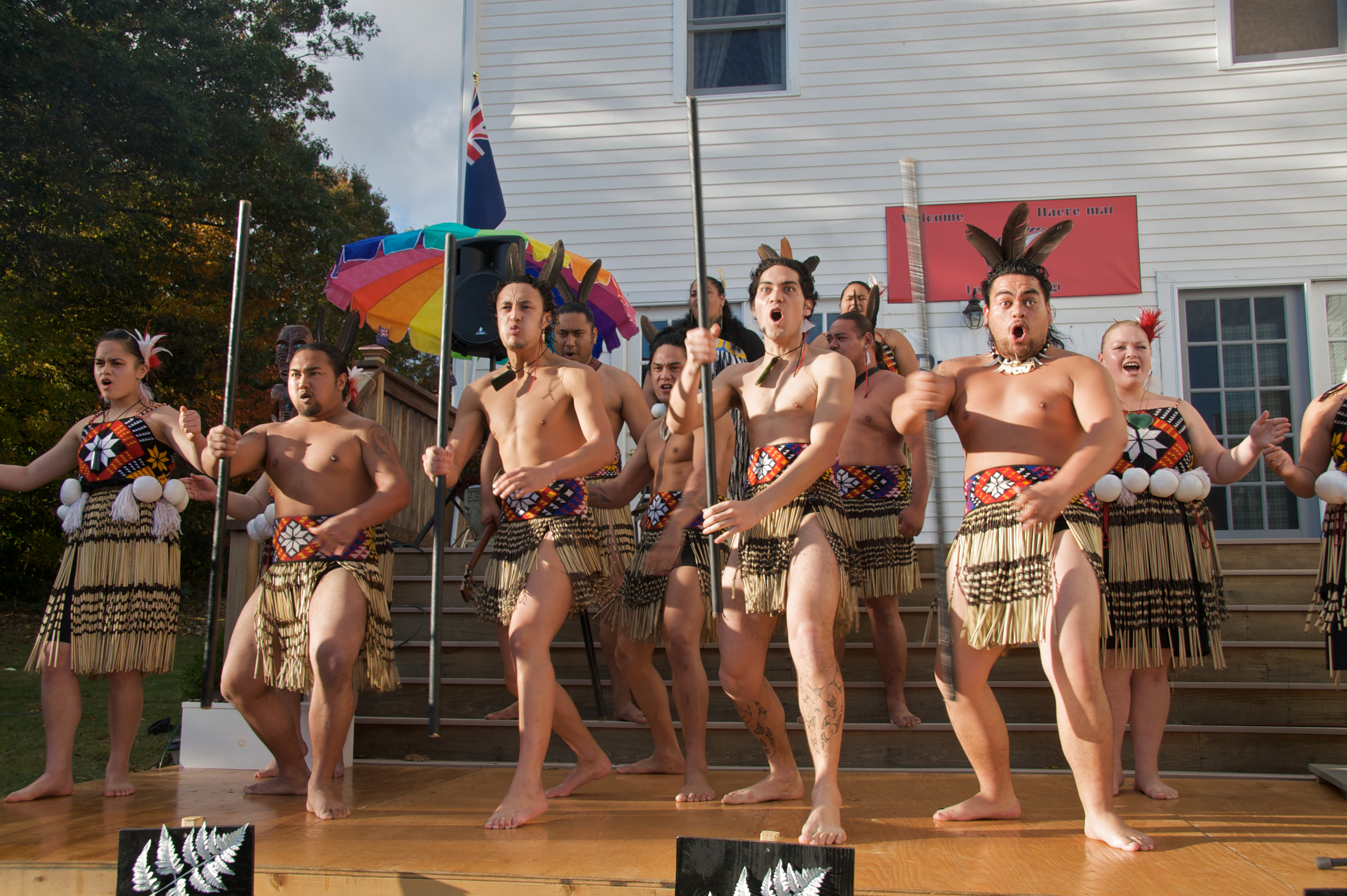
In the 21st century, kapa haka has been offered as a subject in universities, including the study of haka, and is practiced in schools and military institutions.
In addition to the national Te Matatini ("many faces") festival, local and regional competitions attract dozens of teams and thousands of spectators.
The All Blacks' use of haka has become the most widely known, but several other New Zealand sports teams now perform haka before commencing a game. These include the national rugby league team ("the Kiwis"), and the men's national basketball team ("Tall Blacks"). In the lead up to the Rugby World Cup in 2011, flashmob haka became a popular way of expressing support for the All Blacks. Some Māori leaders thought it was "inappropriate" and a "bastardisation" of haka. Sizeable flashmob haka were performed in Wellington and Auckland, as well as London, which has a large New Zealander immigrant community.
The music video for the song "Poi E" (1983) by the Pātea Māori Club, written by Dalvanius Prime and Ngoi Pēwhairangi, used a mixture of kapa haka and hip-hop choreography. This was then mixed with moves from Michael Jackson's Thriller music video as the outro song parody for Taika Waititi's movie Boy (2010).
The training of haka plays an important role in the New Zealand film Whale Rider (2002).
In November 2012, a Māori kapa haka group from Rotorua performed a version of the "Gangnam Style" dance mixed with a traditional haka in Seoul, celebrating 50 years of diplomatic relations between South Korea and New Zealand.
On 7 December 2014, at the 2014 Roller Derby World Cup in Dallas, Texas, Team New Zealand performed a haka on roller skates to the Australian Roller Derby team before their bout in the quarter-finals. Team New Zealand performed a haka before their debut game against Team USA at the 2011 Roller Derby World Cup, on 1 December 2011; however, it was unexpected and the arena music was still playing. It has since become an expected tradition.
In 2017, actor Dwayne Johnson performed a haka with a girls' soccer team in The Fate of the Furious.
Actor Jason Momoa performed a haka with a group of performers that included New Zealand actor Temuera Morrison on the red carpet at the Aquaman premiere in Los Angeles in 2018.
In March 2019, following the Christchurch mosque shootings, school pupils and other groups performed haka to honour those killed in the attacks.
The choreography in the "Miroh" music video by South Korean boy band Stray Kids featured haka elements.
Three or four American football teams are known to perform haka as a pregame rite. This appears to have begun at Kahuku High School where both the student body and local community includes many Polynesian Hawaiians, Māori, Samoans, Tahitians, and Tongans. The University of Hawaii Rainbow Warriors football team also adopted haka as a pregame rite during the 2006 season, and the practice has spread to a number of other teams overseas; there has, however, been some criticism of the practice as inappropriate and disrespectful. Non-traditional or inaccurate haka performances have been criticised by Māori academics, such as Morgan Godfery.
In September 2024, thousands gathered in Eden Park in Auckland to break the record of the largest haka performance. France held the previous official world record since 2014.
On 14 November 2024, MP Hana-Rawhiti Maipi-Clarke led a haka inside the New Zealand Parliament to protest the Treaty Principles Bill, joined by Debbie Ngarewa-Packer, Rawiri Waititi, and other MPs. Debate was temporarily paused and the house voted to suspend Maipi-Clarke.
References
Inline citations
General references
- McLean, Mervyn (1996). Maori music. Auckland: Auckland University Press.
- Pōmare, Mīria (3 March 2017). "Ngāti Toarangatira – Chant composed by Te Rauparaha". Te Ara: The Encyclopedia of New Zealand.
References
- "Haka {{!}} English meaning". [[Oxford Advanced Learner's Dictionary]].
- "haka noun". [[Cambridge Advanced Learner's Dictionary.
- "haka – Māori Dictionary".
- "Haka, Maori dance".
- "Haka!".
- Patrick, Alice. (21 November 2017). "Kapa haka in mainstream schools – Affirming Māori students as Māori {{!}} School News – New Zealand".
- (2011). "Te Matatini – The Evolution of Kapa Haka".
- (2020-01-23). "The haka isn't yours – stop performing it {{!}} Morgan Godfery".
- "kapa". Te Aka Māori Dictionary.
- "haka".
- "Haka – Ka Mate".
- (9 December 2016). "New Zealand's first royal visit". [[Ministry for Culture and Heritage]].
- [http://paperspast.natlib.govt.nz/cgi-bin/paperspast?a=d&cl=search&d=WI18690413.2.11.1 13 April 1869], ''Wellington Independent'', p. 3. Retrieved on 25 June 2018.
- "The role of women in the traditional use of the haka Ka Eke i te Wiwī". Te Kete Ipurangi.
- "History of the All Black haka". [[Tourism New Zealand]].
- Keane, Basil. (1 Jun 2017). "Engineers' haka, 1955".
- Day, Simon. (2017-10-17). "Mocking the haka: The Haka Party Incident and 'casual' racism in New Zealand".
- Tahana, Yvonne. (2 May 2009). "Haka brawl rivals unite to remember". [[The New Zealand Herald]].
- . (30 March 2021). ["Support He Taua"](http://mananews.co.nz/wp/?p=10947).
- "Chant composed by Te Rauparaha".
- (11 February 2009). "New Zealand Maori win haka fight". [[BBC News]].
- (7 December 2012). "Link to Ngāti Toa Rangātira Deed of Settlement documents".
- Syed Nazri. (April 3, 2005). "Preserving a bastion as MCKK hits a century". [[New Straits Times]].
- (28 February 2004). "What's the Singapore Roar?". [[Today (Singapore newspaper).
- (22 September 2023). "Lomba Beladiri Chadrick Dan Haka Haka Tingkat Pasmar 1 Resmi Dibuka".
- (7 October 2014). "Serma Asep Ciptakan 'Haka Haka' Khusus untuk HUT TNI".
- TNI, Puspen. (24 April 2013). "Atraksi Haka-Haka dari Wan TNI (Part 1)".
- (31 October 2018). "Rugby League: Kiwis perform haka for Liverpool football players". [[The New Zealand Herald]].
- (4 September 2014). "New Zealand haka war dance bewilders USA basketball team". [[The Guardian]].
- (20 September 2011). "Maori leaders at odds over flash mob haka". 3 News NZ.
- (8 September 2011). "Wellington haka attracts hundreds". 3 News NZ.
- (9 September 2011). "Flash mob haka on Auckland's Queen Street ahead of RWC opener All Blacks vs Tonga". 3 News NZ.
- (19 November 2011). "Flashmob haka takes over Trafalgar Square". 3 News NZ.
- Powell, Jacob. (June 2024). "Review: Poi E: The Story of Our Song".
- Kara, Scott. (5 May 2010). "Poi Story 2 – Entertainment News".
- Morris, Paula. (2003). "Film Review: Whale Rider". Cinéaste.
- (30 November 2012). "Maori take on Gangnam Style in Korea". [[3 News]].
- (7 December 2014). "Team New Zealand vs Team Australia Haka". Blood and Thunder World Cup Official Facebook.
- (1 December 2011). "Team New Zealand Haka". Blood and Thunder World Cup Official Youtube.
- (2017-04-18). "'The Fate of the Furious': Dwayne Johnson Explains That Soccer Haka Scene".
- Woerner, Meredith. (2018-12-13). "Jason Momoa Performs Haka at the 'Aquaman' Premiere".
- (13 December 2018). "'AQUAMAN' Los Angeles Premiere LiveStream (december 12, 2018) — Warner Bros. Pictures".
- (December 12, 2018). "Jason Momoa leads haka at Aquaman premiere in Los Angeles".
- (2019-03-18). "The power of the haka: New Zealanders pay traditional tribute to mosque attack victims". The Washington Post.
- Bell, Crystal. (March 25, 2019). "Stray Kids Are Back And Bolder Than Ever With Celebratory New Single 'MIROH'".
- (26 December 2006). "2006 Hawaii Bowl UH over ASU – UH Haka".
- Sygall, David. (2015-10-01). "New Zealanders outraged over awkward haka performed by Arizona Wildcats college football team".
- Carpenter, Cam. (2015-09-28). "Mixed reaction to an American haka". [[The New Zealand Herald]].
- "New Zealand reclaims the world record for the largest haka – DW – 09/30/2024".
- Ensor, Jamie. (2024-11-14). "Treaty Principles Bill vote: How the fiery debate led to MP being suspended, another kicked out". [[The New Zealand Herald]].
This article was imported from Wikipedia and is available under the Creative Commons Attribution-ShareAlike 4.0 License. Content has been adapted to SurfDoc format. Original contributors can be found on the article history page.
Ask Mako anything about Haka — get instant answers, deeper analysis, and related topics.
Research with MakoFree with your Surf account
Create a free account to save articles, ask Mako questions, and organize your research.
Sign up freeThis content may have been generated or modified by AI. CloudSurf Software LLC is not responsible for the accuracy, completeness, or reliability of AI-generated content. Always verify important information from primary sources.
Report