From Surf Wiki (app.surf) — the open knowledge base
Hagafen Cellars
| Field | Value |
|---|---|
| name | Hagafen Cellars |
| logo | Hagafen.jpg |
| trading_name | |
| native_name | |
| genre | |
| foundation | |
| defunct | |
| key_people | Ernie Weir; |
| Irit Weir. | |
| products | wine |
| production | 8000 cases |
| homepage |
Irit Weir. Hagafen Cellars is a winery located in the Napa Valley. Founded in 1979, it was the first kosher winery in California, and is "the first of the upscale kosher brands."{{Cite news | archive-url = https://archive.today/20130131181217/http://pqasb.pqarchiver.com/latimes/access/11280802.html?dids=11280802:11280802&FMT=CITE&FMTS=CITE:FT&type=current&date=Mar+19,+1997&author=DAN+BERGER&pub=Los+Angeles+Times&desc=Drink;+Wine;+The+New+Kosher+Wine&pqatl=google | url-status = dead | archive-date = January 31, 2013 | access-date = February 19, 2011}} The winery is owned and operated by winemaker Ernie Weir and his wife, Irit Weir.
Wines

Many wine writers praise Hagafen wines, writing for example that the winery makes "a broad selection of highly recommended kosher wines".{{Cite news | access-date = February 17, 2011}} Hagafen wines have been called "sophisticated, classic and correct", and are "rated as some of the best kosher wines in the world".
Hagafen's red wines include Cabernet Sauvignon, Syrah, Zinfandel, Cabernet Franc, Merlot, and Pinot noir. Their white wines include Chardonnay, Sauvignon blanc, Riesling, and Rousanne. They also produce brut cuvée sparkling wines, and a Vin Gris Rosé.
Wines are sold under three labels. Hagafen is the main label, Prix is the premium label and Don Ernesto is the label used for their more economical offerings.{{Cite news | access-date = February 20, 2011}}
The majority of the grapes used are grown in the Napa Valley American Viticultural Area, although the Rousanne comes from Lodi, and some of the Riesling comes from Lake County.
Like many Napa Valley wineries, Hagafen emphasizes Cabernet Sauvignon, and those wines have been favorably received by wine critics and writers for decades. In 1990, The New York Times reported that "in conjunction with the International Jewish Festival in New York, a group of wine experts evaluated more than 125 kosher wines. The panel selected the Hagafen Cellar 1987 cabernet sauvignon from California as the gold medal winner."{{Cite news | access-date = February 22, 2011}} Sixteen years later, two wine writers for The Wall Street Journal wrote, "We feel strongly that you simply can't go wrong with a Hagafen Cabernet Sauvignon."{{Cite news | access-date = February 22, 2011}} In reviewing a Hagafen Cabernet Sauvignon, a wine writer for The Washington Post wrote, "Classic, rich and powerful, this is a real Napa Cab at an optimal stage of maturity".{{Cite news | access-date = February 22, 2011 | archive-date = June 29, 2011 | archive-url = https://web.archive.org/web/20110629023717/http://pqasb.pqarchiver.com/washingtonpost/access/587221941.html?dids=587221941:587221941&FMT=ABS&FMTS=ABS:FT&type=current&date=Mar+24,+2004&author=Michael+Franz&pub=The+Washington+Post&desc=Kosher+for+Passover&pqatl=google | url-status = dead
Smaller in production, Hagafen's Rousanne is described as "a white wine that blends the tart freshness of a sauvignon blanc with the richness of a chardonnay, made from a "less familiar variety". "{{Cite news | access-date = February 19, 2011}}
About one-sixth of Hagafen's production is Riesling, which is cold fermented in stainless steel tanks. Wine writers with The Wall Street Journal have praised Hagafen Riesling as "one of our favorite American Rieslings – kosher or not – for years", commenting that "Longtime wine lovers like his Riesling because it's a noble grape done right and novices find it unintimidating because it's slightly sweet and relatively low in alcohol. Everyone appreciates that it goes well with a wide variety of foods."{{Cite news | access-date = February 19, 2011}}
White House dinners
On September 9, 1981, Hagafen Riesling was served at a White House state dinner, held by President Ronald Reagan to honor Israeli Prime Minister Menachem Begin.{{Cite news | access-date = February 20, 2011 | archive-date = June 29, 2011 | archive-url = https://web.archive.org/web/20110629015354/http://pqasb.pqarchiver.com/baltsun/access/1854147582.html?FMT=CITE&FMTS=CITE%3AAI&type=historic&date=Sep%2010%2C%201981&author=&pub=The%20Sun%20%281837-1985%29&desc=Kosher%20for%20Begin&pqatl=google | url-status = dead | access-date = February 17, 2011}}
More recently, Hagafen sparking wine was the only alcoholic beverage served at President Barack Obama's annual White House Hanukkah dinner{{Cite news | access-date = February 20, 2011}} on December 2, 2010. The 500 guests at that Hanukkah party included three Supreme Court justices, members of Congress, rabbis, astronauts and artists.{{Cite web | access-date = February 20, 2011}}
The official menus of many of these White House dinners "now adorn the walls of the winery's intimate tasting room."{{Cite news | access-date = February 19, 2011}}
Winery

Hagafen Cellars was founded in 1979 by Ernie Weir and partners Zach Berkowitz, Norm Miller and Rene di Rosa. | access-date = February 19, 2011 | archive-date = June 29, 2011 | archive-url = https://web.archive.org/web/20110629014308/http://pqasb.pqarchiver.com/latimes/access/59338423.html?dids=59338423:59338423&FMT=ABS&FMTS=ABS:FT&type=current&date=Mar+24,+1994&author=DAN+BERGER&pub=Los+Angeles+Times+(pre-1997+Fulltext)&desc=Passover+Kosher+Wine+for+Wine+Lovers&pqatl=google | url-status = dead | access-date = February 19, 2011}} and later used custom crush facilities.
Early in the company's history, Weir decided to "go for the top end of the market."{{Cite news | access-date = February 19, 2011}} Weir and his wife Irit later gained full ownership of the business.
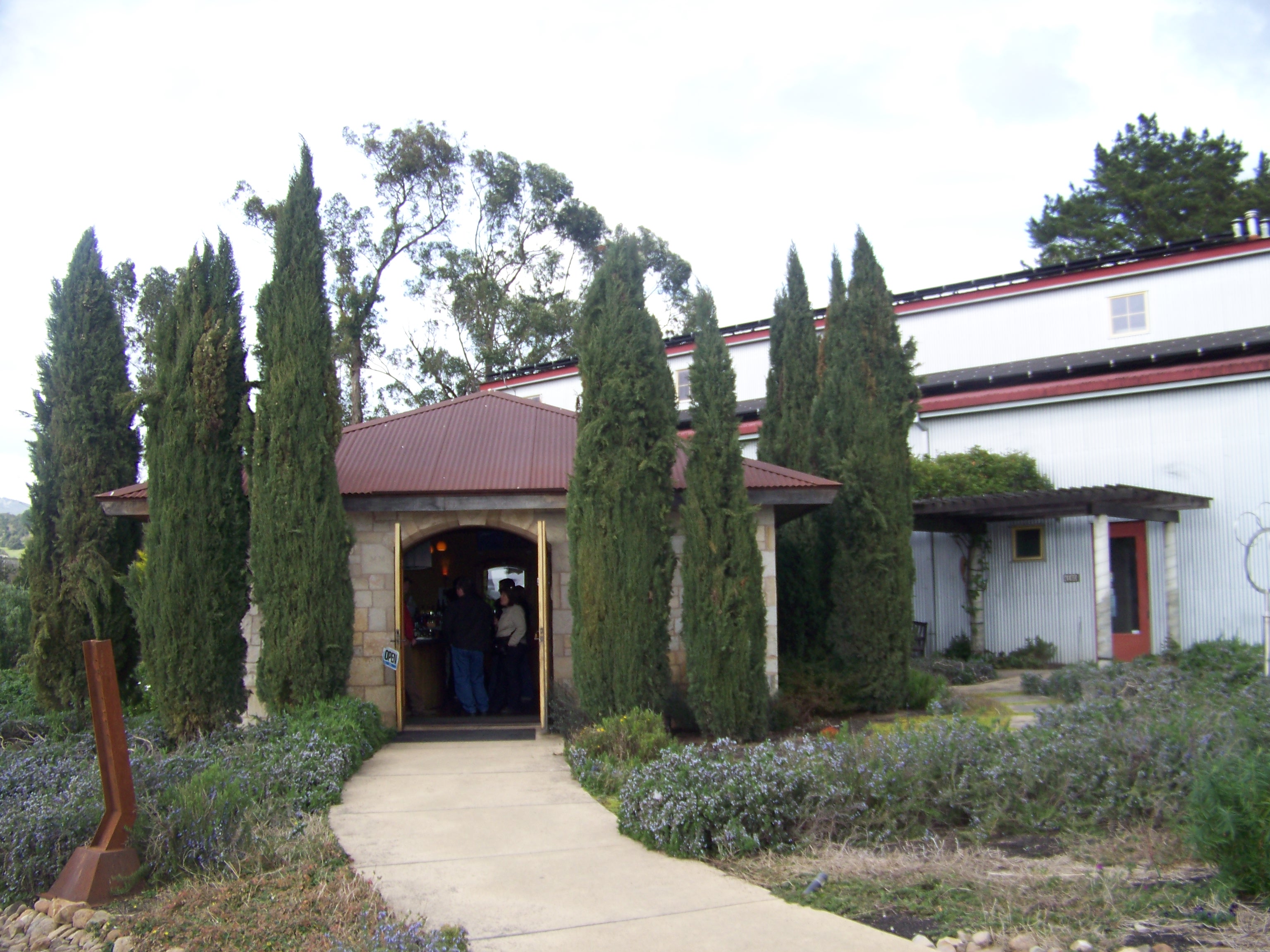
In 1999, Hagafen announced plans for a new winery.{{Cite news | access-date = February 19, 2011 }} The Hagafen wine production facility on the Silverado Trail opened in 2000 and the stand-alone tasting room opened in 2002.{{Cite book | url-access = registration
In 2004, vandals hit the winery, opening valves and dumping out $200,000 worth of wine. This included the winery's entire production of its 2002 estate Syrah and 2003 estate Pinot Noir. The incident occurred either late at night on June 1 or early in the morning on June 2. The tanks were located outside the winery, near the main building.{{Cite news
The winery's annual production is approximately 8000 cases, or 100,000 bottles.
Vineyards
Originally, Hagafen purchased all its grapes from other wine grape growers. In 1984, it was reported that "Hagafen Cellars produces kosher wine from some of the best vineyards, such as riesling and chardonnay from Winery Lake Vineyard in the Carneros region of Napa Valley."{{Cite book
In 1986, they purchased their own vineyard, where the winery was later built. Called Weir Family Vineyard II, it consists of 12 acres of Cabernet Sauvignon. Later, they added nine acre Weir Family Vineyard III, with three acres each of Riesling, Cabernet Franc and Syrah. Their own vineyards now yield roughly half of the grapes they use for their annual production.
Winemaker

A native of Los Angeles, Ernie Weir was a sociology major at UCLA, and then enrolled in the viticulture program at UC Davis. His first exposure to agriculture came while working on a kibbutz in Israel.{{Cite news | access-date = February 18, 2011 | archive-date = July 17, 2011 | archive-url = https://web.archive.org/web/20110717011356/http://www.thejewishweek.com/travel/vacations/blessed_fruit_hagafen_cellars | url-status = dead | access-date = February 17, 2011 }}
According to Joan Nathan, Weir makes wine "out of cultural conviction". He said that "As a Jew I though it was important to produce a first-rate kosher wine."{{Cite book | author-link = Joan Nathan
Weir has done consulting work for Israeli wineries, such as Carmel Winery, Yarden and the Margalit Winery. Weir also "lectures to Israeli winemakers on what he's learned making wine in California."{{Cite book
In 2008, Weir was the winner of the Al Brounstein Meritorious Service Award, given by nonprofit group L’Chaim Napa Valley in memory of the notable Napa Valley Cabernet Sauvignon leader who founded Diamond Creek Vineyards. | access-date = February 19, 2011}} Weir was featured in the 2007 documentary film about California' wine industry, called A State of Vine.{{Cite news | access-date = February 19, 2011}} He served as president of the board of trustees of Napa's Reform synagogue, Congregation Beth Sholom, from 2007 to 2009.{{Cite news | access-date = February 22, 2011}}
Kosher standards
Hagafen has overcome several significant challenges in making fine wines that comply fully with the Jewish laws of kashrut.
First of all, "the High Holy Days often fall in the middle of peak harvesting and crush periods",{{Cite news | access-date = February 20, 2011}} and that is by far the busiest time of year for Napa Valley winemakers. No work on kosher wines can take place on the most sacred of these days, including Rosh Hashanah and Yom Kippur, so Weir must coordinate his schedule carefully at this time of year, and work every available moment.
Although he is Jewish, Weir's level of religious observance does not comply with Orthodox Jewish standards, and only such Jews are allowed to do the physical work of producing kosher wines. Accordingly, Weir has to direct and monitor temporary Orthodox Jewish employees on the exact steps to take during production, but he can't do any of the hands-on work himself.
Jewish law also requires that kosher wines that are to be served to observant Jews by non-Jewish waiters must be mevushal, which means "boiled" in Hebrew. Israeli wine critic Daniel Rogov described the common wisdom about the shortcomings of mevushal kosher wines: "nearly everyone knows that that after a few months in bottle, most mevushal (flash pasteurized) wines tend to offer cooked aromas and flavors, and too often remind one more of oxidized fruit compote than of fine wine." Rogov praises Weir's success at the process: "No one is quite sure how Hagafen winemaker Ernie Weir does it, but his are among the very few flash pasteurized wines to have escaped this fate, and his wines, frequently earning scores of 90 or above, tend to be rather long lived. Some may think that shipping kosher wines to Israel is somewhat akin to selling ice to Eskimos, but in this case the Hagafen wines are a most welcome addition to local shelves."{{Cite news | access-date = February 19, 2011}}
References
This article was imported from Wikipedia and is available under the Creative Commons Attribution-ShareAlike 4.0 License. Content has been adapted to SurfDoc format. Original contributors can be found on the article history page.
Ask Mako anything about Hagafen Cellars — get instant answers, deeper analysis, and related topics.
Research with MakoFree with your Surf account
Create a free account to save articles, ask Mako questions, and organize your research.
Sign up freeThis content may have been generated or modified by AI. CloudSurf Software LLC is not responsible for the accuracy, completeness, or reliability of AI-generated content. Always verify important information from primary sources.
Report