From Surf Wiki (app.surf) — the open knowledge base
Haematoxylum brasiletto
Species of legume
_(8204867827).jpg)
Species of legume
Haematoxylum brasiletto, or Mexican logwood, is a species of tropical hardwood tree in the legume family, Fabaceae. It is known in its native Mexico and Guatemala as "palo de brasil" or "palo de tinto". The timber is used to make bows for stringed instruments, the manufacture of dyes and in ethnobotany.
Description
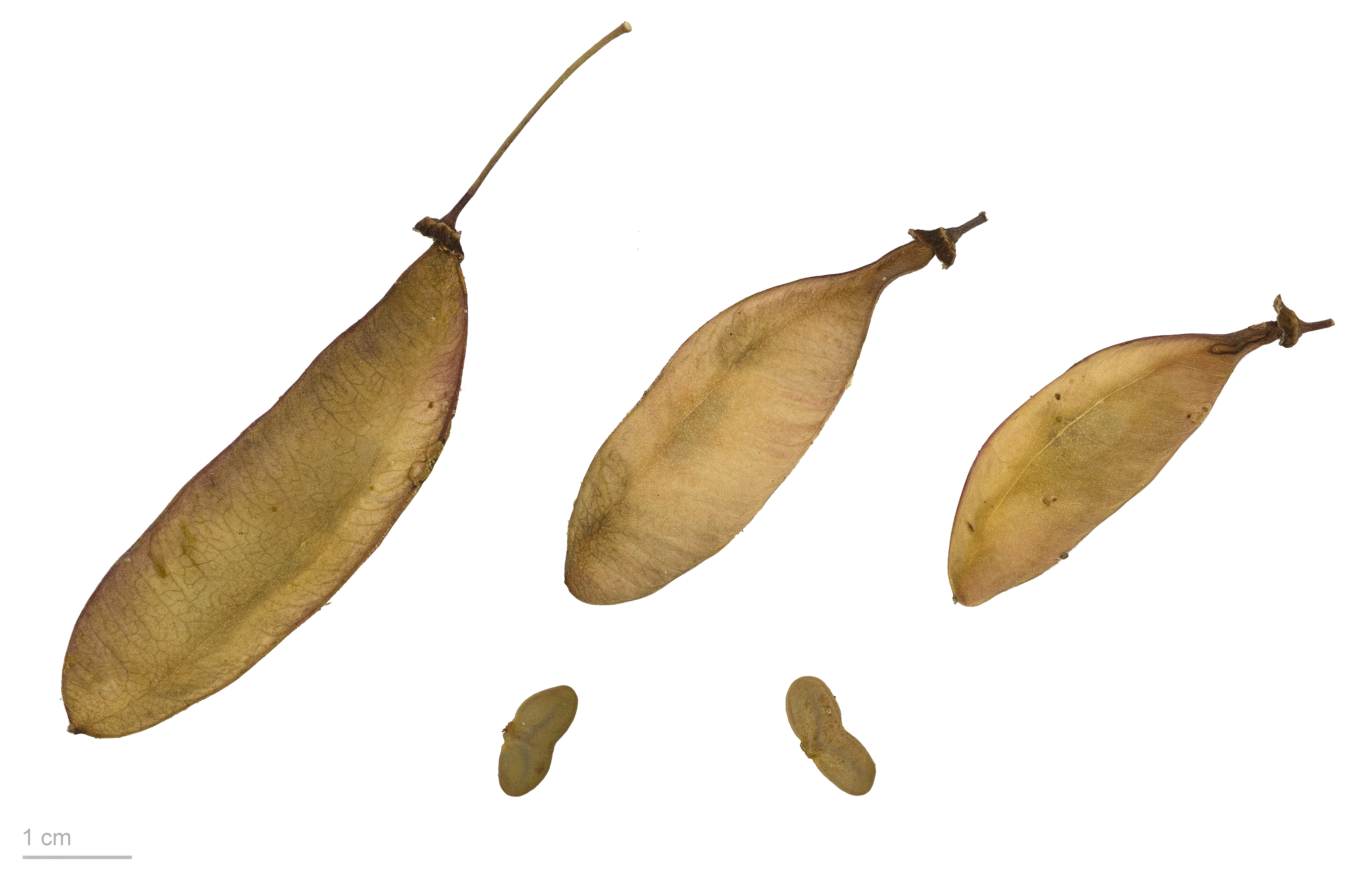
H. brasiletto is a small tree or large thorny shrub, seven to fifteen metres high. The trunk and larger branches are fluted and the heartwood is deep red. The tree has pinnate leaves with three pairs of heart-shaped leaflets and no terminal leaflet. The clusters of yellow flowers are typical of the Caesalpinioideae, with five distinct lobes, and are followed by copper-coloured seed pods that split laterally when ripe, rather than at the edge. The seeds are black and kidney-shaped.
Distribution and habitat
H. brasiletto occurs in Mexico, Belize, Costa Rica, Guatemala, El Salvador, Honduras, Nicaragua and Colombia. It is found growing in desert scrub in Baja California in association with elephant trees (Bursera microphylla), the woodrose (Merremia aurea) and the large Cardón cactus (Pachycereus pringlei).
Uses
The wood of this tree is used in the making of bows for stringed instruments. The tree yields other valuable products and has been exported for several centuries. It was included in the London Pharmacopoeia of 1740, which listed logwood tea as being effective against tuberculosis and dysentery. An extract of boiled heartwood chips is reported to have antibiotic properties, to reduce fever, and to act as a tonic to strengthen the body.
References
References
- Botanic Gardens Conservation International (BGCI) & IUCN SSC Global Tree Specialist Group. (2019). "''Haematoxylum brasiletto''".
- [http://www.eol.org/pages/639844 Haematoxylum brasiletto H. Karst.] Encyclopedia of Life. Retrieved 2011-08-21.
- {{GRIN
- [http://waynesword.palomar.edu/ecoph4.htm Logwood and Brazilwood: Trees That Spawned 2 Nations] {{Webarchive. link. (2011-08-06 Retrieved 2011-08-21.)
- link. (2016-03-04 Biblioteca digital de la Medicina Tradicional Mexicana. Retrieved 2011-08-21)
- [http://www.wangbow.com/shop/ipe-carbon-fiber-pernambuco-ebony-fiberglass-ezp-22.html WangBow.] {{Webarchive. link. (2014-09-11 Retrieved 2011-08-21.)
- The heartwood is used to produce dye for wool and cotton cloth and a pink colouring used in pharmaceuticals and toothpaste. The pigments [[hematoxylin]] and [[hematein]] can be extracted and are complex phenols similar to [[bioflavonoid]]s. Extracts of hardwood chips are used as remedies by the [[Tarahumara people. Ethnobotanical]] uses mentioned in "Duke's Phytochemical and Ethnobotanical Databases" includes use as an [[astringent]], a [[dentifrice]], a refrigerant, for treating [[Condyloma acuminata. condyloma]], [[erysipelas]], [[fever]], [[jaundice]], [[inflammation]] and stomach pain.[https://phytochem.nal.usda.gov/phytochem/ethnoPlants/show/3057 Duke's Phytochemical and Ethnobotanical Databases] {{Webarchive. link. (2018-01-21 Retrieved 2011-08-21.)
This article was imported from Wikipedia and is available under the Creative Commons Attribution-ShareAlike 4.0 License. Content has been adapted to SurfDoc format. Original contributors can be found on the article history page.
Ask Mako anything about Haematoxylum brasiletto — get instant answers, deeper analysis, and related topics.
Research with MakoFree with your Surf account
Create a free account to save articles, ask Mako questions, and organize your research.
Sign up freeThis content may have been generated or modified by AI. CloudSurf Software LLC is not responsible for the accuracy, completeness, or reliability of AI-generated content. Always verify important information from primary sources.
Report