From Surf Wiki (app.surf) — the open knowledge base
Haemaphysalis longicornis
Species of tick
.png)
Species of tick
Haemaphysalis longicornis, the Asian longhorned tick, longhorned tick, bush tick, or cattle tick, is a parasitic arachnid belonging to the tick family Ixodidae. The Asian longhorned tick is a known livestock pest, especially in New Zealand, and can transmit a disease called theileriosis to cattle but not to humans. However, the tick has been associated with several other tickborne diseases in humans.
An unfed female is typically 2.0–2.6 mm long and 1.5–1.8 mm wide, and grows to 9.8 mm long and 8.2 mm wide with engorgement.{{cite web |url=http://neregionalvectorcenter.com/longhorned-tick
Geographic distribution
The Asian longhorned tick is native to temperate areas of East and Central Asia, including China, Korea, and Japan, as well as Pacific islands including Australia, New Zealand, and Fiji to name a few.
The species was not known to be present on the mainland United States until 9 November 2017, when it was first discovered on a sheep farm in Hunterdon County, New Jersey, although it had been intercepted at U.S. ports on import animals and materials at least a dozen times. Attempts to eradicate the species from New Jersey failed; the tick successfully overwintered and has since become established in the state as an invasive species. The tick may have been present in the eastern US for several years, but only recently detected.
Biology
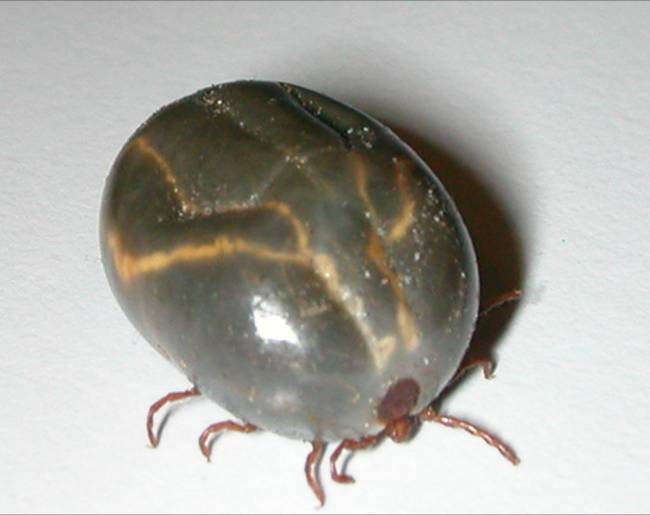
The seasonal feeding and reproductive cycle resembles that of other ticks. The tick can reproduce sexually or by an asexual process called parthenogenesis. The latter exist in northern Japan and Russia, whereas the former exist in southern Japan, southern Korea and southern parts of the former Soviet Union. An aneuploid race capable of both sexual and asexual reproduction capability exists in China. Unfed ticks can survive for close to a year, nymphs and adult females the longest, depending on temperature and humidity.
Host
The Asian longhorned tick parasitizes mammals and birds. It spreads quickly in farm animals such as cattle, horses, sheep, pigs, and chickens. Natural infestations have been found on wild animals like bear, deer, foxes and hares, small mammals like ferrets and rats, and birds. It has also been found on cats, dogs, and humans. It is believed to migrate by parasitizing birds, which carry it to new areas.
Disease vector
The Asian longhorned tick can transmit an animal disease called theileriosis to cattle, which can cause considerable blood loss and occasional death of calves, but mainly is important to dairy farmers because of decreased milk production and sheep farmers because of decreased wool quantity and quality.
Human diseases such as Lyme spirochetes, spotted fever group rickettsiae, Ehrlichia chaffeensis, and Anaplasma bovis have been detected in H. longicornis. It has been associated with Russian spring-summer encephalitis, Powassan virus, Khasan virus, tick-borne encephalitis virus, and severe fever with thrombocytopenia syndrome. Human pathogens have not so far been detected in the Asian longhorned tick in the US.
References
References
- (8 August 2018). "US invaded by savage tick that sucks animals dry, spawns without mating". Ars Technica.
- (2017-11-21). "Exotic Tick Species Identified on Hunterdon County Farm". Department of Agriculture, State of New Jersey.
- (2018-02-21). "Native to Asia, Found in New Jersey: The Curious Case of an Invasive Tick". Entomology Today.
- James Gathany. "Haemaphysalis longicornis".
- "Intruder Alert: Longhorned Tick".
- Rachel Cane [http://www.smsl.co.nz/site/southernmonitoring/files/NZB/Ha%20longicornis%20Profile.pdf ''Haemaphysalis longicornis'' Neumann, 1901 Profile] New Zealand Biosecure Entomology Laboratory, April 2010, 9pp.
- "PRO/AH/EDR> Invasive tick – USA (09): (NY)".
- "Invasive tick – USA (11): (PA)".
- Beard, C. Ben. (2018-11-30). "Multistate Infestation with the Exotic Disease–Vector Tick Haemaphysalis longicornis – United States, August 2017–September 2018". Morbidity and Mortality Weekly Report.
- "UMaine Extension Tick Lab researchers confirm presence of invasive Asian longhorned tick in Maine".
- Lee, Bruce Y.. (2018-04-21). "New Jersey Is Dealing with a Tick Species That Is New to America". [[Forbes]].
- (2018-04-21). "A swarming, exotic tick species is now living year round in N.J.".
- Taylor, Dan. (2018-04-21). "Shocking discovery in New Jersey, authorities scrambling". Morning Ticker.
- (December 2008). "[Detection of co-infection with Lyme spirochetes and spotted fever group rickettsiae in a group of ''Haemaphysalis longicornis'']". Zhonghua Liu Xing Bing Xue Za Zhi.
- (2010). "Molecular detection of ''Ehrlichia chaffeensis'' and ''Anaplasma bovis'' in the salivary glands from ''Haemaphysalis longicornis'' ticks". Vector-Borne and Zoonotic Diseases.
- "PRO/AH/EDR> Invasive tick – USA: (NJ)".
This article was imported from Wikipedia and is available under the Creative Commons Attribution-ShareAlike 4.0 License. Content has been adapted to SurfDoc format. Original contributors can be found on the article history page.
Ask Mako anything about Haemaphysalis longicornis — get instant answers, deeper analysis, and related topics.
Research with MakoFree with your Surf account
Create a free account to save articles, ask Mako questions, and organize your research.
Sign up freeThis content may have been generated or modified by AI. CloudSurf Software LLC is not responsible for the accuracy, completeness, or reliability of AI-generated content. Always verify important information from primary sources.
Report