From Surf Wiki (app.surf) — the open knowledge base
Hadwiger number
Size of largest complete graph made by contracting edges of a given graph
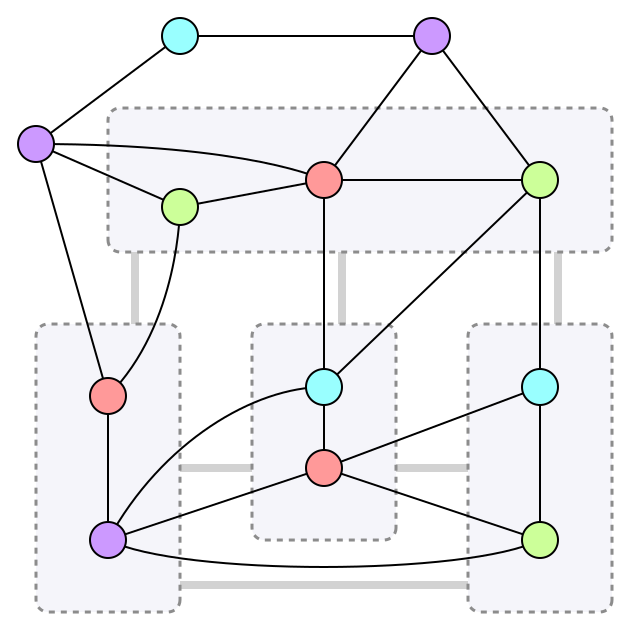
Size of largest complete graph made by contracting edges of a given graph
In graph theory, the Hadwiger number of an undirected graph G is the size of the largest complete graph that can be obtained by contracting edges of G. Equivalently, the Hadwiger number h(G) is the largest number n for which the complete graph K is a minor of G, a smaller graph obtained from G by edge contractions and vertex and edge deletions. The Hadwiger number is also known as the contraction clique number of G or the homomorphism degree of G. It is named after Hugo Hadwiger, who introduced it in 1943 in conjunction with the Hadwiger conjecture, which states that the Hadwiger number is always at least as large as the chromatic number of G.
The graphs that have Hadwiger number at most four have been characterized by . The graphs with any finite bound on the Hadwiger number are sparse, and have small chromatic number. Determining the Hadwiger number of a graph is NP-hard but fixed-parameter tractable.
Graphs with small Hadwiger number
A graph G has Hadwiger number at most two if and only if it is a forest, for a three-vertex complete minor can only be formed by contracting a cycle in G.
A graph has Hadwiger number at most three if and only if its treewidth is at most two, which is true if and only if each of its biconnected components is a series–parallel graph.

Wagner's theorem, which characterizes the planar graphs by their forbidden minors, implies that the planar graphs have Hadwiger number at most four. In the same paper that proved this theorem, also characterized the graphs with Hadwiger number at most four more precisely: they are graphs that can be formed by clique-sum operations that combine planar graphs with the eight-vertex Wagner graph.
The graphs with Hadwiger number at most five include the apex graphs and the linklessly embeddable graphs, both of which have the complete graph K among their forbidden minors.
Sparsity
Every graph with n vertices and Hadwiger number k has edges. This bound is tight: for every k, there exist graphs with Hadwiger number k that have edges. If a graph G has Hadwiger number k, then all of its subgraphs also have Hadwiger number at most k, and it follows that G must have degeneracy . Therefore, the graphs with bounded Hadwiger number are sparse graphs.
Coloring
The Hadwiger conjecture states that the Hadwiger number is always at least as large as the chromatic number of G. That is, every graph with Hadwiger number k should have a graph coloring with at most k colors. The case is equivalent (by Wagner's characterization of the graphs with this Hadwiger number) to the four color theorem on colorings of planar graphs, and the conjecture has also been proven for k ≤ 5, but remains unproven for larger values of k.
Because of their low degeneracy, the graphs with Hadwiger number at most k can be colored by a greedy coloring algorithm using colors.
Computational complexity
Testing whether the Hadwiger number of a given graph is at least a given value k is NP-complete, from which it follows that determining the Hadwiger number is NP-hard. However, the problem is fixed-parameter tractable: there is an algorithm for finding the largest clique minor in an amount of time that depends only polynomially on the size of the graph, but exponentially in h(G). Additionally, polynomial time algorithms can approximate the Hadwiger number to within an approximation ratio of O(\sqrt n), significantly more accurately than the best polynomial-time approximation (assuming P ≠ NP) to the size of the largest complete subgraph.
Footnotes
Notes
References
- .
- .
- {{citation
- {{citation
- .
- {{citation
- .
- {{citation
- .
- {{citation
- {{citation
- .
References
- {{harvtxt. Kostochka. 1984; {{harvtxt. Thomason. 2001. The letters O and Ω in these expressions invoke [[big O notation]].
- {{harvtxt. Alon. Lingas. Wahlen. 2007
This article was imported from Wikipedia and is available under the Creative Commons Attribution-ShareAlike 4.0 License. Content has been adapted to SurfDoc format. Original contributors can be found on the article history page.
Ask Mako anything about Hadwiger number — get instant answers, deeper analysis, and related topics.
Research with MakoFree with your Surf account
Create a free account to save articles, ask Mako questions, and organize your research.
Sign up freeThis content may have been generated or modified by AI. CloudSurf Software LLC is not responsible for the accuracy, completeness, or reliability of AI-generated content. Always verify important information from primary sources.
Report