From Surf Wiki (app.surf) — the open knowledge base
Hacktivism
Computer-based activities as a means of protest

Computer-based activities as a means of protest
Hacktivism (or hactivism; a portmanteau of hack and activism) is the use of computer-based techniques such as hacking as a form of civil disobedience to promote a political agenda or social change. A form of Internet activism with roots in hacker culture and hacker ethics, its ends are often related to free speech, human rights, or freedom of information movements.
Hacktivist activities span many political ideals and issues. Hacking as a form of activism can be carried out by a singular activist or through a network of activists, such as Anonymous and WikiLeaks, working in collaboration toward common goals without an overarching authority figure. For context, according to a statement by the U.S. Justice Department, Julian Assange, the founder of WikiLeaks, plotted with hackers connected to the "Anonymous" and "LulzSec" groups, who have been linked to multiple cyberattacks worldwide. In 2012, Assange, who was being held in the United Kingdom on a request for extradition from the United States, gave the head of LulzSec a list of targets to hack and informed him that the most significant leaks of compromised material would come from the National Security Agency, the Central Intelligence Agency, or the New York Times.
"Hacktivism" is a controversial term with several meanings. The word was coined to characterize electronic direct action as working toward social change by combining programming skills with critical thinking. But just as hack can sometimes mean cyber crime, hacktivism can be used to mean activism that is malicious, destructive, and undermining the security of the Internet as a technical, economic, and political platform. In comparison to previous forms of social activism, hacktivism has had unprecedented success, bringing in more participants, using more tools, and having more influence in that it has the ability to alter elections, begin conflicts, and take down businesses.
According to the United States 2020–2022 Counterintelligence Strategy, in addition to state adversaries and transnational criminal organizations, "ideologically motivated entities such as hacktivists, leaktivists, and public disclosure organizations, also pose significant threats".
Origins and definitions
Writer Jason Sack first used the term hacktivism in a 1995 article in conceptualizing New Media artist Shu Lea Cheang's film Fresh Kill. However, the term is frequently attributed to the Cult of the Dead Cow (cDc) member "Omega," who used it in a 1996 e-mail to the group. Due to the variety of meanings of its root words, the definition of hacktivism is nebulous and there exists significant disagreement over the kinds of activities and purposes it encompasses. Some definitions include acts of cyberterrorism while others simply reaffirm the use of technological hacking to effect social change.
Forms and methods

Self-proclaimed "hacktivists" often work anonymously, sometimes operating in groups while other times operating as a lone wolf with several cyber-personas all corresponding to one activist within the cyberactivism umbrella that has been gaining public interest and power in pop culture. Hacktivists generally operate under apolitical ideals and express uninhibited ideas or abuse without being scrutinized by society while representing or defending themselves publicly under an anonymous identity giving them a sense of power in the cyberactivism community.
In order to carry out their operations, hacktivists might create new tools, or integrate or use a variety of software tools readily available on the Internet. One class of hacktivist activities is increasing the accessibility of others to take politically motivated action online.
Repertoire of contention of hacktivism includes among others:
- Code: Software and websites can achieve political goals. For example, the encryption software PGP can be used to secure communications; PGP's author, Phil Zimmermann said he distributed it first to the peace movement. Jim Warren suggests PGP's wide dissemination was in response to Senate Bill 266, authored by Senators Biden and DeConcini, which demanded that "communications systems permit the government to obtain the plain text contents of voice, data, and other communications". WikiLeaks is an example of a politically motivated website: it seeks to "keep governments open".
- Mirroring: Website mirroring is used as a circumvention tool in order to bypass various censorship blocks on websites. This technique copies the contents of a censored website and disseminates it on other domains and sub-domains that are not censored. Document mirroring, similar to website mirroring, is a technique that focuses on backing up various documents and other works. RECAP is software that was written with the purpose to 'liberate US case law' and make it openly available online. The software project takes the form of distributed document collection and archival. Major mirroring projects include initiatives such as the Internet Archive and Wikisource.
- Anonymity: A method of speaking out to a wide audience about human rights issues, government oppression, etc. that utilizes various web tools such as free and/or disposable email accounts, IP masking, and blogging software to preserve a high level of anonymity.
- Doxing: The practice in which private and/or confidential documents and records are hacked into and made public. Hacktivists see this as a form of assured transparency, experts claim it is harassment.
- Denial-of-service attacks: These attacks, commonly referred to as DoS attacks, use large arrays of personal and public computers that hackers take control of via malware executable files usually transmitted through email attachments or website links. After taking control, these computers act like a herd of zombies, redirecting their network traffic to one website, with the intention of overloading servers and taking a website offline.
- Virtual sit-ins: Similar to DoS attacks but executed by individuals rather than software, a large number of protesters visit a targeted website and rapidly load pages to overwhelm the site with network traffic to slow the site or take it offline.
- Website defacements: Hackers infiltrate a web server to replace a specific web page with one of their own, usually to convey a specific message.
- Website redirects: This method involves changing the address of a website within the server so would-be visitors of the site are redirected to a site created by the perpetrator, typically to denounce the original site.
- Geo-bombing: A technique in which netizens add a geo-tag while editing YouTube videos so that the location of the video can be seen in Google Earth.
- Protestware: The use of malware to promote a social cause or protest. Protestware is self-inflicted by a project's maintainer in order to spread a message, most commonly in a disruptive manner. The term was popularized during the Russo-Ukrainian War after the peacenotwar supply chain attack on the npm ecosystem.
Controversy
Depending on who is using the term, hacktivism can be a politically motivated technology hack, a constructive form of anarchic civil disobedience, or an undefined anti-systemic gesture. It can signal anticapitalist or political protest; it can denote anti-spam activists, security experts, or open-source advocates.
Some people describing themselves as hacktivists have taken to defacing websites for political reasons, such as attacking and defacing websites of governments and those who oppose their ideology. Others, such as Oxblood Ruffin (the "foreign affairs minister" of Cult of the Dead Cow and Hacktivismo), have argued forcefully against definitions of hacktivism that include web defacements or denial-of-service attacks.
Hacktivism is often seen as shadowy due to its anonymity, commonly attributed to the work of fringe groups and outlying members of society. The lack of responsible parties to be held accountable for the social-media attacks performed by hactivists has created implications in corporate and federal security measures both on and offline.
While some self-described hacktivists have engaged in DoS attacks, critics suggest that DoS attacks are an attack on free speech and that they have unintended consequences. DoS attacks waste resources and they can lead to a "DoS war" that nobody will win. In 2006, Blue Security attempted to automate a DoS attack against spammers; this led to a massive DoS attack against Blue Security which knocked them, their old ISP and their DNS provider off the Internet, destroying their business.
Following denial-of-service attacks by Anonymous on multiple sites, in reprisal for the apparent suppression of WikiLeaks, John Perry Barlow, a founding member of the EFF, said, "I support freedom of expression, no matter whose, so I oppose DDoS attacks regardless of their target... they're the poison gas of cyberspace". On the other hand, Jay Leiderman, an attorney for many hacktivists, argues that DDoS can be a legitimate form of protest speech in situations that are reasonably limited in time, place and manner.
Notable hacktivist events
- The Cult of the Dead Cow announces the existence of the Hong Kong Blondes, a supposed group of Chinese dissident hackers working to undermine internet censorship in the PRC. Though widely reported and discussed at high levels of the U.S. government, the group was later revealed to be a fabrication intended to draw attention to digital repression and possibly to provide cover for the extraction of Chinese activists.
- In 1996, the title of the United States Department of Justice's homepage was changed to "Department of Injustice". Pornographic images were also added to the homepage to protest the Communications Decency Act.
- In 1998, members of the Electronic Disturbance Theater created FloodNet, a web tool that allowed users to participate in DDoS attacks (or what they called electronic civil disobedience) in support of Zapatista rebels in Chiapas.
- In December 1998, a hacktivist group from the US called Legions of the Underground emerged. They declared a cyberwar against Iraq and China and planned on disabling internet access in retaliation for the countries' human rights abuses. Opposing hackers criticized this move by Legions of the Underground, saying that by shutting down internet systems, the hacktivist group would have no impact on providing free access to information.
- In July 2001, Hacktivismo, a sect of the Cult of the Dead Cow, issued the "Hacktivismo Declaration". This served as a code of conduct for those participating in hacktivism, and declared the hacker community's goals of stopping "state-sponsored censorship of the Internet" as well as affirming the rights of those therein to "freedom of opinion and expression".
- During the 2009 Iranian election protests, Anonymous played a role in disseminating information to and from Iran by setting up the website Anonymous Iran; they also released a video manifesto to the Iranian government.
- Google worked with engineers from SayNow and Twitter to provide communications for the Egyptian people in response to the government sanctioned Internet blackout during the 2011 protests. The result, Speak To Tweet, was a service in which voicemail left by phone was then tweeted via Twitter with a link to the voice message on Google's SayNow.
- On Saturday 29 May 2010 a hacker calling himself 'Kaka Argentine' hacked into the Ugandan State House website and posted a conspicuous picture of Adolf Hitler with the swastika, a Nazi Party symbol.
- During the Egyptian Internet black out, January 28 – February 2, 2011, Telecomix provided dial up services, and technical support for the Egyptian people. Telecomix released a video stating their support of the Egyptian people, describing their efforts to provide dial-up connections, and offering methods to avoid internet filters and government surveillance. The hacktivist group also announced that they were closely tracking radio frequencies in the event that someone was sending out important messages.
- Project Chanology, also known as "Operation Chanology", was a hacktivist protest against the Church of Scientology to punish the church for participating in Internet censorship relating to the removal of material from a 2008 interview with Church of Scientology member Tom Cruise. Hacker group Anonymous attempted to "expel the church from the Internet" via DDoS attacks. In February 2008 the movement shifted toward legal methods of nonviolent protesting. Several protests were held as part of Project Chanology, beginning in 2008 and ending in 2009.
- On June 3, 2011, LulzSec took down a website of the FBI. This was the first time they had targeted a website that was not part of the private sector. That week, the FBI was able to track the leader of LulzSec, Hector Xavier Monsegur.
- On June 20, 2011, LulzSec targeted the Serious Organised Crime Agency of the United Kingdom, causing UK authorities to take down the website.
- In August 2011 a member of Anonymous working under the name "Oliver Tucket" took control of the Syrian Defense Ministry website and added an Israeli government web portal in addition to changing the mail server for the website to one belonging to the Chinese navy.
- Anonymous and New World Hackers claimed responsibility for the 2016 Dyn cyberattack in retaliation for Ecuador's rescinding Internet access to WikiLeaks founder Julian Assange at their embassy in London. WikiLeaks alluded to the attack. Subsequently, FlashPoint stated that the attack was most likely done by script kiddies.
- In 2013, as an online component to the Million Mask March, Anonymous in the Philippines crashed 30 government websites and posted a YouTube video to congregate people in front of the parliament house on November 5 to demonstrate their disdain toward the Filipino government.
- In 2014, Sony Pictures Entertainment was hacked by a group by the name of Guardians of Peace (GOP), who obtained over 100 terabytes of data including unreleased films, employee salary, social security data, passwords, and account information. GOP hacked various social media accounts and hijacked them by changing their passwords to diespe123 (die sony pictures entertainment) and posting threats on the pages.
- In 2016, Turkish programmer Azer Koçulu removed his software package left-pad from npm, causing a cascading failure of other software packages that contained left-pad as a dependency. This was done after Kik, a messaging application, threatened legal action against Koçulu after he refused to rename his
kikpackage. npm ultimately sided with Kik, prompting Koçulu to unpublish all of his packages from npm in protest, including left-pad. - British hacker Kane Gamble, who was sentenced to two years in youth detention, posed as John Brennan, the then director of the CIA, and Mark F. Giuliano, a former deputy director of the FBI, to access highly sensitive information. The judge said Gamble engaged in "politically motivated cyber-terrorism."
- In 2021, Anonymous hacked and leaked the databases of American web hosting company Epik.
- As a response against 2022 Russian invasion of Ukraine, Anonymous performed multiple cyberattacks against Russian computer systems.
- Following the Gaza war since 2023, multiple cyberattacks attacks were seen from pro-Israel and pro-Palestine hacktivist groups. India's pro-Israel hacktivists took down the portals of Palestinian National Bank, the National Telecommunications Company and the website of Hamas. Multiple Israeli websites were flooded with malicious traffic by pro-Palestine hacktivists. Israeli newspaper The Jerusalem Post reported that its website was down due to a series of cyberattacks initiated against them.
Notable hacktivist people/groups
WikiLeaks
Main article: WikiLeaks
WikiLeaks is a media organisation and publisher founded in 2006. It operates as a non-profit and is funded by donations and media partnerships. It has published classified documents and other media provided by anonymous sources. It was founded by Julian Assange, an Australian editor, publisher, and activist, who is currently challenging extradition to the United States over his work with WikiLeaks. Since September 2018, Kristinn Hrafnsson has served as its editor-in-chief. Its website states that it has released more than ten million documents and associated analyses. WikiLeaks' most recent publication was in 2021, and its most recent publication of original documents was in 2019. Beginning in November 2022, many of the documents on the organisation's website could not be accessed.
WikiLeaks has released document caches and media that exposed serious violations of human rights and civil liberties by various governments. It released footage, which it titled Collateral Murder, of the 12July 2007 Baghdad airstrike, in which Iraqi Reuters journalists and several civilians were killed by a U.S. helicopter crew. WikiLeaks has also published leaks such as diplomatic cables from the United States and Saudi Arabia, emails from the governments of Syria and Turkey, corruption in Kenya and at Samherji. WikiLeaks has also published documents exposing cyber warfare and surveillance tools created by the CIA, and surveillance of the French president by the National Security Agency. During the 2016 U.S. presidential election campaign, WikiLeaks released emails from the Democratic National Committee (DNC) and from Hillary Clinton's campaign manager, showing that the party's national committee had effectively acted as an arm of the Clinton campaign during the primaries, seeking to undercut the campaign of Bernie Sanders. These releases resulted in the resignation of the chairwoman of the DNC and caused significant harm to the Clinton campaign. During the campaign, WikiLeaks promoted false conspiracy theories about Hillary Clinton, the Democratic Party and the murder of Seth Rich.
WikiLeaks has won a number of awards and has been commended for exposing state and corporate secrets, increasing transparency, assisting freedom of the press, and enhancing democratic discourse while challenging powerful institutions. WikiLeaks and some of its supporters say the organisation's publications have a perfect record of publishing authentic documents. The organisation has been the target of campaigns to discredit it, including aborted ones by Palantir and HBGary. WikiLeaks has also had its donation systems disrupted by problems with its payment processors. As a result, the Wau Holland Foundation helps process WikiLeaks' donations.
The organisation has been criticised for inadequately curating some of its content and violating the personal privacy of individuals. WikiLeaks has, for instance, revealed Social Security numbers, medical information, credit card numbers and details of suicide attempts. News organisations, activists, journalists and former members have also criticised the organisation over allegations of anti-Clinton and pro-Trump bias, various associations with the Russian government, buying and selling of leaks, and a lack of internal transparency. Journalists have also criticised the organisation for promotion of false flag conspiracy theories, and what they describe as exaggerated and misleading descriptions of the contents of leaks. The CIA defined the organisation as a "non-state hostile intelligence service" after the release of Vault 7.
Anonymous
Main article: Anonymous (group)
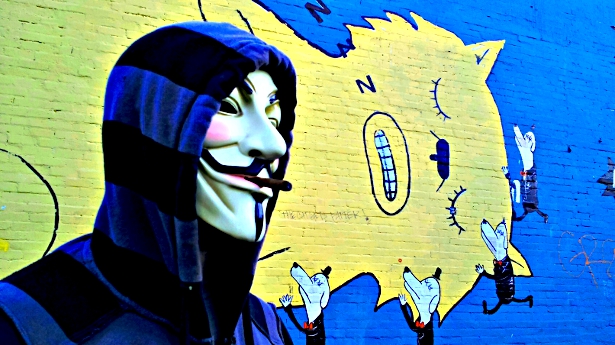
Perhaps the most prolific and well known hacktivist group, Anonymous has been prominent and prevalent in many major online hacks over the past decade. Anonymous is a decentralized group that originated on the forums of 4chan during 2003, but didn't rise to prominence until 2008 when they directly attacked the Church of Scientology in a massive DoS attack. Since then, Anonymous has participated in a great number of online projects such as Operation: Payback and Operation: Safe Winter. However, while a great number of their projects have been for a charitable cause, they have still gained notoriety from the media due to the nature of their work mostly consisting of illegal hacking.
Following the Paris terror attacks in 2015, Anonymous posted a video declaring war on ISIS, the terror group that claimed responsibility for the attacks. Since declaring war on ISIS, Anonymous since identified several Twitter accounts associated with the movement in order to stop the distribution of ISIS propaganda. However, Anonymous fell under heavy criticism when Twitter issued a statement calling the lists Anonymous had compiled "wildly inaccurate," as it contained accounts of journalists and academics rather than members of ISIS.
Anonymous has also been involved with the Black Lives Matter movement. Early in July 2015, a rumor circulated that Anonymous was calling for a Day of Rage protests in retaliation for the shootings of Alton Sterling and Philando Castile, which would entail violent protests and riots. This rumor was based on a video that was not posted with the official Anonymous YouTube account. None of the Twitter accounts associated with Anonymous had tweeted anything in relation to a Day of Rage, and the rumors were identical to past rumors that had circulated in 2014 following the death of Mike Brown. Instead, on July 15, a Twitter account associated with Anonymous posted a series of tweets calling for a day of solidarity with the Black Lives Matter movement. The Twitter account used the hashtag "#FridayofSolidarity" to coordinate protests across the nation, and emphasized the fact that the Friday of Solidarity was intended for peaceful protests. The account also stated that the group was unaware of any Day of Rage plans.
In February 2017 the group took down more than 10,000 sites on the dark web related to child porn.
DkD||
DkD[||, a French cyberhacktivist, was arrested by the OCLCTIC (office central de lutte contre la criminalité liée aux technologies de l’information et de la communication), in March 2003. DkD[|| defaced more than 2000 pages, many of them governments and US military sites. Eric Voulleminot of the Regional Service of Judicial Police in Lille classified the young hacker as "the most wanted hacktivist in France".
DkD[|| was a very known defacer in the underground for his political view, doing his defacements for various political reasons. In response to his arrest, The Ghost Boys defaced many sites using the “Free DkD[||!!” slogan.
LulzSec
Main article: [LulzSec
In May 2011, five members of Anonymous formed the hacktivist group Lulz Security, otherwise known as LulzSec. LulzSec's name originated from the conjunction of the internet slang term "lulz", meaning laughs, and "sec", meaning security. The group members used specific handles to identify themselves on Internet Relay Channels, the most notable being: "Sabu," "Kayla," "T-Flow," "Topiary," "AVUnit," and "Pwnsauce." Though the members of LulzSec would spend up to 20 hours a day in communication, they did not know one another personally, nor did they share personal information. For example, once the members' identities were revealed, "T-Flow" was revealed to be 15 years old. Other members, on the basis of his advanced coding ability, thought he was around 30 years old.
One of the first notable targets that LulzSec pursued was HBGary, which was performed in response to a claim made by the technology security company that it had identified members of Anonymous. Following this, the members of LulzSec targeted an array of companies and entities, including but not limited to Fox Television, Tribune Company, PBS, Sony, Nintendo, and the Senate.gov website. The targeting of these entities typically involved gaining access to and downloading confidential user information, or defacing the website at hand. While not as strongly political as WikiLeaks or Anonymous, LulzSec shared similar sentiments for the freedom of information. One of their distinctly politically driven attacks involved targeting the Arizona State Police in response to new immigration laws.
The group's first attack that garnered significant government attention was in 2011, when they collectively took down a website of the FBI. Following the incident, the leader of LulzSec, "Sabu," was identified as Hector Xavier Monsegur by the FBI, and he was the first of the group to be arrested. Immediately following his arrest, Monsegur admitted to criminal activity. He then began his cooperation with the US government, helping FBI authorities to arrest 8 of his co-conspirators, prevent 300 potential cyber attacks, and helped to identify vulnerabilities in existing computer systems. In August 2011, Monsegur pleaded guilty to "computer hacking conspiracy, computer hacking, computer hacking in furtherance of fraud, conspiracy to commit access device fraud, conspiracy to commit bank fraud, and aggravated identity theft pursuant to a cooperation agreement with the government." He served a total of one year and seven months and was charged a $1,200 fine.
SiegedSec
Main article: SiegedSec
SiegedSec, short for Sieged Security and commonly self-referred to as the "Gay Furry Hackers", is a black-hat criminal hacktivist group that was formed in early 2022, that has committed a number of high-profile cyber attacks, including attacks on NATO, The Idaho National Laboratory, and Real America's Voice. On July 10, 2024, the group announced that they would be disbanding after attacking The Heritage Foundation.
SiegedSec is led by an individual under the alias "vio". Short for "Sieged Security", SiegedSec's Telegram channel was created in April 2022, and they commonly refer to themselves as "gay furry hackers". On multiple occasions, the group has targeted right-wing movements through breaching data, including The Heritage Foundation, Real America's Voice, and various U.S. states that have pursued legislation against gender-affirming care.
References
References
- "THE "ANONYMOUS" MOVEMENT: HACKTIVISM AS AN EMERGING FORM OF POLITICAL PARTICIPATION".
- (2024). "Hacktivism". Internet Policy Review.
- "Hackers take down thousands of 'dark web' sites, post private data". NBC News.
- Milone, Mark. (2002). "Hactivism: Securing the National Infrastructure". The Business Lawyer.
- (2021). "The stray sheep of cyberspace a.k.a. the actors who claim they break the law for the greater good". [[Personal and Ubiquitous Computing]].
- Pettersson, Edvard. (2020-06-25). "WikiLeaks Founder Julian Assange Accused of Conspiring With LulzSec and Anonymous Hackers".
- Peter Krapp, [http://www.upress.umn.edu/book-division/books/noise-channels "Noise Channels: Glitch and Error in Digital Culture"], University of Minnesota Press 2011. {{ISBN. 978-0-8166-7625-5. {{webarchive. link. (2013-05-23 .)
- (2019-09-01). "From clicktivism to hacktivism: Understanding digital activism". Information and Organization.
- Menn, Joseph. (March 25, 2021). "New wave of 'hacktivism' adds twist to cybersecurity woes".
- "[https://www.dni.gov/files/NCSC/documents/features/20200205-National_CI_Strategy_2020_2022.pdf National Counterintelligence Strategy of the United States of America 2020-2022]", Director of National Intelligence.
- Logan, Jason. (November 1995). "Take the Skinheads Bowling".
- (June 2018). "The Rise of Chinese Cyber Warriors: Towards a Theoretical Model of Online Hacktivism". International Journal of Cyber Criminology.
- (2014-11-28). "Cyber Disobedience: Re: // Presenting Online Anarchy". John Hunt Publishing.
- Mills, Elinor. (30 March 2012). "Old-time hacktivists: Anonymous, you've crossed the line".
- Peter Ludlow [http://opinionator.blogs.nytimes.com/2013/01/13/what-is-a-hacktivist/ "What is a 'Hacktivist'?"] {{webarchive. link. (2013-05-21 The New York Times. January 2013.)
- Jordon, Tomblin. (2015-01-01). "The Rehearsal and Performance of Lawful Access".
- "What is Hacktivism? | CrowdStrike".
- "Becoming a hacktivist. Examining the motivations and the processes that prompt an individual to engage in hacktivism". Journal of Crime and Justice.
- "PGP Marks 10th Anniversary". Phil Zimmermann.
- (1996-01-08). "The Persecution of Phil Zimmermann, American". Jim Warren.
- "WikiLeaks homepage". WikiLeaks.
- Ben Gharbia, Sami. "Mirroring a Censored Wordpress Blog". Global Voices Advocacy.
- "Recap the law".
- Zuckerman, Ethan. "Anonymous Blogging with Wordpress and Tor". Global Voices Advocacy.
- (October 2017). "Hacktivism and Website Defacement: Motivations, Capabilities and potential Threats". Proceedings of the 27th Virus Bulletin International Conference.
- Fitri, Nofia. (April 2011). "Democracy Discourses through the Internet Communication: Understanding the Hacktivism for the Global Changing". Online Journal of Communication and Media Technologies.
- "Geo-bombing: YouTube + Google Earth · Global Voices Advocacy".
- (24 March 2022). "Open source 'protestware' harms Open Source".
- (17 March 2022). "Pro-Ukraine 'Protestware' Pushes Antiwar Ads, Geo-Targeted Malware – Krebs on Security".
- (2010). "Hactivism's New Face: Are Your Company's Enemies Embracing New Tactics?". Security Directors Report.
- Ragan, Steve. (2014). "Hactivism Struggles With a Slippery Slope as Anonymous Targets Children's Hospital". CSO Magazine.
- (2017). "Electronic protests: Hacktivism as a form of protest in Uganda". Computer Law & Security Review.
- Ruffin, Oxblood. (3 June 2004). "Hacktivism, From Here to There".
- Sorell, Tom. (2015-09-22). "Human Rights and Hacktivism: The Cases of Wikileaks and Anonymous". Journal of Human Rights Practice.
- (10 January 2017). "'Hacktivists' Increasingly Target Local and State Government Computers".
- Lemos, Robert. (17 May 2006). "Blue Security folds under spammer's wrath". SecurityFocus.
- (2010-12-09). "Analysis: WikiLeaks — a new face of cyber-war?". Reuters.
- Leiderman, Jay. (22 January 2013). "Why DDoS is Free Speech". The Guardian.
- Menn, Joseph. (2019). "Cult of the Dead Cow: How the Original Hacking Supergroup Might Just Save the World". PublicAffairs.
- Hesseldahl, Arik. (December 1, 1997). "Updata: Hacking The Great Firewall".
- (March 23, 2015). "Blondie Wong And The Hong Kong Blondes: hacking, human rights, and hype". Medium.
- "The Rise of Hacktivism {{!}}".
- "When art meets cyberwar".
- "Old-time hacktivists: Anonymous, you've crossed the line". CNET.
- D'Amico, Mary Lisbeth. "CNN – Hackers spar over cyber war on Iraq, China – January 13, 1999".
- McCormick, Ty. (April 29, 2013). "Hacktivism: A Short History".
- "Anonymous Iran @WhyWeProtest.net". Iran.whyweprotest.net.
- Singh, Ujjwal. "Some weekend work that will (hopefully) allow more Egyptians to be heard".
- Galperin, Eva. (8 February 2011). "Egypt's Internet Blackout Highlights Danger of Weak Links, Usefulness of Quick Links". Electric Frontier Foundation.
- (2011-01-30). "Telecomix Message to North Africa and the Middle east". czardalan.
- Greenberg, Andy. "Amid Digital Blackout, Anonymous Mass-Faxes WikiLeaks Cables To Egypt". Forbes.
- (2012-05-03). "Soca shuts down website after cyber-attack". The Guardian.
- Peterson, Andrea. (August 28, 2013). "Here's how one hacker is waging war on the Syrian government". The Washington Post.
- (21 October 2016). "WikiLeaks supporters claim credit for massive U.S. cyberattack, but researchers skeptical".
- (22 October 2016). "WikiLeaks' strange admission around internet attacks against Netflix and Twitter".
- (26 October 2016). "Dyn DNS DDoS likely the work of script kiddies, says FlashPoint". TechCrunch.
- Potter, Garry. (2015). "Anonymous: A Political Ontology of Hope". Theory in Action.
- (5 December 2014). "A Breakdown and Analysis of the December, 2014 Sony Hack".
- Collins, Keith. (27 March 2016). "How one programmer broke the internet by deleting a tiny piece of code".
- "[https://www.telegraph.co.uk/news/2018/01/19/british-15-year-old-gained-access-intelligence-operations-afghanistan/ British 15-year-old gained access to intelligence operations in Afghanistan and Iran by pretending to be head of CIA, court hears] {{webarchive. link. (2018-04-23 ". ''The Daily Telegraph''. 19 January 2018.)
- [http://www.dw.com/en/uk-teen-kane-gamble-gets-two-years-for-hacking-cia-ex-chief-john-brennan/a-43477403 UK teen Kane Gamble gets two years for hacking CIA ex-chief John Brennan] {{webarchive. link. (2018-04-22 ". ''Deutsche Welle''. 20 April 2018.)
- (3 April 2022). "Anonymous apparently behind doxing of 120K Russian soldiers in Ukraine war".
- (2023-10-15). "How hackers piled onto the Israeli-Hamas conflict".
- "Hacktivists take sides in Israel-Palestinian war".
- "Attacks on Israeli orgs 'more than doubled' since October 7, cyber researcher says".
- "Israel-Palestine conflict: How Indian hackers sunk their cyber fangs into Hamas, Palestinian national bank".
- (2023-10-10). "Pro-Palestine hackers target India, pro-India groups strike back". The Times of India.
- (2023-10-08). "Israeli daily Jerusalem Post hit by multiple cyberattacks".
- Franceschi-Bicchierai, Lorenzo. (2023-10-09). "Hacktivism erupts in response to Hamas-Israel war".
- (2012). "Aftermath: The Cultures of the Economic Crisis". [[Oxford University Press]].
- (2019). "Navigating New Cyber Risks: How Businesses Can Plan, Build and Manage Safe Spaces in the Digital Age". [[Palgrave MacMillan]].
- (2013). "Designing Organizational Systems: An Interdisciplinary Discourse". [[Springer Nature]].
- (June 2014). "When Old and New Media Collide: The Case of WikiLeaks". [[SAGE Publishing]].
- (2012). "The WikiLeaks Arctic Cables". [[Cambridge University Press]].
- Benkler, Yochai. (2011). "A Free Irresponsible Press: Wikileaks and the Battle over the Soul of the Networked Fourth Estate". [[Harvard Law School]].
- (2014). "Social Media: A Critical Introduction". [[SAGE Publishing]].
- (2012). "Wikileaks: News in the Networked Era". [[Wiley (publisher).
- (2020). "Social Movements in a Globalized World". [[Bloomsbury Publishing]].
- (2014). "The Privatization of the Internet, WikiLeaks and Free Expression". [[USC Annenberg Press]].
- "WikiLeaks". [[The New York Times]].
- McGreal, Chris. (5 April 2010). "Wikileaks reveals video showing US air crew shooting down Iraqi civilians". [[The Guardian]].
- "WikiLeaks names one-time spokesman as editor-in-chief". [[Associated Press]].
- Bridge, Mark. (27 September 2018). "Loss of internet forces Assange to step down from Wikileaks editor role". [[The Times]].
- "What is Wikileaks".
- (22 November 2022). "WikiLeaks' Website Is Falling Apart".
- Thalen, Mikael. (22 November 2022). "Millions of documents disappear from WikiLeaks as site completely breaks down".
- Burgess, Matt. "Apple Tracks You More Than You Think".
- . (22 November 2022). ["WikiLeaks è in grave difficoltà: sito a malapena online, leak ormai assenti"](https://www.hdblog.it/internet/articoli/n563620/wikileaks-problemi-funzionamento-sito-offline/).
- "Reporters Sans Frontières - Open letter to Wikileaks founder Julian Assange: ''A bad precedent for the Internet's future''".
- Hubbard, Ben. (20 June 2015). "Cables Released by WikiLeaks Reveal Saudis' Checkbook Diplomacy". [[The New York Times]].
- Zorthian, Julia. (19 June 2015). "WikiLeaks Begins Releasing Leaked Saudi Arabia Cables".
- (5 July 2012). "Syria files: Wikileaks releases 2m 'embarrassing' emails". [[BBC News]].
- Greenberg, Andy. (5 July 2012). "WikiLeaks Announces Massive Release With The 'Syria Files': 2.4 Million Emails From Syrian Officials And Companies".
- Yeung, Peter. (20 July 2016). "President Erdogan emails: What is in the Wikileaks release about Turkey's government?". [[The Independent]].
- Doctorow, Cory. (29 July 2016). "Wikileaks' dump of "Erdogan emails" turn out to be public mailing list archives". BoingBoing.
- Gramer, Robbie. (7 December 2016). "Latest Wikileaks Dump Sheds New Light on Erdogan's Power In Turkey".
- Dahir, Abdi Latif. (13 April 2019). "It all started in Nairobi: How Kenya gave Julian Assange's WikiLeaks its first major global scoop". Quartz Africa.
- Rice, Xan. (31 August 2007). "The looting of Kenya". [[The Guardian]].
- . (7 March 2022). ["The Fishrot scandal"](https://pplaaf.org/cases/fishrot.html).
- Menn, Joseph. (29 March 2017). "A scramble at Cisco exposes uncomfortable truths about U.S. cyber defense". [[Reuters]].
- (7 March 2017). "WikiLeaks Releases Trove of Alleged C.I.A. Hacking Documents". [[The New York Times]].
- (23 June 2015). "NSA spied on French presidents: WikiLeaks". [[Reuters]].
- (24 June 2015). "Hollande Condemns Spying by U.S., but Not Too Harshly". [[The New York Times]].
- "Why it's entirely predictable that Hillary Clinton's emails are back in the news". [[The Washington Post]].
- Ohlheiser, Abby. (4 November 2016). "No, John Podesta didn't drink bodily fluids at a secret Satanist dinner". [[The Washington Post]].
- "WikiLeaks Fuels Conspiracy Theories About DNC Staffer's Death". [[NBC News]].
- (10 October 2016). "How Julian Assange turned WikiLeaks into Trump's best friend".
- Brustein, Joshua. (29 July 2016). "Why Wikileaks Is Losing Its Friends". [[Bloomberg News.
- (23 August 2016). "Private lives are exposed as WikiLeaks spills its secrets".
- Peterson, Andrea. "Snowden and WikiLeaks clash over leaked Democratic Party emails". [[The Washington Post]].
- (6 October 2021). "U.S. prosecution of alleged WikiLeaks 'Vault 7' source hits multiple roadblocks".
- (2008-06-08). "Feature by Chris Landers: Serious Business {{!}} 4/2/2008".
- (4 January 2014). "#OpSafeWinter: Anonymous fights homelessness worldwide".
- (17 September 2010). "4chan Users Organize Surgical Strike Against MPAA – MediaCenter Panda Security".
- Goldman, David. "Hacker group Anonymous is a nuisance, not a threat".
- (2015-11-16). "Anonymous has declared war on Isis after the Paris attacks". The Independent.
- (2015-12-15). "Anonymous Hacks ISIS, But Warns Against Collaborating With US". International Business Times.
- LaCapria, Kim. (11 July 2016). "Anonymous 'Day of Rage' Protests".
- "Black Lives Matter Protests Happening Today At SF's Civic Center And Downtown Oakland". SFist.
- Antson, Franck. (2003-07-09). "Arrestation du " hacker " le plus recherché de France".
- ["DKD{{!}}{{!}} Officially stopped".
- "Arrestation du " hacker " le plus recherché de France".
- Arthur, Charles. (2013-05-16). "LulzSec: what they did, who they were and how they were caught". The Guardian.
- Gilbert, David. (2014-09-30). "LulzSec Reunited: Anonymous Hackers Meet for the First Time in Real Life". International Business Times UK.
- United States of America v. Hector Monsegur. Southern District Court of New York. 23 May 2014. ''Cryptome.org''. N.p., n.d. Web. 20 Oct. 2016.
- Watts, Susan. (2013-05-16). "Former Lulzsec hacker Jake Davis on his motivations". BBC News.
- "Leading Member of the International Cyber Criminal Group LulzSec Sentenced in Manhattan Federal Court".
- (2023-11-23). "Self-described gay furry hackers breach one of the biggest nuclear labs in the US, and demand it begin researching 'IRL catgirls'". PC Gamer.
- (2023-11-22). "Self-proclaimed 'gay furry hackers' breach nuclear lab".
- Lyons, Jessica. "NATO investigates hacktivist group's stolen data claims".
- "NATO investigates alleged data theft by SiegedSec hackers".
- Vicens, A. J.. (2023-07-26). "NATO investigating apparent breach of unclassified information sharing platform".
- Thalen, Mikael. (2024-04-16). "Furry hackers far-right campaign sets sights on Charlie Kirk, Steve Bannon".
- "Gay Furry Hacker Group SiegedSec Breached a Far-Right Media Outlet and Wreaked Havoc".
- (July 10, 2024). "Read the furious texts the Heritage Foundation sent furry hacking collective SiegedSec after breach". [[The Daily Dot]].
- (July 5, 2023). "UConn targeted in cyberattack allegedly by hacker in group known for targeting government agencies". [[Hartford Courant]].
- (July 11, 2024). "Claws Out: 'Gay Furry Hackers' Target Heritage Foundation". [[National Review]].
- (November 24, 2023). "'Gay furry hackers' breach nuclear lab, demand it create catgirls". [[Mashable]].
- (November 24, 2023). "Gay Furry Hackers Break Into Nuclear Lab Data, Want Catgirls". [[Kotaku Australia]].
- (July 9, 2024). "Hacktivists release two gigabytes of Heritage Foundation data". CyberScoop.
- (July 14, 2023). "Gay furry hackers are targeting US states for passing anti-trans legislation". [[Business Insider]].
- (July 9, 2024). ""Gay Furry Hackers" Claim Credit for Hacking Heritage Foundation Over Project 2025". [[The Intercept]].
- (July 10, 2024). "'Gay furry hackers' steal 200GB of data in huge anti-Project 2025 cyber attack". [[PinkNews]].
- (July 10, 2024). ""Gay furry hackers" claim credit for Heritage Foundation cyberattack". [[Salon.com]].
- (April 19, 2024). "Gay Furry Hacker Group SiegedSec Breached a Far-Right Media Outlet and Wreaked Havoc". [[Them (website).
- (June 29, 2023). "'Gay furries' group hacks agencies in US states attacking gender-affirming care". [[The Guardian]].
- (18 February 2020). "Collaborative Society". MIT Press.
- Steinberg, Monica. (2021-07-03). "Coercive Disobedience: Art and Simulated Transgression". Art Journal.
- Leng, Kirsten. (2020). "Art, Humor, and Activism: The Sardonic, Sustaining Feminism of the Guerrilla Girls, 1985–2000". Journal of Women's History.
- Carducci, Vince. (2006). "Culture Jamming". Journal of Consumer Culture.
- Bohan, S.. (2005). "Media Hacking". SeanBohan.com.
- Heavens, A.. (2005). "Hacking Baby Cheetahs and Hunger Strikes". Meskel Square.
- Peter Kafka. (2008-06-20). "Obama, McCain Debate Via Twitter: How To Follow Along*". Alleyinsider.com.
- (2008-09-25). "Twitter backlash over McCain campaign 'suspension'". Good Gear Guide.
- Howard Rheingold. (2006-08-22). "Blog Archive » Wikipedia on SMS, political impacts". Smart Mobs.
- (2008). "Proceedings of the 2008 International Conference in Advances on Computer Entertainment Technology - ACE '08".
- "Urban Hacking: Cultural Jamming Strategies in the Risky Spaces of Modernity". Transcript.
This article was imported from Wikipedia and is available under the Creative Commons Attribution-ShareAlike 4.0 License. Content has been adapted to SurfDoc format. Original contributors can be found on the article history page.
Ask Mako anything about Hacktivism — get instant answers, deeper analysis, and related topics.
Research with MakoFree with your Surf account
Create a free account to save articles, ask Mako questions, and organize your research.
Sign up freeThis content may have been generated or modified by AI. CloudSurf Software LLC is not responsible for the accuracy, completeness, or reliability of AI-generated content. Always verify important information from primary sources.
Report