From Surf Wiki (app.surf) — the open knowledge base
Habima Theatre
Theatre in Tel Aviv, Israel

Theatre in Tel Aviv, Israel
| Field | Value |
|---|---|
| name | Habima Theatre |
| native_name | תיאטרון הבימה |
| native_name_lang | Hebrew |
| logo_image | File:HabimaLogo.svg |
| image | PikiWiki Israel 14066 Habimaquot; Theatre.JPG |
| image_size | 250px |
| caption | Habima Theatre, 2011 |
| address | Habima Square |
| city | Tel Aviv |
| country | Israel |
| architect | Oskar Kaufmann, Eugene Stolzer |
| capacity | Rovina Theatre: 930 seats |
| Meskin Theatre: 320 seats | |
| Bertonov Theatre: 220 seats | |
| Blanche Rapaport Theatre: 170 seats | |
| type | National theatre |
| opened | |
| website | habima.co.il |
Meskin Theatre: 320 seats Bertonov Theatre: 220 seats Blanche Rapaport Theatre: 170 seats
The Habima Theatre ( Te'atron HaBima, lit. "The Stage Theatre") is the national theatre of Israel and one of the first Hebrew language theatres. It is located in Habima Square in the center of Tel Aviv.
History
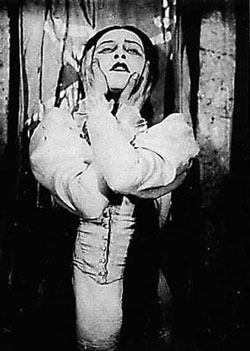
Habima was founded as an amateur troup by Nahum Lazarevich Tsemakh (Hebrew: Naḥum Tsemaḥ; 1887–1939) in Białystok (then in Grodno Governorate, Russian Empire) in 1912. Menahem Gnessin was one of its cofounders and early actors. Because its performances were in Hebrew, invoked the Jewish folk tradition, and dealt with issues of the Jewish people, soon it was banned by Russian authorities, and the theatre troupe was forced to become a travelling one. Beginning in 1918, the theatre operated under the auspices of the Moscow Art Theatre, which some consider its actual beginning. It encountered difficulties under the Soviet government as well, after the Russian Revolution. Konstantin Stanislavsky arranged for the mainly Jewish Polish actors to be trained by Yevgeny Vakhtangov. The People's Commissar for Nationalities Affairs, Joseph Stalin, also authorized the theatre's creation. However, the Yevsektsiya attempted to use its influence to cut off state funds to Habima, branding it counter-revolutionary.
International tour
In 1926, the theatre left the Soviet Union to tour abroad, in countries including Latvia, Lithuania, Poland, France, Germany, the Netherlands, and the United States. Their productions met with great success. In 1927, the company split up, with Zemach and some of the actors choosing to stay in the U.S.
Lodz Impact
The theatre staff visited the city of Lodz, and the pre-war photographer and artist Mendel Grossman, photographed the actors and actresses from the wings of the stage. His life was changed as a result of the visit of the theatre.
Establishment in Palestine
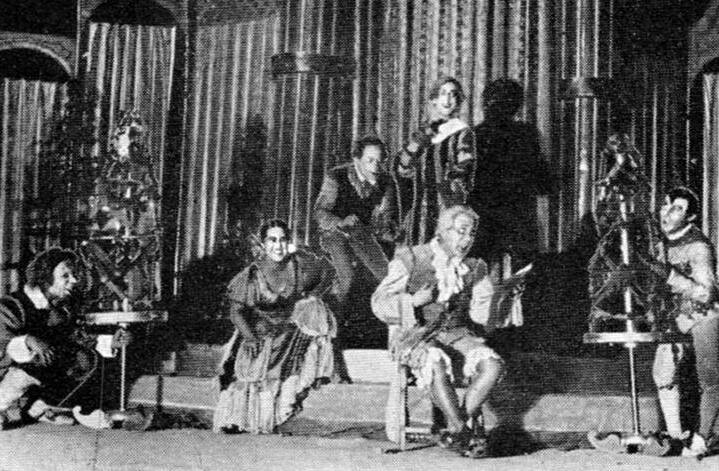
Other members of the theatre took the company to Mandate Palestine in 1928. In the 1928–29 season there, the Habima Players presented two plays, both under the direction of Aleksei Dikiy, from the Moscow Art Theatre. The first production, Ha-otsar (The Treasure), a translation of Sholem Aleichem's Yiddish play Der Oytser, premiered on December 29, 1928. The second production, which premiered on May 23, 1929, in Tel Aviv, was Keter David (David's Crown), an adaptation by Hebrew writer Isaac Lamdan of The Hair of Absalom (Los cabellos de Absalón), by the 17th-century Spanish dramatist Calderón.
In 1930 the company traveled to Berlin, Germany, where it produced Shakespeare's Twelfth Night, directed by Michael Chekhov, and Karl Gutzkow's Uriel Acosta, under the direction of Alexander Granovski.
The company finally settled in Palestine in 1931. In 1945, it built a theatre in Tel Aviv, which it occupied before completion.
.jpg)
National Theatre of Israel
Habima has been officially considered the national theatre of Israel since 1958, the year in which it received the Israel Prize for theatre. This was the first year in which the Prize was awarded to an organization. In the 21st century, Habima employs 80 actors, and another 120 staff members work at the complex.
Restoration
In January 2012, the theatre reopened after four and a half years of renovations. Architect Ram Karmi was commissioned to redesign the historic building. More than NIS 100 million was invested in the makeover, which has added 500 square meters of floor space and three new rehearsal rooms. The building's four auditoriums were completely rebuilt. Each is a different size and color: Rovina is blue and seats 930 people; Meskin is lavender and seats 320; Bertonov (also known as Bamartef) is green and seats 220; and Habima 4 (formerly known as Heineken) is wood panelled and seats 170.
Other theaters
- Solomon Stramer's Yiddish theater troupe in Cluj, Transylvania, Romania in the 1920s was also called Habimah.
References
- Levy, Emanuel. The Habima, 1917-1977: A Study of Cultural Nationalism. Columbia University Press, 1979.
References
- "Habimah".
- [http://www.museumoffamilyhistory.com/habima-01.htm "Habima in New York: The Origin and Early History of the Habima"], Museum of Family History, accessed 6 Sep 2010
- (2012). "Israel and the European Left". Continuum.
- Ivanov, Vladislav (August 10, 2010). “[http://www.yivoencyclopedia.org/article.aspx/Habimah Habimah]”. ''[[The YIVO Encyclopedia of Jews in Eastern Europe. YIVO Encyclopedia of Jews in Eastern Europe]]''. yivoencyclopedia.org. Translated from Russian by I. Michael Aronson; revised by Alice Nakhimovsky and Michael C. Steinlauf. Retrieved 2018-06-05.
- (1977). "With a Camera in the Ghetto". Schocken Books.
- Politzer, Heinz (August 1948). "[https://www.commentarymagazine.com/articles/heinz-politzer/habimah-in-new-yorka-great-theater-enters-a-new-period/ Habimah in New York: A Great Theater Enters a New Period] {{Webarchive. link. (2021-05-09 ". ''Commentary Magazine''. Retrieved 2017-03-06.)
- Sullivan, Henry W. (2009). ''[https://books.google.com/books?id=mcC0hgK8FI0C&pg=PA476 Calderón in the German Lands and the Low Countries: His Reception and Influence, 1654-1980]''. Cambridge: Cambridge University Press. p. 476, footnote 17. Sullivan notes that Lamdan worked from the German translation by [[Johann Diederich Gries]].
- 0472106074. pp. 51-84; here: p. 72. "The production of ''David's Crown'', produced in Tel Aviv in 1929, during Habima's first visit there, was a very radical adaptation of Calderón de la Barca's ''Hair of Absalom''."
- "Israel Prize recipients in 1958 (in Hebrew)". Israel Prize Official Site.
- Shohat, Zipi (November 21, 2011). "[https://www.haaretz.com/print-edition/news/curtain-rises-over-tel-aviv-s-newly-renovated-habima-theater-1.396685 Curtain Rises over Tel Aviv's Newly Renovated Habima Theater]". ''[[Haaretz]]''. haaretz.com. Retrieved 2017-03-06.
- Shohat, Zipi. (October 24, 2006). "A New Stage for Habima". Haaretz. haaretz.com.
- "[https://www.haaretz.com/print-edition/business/habima-architect-tells-critics-kiss-my-ass-1.318315 Habima Architect Tells Critics: 'Kiss My Ass' ]" (October 11, 2010). ''Haaretz''. haaretz.com. Retrieved 2017-03-06.
This article was imported from Wikipedia and is available under the Creative Commons Attribution-ShareAlike 4.0 License. Content has been adapted to SurfDoc format. Original contributors can be found on the article history page.
Ask Mako anything about Habima Theatre — get instant answers, deeper analysis, and related topics.
Research with MakoFree with your Surf account
Create a free account to save articles, ask Mako questions, and organize your research.
Sign up freeThis content may have been generated or modified by AI. CloudSurf Software LLC is not responsible for the accuracy, completeness, or reliability of AI-generated content. Always verify important information from primary sources.
Report