From Surf Wiki (app.surf) — the open knowledge base
Ha'penny Bridge
Footbridge over the River Liffey in Ireland
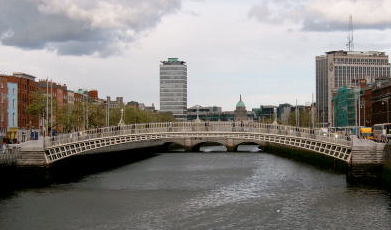
Footbridge over the River Liffey in Ireland
| Field | Value |
|---|---|
| bridge_name | Ha'penny Bridge |
| native_name | Droichead na Life |
| native_name_lang | Irish |
| image | HalfPennyBridge.jpg |
| image_size | 240 |
| alt | Dublin's Ha'penny Bridge |
| caption | Ha'penny Bridge in Dublin |
| other_name | Liffey Bridge (official), Wellington Bridge (historical) |
| crosses | River Liffey |
| carries | Pedestrians |
| locale | Dublin, Ireland |
| design | Arch bridge |
| upstream | Millennium Bridge |
| downstream | O'Connell Bridge |
| designer | John Windsor |
| material | Cast iron (arch), wood (deck) Cement (deck) (2015) |
| length | 43 m with a 3.35 m rise |
| width | 3.66 m |
| spans | 1 |
| open | May 1816 |
| coordinates |
the bridge in Dublin
The Ha'penny Bridge ( ; , or Droichead na Life), known later for a time as the Penny Ha'penny Bridge, and officially the Liffey Bridge, is a pedestrian bridge built in May 1816 over the River Liffey in Dublin, Ireland. Made of cast iron, the bridge was cast in Shropshire, England.
Name

Originally called the Wellington Bridge (after the Dublin-born Duke of Wellington), the name of the bridge was changed to Liffey Bridge after the Irish War of Independence in 1922. Liffey Bridge () remains the bridge's official name to this day, although it is most commonly referred to as the Ha'penny Bridge.
History
Before the Ha'penny Bridge was built there were seven ferries, operated by William Walsh, across the Liffey. The ferries were in bad condition and Walsh was informed that he had to either fix them or build a bridge. Walsh chose the latter option and the bridge was opened in May 1816, with Walsh holding the right to extract a ha'penny toll from anyone crossing it for 100 years.
Initially, the toll charge was based not on the cost of construction, but to match the charges levied by the ferries it replaced. A further condition of construction was that, if the citizens of Dublin found the bridge and toll to be "objectionable" within its first year of operation, it was to be removed at no cost to the city.
The toll was increased for a time to a penny-ha'penny ( pence), but was eventually dropped in 1919. While the toll was in operation, there were turnstiles at either end of the bridge.
The manufacture of the bridge was commissioned by the then Lord Mayor of Dublin, John Claudius Beresford with the Coalbrookdale Company of England. Using ore originally mined in County Leitrim's Sliabh an Iarainn, the bridge's cast iron ribs were made in 18 sections and then shipped to Dublin. The design and erection was supervised by John Windsor, one of the company's foremen and a pattern-maker.
Renovation and maintenance
In 2001, the number of pedestrians using the bridge on a daily basis was 27,000 and, given these traffic levels, a structural survey indicated that renovation was required. The bridge was closed for repair and renovations during 2001 and was reopened in December 2001, sporting its original white colour.
The structure was rebuilt to retain many of its old components, although, controversially, some features were removed. The repair work was carried out by Harland & Wolff.
In 2012, citing a maintenance and damage risk, Dublin City Council removed a number of love locks from the Ha'penny Bridge and nearby Millennium Bridge, and asked people not to add any more. In 2013, the council removed over 300 kg of locks from the bridge, and signage was added asking people not to put padlocks on the bridge.
On 19 May 2016, the bicentenary of the bridge was celebrated with a symbolic procession over the bridge involving the current Lord Mayor, Críona Ní Dhálaigh, descendants of J.C. Beresford and John Windsor from England.
References
References
- "Droichead na Life / Ha'penny Bridge". Placenames Commission of Ireland.
- "Ha'penny Bridge".
- McNally, Frank. (19 May 2016). "Dublin's Ha'penny Bridge reaches its 200th birthday". [[The Irish Times]].
- "Archiseek page on the Ha'penny Bridge". Archiseek.
- (19 May 2016). "Iconic Ha'penny Bridge turns 200 years old today". [[Irish Independent]].
- (December 2003). "Project history of Dublin's River Liffey bridges". Emerald Publishing.
- (25 May 2016). "Leitrim iron built Ha'penny bridge". [[Leitrim Observer]].
- (20 May 2016). "Made in Shropshire: Spanning the years as Dublin's iconic Ha'penny Bridge is celebrated". [[Shropshire Star]].
- (21 December 2001). "Dublin bridge reopens after 'make-over'". BBC News.
- (13 January 2012). "Where's the love? Council removes 'love padlocks' from Dublin's Ha'penny Bridge". [[TheJournal.ie]].
- (26 February 2014). "Council sign calls on couples not to lock love to Ha'penny bridge". The Irish Times.
- (3 May 2014). "I love you. Let's vandalise the Ha'penny Bridge". The Irish Times.
This article was imported from Wikipedia and is available under the Creative Commons Attribution-ShareAlike 4.0 License. Content has been adapted to SurfDoc format. Original contributors can be found on the article history page.
Ask Mako anything about Ha'penny Bridge — get instant answers, deeper analysis, and related topics.
Research with MakoFree with your Surf account
Create a free account to save articles, ask Mako questions, and organize your research.
Sign up freeThis content may have been generated or modified by AI. CloudSurf Software LLC is not responsible for the accuracy, completeness, or reliability of AI-generated content. Always verify important information from primary sources.
Report