From Surf Wiki (app.surf) — the open knowledge base
H-II Transfer Vehicle
Uncrewed cargo spacecraft developed by JAXA

Uncrewed cargo spacecraft developed by JAXA
| Field | Value |
|---|---|
| name | H-II Transfer Vehicle |
| Kounotori | |
| image | Iss020e0413802 - cropped.jpg |
| image_caption | H-II Transfer Vehicle (HTV-1) approaching the ISS |
| country | Japan |
| operator | JAXA |
| applications | ISS resupply |
| spacecraft_type | Uncrewed cargo vehicle |
| launch_mass | 16500 kg |
| dry_mass | 10500 kg |
| payload_capacity | 6000 - |
| volume | {{Unbulleted indent list |
| length | ~9.8 m (including thrusters) |
| diameter | 4.4 m |
| status | Retired |
| built | 9 |
| launched | 9 |
| first | 10 September 2009 (HTV-1) |
| last | 20 May 2020 (Kounotori 9) |
| derivatives | HTV-X |
| launch_vehicle | H-IIB |
Kounotori | Pressurised: 14 m3 | Unpressurised: 35 m3
The H-II Transfer Vehicle (HTV), also called Kounotori, was an expendable Japanese automated cargo spacecraft designed for International Space Station (ISS) resupply missions, particularly Kibō, the Japanese laboratory module.
Development of the spacecraft began in the early 1990s and the HTV's first mission, HTV-1, was launched on 10September 2009 on an H-IIB launch vehicle. The HTV was crucial for ISS resupply, especially after the retirement of the Space Shuttle, as it was the only vehicle capable of transporting large International Standard Payload Racks (ISPR) and disposing of old ones within the ISS's US Orbital Segment. The final HTV mission, Kounotori 9, was launched on 20 May 2020. HTV's successor, the HTV-X, made its maiden flight in October 2025.
Name
The name Kounotori was chosen because: "a white stork carries an image of conveying an important thing (a baby, happiness, and other joyful things), therefore, it precisely expresses the HTV's mission to transport essential materials to the ISS".
Design
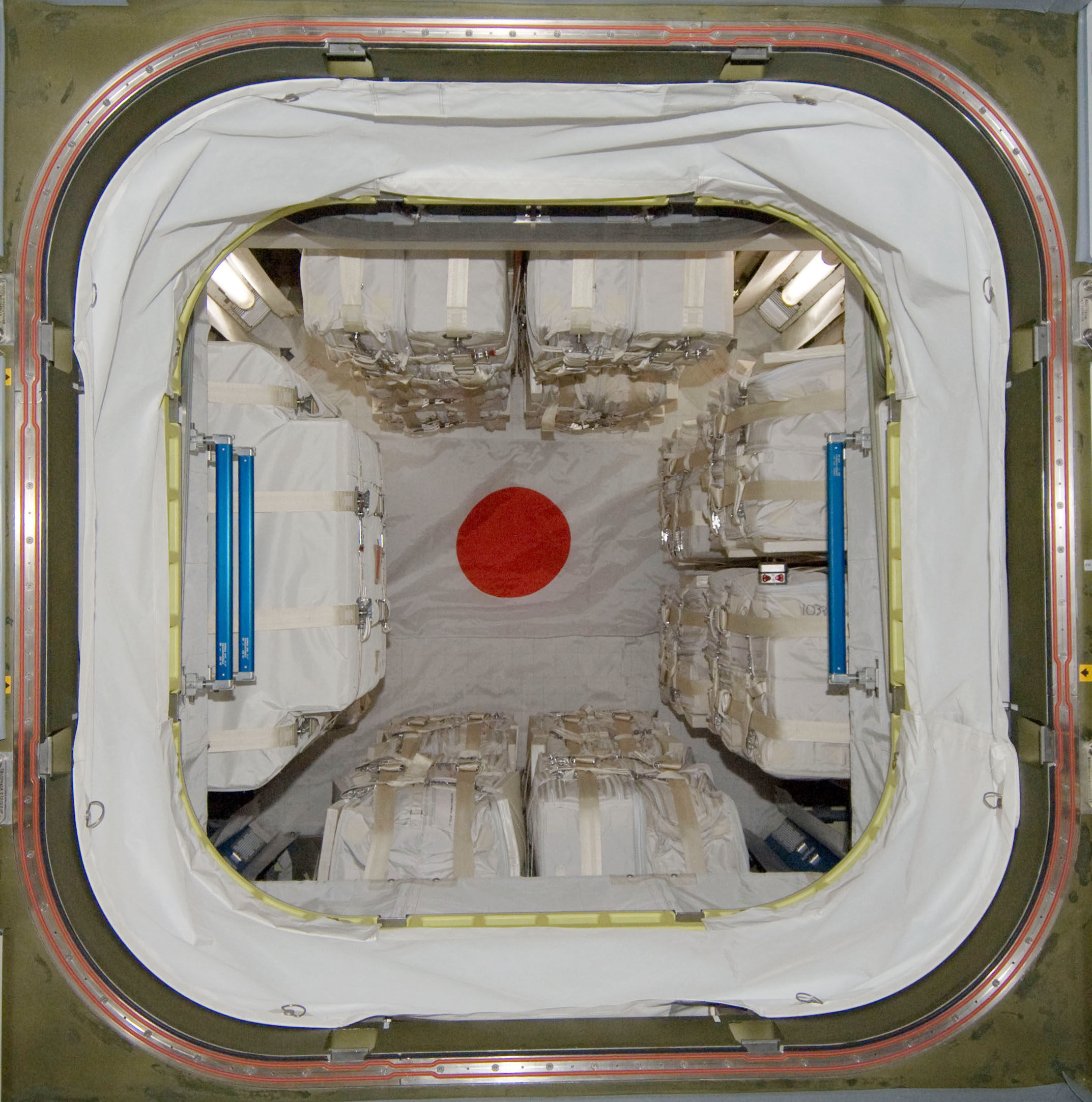


The HTV was about 9.8 m long (including maneuvering thrusters at one end) and 4.4 m in diameter. Total mass when empty was 10500 kg, with a maximum total payload of 6000 kg, for a maximum launch weight of 16500 kg.{{cite web|title=H-II Transfer Vehicle "KOUNOTORI" (HTV)|url=http://www.jaxa.jp/projects/rockets/htv/design_e.html |publisher=Japan Aerospace Exploration Agency|year=2007|access-date=2010-11-11|url-status=dead|archive-url=https://web.archive.org/web/20101116044853/http://www.jaxa.jp/projects/rockets/htv/design_e.html |archive-date=2010-11-16}} It consists of Pressurised Logistics Carrier (PLC), Unpressurised Logistics Carrier (ULC), and Main Body which contains avionics and propulsion system. The intent behind the HTV's modularized design was to use different module configurations to match different mission requirements.{{cite journal
To control the HTV's attitude and perform the orbital maneuvers such as rendezvous and reentry, the craft had four 500-N-class main thrusters and twenty-eight 110-N-class attitude control thrusters. Both used bipropellant, namely monomethylhydrazine (MMH) as fuel and mixed oxides of nitrogen (MON3) as oxidizer. HTV-1, HTV-2, and HTV-4 used Aerojet's 110 N R-1E, Space Shuttle's vernier engine, and the 500 N based on the Apollo spacecraft's R-4D. Later HTVs used 500 N class HBT-5 thrusters and 120 N class HBT-1 thrusters made by Japanese manufacturer IHI Aerospace Co., Ltd. The HTV's four spherical propellant tanks usually carried about 2 tonnes of propellant (the maximum capacity was 2432 kg).
Mission profile
The HTV was comparable in function to the Russian Progress, the ESA ATV, the SpaceX Cargo Dragons, and the Cygnus spacecraft, all of which brought supplies to the ISS. Like the ATV, the HTV carried more than twice the payload of the Progress, but was launched less than half as often. Unlike Progress spacecraft, Cargo Dragon 2's and ATV's which used the docking ports automatically, HTVs and American Dragon 1 approached the ISS in stages, and once they reached their closest parking orbit to the ISS, crew grappled them using the robotic arm Canadarm2 and berthed them to an open berthing port on the Harmony module.
The HTV had an external payload bay which was accessed by the robotic arm after it had been berthed to the ISS. New payloads could be moved directly from the HTV to ''Kibō'''s exposed facility. Internally, it had eight International Standard Payload Racks (ISPRs) in total which could be unloaded by the crew in a shirt-sleeve environment. After the retirement of NASA's Space Shuttle in 2011, HTVs became the only spacecraft capable of transporting ISPRs to the ISS. The SpaceX Dragon and Northrop Grumman Cygnus could carry resupply cargo bags but not ISPRs.
After the unloading process was completed, the HTV was loaded with waste and unberthed. The vehicle then deorbited and was destroyed during reentry, the debris felling into the Pacific Ocean.
Flights
Initially seven missions were planned between 2008–2015. With the extension of the ISS project through 2028, three more missions were added, with the tenth flight planned to debut an improved, cost-reduced version called the HTV-X.
The first vehicle was launched on an H-IIB rocket, a more powerful version of the earlier H-IIA, at 17:01 UTC on 10 September 2009, from Launch Pad 2 of the Yoshinobu Launch Complex at the Tanegashima Space Center.
By May 2020, all nine missions planned for HTV had been successfully launched, and the spacecraft was retired. The improved HTV-X is planned to be first used for the tenth flight and will perform scheduled ISS resupply duties starting in 2025.
| HTV | Launch date/time (UTC) | Berth date/time (UTC) | Rocket, flight | Reentry date/time (UTC) | Outcome | ||||
|---|---|---|---|---|---|---|---|---|---|
| HTV-1 | 10 September 2009, 17:01:56 | 17 September 2009, 22:12 | H-IIB, TF1 | 1 November 2009, 21:26 | |||||
| HTV-2 | 22 January 2011, 05:37:57 | 27 January 2011, 14:51 | H-IIB, F2 | 30 March 2011, 03:09 | |||||
| HTV-3 | 21 July 2012, 02:06:18 | 27 July 2012, 14:34 | H-IIB, F3 | 14 September 2012, 05:27 | |||||
| HTV-4 | 3 August 2013, 19:48:46 | 9 August 2013, 15:38 | H-IIB, F4 | 7 September 2013, 06:37 | |||||
| HTV-5 | 19 August 2015, 11:50:49 | url=http://global.jaxa.jp/press/2015/08/20150825_kounotori5.html | title=Successful berthing of the H-II Transfer Vehicle KOUNOTORI5 (HTV5) to the International Space Station (ISS) | url-status=live | archive-url=https://web.archive.org/web/20161104014317/http://global.jaxa.jp/press/2015/08/20150825_kounotori5.html | archive-date=2016-11-04}} | H-IIB, F5 | 29 September 2015, 20:33 | |
| HTV-6 | 9 December 2016, 13:26:47 | 13 December 2016, 18:24 | H-IIB, F6 | 5 February 2017, 15:06 | |||||
| HTV-7 | 22 September 2018, 17:52:27 | 27 September 2018, 18:08 | H-IIB, F7 | 10 November 2018, 21:38 | |||||
| HTV-8 | 24 September 2019, 16:05:05 | 28 September 2019, 14:09 | H-IIB, F8 | 3 November 2019, 02:09 | |||||
| HTV-9 | 20 May 2020, 17:31:00 | 25 May 2020, 12:13 | H-IIB, F9 (last) | 20 August 2020, 07:07 |
Successor: HTV-X
Main article: HTV-X
In May 2015, Japan's Ministry of Education, Culture, Sports, Science and Technology announced a proposal to replace the HTV with an improved, cost-reduced version preliminary called HTV-X. The HTV-X has a length of 6.2 m, or 10 m with the unpressurised cargo module fitted. The payload fairing adaptor and payload dispenser have been widened from 1.7 m to 4.4 m. An evolved version of HTV-X called HTV-XG is being considered for transferring cargo to the Lunar Gateway as part of the Artemis program. The first flight of HTV-X took place on 26 October 2025.
Former evolutionary proposals
HTV-R
, JAXA was planning to add a return capsule option. In this concept, HTV's pressurized cargo would be replaced by a reentry module capable of returning 1600 kg cargo from ISS to Earth. Further, conceptual plans in 2012 included a follow-on spacecraft design by 2022 which would accommodate a crew of three and carry up to 400 kg of cargo.
Lagrange outpost resupply
, both JAXA and Mitsubishi conducted studies of a next generation HTV as a possible Japanese contribution to the proposed international crewed outpost at Earth-Moon L2. This variant of HTV was to be launched by H-X Heavy and can carry 1800 kg of supplies to EML2. Modifications from the current HTV included the addition of solar electric paddles and extension of the propellant tank.
Human-rated variant
A proposal announced in June 2008, "Preliminary Study for Manned Spacecraft with Escape System and H-IIB Rocket" suggested combining HTV's propulsion module with a human-rated capsule for four people.
Japanese space station
A Japanese space station was proposed to be built up from HTV modules. This method was similar to how the modules in Mir, as well as many modules of the Russian Orbital Segment of the ISS were based on the TKS cargo vehicle design.
Gallery
File:ISS-32 HTV-3 berthing 1.jpg|HTV-3 near ISS File:ISS-44 Purple Aurora australis.jpg|Kounotori 5 (HTV-5) with Aurora australis File:HTV-6 grappled by the International Space Station's robotic arm (2).jpg|HTV-6 grappled to a robotic arm of ISS
References
References
- "Overview of the "KOUNOTORI"". [[JAXA]].
- link. (31 July 2015)
- "NASA Sets Briefing, TV Coverage of Japan's First Cargo Spacecraft". NASA.
- (2025-08-22). "Japan to launch new spacecraft to resupply International Space Station in October". Reuters.
- (11 November 2010). ""KOUNOTORI" Chosen as Nickname of the H-II Transfer Vehicle (HTV)". JAXA.
- (17–21 October 2005). "The Design Characteristics of the HTV Propulsion Module".
- (June 20, 2012). "宇宙ステーション補給機「こうのとり」3号機(HTV3)ミッションプレスキット".
- Fujimoto, Nobuyoshi. (23–26 November 2010). "Kibo Utilization Status Update".
- JAXA. (2007). "HTV Operations".
- link. Research and Development Division, Ministry of Education, Culture, Sports, Science and Technology. (May 20, 2015)
- (8 July 2009). "Launch of the H-IIB Launch Vehicle Test Flight". [[JAXA]].
- (27 July 2018). "Koichi Wakata, JAXA vice president and astronaut, helps chart future of ISS and human space exploration".
- "H-II Transfer Vehicle "KOUNOTORI" (HTV) Topics". Japan Aerospace Exploration Agency.
- Stephen Clark. (1 November 2009). "History-making Japanese space mission ends in flames". Spaceflight Now.
- Stephen Clark. (29 March 2011). "Japan's HTV cargo freighter proves useful to the end". Spaceflight Now.
- Stephen Clark. (3 August 2013). "Japan launches resupply mission to space station". Spaceflight Now.
- Stephen Clark. (9 August 2013). "Japan's cargo craft makes in-orbit delivery to space station". Spaceflight Now.
- "Successful berthing of the H-II Transfer Vehicle KOUNOTORI5 (HTV5) to the International Space Station (ISS)".
- (September 30, 2015). "Successful re-entry of H-II Transfer Vehicle "KOUNOTORI5" (HTV5)". JAXA.
- JAXA. "HTV6:H-II Transfer Vehicle KOUNOTORI (HTV) - International Space Station - JAXA".
- JAXA. "HTV7:H-II Transfer Vehicle KOUNOTORI (HTV) - International Space Station - JAXA".
- (June 3, 2015). "国際宇宙ステーション計画を含む有人計画について".
- JAXA. (14 July 2016). link
- link. JAXA. Ministry of Education, Cultura, Sports and Technology. (30 June 2021)
- (August 11, 2010). "回収機能付加型宇宙ステーション補給機(HTV-R)検討状況". JAXA.
- "回収機能付加型HTV(HTV-R)". JAXA.
- Rob Coppinger. "Japan Wants Space Plane or Capsule by 2022". Space.com.
- (2014-04-10). "International Human Lunar Mission Architecture / System and its Technologies". JAXA.
- (2014-04-10). "An International Industry Perspective on Extended Duration Missions Near the Moon". Lockheed Martin Corporation.
- (June 2008). "Preliminary Study for Manned Spacecraft with Escape System and H-IIB Rocket". 26th ISTS.
- (2008). "Development Plan for Future Mission from HTV System". JAXA.
This article was imported from Wikipedia and is available under the Creative Commons Attribution-ShareAlike 4.0 License. Content has been adapted to SurfDoc format. Original contributors can be found on the article history page.
Ask Mako anything about H-II Transfer Vehicle — get instant answers, deeper analysis, and related topics.
Research with MakoFree with your Surf account
Create a free account to save articles, ask Mako questions, and organize your research.
Sign up freeThis content may have been generated or modified by AI. CloudSurf Software LLC is not responsible for the accuracy, completeness, or reliability of AI-generated content. Always verify important information from primary sources.
Report