From Surf Wiki (app.surf) — the open knowledge base
Gytrash
Legendary English ghost animal
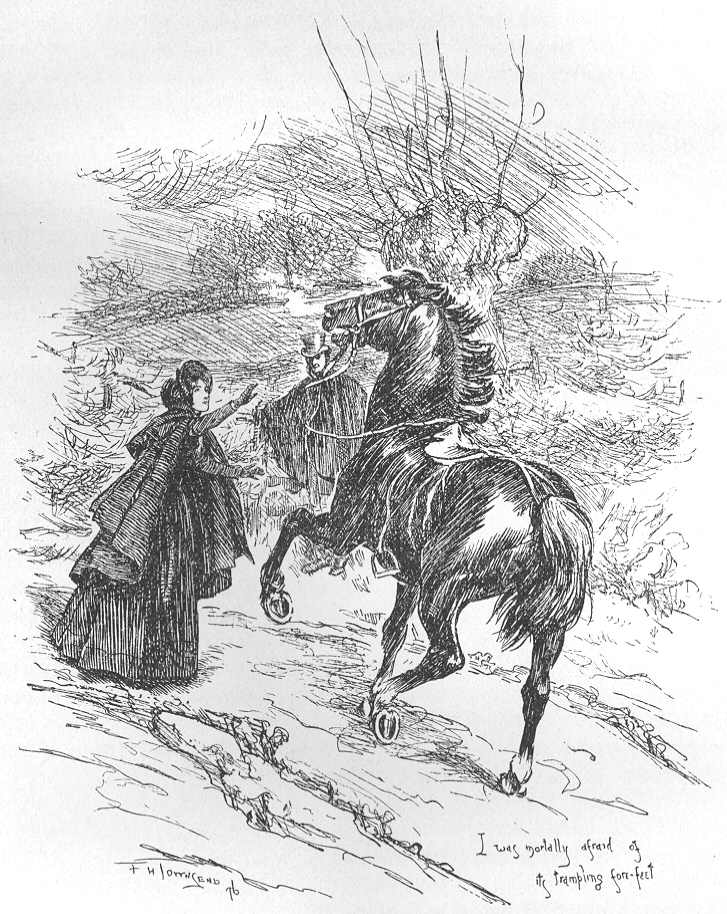
Legendary English ghost animal
The Gytrash was a legendary shape-changer known in parts of the West Riding of Yorkshire. It was said to haunt lonely roads awaiting travelers. | author-link = E. Cobham Brewer | orig-year = 1870
The most important gytrash references appear in the writings of the Brontës.
It was very near, but not yet in sight; when, in addition to the tramp, tramp, I heard a rush under the hedge, and close down by the hazel stems glided a great dog, whose black and white colour made him a distinct object against the trees. It was exactly one form of Bessie's Gytrash -- a lion-like creature with long hair and a huge head [...], with strange pretercanine eyes [...]. The horse followed, -- a tall steed [...]. Nothing ever rode the Gytrash: it was always alone [...].|Excerpt from Charlotte Brontë's Jane Eyre, chapter xii | author-link = Charlotte Brontë | access-date = 2008-11-15 | chapter-url = http://www.gutenberg.org/files/1260/1260-h/1260-h.htm | orig-year = 1847
The Gytrash's emergence as Rochester's innocuous dog Pilot has been interpreted as a subtle mockery of the mysteriousness and romanticism that surrounds his character and which clouds Jane's perception. Brontë's reference in 1847 is the earliest reference to the beast in print and forms the basis for subsequent citations.
Branwell Brontë referred to the guytrash in his unpublished writing in December 1837, predating Charlotte Brontë's reference: 'A Gytrash is a Spectre neither at all similar to the Ghosts of those who once were alive nor to fairys and silvan Creatures nor to Demons and the powers of the air[.] It does not confine its forms to the Human and indeed most seldom appears in such a form[.] A Black Dog dragging a chain a dusky calf[,] nay even a rolling stone or a self impelled cart wheel are more commonly the mortal coil of the Sullen Spectre[.] But the Darkwall Gytrash was known by the form of an Old Dwarfish and hideous Man as often seen without a head as with one and moving at dark along the naked feilds which spread round the Aged House[.] its visits were connected in all mens minds with the fortunes of the family[.] he hovered round and evil omens were always drawn on such occasions and if tradition spoke true fullfilled upon them.'
This spirit is also known as Guytrash and Guytresh according to The English Dialect Dictionary of Joseph Wright (1855–1930) where it is defined as a ghost that takes the form of an animal. These include a "great black dog" as well as "an evil cow whose appearance was formerly believed in as a sign of death."
References
References
- (1988). "Brother in the Shadow: Stories and Sketches by Branwell Brontë". Bradford Libraries.
- Dr. Sally Minogue. (1999). "Jane Eyre". Wordsworth Editions.
- Wood, Juliette. (August 1999). "The Gytrash".
- Neufeldt, Victor A.. (1999). "The Works of Patrick Branwell Brontë". Routledge.
- Wright, Joseph (1923). [https://archive.org/stream/in.ernet.dli.2015.13023/2015.13023.The-English-Dialect-Dictionary-Vol-Ii-D-g#page/n777/mode/2up ''The English Dialect Dictionary (Vol. 2)''.] Humphrey Milford, Oxford University Press. p. 770.
This article was imported from Wikipedia and is available under the Creative Commons Attribution-ShareAlike 4.0 License. Content has been adapted to SurfDoc format. Original contributors can be found on the article history page.
Ask Mako anything about Gytrash — get instant answers, deeper analysis, and related topics.
Research with MakoFree with your Surf account
Create a free account to save articles, ask Mako questions, and organize your research.
Sign up freeThis content may have been generated or modified by AI. CloudSurf Software LLC is not responsible for the accuracy, completeness, or reliability of AI-generated content. Always verify important information from primary sources.
Report