From Surf Wiki (app.surf) — the open knowledge base
Gyrus
Ridge on the cerebral cortex of the brain
Ridge on the cerebral cortex of the brain
| Field | Value |
|---|---|
| Name | Gyrus |
| Image | Gyrus sulcus-en.svg |
| Caption | Gyrus and sulcus |

In neuroanatomy, a gyrus (: gyri) is a ridge on the cerebral cortex. It is generally surrounded by one or more sulci (depressions or furrows; : sulcus). Gyri and sulci create the folded appearance of the brain in humans and other mammals.
Structure
The gyri are part of a system of folds and ridges that create a larger surface area for the human brain and other mammalian brains.
Development
Main article: Gyrification
The human brain undergoes gyrification during fetal and neonatal development. In embryonic development, all mammalian brains begin as smooth structures derived from the neural tube. A cerebral cortex without surface convolutions is lissencephalic, meaning 'smooth-brained'. As development continues, gyri and sulci begin to take shape on the fetal brain, with deepening indentations and ridges developing on the surface of the cortex.
Clinical significance
Changes in the structure of gyri in the cerebral cortex are associated with various diseases and disorders. Pachygyria, lissencephaly, and polymicrogyria are all the results of abnormal cell migration associated with a disorganized cellular architecture, failure to form six layers of cortical neurons (a four-layer cortex is common), and functional problems. The abnormal formation is commonly associated with epilepsy and mental dysfunctions.
Pachygyria (meaning "thick" or "fat" gyri) is a congenital malformation of the cerebral hemisphere, resulting in unusually thick gyri in the cerebral cortex. Pachygyria is used to describe brain characteristics in association with several neuronal migration disorders; most commonly relating to lissencephaly.
Lissencephaly (smooth brain) is a rare congenital brain malformation caused by defective neuronal migration during the 12th to 24th weeks of fetal gestation resulting in a lack of development of gyri and sulci.
Polymicrogyria (meaning "many small gyri") is a developmental malformation of the human brain characterized by excessive folding of the gyri and a thickening of the cerebral cortex. It may be generalized, affecting the whole surface of the cerebral cortex or may be focal, affecting only parts of the surface. Polymicrogyria may be caused by mutations within several genes, including ion channels.
Notable gyri
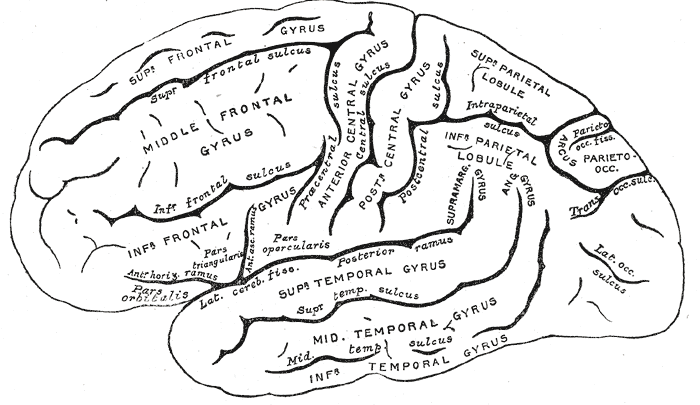
- Superior frontal gyrus, lat. gyrus frontalis superior
- Middle frontal gyrus, lat. gyrus frontalis medius
- Inferior frontal gyrus, lat. gyrus frontalis inferior with 3 parts: pars opercularis (Brodmann area 44) pars triangularis (Brodmann area 45), and pars orbitalis (orbital part of inferior frontal gyrus)
- Superior temporal gyrus, lat. gyrus temporalis superior
- Middle temporal gyrus, lat. gyrus temporalis medius
- Inferior temporal gyrus, lat. gyrus temporalis inferior
- Fusiform gyrus, lat. gyrus occipitotemporalis lateralis
- Parahippocampal gyrus, lat. gyrus parahippocampalis
- Transverse temporal gyrus
- Lingual gyrus lat. gyrus lingualis
- Precentral gyrus, lat. gyrus praecentralis
- Postcentral gyrus, lat. gyrus postcentralis
- Supramarginal gyrus, lat. gyrus supramarginalis
- Angular gyrus, lat. gyrus angularis
- Cingulate gyrus lat. gyrus cinguli
- Fornicate gyrus
References
sv:Hjärnbark#Gyrus och sulcus
References
- (2013). "A functional model of cortical gyri and sulci". Brain Structure and Function.
- (April 2005). "The Intraparietal Sulcus and Perceptual Organization". Journal of Cognitive Neuroscience.
- (1991). "The ontogeny of human gyrification.". Cerebral Cortex.
- (23 February 2011). "Local tissue growth patterns underlying normal fetal human brain gyrification quantified in utero.". The Journal of Neuroscience.
- (2012). "A developmental and genetic classification for malformations of cortical development: update 2012". Brain.
- (2008). "Malformations of Cortical Development". The Neurologist.
- Guerrini R. (2005). "Genetic malformations of the cerebral cortex and epilepsy". Epilepsia.
- Dobyns WB. (1987). "Developmental aspects of lissencephaly and the lissencephaly syndromes". Birth Defects Orig. Artic. Ser..
- (1993). "Polymicrogyria Overview". GeneReviews.
- (February 2020). "Ion Channel Functions in Early Brain Development.". Trends in Neurosciences.
This article was imported from Wikipedia and is available under the Creative Commons Attribution-ShareAlike 4.0 License. Content has been adapted to SurfDoc format. Original contributors can be found on the article history page.
Ask Mako anything about Gyrus — get instant answers, deeper analysis, and related topics.
Research with MakoFree with your Surf account
Create a free account to save articles, ask Mako questions, and organize your research.
Sign up freeThis content may have been generated or modified by AI. CloudSurf Software LLC is not responsible for the accuracy, completeness, or reliability of AI-generated content. Always verify important information from primary sources.
Report