From Surf Wiki (app.surf) — the open knowledge base
Gymkhana
Social and sporting club in the Indian subcontinent

Social and sporting club in the Indian subcontinent
Indian subcontinent culture
Gymkhana () (, , , , ) is a British Raj term which originally referred to a place of assembly. The meaning then altered to denote a place where skill-based contests were held. "Gymkhana" is an Anglo-Indian expression, which is derived from the Persian word "Jamat-khana". Most gymkhanas have a Gymkhana Club associated with them, a term coined during the British Raj for gentlemen's club.
More generally, gymkhana refers to a social and sporting club in the Indian subcontinent, and in other Asian countries including Malaysia, Thailand, Burma, and Singapore, as well as in East Africa.
Etymology
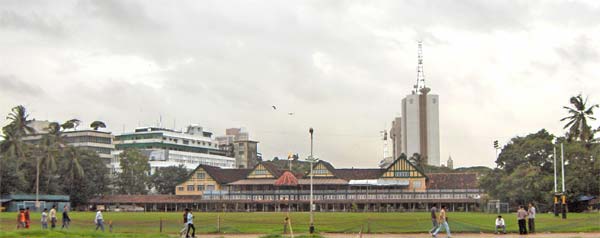
The first element of Gymkhana comes from gend meaning ball in Urdu/Hindi/Hindustani/Khariboli. This element is distinct from the English word gym, short for gymnasium and gymnastics which has Greek and Latin roots. The second element, khānā has a Persian origin, meaning a home or a compartment. In Persian, (خانه) is a term for dwelling, house. The court language of the Mughal Empire was Persian.
References
References
- (1895). "The Globe Trotter in India Two Hundred Years Ago: And Other Indian Studies". S. Sonnenschein & Company.
- Parekh, Rauf. (2021-07-05). "Origin of 'gymkhana' and 'kanjee house'".
- Oxford Dictionaries [http://www.oxforddictionaries.com/view/entry/m_en_us1252920#m_en_us1252920 Gymnasium etymology]{{dead link. (September 2022)
- From ''Loghat'nāmeh-ye'' [[Ali Akbar Dehkhoda. Dehkhoda]], Third Edition ([[Tehran University Press]], 2006), quoted from ''Borhān-e Ghāte{{''' by [[Mohammad Moin]].
This article was imported from Wikipedia and is available under the Creative Commons Attribution-ShareAlike 4.0 License. Content has been adapted to SurfDoc format. Original contributors can be found on the article history page.
Ask Mako anything about Gymkhana — get instant answers, deeper analysis, and related topics.
Research with MakoFree with your Surf account
Create a free account to save articles, ask Mako questions, and organize your research.
Sign up freeThis content may have been generated or modified by AI. CloudSurf Software LLC is not responsible for the accuracy, completeness, or reliability of AI-generated content. Always verify important information from primary sources.
Report