From Surf Wiki (app.surf) — the open knowledge base
Guyenne
Medieval Duchy in Kingdom of France
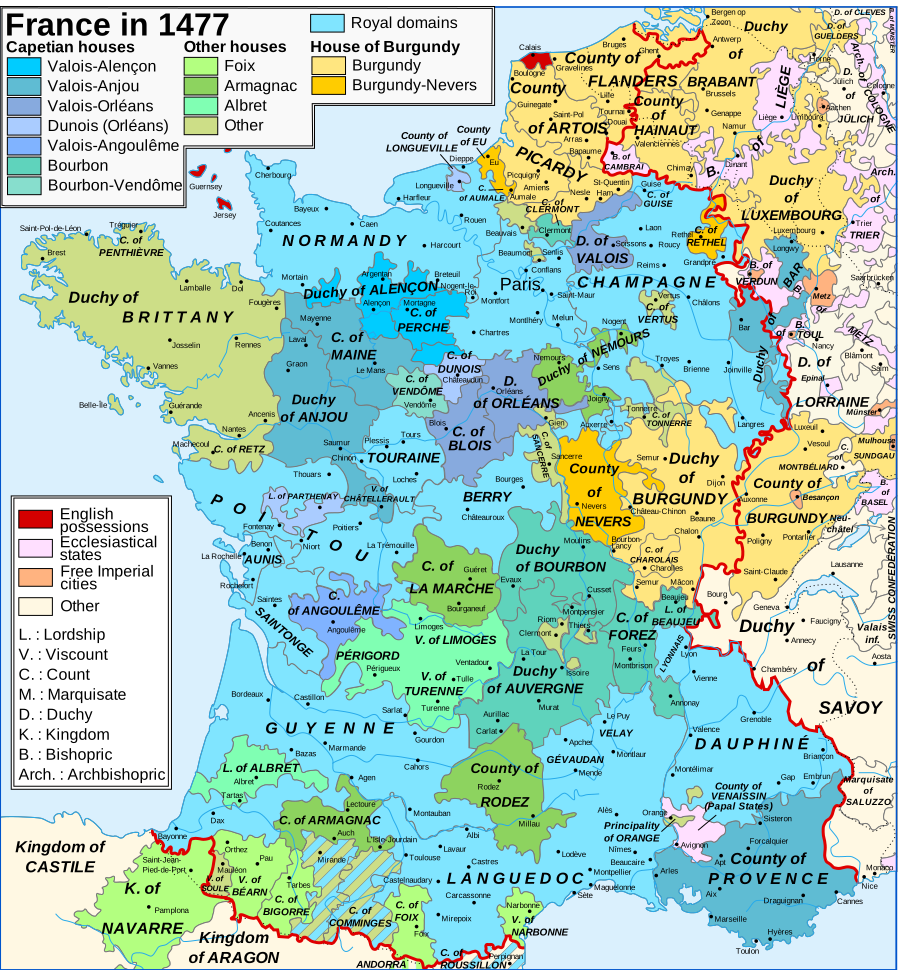
Medieval Duchy in Kingdom of France
.jpg)
Guyenne or Guienne ( , ; ) was an old French province which corresponded roughly to the Roman province of Aquitania Secunda and the Catholic archdiocese of Bordeaux.
Etymology
Name
The name "Guyenne" comes from Aguyenne, a popular transformation of Aquitania. In the 12th century it formed, along with Gascony, the duchy of Aquitaine, which passed under the dominion of the kings of England by the marriage of Eleanor of Aquitaine to Henry II.
History
In the 13th century, as a result of the conquests of Philip II, Louis VIII and Louis IX, Guyenne was confined within the narrower limits fixed by the 1259 Treaty of Paris and became distinct from Aquitaine. Guyenne then comprised the Bordelais (the old countship of Bordeaux), the Bazadais, part of Périgord, Limousin, Quercy and Rouergue, and the Agenais ceded by Philip III to Edward I in the 1279 Treaty of Amiens. Still united with Gascony, it formed a duchy extending from the Charente River to the Pyrenees mountains. This duchy was held as a fief on the terms of homage to the French kings and, both in 1296 and 1324, it was confiscated by the kings of France on the ground that there had been a failure in the feudal duties.
By the 1360 Treaty of Brétigny, King Edward III of England acquired the full sovereignty of the duchy of Guyenne, together with Aunis, Saintonge, Angoumois, and Poitou. Soon after, the victories of Bertrand du Guesclin and Gaston III, Count of Foix, restored the duchy to its 13th-century limits. In 1451, it was conquered and finally united to the French crown by CharlesVII. In 1469, Louis XI gave it in exchange for the territories of Champagne and Brie to his brother Charles, Duke of Berry, after whose death in 1472 it again became part of the royal domain.
Guyenne then formed a government (gouvernement général) which from the 17th century onwards was united with Gascony. In 1779, Louis XVI convened the provincial assemblies of Guyenne and considered expanding the assembly to other provinces, but abandoned this idea after experiencing the opposition of the privileged classes in Guyenne.{{cite book
References
Citations
Bibliography
References
- Xavier de Planhol, ''An Historical Geography of France'' (Cambridge, 1994), p. 168.
- {{EB1911
This article was imported from Wikipedia and is available under the Creative Commons Attribution-ShareAlike 4.0 License. Content has been adapted to SurfDoc format. Original contributors can be found on the article history page.
Ask Mako anything about Guyenne — get instant answers, deeper analysis, and related topics.
Research with MakoFree with your Surf account
Create a free account to save articles, ask Mako questions, and organize your research.
Sign up freeThis content may have been generated or modified by AI. CloudSurf Software LLC is not responsible for the accuracy, completeness, or reliability of AI-generated content. Always verify important information from primary sources.
Report