From Surf Wiki (app.surf) — the open knowledge base
Gutenberg Bible
Earliest major book printed in Europe

Earliest major book printed in Europe

The Gutenberg Bible, also known as the 42-line Bible, the Mazarin Bible or the B42, was the earliest major book printed in Europe using mass-produced metal movable type. It marked the start of the "Gutenberg Revolution" and the age of printed books in the West. The book is valued and revered for its high aesthetic and artistic qualities and its historical significance.
The Gutenberg Bible is an edition of the Latin Vulgate printed in the 1450s by Johannes Gutenberg in Mainz (Holy Roman Empire), in present-day Germany. Out of either 158 or 180 copies that were originally printed, 49 survive in at least substantial portion, 21 of them in entirety; of these, the copy with the earliest visible print date is marked as 15 August 1456. They are thought to be among the world's most valuable books, although no complete copy has been sold since 1978. In March 1455, the future Pope Pius II wrote that he had seen pages from the Gutenberg Bible, displayed in Frankfurt to promote the edition.
The 36-line Bible, said to be the second printed Bible, is also sometimes referred to as a Gutenberg Bible, but may be the work of another printer.
Text

The Gutenberg Bible is an edition of the Vulgate, a Latin translation of the Hebrew Bible (Old Testament) and the Greek New Testament by St Jerome. The text contains emendations from the Parisian Bible tradition, and further divergences.
Printing history
While it is unlikely that any of Gutenberg's early publications would bear his name, the initial expense of press equipment and materials and of the work to be done before the Bible was ready for sale suggests that he may have started with more lucrative texts, including several religious documents, a German poem, and some editions of Aelius Donatus's Ars Grammatica, a popular Latin grammar school book.
Preparation of the Bible probably began soon after 1450, and the first finished copies were available in 1454 or 1455. It is not known exactly how long the Bible took to print. The first precisely datable printing is Gutenberg's 31-line Indulgence which certainly existed by 22 October 1454.
Gutenberg made three significant changes during the printing process. Each sheet of paper was dampened before printing to improve ink absorption. It was then pressed onto an inked surface consisting of moveable type. After each sheet was printed, the type was re-inked, and the process repeated until the entire print run was completed. Once finished, the type was cleaned and redistributed into type cases for future use. This method is a form of relief printing.

Some time later, after more sheets had been printed, the number of lines per page was increased from 40 to 42, presumably to save paper. Therefore, pages 1 to 9 and pages 256 to 265, presumably the first ones printed, have 40 lines each. Page 10 has 41, and from there on the 42 lines appear. The increase in line number was achieved by decreasing the interline spacing, rather than increasing the printed area of the page. Finally, the print run was increased, necessitating resetting those pages which had already been printed. The new sheets were all reset to 42 lines per page. Consequently, there are two distinct settings in folios 1–32 and 129–158 of volume I and folios 1–16 and 162 of volume II.
The most reliable information about the Bible's date comes from a letter. In March 1455, the future Pope Pius II wrote that he had seen pages from the Gutenberg Bible, being displayed to promote the edition, in Frankfurt. It is not known how many copies were printed, with the 1455 letter citing sources for both 158 and 180 copies. Scholars today think that examination of surviving copies suggests that somewhere between 160 and 185 copies were printed, with about three-quarters on paper and the others on vellum.
The production process: ''Das Werk der Bücher''
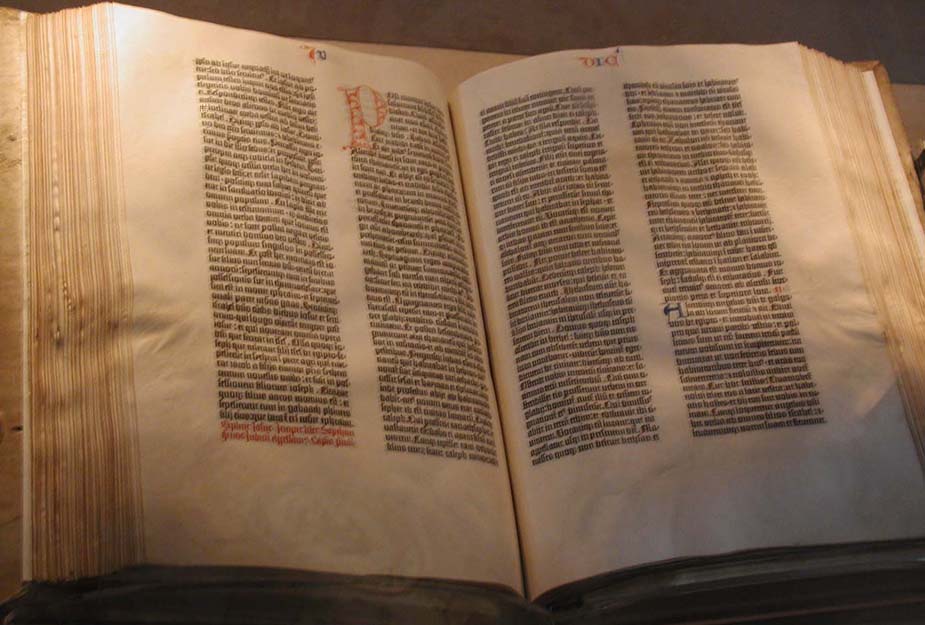
In a legal paper, written after completion of the Bible, Johannes Gutenberg refers to the process as Das Werk der Bücher ("the work of the books"). He had introduced the printing press to Europe and created the technology to make printing with movable types finally efficient enough to facilitate the mass production of entire books.
Many book-lovers have commented on the high standards achieved in the production of the Gutenberg Bible, some describing it as one of the most beautiful books ever printed. The quality of both the ink and other materials and the printing itself have been noted.
Pages
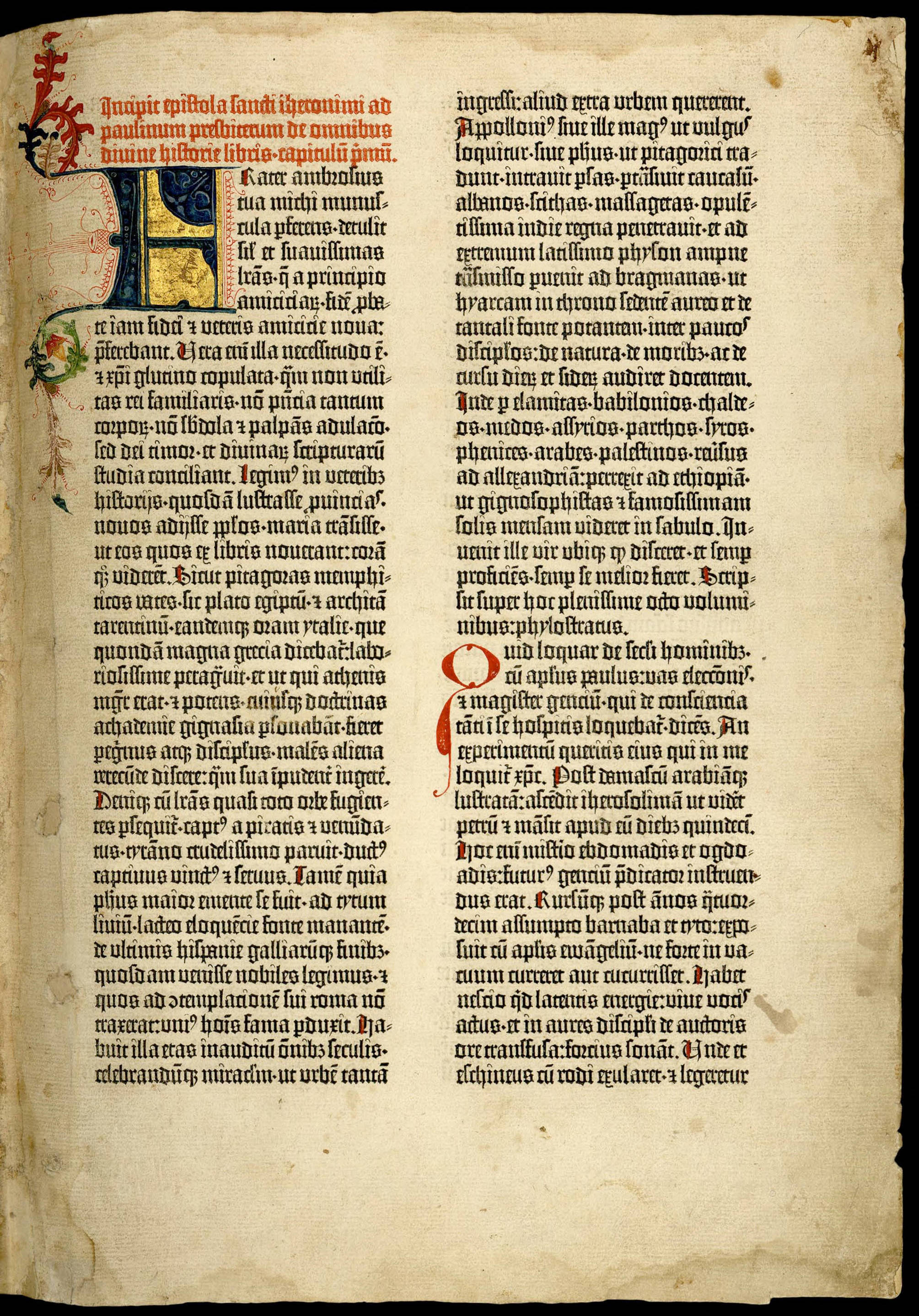
The paper size is 'double folio', with two pages printed on each side (four pages per sheet). After printing the paper was folded once to the size of a single page. Typically, five of these folded sheets (ten leaves, or twenty printed pages) were combined to a single physical section, called a quinternion, that could then be bound into a book. Some sections, however, had as few as four leaves or as many as twelve leaves.

The 42-line Bible was printed on the size of paper known as 'Royal'. A full sheet of Royal paper measures 42 x and a single untrimmed folio leaf measures 42 x. There have been attempts to claim that the book was printed on larger paper measuring 44.5 x, but this assertion is contradicted by the dimensions of existing copies. For example, the leaves of the copy in the Bodleian Library, Oxford, measure 40 ×. This is typical of other folio Bibles printed on Royal paper in the fifteenth century. Most fifteenth-century printing papers have a width-to-height ratio of 1:1.4 (e.g. 30:42 cm) which, mathematically, is a ratio of 1 to the square root of 2 or, simply, \sqrt{2}. Many suggest that this ratio was chosen to match the so-called Golden Ratio, \tfrac{1+\sqrt{5}}{2}, of 1:1.6; in fact the ratios are, plainly, not at all similar (equating to a difference of about 12 per cent). The ratio of 1:1.4 was a long established one for medieval paper sizes. A single complete copy of the Gutenberg Bible has 1,288 pages (4×322 = 1288) (usually bound in two volumes); with four pages per folio-sheet, 322 sheets of paper are required per copy. The Bible's paper consists of linen fibers and is thought to have been imported from Caselle in Piedmont, Italy based on the watermarks present throughout the volume.
Ink
In Gutenberg's time, inks used by scribes to produce manuscripts were water-based. Gutenberg developed an oil-based ink that would better adhere to his metal type. His ink was primarily carbon, but also had a high metallic content, with copper, lead, and titanium predominating. Head of collections at the British Library, Kristian Jensen, described it thus: "if you look [at the pages of The Gutenberg Bible] closely you will see this is a very shiny surface. When you write you use a water-based ink, you put your pen into it and it runs off. Now if you print that's exactly what you don't want. One of Gutenberg's inventions was an ink which wasn't ink, it's a varnish. So what we call printer's ink is actually a varnish, and that means it sticks to its surface."
Type
Each unique character requires a piece of master type in order to be replicated. Given that each letter has uppercase and lowercase forms, and the number of various punctuation marks and ligatures (e.g., "fi" for the letter sequence "fi", commonly used in writing), the Gutenberg Bible needed a set of 290 master characters. It seems probable that six pages, containing 15,600 characters altogether, would be set at any one moment.
Type style
The Gutenberg Bible is printed in the blackletter type styles that would become known as Textualis (Textura) and Schwabacher. The name Textura refers to the texture of the printed page: straight vertical strokes combined with horizontal lines, giving the impression of a woven structure. Gutenberg already used the technique of justification, that is, creating a vertical, not indented, alignment at the left and right-hand sides of the column. To do this, he used various methods, including using characters of narrower widths, adding extra spaces around punctuation, and varying the widths of spaces around words.
Rubrication, illumination and binding
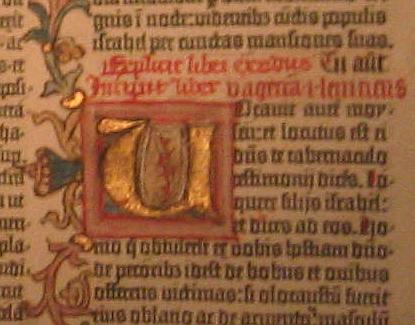
Initially the rubrics—the headings before each book of the Bible—were printed, but this practice was quickly abandoned at an unknown date, and gaps were left for rubrication to be added by hand. A guide of the text to be added to each page, printed for use by rubricators, survives.
The spacious margin allowed illuminated decoration to be added by hand. The amount of decoration presumably depended on how much each buyer could or would pay. Some copies were never decorated. The place of decoration can be known or inferred for about 30 of the surviving copies. It is possible that 13 of these copies received their decoration in Mainz, but others were worked on as far away as London. The vellum Bibles were more expensive, and perhaps for this reason tend to be more highly decorated, although the vellum copy in the British Library is completely undecorated.
There has been speculation that the "Master of the Playing Cards", an unidentified engraver who has been called "the first personality in the history of engraving," was partly responsible for the illumination of the copy held by the Princeton University library. However, all that can be said for certain is that the same model book was used for some of the illustrations in this copy and for some of the Master's illustrated playing cards.
Although many Gutenberg Bibles have been rebound over the years, nine copies retain fifteenth-century bindings. Most of these copies were bound in either Mainz or Erfurt. Most copies were divided into two volumes, the first volume ending with The Book of Psalms. Copies on vellum were heavier and for this reason were sometimes bound in three or four volumes.
Early owners

The Bible seems to have sold out immediately, with some initial purchases as far away as England and possibly Sweden and Hungary. At least some copies are known to have sold for 30 florins (equivalent to about 100 g of gold), which was about three years' wages for a clerk. Although this made them significantly cheaper than manuscript Bibles, most students, priests or other people of moderate income would not have been able to afford them. It is assumed that most were sold to monasteries, universities and particularly wealthy individuals. At present only one copy is known to have been privately owned in the fifteenth century. Some are known to have been used for communal readings in monastery refectories; others may have been for display rather than use, and a few were certainly used for study. Kristian Jensen suggests that many copies were bought by wealthy and pious laymen for donation to religious institutions.
Influence on later Bibles
The Gutenberg Bible had a profound effect on the history of the printed book. Textually, it also had an influence on future editions of the Bible. It provided the model for several later editions, including the 36 Line Bible, Mentelin's Latin Bible, and the first and third Eggestein Bibles. The third Eggestein Bible was set from the copy of the Gutenberg Bible now in Cambridge University Library. The Gutenberg Bible also had an influence on the Clementine edition of the Vulgate commissioned by the Papacy in the late sixteenth century.
Forgeries
Joseph Martini, a New York book dealer, found that the Gutenberg Bible held by the library of the General Theological Seminary in New York had a forged leaf, carrying part of Chapter 14, all of Chapter 15, and part of Chapter 16 of the Book of Ezekiel. It was impossible to tell when the leaf had been inserted into the volume. It was replaced in the fall of 1953, when a patron donated the corresponding leaf from a defective Gutenberg second volume which was being broken up and sold in parts. This made it "the first imperfect Gutenberg Bible ever restored to completeness." In 1978, this copy was sold for US$2.2 million to the Württembergische Landesbibliothek in Stuttgart, Germany.
Surviving copies
, 49 Gutenberg Bibles are known to exist, but of these only 25 are complete. Others have pages or even whole volumes missing. In addition, there are a substantial number of fragments, some as small as individual leaves, which are likely to represent about another 16 copies. Many of these fragments have survived because they were used as part of the binding of later books.
Substantially complete copies
| Country | Holding institution | Hubay no. | Length | Material | Notes and external links | ||||||||||||||||||
|---|---|---|---|---|---|---|---|---|---|---|---|---|---|---|---|---|---|---|---|---|---|---|---|
| Austria (1) | Austrian National Library, Vienna | 27 | complete | paper | One of only two copies to contain the "tabula rubricarum" (index of rubrics) on four leaves at the end. Obtained from Friedrich Karl Joseph von Erthal in 1793. | ||||||||||||||||||
| Online images | |||||||||||||||||||||||
| Belgium (1) | Library of the University of Mons-Hainaut, Mons | 1 | incomplete | paper | Vol. I, 104 leaves missing, bequeathed by Edmond Puissant to the city of Mons in 1934, but not identified until 1950. Part of the same copy as the volume in Indiana (see below). | ||||||||||||||||||
| Denmark (1) | Danish Royal Library, Copenhagen | 13 | incomplete | paper | author1=Kongelige Bibliotek (Denmark) | author2=Harald Ilsøe | title=On parchment, paper and palm leaves – treasures of the Royal Library, Denmark : a presentation in pictures and words on the occasion of the 200th anniversary of the opening of the library to the public | url=https://books.google.com/books?id=h_RLAQAAIAAJ | date=1993 | publisher=Royal Library | isbn=978-87-7023-621-8 | pages=30– | quote=Then, in 1713, Gottorp was captured during the war with Danmark and the library made the property of the Danish king. At that ... was volume 2 of the famous 42-line Bible, Johan Gutenberg's first great work of the art of printing done at Mainz c. ...}} | ||||||||||
| France (4) | Bibliothèque nationale de France, Paris | 15 | complete | vellum | Sold to the library in 1788 by Cardinal Étienne Charles de Loménie de Brienne, and rebound in four volumes. | ||||||||||||||||||
| Online images of vol. 1 vol. 2 vol. 3 vol. 4 | |||||||||||||||||||||||
| 17 | incomplete | paper | title=Das Antiquariat ... | url=https://books.google.com/books?id=wOziAAAAMAAJ | volume=7 | year=1951 | publisher=W. Krieg | language=de | pages=122– | quote=Am Schlüsse der beiden Bände sind Vermerke des Rubrikators und Buchbinders Henricus Cremer über die Voll*endung seiner Arbeit eingetragen: (Bd. I ... 24. August 1456; Bd. II . . . 15. August 1456).}} | |||||||||||||
| Online images of vol. 1 | |||||||||||||||||||||||
| Bibliothèque Mazarine, Paris | 16 | complete | paper | author=Frederick Richmond Goff | title=The permanence of Johann Gutenberg | url=https://books.google.com/books?id=W_fgAAAAMAAJ | date= 1971 | publisher=Humanities Research Center, University of Texas at Austin; distributed by University of Texas Press | pages=18– | isbn=9780292700598 }} | |||||||||||||
| Online images of vol. 1 and vol. 2 | |||||||||||||||||||||||
| Bibliothèque Municipale, Saint-Omer | 18 | incomplete | paper | author=Alexandre Saint-Léger | title=Revue du Nord | url=https://books.google.com/books?id=RelnAAAAMAAJ | series=261–263 | volume=66 | year=1984 | language=fr | pages=637– | quote=Nous ne saurions bien évidemment passer sous silence un volume de la Bible à 42 lignes de Gutenberg, conservé à Saint-Omer et venant de l'abbaye de Saint-Bertin '3, mais le catalogue relève également les éditions de Pierre Schoeffer à ...}} | |||||||||||
| Online images | |||||||||||||||||||||||
| Germany (13) | Gutenberg Museum, Mainz | 8 | incomplete | paper | The Shuckburgh copy, two volumes but imperfect, sold by Hans P. Kraus for $1.8 million in March 1978. | ||||||||||||||||||
| Online images | |||||||||||||||||||||||
| 9 | incomplete | paper | author=Gutenberg-Gesellschaft | title=Aloys Ruppel, 1882–1977: Würdigung bei der Gedächtnisfeier des Fachbereichs 16 Geschichtswissenschaft der Johannes Gutenberg-Universität Mainz und der Gutenberg-Gesellschaft am 21. Juni 1978 | url=https://books.google.com/books?id=BqUOAQAAMAAJ | year=1979 | publisher=Verlag der Gutenberg-Gesellschaft | language=de | pages=26– | quote=Als wir 1925 das silberne Jubiläum des Gutenberg-Museums vorbereiteten, rief mich Ministerialrat Hassinger vom ... von Solms-Laubach wolle sein Exemplar verkaufen und habe bereits ein Angebot von einem Leipziger Antiquar erhalten.}} | |||||||||||||
| , Fulda | 4 | incomplete | vellum | Vol. I. Two individual leaves from Vol. II survive in other libraries. | |||||||||||||||||||
| Leipzig University Library, Leipzig | 14 | incomplete | vellum | Vol. I through IV. | |||||||||||||||||||
| Göttingen State and University Library, Göttingen | 2 | complete | vellum | Inscribed in UNESCO's Memory of the World International Register since 2001. | |||||||||||||||||||
| Online images | |||||||||||||||||||||||
| Berlin State Library, Berlin | 3 | incomplete | vellum | Online images | |||||||||||||||||||
| Bavarian State Library, Munich | 5 | complete | paper | de}} | |||||||||||||||||||
| Frankfurt University Library, Frankfurt am Main | 6 | complete | paper | Online images | |||||||||||||||||||
| Hofbibliothek, Aschaffenburg | 7 | incomplete | paper | ||||||||||||||||||||
| Württembergische Landesbibliothek, Stuttgart | 10 | incomplete | paper | Purchased in April 1978 for US$2.2 million from the General Theological Seminary. | |||||||||||||||||||
| Online images | |||||||||||||||||||||||
| Stadtbibliothek, Trier | 11 | incomplete | paper | Vol. I | |||||||||||||||||||
| Landesbibliothek, Kassel | 12 | incomplete | paper | Vol. I | |||||||||||||||||||
| Gottorf Castle, Schleswig | 47 | incomplete | paper | last1=White | first1=Eric Marshall | last2=Rosenstein | first2=Natalee | last3=Travis | first3=Trysh | last4=Adams | first4=Peter W. | last5=Baensch | first5=Robert E. | title=Book reviews | journal=Publishing Research Quarterly | volume=19 | issue=2 | year=2003 | pages=65–72 | issn=1053-8801 | doi=10.1007/s12109-003-0009-3 | s2cid=189906589 }} | |
| Japan (1) | Keio University Library, Tokyo | 45 | incomplete | paper | Originally part of the Estelle Doheny bequest to St. John's Seminary in Camarillo, California. Vol. I, sold in October 1987 to Maruzen booksellers for US$4.9 million (plus an auction house commission of $490,000) for a total of $5.4 million. Purchased by Keio University in 1996. | ||||||||||||||||||
| Online images | |||||||||||||||||||||||
| Poland (1) | Diocesan Museum in Pelplin | 28 | incomplete | paper | It has a blot on page 46 and it lacks a page 217 in Volume Two. | ||||||||||||||||||
| Portugal (1) | Biblioteca Nacional de Portugal, Lisbon | 29 | complete | paper | Formerly owned by Cardinal Étienne Charles de Loménie de Brienne. | ||||||||||||||||||
| Online images. | |||||||||||||||||||||||
| Russia (2) | Moscow State University, Moscow | 49 | complete | paper | Looted in 1945 from the library of the University of Leipzig. | ||||||||||||||||||
| Russian State Library, Moscow | 48 | incomplete | vellum | Acquired in 1886 by the German Museum of Books and Writing, Leipzig, as part of the book collection of . At the end of World War II, it was taken as war booty and transferred to the Russian State Library in Moscow, where it remains today. | |||||||||||||||||||
| Spain (2) | Biblioteca Universitaria y Provincial, Seville | 32 | incomplete | paper | New Testament only | ||||||||||||||||||
| Online images | |||||||||||||||||||||||
| Biblioteca Pública Provincial, Burgos | 31 | complete | paper | Online images | |||||||||||||||||||
| Switzerland (1) | Bodmer Library, Cologny | 30 | incomplete | paper | |||||||||||||||||||
| United Kingdom (8) | British Library, London | 19 | complete | vellum | author1=Johann Wetter | title=Kritische Geschichte der Erfindung der Buchdruckerkunst durch Johann Gutenberg zu Mainz, begleitet mit einer, vorhin noch nie angestellten, genauen Prüfung und gänzlichen Beseitigung der von Schöpfiin und seinen Anhängern verfochtenen Ansprüche der Stadt Strassburg, und einer neuen Untersuchung der Ansprüche der Stadt Harlem und vollständigen Widerlegung ihrei Verfechter Junius, Meerman, Koning, Dibdin, Otley und Ebert | url=https://books.google.com/books?id=fr4yAQAAMAAJ&pg=PA520 | year=1836 | publisher=J. Wirth | language=de | pages=520–}} Bought for 6260 francs in 1817 by Thomas Grenville, who bequeathed his collection to the British Museum in 1846. | ||||||||||||
| Online images | |||||||||||||||||||||||
| 21 | complete | paper | Online images | ||||||||||||||||||||
| National Library of Scotland, Edinburgh | 26 | complete | paper | Online images | |||||||||||||||||||
| Lambeth Palace Library, London | 20 | incomplete | vellum | New Testament only | |||||||||||||||||||
| Eton College Library, Eton College | 23 | complete | paper | Printed in Mainz with the original 15th Century Erfurt binding, stamped calfskin, signed by Johannes Vogel. Donated by John Fuller (1757–1834). Belonged in the 15th century to the Carthusians at Erfurt. Only copy to retain the original binding in both volumes and is complete. Also one of three existing copies in its original binding. Also the only copy with the original binding to be signed with the binders mark. Illuminated copy, probably in Erfurt. | |||||||||||||||||||
| John Rylands Library, Manchester | 25 | complete | paper | Acquired for £80 by George Spencer, 2nd Earl Spencer some time before 1814, Enriqueta Augustina Rylands bought it in 1892 for the John Rylands Library. | |||||||||||||||||||
| Online images of 11 pages | |||||||||||||||||||||||
| Bodleian Library, Oxford | 24 | complete | paper | Bought in 1793 for £100 from Cardinal Étienne Charles de Loménie de Brienne. | |||||||||||||||||||
| Online images of vol. 1 and vol. 2 | |||||||||||||||||||||||
| Cambridge University Library, Cambridge | 22 | complete | paper | author=Peter Fox | title=Cambridge University Library: The Great Collections | url=https://books.google.com/books?id=xxlgKP5thL8C&pg=PA65 | date= 1998 | publisher=Cambridge University Press | isbn=978-0-521-62647-7 | pages=65–}} | |||||||||||||
| Online images of vol. 1 and vol. 2 | |||||||||||||||||||||||
| United States (11) | The Morgan Library & Museum, New York | 37 | complete | vellum | author1=Takami Matsuda | author2=Richard A. Linenthal | author3=John Scahill | title=The medieval book and a modern collector: essays in honour of Toshiyuki Takamiya | url=https://books.google.com/books?id=-roPAQAAMAAJ | date= 2004 | publisher=D.S. Brewer | isbn=978-4-8419-0348-5 | pages=448–}} | ||||||||||
| 38 | complete | paper | PML 19206–7 | ||||||||||||||||||||
| 44 | incomplete | paper | PML 1. Old Testament only | ||||||||||||||||||||
| Online images | |||||||||||||||||||||||
| Library of Congress, Washington, D.C. | 35 | complete | vellum | Online images Printed on vellum and bound in three alum-tawed pigskin-covered volumes. On permanent display. Purchased in 1930 with government funds for the Library of Congress. It is the centerpiece of a larger book collection acquired from Dr. Otto Vollbehr. | |||||||||||||||||||
| New York Public Library | 42 | complete | paper | ||||||||||||||||||||
| Widener Library, Harvard University | 40 | complete | paper | Online images of selected pages | |||||||||||||||||||
| Beinecke Library, Yale University | 41 | complete | paper | The Melk copy, a gift from Mrs. Edward Harkness in 1926. | |||||||||||||||||||
| Scheide Library, Princeton University | 43 | complete | paper | The Brinley-Cole-Ives-Ellsworth-Scheide copy, one of three existing copies in its original binding. | |||||||||||||||||||
| Online images | |||||||||||||||||||||||
| Lilly Library, Indiana University | author=Frank P. Leslie | title=The 46th Gutenberg | url=https://books.google.com/books?id=wXw2AAAAIAAJ | year=1960 | publisher=Vagabond Press}} | incomplete | paper | New Testament only, 12 leaves missing. Part of the same copy as the volume in Mons, Belgium (see above). | |||||||||||||||
| Online images | |||||||||||||||||||||||
| Henry E. Huntington Library, San Marino, California | 36 | complete | vellum | ||||||||||||||||||||
| Harry Ransom Humanities Research Center, University of Texas at Austin | 39 | complete | paper | Purchased in 1978 for US$2.4 million. | |||||||||||||||||||
| Online images | |||||||||||||||||||||||
| Vatican City (2) | Vatican Library | 33 | incomplete | vellum | Online images of vol. 1 and vol. 2 | ||||||||||||||||||
| 34 | incomplete | paper | Vol. I. |
Fragments
Some fragments of the Gutenberg Bible are housed at:
- The Library of Trinity College Dublin, Dublin, Ireland
- The Basel University Library, Basel, Switzerland
- The British Library, London - known as the Bagford Fragment
- The University of Melbourne, Melbourne, Australia
- The Schiede Library at Princeton University, Princeton, New Jersey, US
- The Rendsberg Fragment at Gottorf Castle, Schleswig, Germany
- The Iowa Masonic Library and Museum located in Cedar Rapids Iowa
- The McCune Collection, California, US
- The Clark Library at UCLA, California, US
- The John Carter Brown Library of the Early Americas in Providence, Rhode Island, US
- The National Library of New Zealand, Wellington, New Zealand Several fragments and single leaves sold at Christie's Auction House or Sotheby's in the 21st century.
Recent history


Few copies remain in religious institutions, with most now owned by university libraries and other major scholarly institutions. After centuries in which all copies seem to have remained in Europe, the first Gutenberg Bible reached North America in 1847. It is now in the New York Public Library. During the 20th century several long-lost copies were discovered, considerably improving the understanding of how the Bible was produced and distributed.
In 1921, a New York rare book dealer, Gabriel Wells, bought a damaged copy, dismantled the book and sold sections and individual leaves to book collectors and libraries. The leaves were sold in a portfolio case with an essay written by A. Edward Newton, and were referred to as "Noble Fragments". In 1953 Charles Scribner's Sons, also book dealers in New York, dismembered a damaged paper copy of volume II. The largest portion of this, the New Testament, is now owned by Indiana University. The leaf carrying part of Chapter 14, all of Chapter 15, and part of Chapter 16 of the Book of Ezekiel was donated to the General Theological Seminary to repair their copy of the bible (now located at the Württembergische Landesbibliothek). The matching first volume of this copy was subsequently discovered in Mons, Belgium, having been bequeathed by Edmond Puissant to the city in 1934.
The only copy held outside Europe and North America is the first volume of a Gutenberg Bible (Hubay 45) at Keio University in Tokyo. The Humanities Media Interface Project (HUMI) at Keio University is known for its high-quality digital images of Gutenberg Bibles and other rare books. Under the direction of Professor Toshiyuki Takamiya, the HUMI team has made digital reproductions of 11 sets of the bible in nine institutions, including both full-text facsimiles held in the collection of the British Library.
The last sale of a complete Gutenberg Bible took place in 1978, which sold for $2.4 million. This copy is now in Austin, Texas. The price of a complete copy today is estimated at $25−35 million.
A two-volume paper edition of the Gutenberg Bible was stolen from Moscow State University in 2009 and subsequently recovered in an FSB sting operation in 2013.
Possession of a Gutenberg Bible by a library has been equated to keeping a "trophy book".
General bibliography
- Niels Henry Sonne. America's Oldest Episcopal Seminary Library and the Needs It Serves. New York: The Library of The General Theological Seminary, 1953. .
- St. Mark's Library (General Theological Seminary). The Gutenberg Bible of the General Theological Seminary. New York: St. Mark's Library, the General Theological Seminary, 1963.
- The Gutenberg Bible of 1454 , Göttingen Library, Facsimile Edition, 2 vols + booklet, ed. Stephan Füssel, 1400 pp. Taschen: Cologne.
References
References
- British Library, [http://www.bl.uk/reshelp/findhelprestype/prbooks/earprintbib/earlyprintedbiblesinlatin/earlyprintedbibleslatin.html "Early Printed Bibles - In Latin 1454 onwards"]
- . (). ["The text of the Bible"](http://www.bl.uk/treasures/gutenberg/textbible.html). *[[British Library]]*.
- Man, John. (2002). "Gutenberg: How One Man Remade the World with Words". John Wiley and Sons, Inc..
- Klooster, John W.. (2009). "Icons of invention : the makers of the modern world from Gutenberg to Gates". Greenwood Press.
- (1984). "A History of Graphic Design". Design Issues.
- Donatus, Aelius. "Type to Print: The Book & The Type Specimen Book".
- (7 March 2025). "The Grammar and the Bible".
- "The Gutenberg Bible". utexas.edu.
- (2010-12-23). "Early Printed Books as Material Objects: Proceedings of the Conference Organized by the IFLA Rare Books and Manuscripts Section Munich, 19–21 August 2009". Walter de Gruyter.
- British Library, [http://www.bl.uk/treasures/gutenberg/threephases.html Three phases in the printing process] {{Webarchive. link. (2011-10-14 accessed 4 July 2009)
- Kent, Philip G.. (2021-01-02). "The Oxford illustrated history of the book". Journal of the Australian Library and Information Association.
- British Library, [http://www.bl.uk/treasures/gutenberg/flash4.html The differences in line lengths per page] {{Webarchive. link. (2009-09-07 : pictures showing differences between the Keio copy (40 lines per page) and the British Library copy (42 lines per page) in Genesis 1. Accessed 10 July 2009)
- British Library, [http://www.bl.uk/treasures/gutenberg/bibleyears.html Gutenberg's life: the years of the Bible] {{Webarchive. link. (2020-09-18 accessed 10 July 2009)
- White, Eric Marshall. (2002). "Long Lost Leaves from Gutenberg's Mons-Trier II Bible". Gutenberg Jahrbuch.
- Lane Ford, Margaret. (2010). "Early Printed Books as Material Objects: Proceedings of the Conference Organized by the Ifla Rare Books and Manuscripts Section Munich, 19–21 August 2009". De Gruyter Sur.
- British Library, [http://www.bl.uk/treasures/gutenberg/background.html Gutenberg Bible: background] {{Webarchive. link. (2021-02-24 accessed 10 July 2009)
- Davies, Martin. (1996). "The Gutenberg Bible". British Library.
- British Library, [http://www.bl.uk/treasures/gutenberg/gatherings.html Making the Bible: the gatherings] {{Webarchive. link. (2008-06-07 accessed 10 July 2009)
- Paul Needham, 'Format and Paper Size in Fifteenth-century Printing', In: ''Materielle Aspekte in der Inkunabelforschung'', Wiesbaden, 2017, pp. 59–108: p. 83.
- George Gordon and William Noel, 'The Needham Calculator', 2017: http://www.needhamcalculator.net/needham_calculator1.pdf {{Webarchive. link. (2018-08-26 . Accessed 26 August 2018.)
- Man, John (2002). ''Gutenberg: How One Man Remade the World with Words'', New York: John Wiley and Sons, Inc. {{ISBN. 0-471-21823-5.
- "Accessed 26 August 2018.".
- Paul Needham, 'Format and Paper Size in Fifteenth-century Printing', In: ''Materielle Aspekte in der Inkunabelforschung'', Wiesbaden, 2017, p. 83.
- Neil Harris, 'The Shape of Paper', subsection 'Sheet-size and the Bologna Stone', in: ''Paper and Watermarks as Bibliographical Evidence'', Lyon, Institut d'histoire du livre, 2017, http://ihl.enssib.fr/en/paper-and-watermarks-as-bibliographical-evidence {{Webarchive. link. (2018-08-26 .)
- "Fast Facts: The Gutenberg Bible". utexas.edu.
- Wight, C.. "Gutenberg Bible: Making the Bible – the Paper".
- British Library, [http://www.bl.uk/treasures/gutenberg/ink.html Making the Bible: the ink] {{Webarchive. link. (2007-09-11 accessed 18 October 2009.)
- BBC Radio 4 programme "Gutenberg: In the Beginning Was the Printer", first broadcast 21-10-2014
- "Kristian Jensen on the Gutenberg Bible | Polonsky Foundation Digitization Project".
- Television presentation, "The Machine that Made Us", presenter: Stephen Fry
- "InDesign, the hz-program and Gutenberg's secret".
- Kapr, Albert. (1996). "Johann Gutenberg: The Man and His Invention". Scolar Press.
- "Gutenberg Bible: The Copy on Paper – the Decoration". bl.uk.
- Estes, Richard. (2005). "The 550th Anniversary Pictorial Census of the Gutenberg Bible". Gutenberg Research Center.
- Jensen, Kristian. (2003). "Incunabula and their readers: printing, selling and using books in the fifteenth century". British Library.
- Shestack, Alan. (1967). "Fifteenth Century Engravings of Northern Europe". National Gallery of Art.
- (March 1974). "Playing Cards and Manuscripts: Some Widely Disseminated Fifteenth Century Model Sheets". The Art Bulletin.
- White, Eric Marshall. (2010). "Early Printed Books as Material Objects: Proceedings of the Conference Organized by the Ifla Rare Books and Manuscripts Section Munich, 19–21 August 2009". De Gruyter Sur.
- McGrath, Alister. (2001). "In the Beginning: The Story of the King James Bible and How It Changed a Nation, a Language, and a Culture". Anchor Books.
- (2004). "A History of Science in Society: From Philosophy to Utility". Broadview Press.
- Needham, Paul. (1999). "The Bible as Book:the First Printed Editions". British Library.
- Needham, Paul. (2010). "Early Printed Books as Material Objects: Proceedings of the Conference Organized by the Ifla Rare Books and Manuscripts Section Munich, 19–21 August 2009". De Gruyter Sur.
- St. Mark's Library (General Theological Seminary). The Gutenberg Bible of the General Theological Seminary. New York: St. Mark's Library, the General Theological Seminary, 1963.
- "Gutenberg Bible Census".
- Estelle Betzold Doheny. (1987). "The Estelle Doheny Collection: Fifteenth-century books, including the Gutenberg Bible". Christie, Manson & Woods International.
- (June 5, 2018). "ISTC (Incunabula Shorttitle Catalogue)". [[Consortium of European Research Libraries]].
- (1951). "Das Antiquariat ...". W. Krieg.
- (2010). "Early Printed Books as Material Objects: Proceedings of the Conference Organized by the IFLA Rare Books and Manuscripts Section Munich, 19–21 August 2009". Walter de Gruyter.
- (1956). "Antiquarian Bookman". R.R. Bowker.
- Josef Stummvoll. (1971). "Die Gutenberg-Bibel". Österreichisches Institut für Bibliotheksforschung.
- (1993). "On parchment, paper and palm leaves – treasures of the Royal Library, Denmark : a presentation in pictures and words on the occasion of the 200th anniversary of the opening of the library to the public". Royal Library.
- Harald Ilsøe. (1999). "Det kongelige Bibliotek i støbeskeen: studier og samlinger til bestandens historie indtil ca. 1780". Museum Tusculanum Press.
- (1908). "Veröffentlichung der Gutenberg-gesellschaft".
- (1956). "AB Bookman's Yearbook". Bookman's weekly.
- (1951). "Das Antiquariat ...". W. Krieg.
- Howard, Nicole. (2005). "The Book: The Life Story Of A Technology". Greenwood Publishing Group.
- Frederick Richmond Goff. (1971). "The permanence of Johann Gutenberg". Humanities Research Center, University of Texas at Austin; distributed by University of Texas Press.
- (2007). "A Passion for Books: A Book Lover's Treasury of Stories, Essays, Humor, Lore, and Lists on Collecting, Reading, Borrowing, Lending, Caring for, and Appreciating Books". Crown/Archetype.
- (1890). "Concise Dictionary of Religious Knowledge: Biblical, Doctrinal, Historical, and Practical". Christian Literature Company.
- Alexandre Saint-Léger. (1984). "Revue du Nord".
- (January 1978). "The Living Church". Morehouse-Gorham Company.
- Sandra Kirshenbaum. (1978). "Fine Print". S. Kirshenbaum.
- Gutenberg-Gesellschaft. (1979). "Aloys Ruppel, 1882–1977: Würdigung bei der Gedächtnisfeier des Fachbereichs 16 Geschichtswissenschaft der Johannes Gutenberg-Universität Mainz und der Gutenberg-Gesellschaft am 21. Juni 1978". Verlag der Gutenberg-Gesellschaft.
- (18 April 2000). "Vor ungefähr 600 Jahren wurde Gutenberg geboren. Mainz ehrt ihn auf verschiedene Weisen: Heute für Stielaugen". Berliner Zeitung.
- "42-line Gutenberg Bible, printed on vellum, and its contemporary documentary background". UNESCO Memory of the World Programme.
- (2003). "Book reviews". Publishing Research Quarterly.
- Davis, Margaret Leslie. (2019). "The Lost Gutenberg: The Astounding Story of One Book's Five-Hundred-Year Odyssey". TarcherPerigee.
- "Ellensburg Daily Record – Google News Archive Search". google.com.
- (4 November 2013). "Gutenberg Bible: The HUMI Project".
- (1993-12-10). "Rare Gutenberg Bible Found In Russia 50 Years After War". The Seattle Times.
- Popova, Anna. (2021-04-22). "8 major cultural trophies the USSR took home after WWII".
- "German Museum of Books and Writing "Signs – Books – Networks"".
- Georg Jäger. (2010). "Geschichte des deutschen Buchhandels im 19. und 20. Jahrhundert. Band 1: Das Kaiserreich 1871–1918". Walter de Gruyter.
- (22 March 2012). "Buch- und Schriftkultur: Das Geisterhaus – Kultur – Tagesspiegel". Der Tagesspiegel Online.
- (1836). "Kritische Geschichte der Erfindung der Buchdruckerkunst durch Johann Gutenberg zu Mainz, begleitet mit einer, vorhin noch nie angestellten, genauen Prüfung und gänzlichen Beseitigung der von Schöpfiin und seinen Anhängern verfochtenen Ansprüche der Stadt Strassburg, und einer neuen Untersuchung der Ansprüche der Stadt Harlem und vollständigen Widerlegung ihrei Verfechter Junius, Meerman, Koning, Dibdin, Otley und Ebert". J. Wirth.
- Henry Noel Humphreys. (1867). "A History of the Art of Printing: From Its Invention to Its Wide-spread Development in the Middle of the 16th Century : Preceded by a Short Account of the Origin of the Alphabet and the Successive Methods of Recording Events and Multiplying Ms. Books Before the Invention of Printing". B. Quaritch.
- Donald Kerr. (2006). "Amassing Treasures for All Times: Sir George Grey, Colonial Bookman and Collector". Oak Knoll Press.
- "Eton Collections | B25545".
- (16 May 2017). "A library as old as the Bible it holds".
- Thomas Frognall Dibdin. (1814). "Bibliotheca Spenceriana; Or a Descriptive Catalogue of the Books Printed in the Fifteenth Century, and of Many Valuable First Editions in the Library of George John Earl Spencer".
- Albert Charles Robinson Carter. (1940). "Let Me Tell You". Hutchinson & Company.
- "Bod-Inc online".
- (9 September 2015). "Cambridge University Library – Addendum". Addendum.
- Peter Fox. (1998). "Cambridge University Library: The Great Collections". Cambridge University Press.
- (2004). "The medieval book and a modern collector: essays in honour of Toshiyuki Takamiya". D.S. Brewer.
- (1982). "Encyclopedia of Library and Information Science: Volume 33 – The Wellesley College Library to Zoological Literature: A Review". CRC Press.
- (1990). "Christopher Morley's Philadelphia". Fordham Univ Press.
- Randolph G. Adams. (1939). "The Americanists".
- Grolier Club. (1966). "Gazette of the Grolier Club".
- (1976). "The Princeton University Library Chronicle". Friends of the Princeton University Library.
- (1960). "Princeton Alumni Weekly". princeton alumni weekly.
- Frank P. Leslie. (1960). "The 46th Gutenberg". Vagabond Press.
- (1998). "The Friends of the Lilly Library Newsletter". Indiana University Foundation.
- (1999). "Incunabula: studies in fifteenth-century printed books presented to Lotte Hellinga". British Library.
- "A fragment of the Gutenberg Bible at the University of Melbourne {{!}} Britannica".
- White, Eric. (2017-04-18). "Princeton Acquires a Vellum Fragment of the Gutenberg Bible Preserved as a Book Cover".
- Tedeschi, Anthony. (2 November 2022). "Off the record {{!}} Europe's first printer".
- Flood, Alison. (2015-06-11). "Fragment of Gutenberg Bible expected to top $500,000 at auction". The Guardian.
- Clausen Books [http://www.clausenbooks.com/gutenbergcensus.htm Gutenberg Bible Census] {{Webarchive. link. (2011-07-08 accessed 7 July 2009)
- (31 August 2014). "Incunabula Leaf Biblia Latina (ca 1450) Gutenberg". The McCune Collection.
- "Johann Gutenberg: A Noble Fragment: Being a Leaf of the Gutenberg Bible, 1450–1455/With a Bibliographical Essay.". Greenslade Special Collections and Archives, Kenyon College.
- (2006). "British Librarianship and Information Work 1991–2000: Rare book librarianship and historical bibliography". Ashgate Publishing Ltd..
- [https://web.archive.org/web/20050204103238/http://www.msnbc.msn.com/id/6124643/ In the book world, the rarest of the rare]
- [http://www.luxist.com/2008/01/31/the-world-of-rare-books-the-gutenberg-bible-first-and-most-val/ The World of Rare Books: The Gutenberg Bible, First and Most Valuable] {{Webarchive. link. (2013-04-10)
- (6 June 2014). "Russia sentences secret agents over theft of Gutenberg Bible". BBC News.
- Hetzer, Armin. (1996). "'The Return from the States of the Former Soviet Union of Cultural Property Removed in the 1940s' as a Bibliographical Undertaking". Solanus.
This article was imported from Wikipedia and is available under the Creative Commons Attribution-ShareAlike 4.0 License. Content has been adapted to SurfDoc format. Original contributors can be found on the article history page.
Ask Mako anything about Gutenberg Bible — get instant answers, deeper analysis, and related topics.
Research with MakoFree with your Surf account
Create a free account to save articles, ask Mako questions, and organize your research.
Sign up freeThis content may have been generated or modified by AI. CloudSurf Software LLC is not responsible for the accuracy, completeness, or reliability of AI-generated content. Always verify important information from primary sources.
Report