From Surf Wiki (app.surf) — the open knowledge base
Gun culture in the United States
Behaviors and attitudes about firearms in the United States

Behaviors and attitudes about firearms in the United States
Gun culture in the United States refers to the behaviors, attitudes, and beliefs surrounding the ownership and use of firearms by private citizens. Gun ownership is deeply rooted in the country's history and is legally protected by the Second Amendment to the United States Constitution. Firearms in the U.S. are commonly used for self-defense, hunting, and recreational activities.
Gun politics in the United States are highly polarized. Advocates of gun rights, typically aligned with conservative or libertarian views, emphasize the importance of the Second Amendment and oppose gun control. In contrast, those who support stricter gun control, often with liberal perspectives, advocate for more regulations to reduce gun violence. The gun culture in the United States is unique among developed nations due to the massive volume of firearms owned by civilians, the popularity of firearms for self-defense, hunting, and sporting activities, and a generally permissive regulatory environment.
History

American militia culture
American attitudes on gun ownership date back to the American Revolutionary War, and also arise from traditions of hunting, militias, and frontier living.
Justifying the unique attitude toward gun ownership in the United States, James Madison wrote in Federalist No. 46, in 1788:

The American hunting and sporting passion comes from a time when the United States was an agrarian, subsistence nation where hunting was a profession for some, an auxiliary source of food for some settlers, and also a deterrence to animal predators. A connection between shooting skills and survival among rural American men was in many cases a necessity and a rite of passage for manhood. Hunting endures as a central sentimental component of a gun culture to control animal populations across the country, regardless of modern trends away from subsistence hunting and rural living.
The militia spirit derives from an early American dependence on arms to protect themselves from foreign armies and hostile Native Americans. Survival depended upon everyone being capable of using a weapon. Before the American Revolution there was neither budget nor manpower nor government desire to maintain a full-time army. Therefore, the armed citizen-soldier carried the responsibility. Service in militia, including providing one's own ammunition and weapons, was mandatory for all men. Yet, as early as the 1790s, the mandatory universal militia duty gave way to voluntary militia units and a reliance on a regular army. Throughout the 19th century, the institution of the civilian militia began to decline.
Closely related to the militia tradition was the frontier tradition with the need for a means of self-protection closely associated with the nineteenth-century westward expansion and the American frontier. In popular literature, frontier adventure was most famously told by James Fenimore Cooper, who is credited by Petri Liukkonen with creating the archetype of an 18th-century frontiersman through such novels as The Last of the Mohicans (1826) and The Deerslayer (1840).
Scotch-Irish Americans arguably best epitomized this frontier spirit. Emigrating from areas of Ireland and Scotland which had historically been economically poor and violent, these immigrants brought with them an intense pride, individualism and love of guns which would shape future decedent's views and help form the origin of American gun culture. Settling in Appalachia, the Scots-Irish would lead the push westward and eventually populate a band stretching from Appalachia to Texas and Oklahoma, and particularly after the Dust Bowl into Southern California.
African American gun culture

A distinct and growing sub-culture of American gun culture has been developed and promoted by African Americans since at least the end of the American Civil War. From Frederick Douglass, DuBois, Ida B. Wells and Marcus Garvey, the American Civil Rights movement, and the Pan-African movement, an array of African American gun cultures and philosophies of violence and self-defense have proliferated in American life.
Ownership levels
According to statistics in the 2017 Small Arms Survey, "Americans made up 4 percent of the world's population but owned about 46 percent of the entire global stock of 857 million civilian firearms." U.S. civilians own 393 million guns. When compared to other countries in the Small Arms Survey, American civilians own more guns "than those held by civilians in the other top 25 countries combined."
In 2018 it was estimated that U.S. civilians own 393 million firearms, and that 40% to 42% of the households in the country have at least one gun. However, record gun sales followed in the following years. The U.S. has by far the highest estimated number of guns per capita in the world, at 120.5 guns for every 100 people.
As per 2023 survey, 32% of Americans own at least one firearm. From 1994 to 2023, 28% gun ownership increased in America. In which women ownership increased by 13.6%, and Hispanics ownership increased by 33.3%.
Although historically there have been significant differences in respect to gun ownership between different races and sexes, that gap may be closing. For example, women and ethnic minorities saw the sharpest rise of private gun ownership in the United States in 2020 and the ongoing ownership trends do not indicate any sign of abatement. Also, in 2020 and 2021 a sharp increase in gun ownership was seen due to the riots and pandemic during that time. Nearly half of the gun buyers appeared to be first-time owners. Over 2 million firearms were purchased during the pandemic alone.
According to Gallup, in 2020, 32% of U.S. adults said they personally own a gun, while a larger percentage, 44%, report living in a gun household.
Popular culture
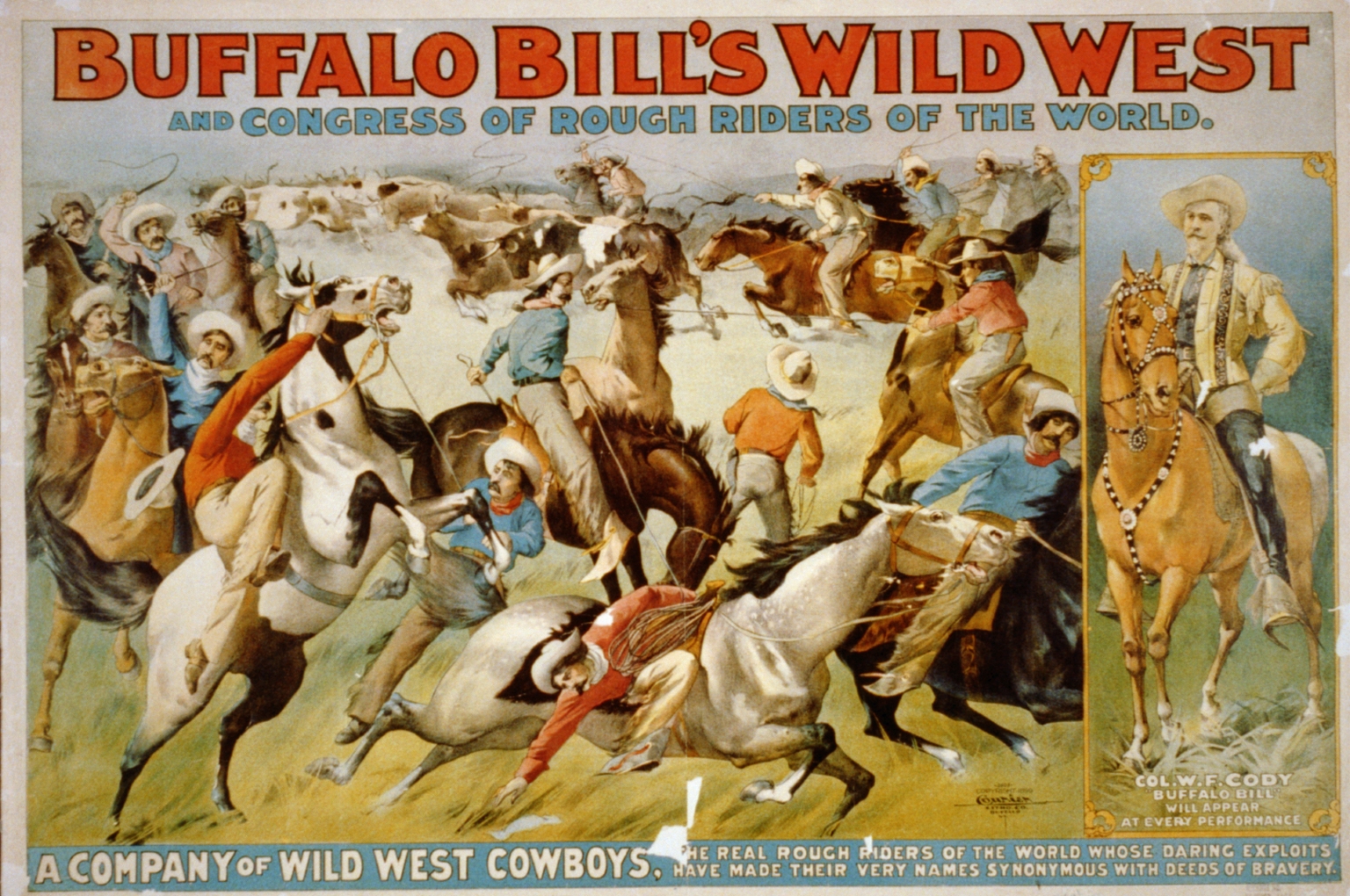

In the late 19th century, cowboy and "Wild West" imagery entered the collective imagination. The first American female superstar, Annie Oakley, was a sharpshooter who toured the country starting in 1885, performing in Buffalo Bill's Wild West show. The cowboy archetype of the individualist hero was established largely by Owen Wister in stories and novels, most notably The Virginian (1902), following close on the heels of Theodore Roosevelt's The Winning of the West (1889–1895), a history of the early frontier. Cowboys were also popularized in turn of the 20th century cinema, notably through such early classics as The Great Train Robbery (1903) and A California Hold Up (1906)—the most commercially successful film of the pre-nickelodeon era.
Gangster films started in 1910, but became popular only with the advent of sound in film in the 1930s. The genre was boosted by the events of the prohibition era, such as bootlegging and the St. Valentine's Day Massacre of 1929, the existence of real-life gangsters such as Al Capone and the rise of contemporary organized crime and escalation of urban violence. These movies flaunted the archetypal exploits of "swaggering, cruel, wily, tough, and law-defying bootleggers and urban gangsters".
Since World War II, Hollywood produced many morale-boosting movies, patriotic rallying cries that affirmed a sense of national purpose. The image of the lone cowboy was replaced in these combat films by stories emphasizing group efforts and the value of individual sacrifices for a larger cause, often featuring a group of men from diverse ethnic backgrounds who were thrown together, tested on the battlefield, and molded into a dedicated fighting unit.
Guns frequently accompanied famous heroes and villains in late 20th-century American films, from the outlaws of Bonnie and Clyde (1967) and The Godfather (1972), to fictional law and order avengers such as Dirty Harry (1971) and RoboCop (1987). In the 1970s, fictional madmen ostensibly produced by the Vietnam War were central to films such as Taxi Driver (1976) and Apocalypse Now (1979), while the 1978 films Coming Home and The Deer Hunter told stories of fictional veterans who were victims of the war and in need of rehabilitation. Many action films continue to celebrate the gun toting hero in fictional settings. The negative role of the gun in fictionalized modern urban violence has been explored in films such as Boyz n the Hood (1991) and Menace 2 Society (1993). Bowling for Columbine was a 2002 documentary by Michael Moore exploring gun culture in the United States.
Political and cultural theories

Gun culture and its effects have been at the center of major debates in the US's public sphere for decades. In his 1970 article "America as a Gun Culture," historian Richard Hofstadter used the phrase "gun culture" to characterize America as having a long-held affection for guns, embracing and celebrating the association of guns and an overall heritage relating to guns. He also noted that the US "is the only industrial nation in which the possession of rifles, shotguns, and handguns is lawfully prevalent among large numbers of its population". In 1995, political scientist Robert Spitzer said that the modern American gun culture is founded on three factors: the proliferation of firearms since the earliest days of the nation, the connection between personal ownership of weapons and the country's revolutionary and frontier history, and the cultural mythology regarding the gun in the frontier and in modern life. In 2008, the US Supreme Court affirmed that the right of individuals to possess firearms is guaranteed by the Second Amendment.
Terms applied to opponents==
Terms used by gun rights and gun control advocates to refer to opponents are part of the larger topic of gun politics.
The term gun nut refers to firearms enthusiasts who are deeply involved with the gun culture. It is regarded as a pejorative stereotype cast upon gun owners by gun control advocates as a means of implying that they are fanatical, exhibit abnormal behavior, or are a threat to the safety of others. Some gun owners embrace the term affectionately.
The term hoplophobia refers to an "irrational aversion to firearms", and US Marine Jeff Cooper claimed to have invented the term in the 1960s.
Foreign perspective
The U.S. relationship with guns often perplexes those in other developed countries, many of whom do not understand the unusual permissiveness of American gun laws, and believe that the American public should push for harsher gun control measures due to mass shootings. Critics contrast the US reaction to terrorism given how few deaths it causes, with their high death rates from non-terror related gun crime.
References
References
- (April 22, 2020). "State-Level Estimates of Household Firearm Ownership". [[RAND Corporation]].
- "Gun Ownership in America". [[RAND Corporation]].
- Fisher, Max. (December 15, 2012). "What makes America's gun culture totally unique in the world, in four charts". Washington Post.
- Spitzer, Robert J.. (1995). "The Politics of Gun Control". Chatham House.
- "Federalist No. 46". Yale Law School.
- Liukkonen, Petri. "James Fenimore Cooper". [[Kuusankoski]] Public Library.
- Fukuyama, Francis. (2015). "Political Order and Political Decay: From the Industrial Revolution to the Globalization of Democracy". Farrar, Straus and Giroux.
- Johnson, Nicholas. (2014). "Negroes and the Gun: The Black Tradition of Arms". Globe Pequot / Prometheus.
- (April 9, 2024). "The Armed Era". The Trace.
- (December 31, 2023). "Gun Violence by the Numbers in 2023". Federal Bureau of Investigation.
- (27 March 2023). "The gun that divides a nation". The Washington Post.
- Christopher Ingraham. (June 19, 2018). "There are more guns than people in the United States, according to a new study of global firearm ownership". [[The Washington Post]].
- Edith M. Lederer. (June 18, 2018). "Americans Own 46% of the World's 1 Billion Guns, Says U.N. Report".
- [https://web.archive.org/web/20180620231909/http://www.smallarmssurvey.org/fileadmin/docs/T-Briefing-Papers/SAS-BP-Civilian-Firearms-Numbers.pdf smallarmssurvey.org] Estimating Global CivilianHELD Firearms Numbers. Aaron Karp. June 2018
- "Key facts about Americans and guns". Pew Research.
- (June 4, 2013). "A Minority of Americans Own Guns, But Just How Many Is Unclear".
- [http://www.gallup.com/poll/1645/Guns.aspx "Guns: Gallup Historical Trends"], Gallup. Retrieved October 25, 2015.
- [https://web.archive.org/web/20180620231909/http://www.smallarmssurvey.org/fileadmin/docs/T-Briefing-Papers/SAS-BP-Civilian-Firearms-Numbers.pdf Briefing Paper. Estimating Global Civilian-Held Firearms Numbers]. June 2018 by Aaron Karp. Of [[Small Arms Survey]]. See box 4 on page 8 for a detailed explanation of "Computation methods for civilian firearms holdings". See country table in annex PDF: [https://web.archive.org/web/20180629102233/http://www.smallarmssurvey.org/fileadmin/docs/Weapons_and_Markets/Tools/Firearms_holdings/SAS-BP-Civilian-held-firearms-annexe.pdf Civilian Firearms Holdings, 2017]. See [http://www.smallarmssurvey.org/weapons-and-markets/tools/global-firearms-holdings.html publications home].
- "How Many Gun Owners Are In America? 2023 - 2024 Statistics".
- (March 28, 2022). "Largest rise in gun ownership? African-American women". NBC4 WCMH-TV.
- "About Us".
- (August 31, 2020). "Boom: 5M new gun owners, with 58% black and 40% women".
- (24 June 2020). "Gun and ammunition sales soar as defund-the-police movement grows". [[CNN]].
- Chris Arnold. (16 July 2020). "Pandemic And Protests Spark Record Gun Sales". [[NPR]].
- Saad, L. (Nov. 13, 2020). [https://news.gallup.com/poll/264932/percentage-americans-own-guns.aspx What percentage of Americans own guns? What Percentage of Americans Own Guns?] Gallup.
- "American Literature: Prose, MSN Encarta".
- (1919-01-06). "New Perspectives on the West: Theodore Roosevelt, PBS, 2001". Pbs.org.
- Liukkonen, Petri. "Owen Wister". [[Kuusankoski]] Public Library.
- ""Western Films", Tim Dirks, Filmsite, 1996-2007". Filmsite.org.
- ""Crime and Gangster Films", Tim Dirks, Filmsite, 1996-2007". Filmsite.org.
- Digital History, Steven Mintz. "Hollywood as History: Wartime Hollywood, Digital History". Digitalhistory.uh.edu.
- Digital History, Steven Mintz. "Hollywood as History: The "New" Hollywood, Digital History". Digitalhistory.uh.edu.
- (April 20, 2021). "Amid a Series of Mass Shootings in the U.S., Gun Policy Remains Deeply Divisive".
- Cramer, Clayton E.. (2009-08-24). "Armed America: The Remarkable Story of How and Why Guns Became as American as Apple Pie". Thomas Nelson Inc.
- Hofstadter, Richard. (October 1970). "America as a Gun Culture". American Heritage Publishing.
- Spitzer, Robert J.. (1995). "The Politics of Gun Control". Chatham House Publishers.
- (June 26, 2008). "US District of Columbia et al v Heller". US Supreme Court.
- "[http://nl.newsbank.com/nl-search/we/Archives?p_product=BN&p_theme=bn&p_action=search&p_maxdocs=200&p_topdoc=1&p_text_direct-0=0EAF9B07493D3700&p_field_direct-0=document_id&p_perpage=10&p_sort=YMD_date:D&s_trackval=GooglePM Shoot-out Confirms Foreign View of America as 'Gun Nut' Country]" by T.R. Reid, ''The Buffalo News'', July 26, 1998
- "[http://www.latimes.com/news/printedition/opinion/la-ed-guns17jun17,1,5131671.story?coll=la-news-comment Small steps on gun control]" Los Angeles Times, June 17, 2007
- "[https://www.washingtonpost.com/wp-srv/national/longterm/shooting/stories/world072698.htm 'Terror in Capitol' No Surprise to World]" By T.R. Reid, ''Washington Post'', July 26, 1998
- [http://fieldandstream.blogs.com/ The Gun Nut] blog at Field & Stream
- Cooper, Jeff (1990). ''[http://www.usrepeals.org/ca/mtbpers/hoplophobia.html To Ride, Shoot Straight, and Speak the Truth] {{webarchive. link. (2013-10-02 ''. Boulder, Colorado: Paladin Press. pp. 16–19.)
- Baum, Dan. (2013). "Gun Guys: A Road Trip". Knopf Doubleday.
- "The world is 'mystified' by America's enduring racism and 'bizarre' gun laws".
- "The Rest of the First World Is Astounded by America's Enduring Gun Culture".
- Friedman, Uri. (5 December 2015). "Australian Gun Reformer: 'It's Time to Call Out the U.S.A.'".
- (2013-09-21). "American gun use is out of control. Shouldn't the world intervene?". The Guardian.
This article was imported from Wikipedia and is available under the Creative Commons Attribution-ShareAlike 4.0 License. Content has been adapted to SurfDoc format. Original contributors can be found on the article history page.
Ask Mako anything about Gun culture in the United States — get instant answers, deeper analysis, and related topics.
Research with MakoFree with your Surf account
Create a free account to save articles, ask Mako questions, and organize your research.
Sign up freeThis content may have been generated or modified by AI. CloudSurf Software LLC is not responsible for the accuracy, completeness, or reliability of AI-generated content. Always verify important information from primary sources.
Report